
Quick Answer
Here's the hard truth: most plumbing and heating businesses do not have a systems problem, they have a systems habit problem. The SOPs either do not exist, or they sit in a folder nobody opens. The ten mistakes below are the ones I see over and over as a P&H accountant, and every single one is fixable without a big budget or a spare month. Start with the one job that causes you the most grief this week. Write it down on a single page, warts and all, and get the engineer who actually does it to check it. That is your first SOP. Do that ten times and you have a business that runs on a process instead of running on you.
Table of Contents
- Why good engineers end up trapped by bad systems
- Mistake 1: Trying to document everything at once
- Mistake 2: Writing the what but never the why
- Mistake 3: Writing SOPs away from the people who do the work
- Mistake 4: Deciding only the boss can write procedures
- Mistake 5: Believing systems kill craftsmanship
- Mistake 6: Nobody owns the SOP once it is written
- Mistake 7: Treating the manual as a dusty reference
- Mistake 8: Burying SOPs where nobody can find them
- Mistake 9: Keeping it all on paper or in your head
- Mistake 10: Writing a 72-page wall of text
- How to roll this out without downing tools
- What tradespeople are saying
- Recommended videos
- Frequently asked questions
- My verdict
Why good engineers end up trapped by bad systems

Let's face it, most people who start a plumbing and heating business are brilliant on the tools and were never taught a thing about running a company. So the business ends up shaped around one person. You. You quote it, you fit it, you answer the phone, you sort the van stock, and you are the only one who knows how any of it is really done.
That works right up until it doesn't. You take on an engineer and jobs come back wrong. You try to take a week off and the phone does not stop. You want to grow and you cannot, because the business only moves as fast as you can think. Sound familiar?
Standard operating procedures are the fix, and I call a spade a spade here: an SOP is nothing more than the agreed best way to do a job, written down so it does not have to live in your head. Get them right and they become the backbone of a business that runs without you in the middle of it. Get them wrong and you have a tidy folder that nobody opens. The gap between those two outcomes is not talent or budget. It is ten specific mistakes.
A quick word before we start. Systems do not have to mean corporate. They do not mean stripping the character out of your firm. In my eyes they do the opposite. They protect the standard you built your name on, so it survives the day you are not there to enforce it. Right, let's go through the ten.
Mistake 1: Trying to document everything at once
The mistake. You decide this is the year you finally get organised. You block out a weekend, open a blank document, and try to write down the entire business in one go. Two hours in you are exhausted, the list has grown instead of shrunk, and the whole thing gets shoved down the priority pile. It feels like a mountain, so you never climb it.
The fix. It is not a mountain, it is a series of small hills. Pick the one process that causes you the most grief right now. The job that gets done differently every time, the thing that always lands back on your desk, the task you dread handing over. Write that one down this week and stop there. Next week, do the next one. A business runs on maybe fifteen or twenty core processes, not a thousand, and you only need one to prove the habit works.
Where to start
If you are stuck choosing, start with quoting. It is the process that decides whether you make money, and it is the one most owners guard hardest. My 12-section boiler quote structure is a quoting SOP you can lift straight into your business.
Mistake 2: Writing the what but never the why
The mistake. You list the steps like a recipe. Do this, then this, then this. No reason attached. The problem is that a step with no reason behind it is the first step to get dropped the moment someone is busy or thinks they know better. People do not follow instructions they do not believe in.
The fix. Explain the reasoning. Not an essay, one line. "We photograph the meter before we start so we are never blamed for damage that was already there." "We ring ahead thirty minutes out because it halves the no-access jobs." When people understand why a step exists, they defend it. They also spot when the reason no longer applies and tell you, which is how a good process gets better instead of just older.
Mistake 3: Writing SOPs away from the people who do the work
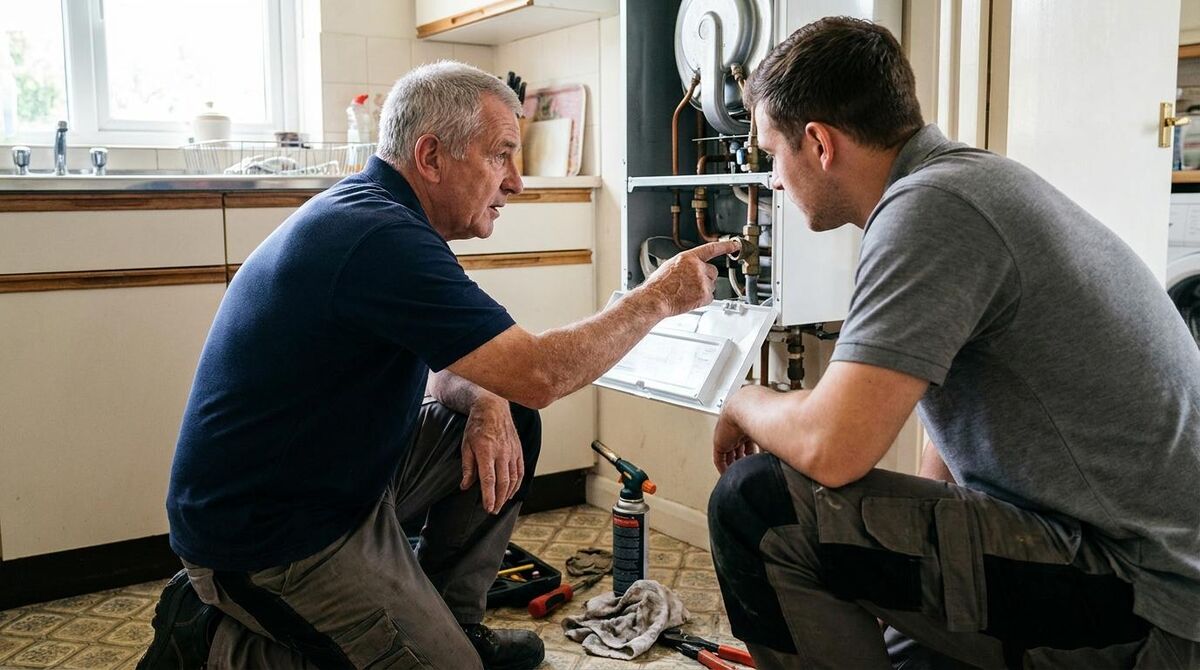
The mistake. You sit at the kitchen table on a Sunday night and write how you think a job should be done. Then you hand it to your engineer, who reads it, raises an eyebrow, and carries on doing it the way that actually works on site. Your version was theory. Theirs is reality. Now the SOP and the shop floor disagree, and the SOP loses every time.
The fix. Build the procedure with the person who does the job, not for them. Stand next to them, or better still get them to talk you through it while you write. Their version will be more accurate than yours and, because they helped write it, they will actually use it. This one change does more for adoption than any piece of software. People back what they helped build.
The theory trap
If your written process and your best engineer's actual method do not match, do not assume the engineer is wrong. Nine times out of ten the site version is smarter than the desk version. Capture that, do not overrule it.
Mistake 4: Deciding only the boss can write procedures
The mistake. You treat SOP writing as a management job, something that has to come from you or the office. So it all funnels through one person who is already the busiest in the building, and it grinds to a halt. Meanwhile the person with twenty years of hard-won knowledge is never asked to put any of it down.
The fix. Your best engineer is your best author. Pull knowledge from wherever it lives. Get the experienced hand to record how they diagnose an intermittent fault. Get whoever runs the van stock best to write the reorder routine. You are not the only source of good practice in your business, and pretending you are is how good practice walks out the door when someone retires or leaves.
Mistake 5: Believing systems kill craftsmanship
The mistake. This is the objection I hear most from good tradespeople, and I understand it. The fear is that a process turns skilled engineers into robots ticking boxes, and that the craft gets lost. So systems get resisted on principle, and the business stays stuck in one person's head to protect a standard that, ironically, only exists in one person's head.
The fix. Structure does not cage good people. It gives them room to be good. A checklist handles the routine 80 percent of a job so nothing gets forgotten, which frees your skilled people to put their expertise where it actually counts, on the tricky diagnosis, the awkward install, the customer who needs reassuring. The craft is in the judgement, not in remembering to bleed the rad. Let the system carry the routine and let your people carry the skill.
Mistake 6: Nobody owns the SOP once it is written
The mistake. You write a cracking procedure, everyone uses it for a bit, then a supplier changes, a reg updates, or you switch software, and the SOP quietly goes out of date. Nobody is responsible for keeping it current, so it slowly turns into a liability. A wrong instruction that people trust is worse than no instruction at all.
The fix. Every SOP gets an owner, a version number, and a review date. That is it. The owner is whoever is closest to the work, not necessarily you. The review date can be once a year for something stable, or straight after any change to the job. It takes thirty seconds to add and it is the single thing that separates a living system from a dead folder.
One line that is never optional
No SOP ever overrides manufacturer instructions, Gas Safe requirements, or current Building Regulations. Write that at the top of every technical procedure. A process is there to make the safe, compliant way the easy way, never to shortcut it.
Mistake 7: Treating the manual as a dusty reference
The mistake. You think of SOPs as something you write once and file away, to be dug out only when there is a dispute or an audit. So they do nothing for you day to day. All that effort, sat idle.
The fix. Your procedures are the fastest way to train someone. Hand a new starter the SOPs on day one and their induction shrinks from weeks of shadowing to days of guided doing. When an experienced engineer leaves, the knowledge stays in the business instead of driving off in their van. Documentation you actually use for training pays for itself the first time you hire. Think of it as onboarding, not archiving.
Mistake 8: Burying SOPs where nobody can find them
The mistake. The procedure exists, but it is three folders deep on a laptop in the office, or in a binder on a shelf, or attached to an email from eight months ago. An engineer on site is not going to phone the office and wait ten minutes for someone to find it. So they guess. And a process nobody can reach in the moment they need it may as well not exist.
The fix. If it takes more than a few seconds to find, it will not get used. Put the SOPs somewhere your team can pull up on a phone in the customer's driveway. A shared drive, a job management app, a simple internal site, it does not matter which. What matters is that the answer is in their pocket, not in your office.
Mistake 9: Keeping it all on paper or in your head

The mistake. Either everything is in your head, which is the worst filing system ever invented, or it is on paper that gets lost, coffee-stained, and never updated. Both leave you as the single point of failure. If you are ill, the business wobbles. That is not a business, that is a job with staff.
The fix. Get it into simple digital tools. You do not need to spend a penny on fancy software to start. A shared folder of one-page documents that everyone can open beats a paper binder in every way, and you can move to dedicated SOP or job management software later once you know what you actually need. Do not wait for the perfect tool. The tool matters far less than getting the first process out of your head and somewhere shared.
The cost of everything living in your head
McKinsey found people spend around a fifth of their working week just hunting for information. In a five-person firm on trade wages, that is thousands of pounds a year lost to "where's the form, what's the price, how do we do this again". A shared, searchable set of SOPs claws most of that back.
Mistake 10: Writing a 72-page wall of text
The mistake. You go the other way and over-engineer it. You produce a beautiful, thorough, 72-page manual with sub-clauses and appendices. Nobody reads it. Nobody could. A document that thorough is a document that dies on the shelf, because on a wet Tuesday with a customer waiting, nobody is scrolling to page 41.
The fix. Short and clear beats long and thorough, every time. One page per process. A photo instead of a paragraph. A sixty-second phone video of the job being done instead of a written description. A checklist instead of prose. If it cannot be taken in at a glance while someone is stood at a van, it is too long. Write for the person doing the job in a hurry, because that is who it is for.
The one-page test
If a new engineer cannot follow your SOP without ringing you, it has failed, no matter how well written it is. Keep cutting until it passes that test.
How to roll this out without downing tools
You do not need to stop working to do this. You need a small, repeatable habit. Here is the order I give the P&H businesses I work with, and it fits around a full diary.
- Week 1, pick your worst process. The one that causes the most grief or lands back on you most often. Just name it.
- Week 2, capture it with the person who does it. One page. Steps, the why for each, and the compliance line at the top. Warts and all.
- Week 3, put it where the team can reach it. Shared drive or job app, openable on a phone on site.
- Week 4, use it to train. Give it to whoever does that job next and watch where they get stuck. Fix those bits.
- Then repeat. One process a week and inside three months you have the twelve or fifteen that run the whole business.
Notice what this is not. It is not a weekend lockdown, it is not new software you have to learn, and it is not a project with an end date. It is a habit. Do it badly and consistently and you will be miles ahead of the firm doing it perfectly and never.
Systems are one lever of several
Documented processes work best alongside the numbers that tell you where the money leaks. If you have not mapped those yet, the nine drivers of profit is the place to look, and a recurring-revenue base like a boiler service plan gives your systems something steady to run on.
What tradespeople are saying
You do not have to take my word for it. The business side is where most tradespeople quietly struggle, and the ones who have been through it say the same things. Here is a mix of forum voices and creators worth following.
Recommended videos

How to Systemise Your Trade Business for Success
The Site Shed

How to Build a Profitable Trade Business (Systems That Scale)
systemHUB

How To Grow a Plumbing / Gas Business (Martin Jones, TradeHelp)
Allen Hart

How to Start a Plumbing & Heating Business (UK)
Todd Glister - Plumber & Heating Engineer

UK Plumbing Business Advice 2026: Earnings, Pricing & Getting Work
Mr London Plumber

Changing the Game with Job Management Software
Ascora
Frequently asked questions
Far fewer than you fear. Most firms run on twelve to twenty core processes: quoting, booking, van stock, the standard install, the annual service, invoicing, chasing payment, and a handful of others. Nail those and you have covered the business. You do not need a procedure for everything, just the things that cost you money or sleep when they go wrong.
Whatever you will actually open on site. Start with a shared folder of one-page documents today, for free. Move to a job management app or dedicated SOP tool once you know what you need. The biggest mistake is waiting for the perfect system and never starting. The tool matters far less than the habit.
Write the SOPs with them, not for them. When your best engineer helps build the procedure, it reflects how the job really gets done and they defend it instead of dodging it. Explain the why behind each step too. People back what they helped make and understand.
Only if you write it like a corporation. Keep it plain, keep it one page, keep the character in it. Structure does not cage good people, it gives them room to be good. A good SOP protects the standard your name is built on, it does not strip it out.
Never. An SOP makes the safe, compliant way the easy way to follow, it does not replace it. Put a line at the top of every technical procedure stating that manufacturer instructions, Gas Safe requirements and Building Regulations always take priority. If a process ever conflicts with them, the process is wrong.
My verdict
My verdict
None of these ten mistakes need a big budget or a spare month to fix. They need a habit. Pick the process that causes you the most grief, write it on a single page with the person who does it, add the why and the compliance line, and put it where your team can reach it on a phone. Then do the next one. That is the whole game.
The point of all this is not paperwork. It is freedom. The business should serve you, not the other way around, and systems are how you get there. This is what working ON your business instead of just IN it actually looks like, one boring, brilliant one-page SOP at a time.
Start with: the one process that lands back on you most often.
Keep it to: one page, with a photo or short video where it helps.
Give it: an owner, a version and a review date.
Aim for: a business that runs the same whether you are there or not.
Want the longer write-up of these mistakes and the fixes? I first set them out over on the Together We Count blog. Same principles, more detail.