
2026 Fleet Compliance: Automate MOT, Insurance & Tax Alerts with Google & WhatsApp
Jump To...

Who this is for
- UK trades businesses running vans, pickups and small HGV fleets under an Operator Licence
- Owners, Transport Managers and office admins currently relying on paper logs, Outlook reminders or a basic spreadsheet
- Operators worried about DVSA investigations, OCRS scores, or Traffic Commissioner audits in 2026
- Teams who want automation using tools they already have such as Google Workspace and WhatsApp, not full blown fleet platforms
What this guide covers
- The 2026 compliance picture for UK SME fleets: MOT, tax, insurance, brake testing, DVS, ULEZ/CAZ and tachograph
- How to design a layered reminder system in Google Calendar tied to a live fleet spreadsheet
- How to drive WhatsApp escalation using Make.com or Zapier so drivers and admins actually act on alerts
- Where DVLA and DVSA APIs fit, and how to use them as the source of truth for MOT and tax status
- How to maintain an audit ready digital trail that satisfies the Guide to Maintaining Roadworthiness and Operator Licence expectations
Why manual reminders will not survive 2026
The regulatory bar has moved. The April 2025 update of the DVSA Guide to Maintaining Roadworthiness now expects electronic records and robust evidence of brake performance at every safety inspection, not just an occasional printout. London Direct Vision Standard (DVS) Phase 2, expanded Clean Air Zones, and Smart Tachograph 2 deadlines have added more dates that can quietly slip through the cracks.
At the same time, enforcement has shifted to desk based audits. If you miss an MOT or run uninsured, DVLA and DVSA can see it instantly through their own systems. Relying on DVLA V11 letters and a whiteboard is no longer credible when an email export of your digital reminders can show, in seconds, whether you run a professional regime or a paper shambles.
The good news is that you no longer need a £500 per month fleet system to get to a digital first posture. With Google Sheets, Google Calendar, WhatsApp Business and light use of Make.com or Zapier, you can build a reminder and evidence layer that looks and behaves like the backbone of a DVSA Earned Recognition style system, but on SME costs.
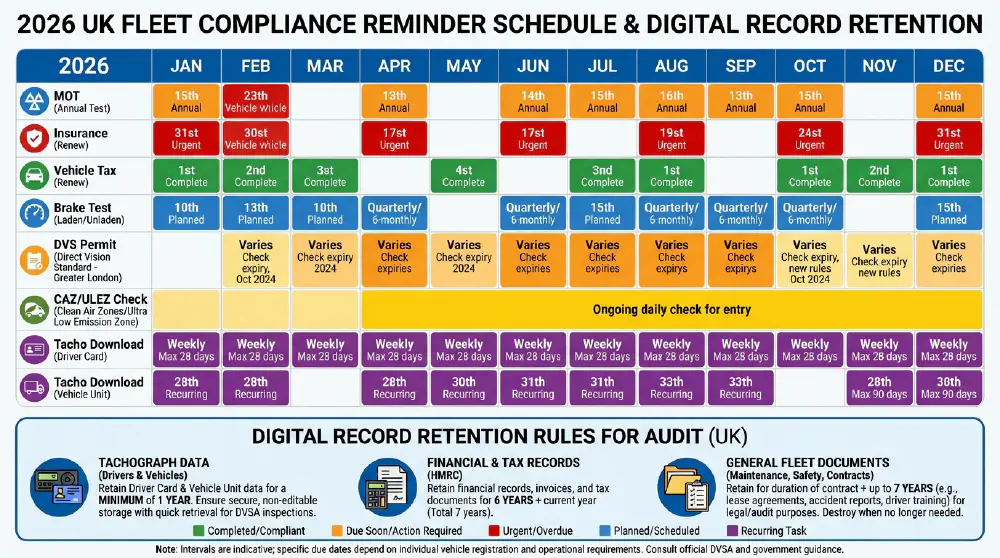
The 2026 compliance landscape in one view
The core obligations have not changed in name, but the standards of proof and enforcement have.
MOT and annual test
Cars and vans still test at 3 years then annually under GOV.UK MOT rules. HGV, PSV and trailer tests are governed by the updated HGV inspection manual, with digital pass certificates now standard. Any missed test is straightforward for DVSA to detect and sanction.Insurance and vehicle tax (VED)
Under Continuous Insurance Enforcement, every vehicle must be insured unless it is off road and SORN, enforced via DVLA and MIB cross checks as set out in vehicle insurance guidance. From April 2025, electric vehicles are drawn into mainstream VED, increasing the number of tax dates you need to track, while DVLA pushes digital reminders via the Driver and Vehicles Account instead of reliable paper letters.Brake testing and safety inspections
The Guide to Maintaining Roadworthiness now requires a brake performance assessment at every safety inspection, ideally laden, or supported by a written risk assessment and EBPMS where appropriate. Electronic records of inspections, repairs and defects must be retained for at least 15 months. Turning those intervals and expiry dates into systematic reminders is no longer optional.Urban standards: DVS and CAZ/ULEZ
London DVS Phase 2 demands a 3 star rating or Progressive Safe System for HGVs over 12 tonnes, or you face PCNs up to £550 per day. Meanwhile, Clean Air Zones listed under official CAZ guidance generate ongoing daily charges if you send the wrong vehicle into the wrong city.Smart Tachograph 2 and drivers hours
International work is steadily being brought under Smart 2 rules via the EU Mobility Package, with retrofit deadlines already passed for older units and more coming into force. Even domestic only operators are under pressure to tighten tachograph downloads and working time records.
In short, missing one date is now enough to trigger an Operator Licence audit, where your ability to export digital evidence is scrutinised just as heavily as whether the vehicle was technically legal on the day.
Build a lightweight digital control centre
The aim is not to copy every feature of a specialist platform. It is to meet three tests:
- Every compliance date is captured and visible.
- Every critical deadline has multi step reminders and escalation.
- Every action leaves a timestamped digital footprint that you can export on demand.
The simplest stack that meets those tests for an SME trades fleet is:
- A master fleet register in Google Sheets
- A set of linked Google Calendars, one per vehicle or asset group
- WhatsApp Business for direct driver and admin notifications
- A light integration layer such as Make.com or Zapier
- Optional but powerful: DVLA Vehicle Enquiry Service API and DVSA MOT History API as authoritative data feeds
Step 1: Master fleet register in Sheets
Create a single Sheet with one row per asset. At minimum, include:
- VRN, make, model, class
- Assigned driver or cost centre
- MOT due date, insurance renewal, VED expiry
- Safety inspection interval and next due date
- DVS permit expiry (where relevant)
- Tacho card download dates (driver and vehicle)
This becomes your single source of truth and the feeder for automation. If you already run site compliance through a dashboard, align the structure with your internal guides such as Automate CSCS, CPCS and SMSTS Renewals – Simple Rota Holds and Reminders That Keep Sites Compliant and Build a Simple Compliance Dashboard in Google Sheets for Site Jobs, Certificates and Photo Evidence, both on the Trainar Academy, so that fleet sits naturally alongside cards, training and inductions.
Step 2: Project dates into Google Calendar
Use a CSV export from Sheets to create or update events in Google Calendar:
- One calendar per vehicle, or per group such as “Vans under 3.5t” and “HGVs”
- Event types such as “MOT due”, “Insurance renewal”, “Tax due”, “PMI & laden brake test”, “DVS permit renewal”, “Tacho download”
On each event, assign layered reminders by email and pop up: for example 28, 14, 7 and 1 day before due date. Share the calendars with your Transport Manager, service admin and senior ops so that compliance dates are no longer hidden in a single inbox.
Google’s own Calendar API quota guidance is generous enough for SME fleets, so you can safely automate updates as vehicles come and go.
Turn Calendar entries into WhatsApp actions
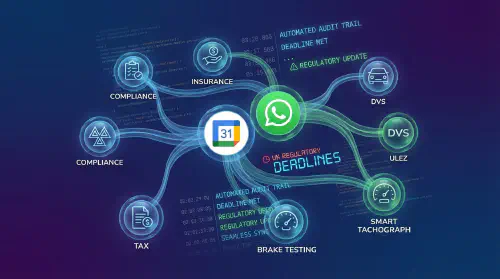
Calendar visibility alone does not change behaviour. The real win is when upcoming and overdue events appear in the tools your drivers and supervisors already live in all day.
Using a no code platform like Make.com or Zapier, you can:
- Run a scheduled job every morning that queries Google Calendar for events in the next 30 days or already overdue.
- Match each event to the driver or responsible manager from the fleet Sheet.
- Fire a WhatsApp template message via a provider such as Vonage using their latest WhatsApp pricing model.
A video such as Get WhatsApp Reminders From Google Calendar Events on YouTube (search for hIvUEhBkeII or embed it directly) is a useful practical walk through of this flow:
The effect in practice is simple: drivers receive a structured message like
“MOT for AB12 CDE is due on 15 March. Booking required by 1 March. Reply DONE with the booking reference.”
Your escalation logic can then post missed responses into an internal admin group, generate a PDF status snapshot and drop it into your digital audit folder.
Plug into DVLA and DVSA as the source of truth
Key dates should not only come from your internal register. To stay ahead of errors and last minute changes you should periodically validate your data against the official record.
Two free APIs provide what most fleets need:
- DVLA Vehicle Enquiry Service: returns tax status, MOT status and basic vehicle details by VRN, documented in the DVLA VES API.
- DVSA MOT History API: provides detailed MOT history and status, with a per day rate limit suitable for SME workloads, documented in the DVSA MOT History API.
In Make.com or n8n, schedule a weekly job to:
- Read each VRN from your fleet Sheet.
- Call DVLA and DVSA APIs.
- Update MOT and tax columns, and correct any dates that have slipped or changed after a retest.
- Regenerate Calendar events where needed.
This turns your calendar and WhatsApp layer into a semi automatic compliance assistant rather than a static list that goes out of date. For teams investing in DVSA Earned Recognition, this style of automated cross checking brings you closer to the digital record requirements set out in the scheme guidance on joining Earned Recognition.
Design an audit ready evidence trail
Digital reminders are only useful if you can prove to DVSA or a Traffic Commissioner that they existed and were acted on.
A simple structure that works in practice:
- A Google Drive folder per vehicle, containing:
- MOT certificates, inspection sheets and brake test printouts or PDFs
- Insurance documents and VED confirmations
- DVS permits and any CAZ or ULEZ exemption proofs
- Tacho download logs and drivers hours summaries
- A calendar export for each vehicle, before any planned audit or after a serious incident, showing all past and future compliance events.
- A WhatsApp export of key reminder threads, stored as a text or HTML file in the same folder.
Tools like Webfleet’s Compliance, Burden or Benefit? How Technology Turns Transport Fleet Compliance into Cost Savings panel (YouTube id HBYYW0Bv43s) are worth watching for real operator case studies of how EBPMS, inspection digitisation and telematics interact with this evidence model:
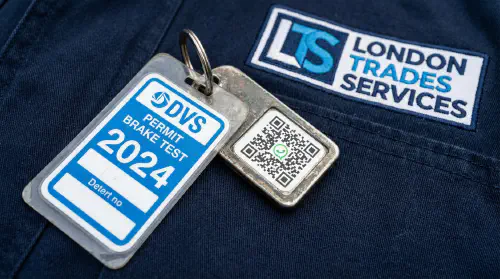
If you already use Trainar patterns for site evidence, such as QR based packs described in Digital Handover Pack with QR Codes – Set Up OM Manuals and Asset Tags Your Client Will Actually Use, then extending that approach to fleet keys and vehicle QR tags creates a joined up story that looks professional in any investigation.
FAQs
Are Google and WhatsApp based systems acceptable to DVSA and Traffic Commissioners?
Yes, provided they are complete, timestamped and exportable. The Guide to Maintaining Roadworthiness allows electronic records, and operators in practice have satisfied audits using calendar exports and messaging logs as part of their pack. What matters is coverage, consistency and the ability to retrieve records quickly, not the brand of software.Is this overkill for a micro fleet of three or four vans?
If you never enter London, never run 3.5 tonne plus vehicles and never rely on an Operator Licence, you might get by with basic reminders. The moment you put a heavier vehicle on the licence, or rely on that van to service major clients, the risk of an MOT or insurance miss more than justifies a lightweight digital system.How does this compare with buying a fleet platform like FleetCheck or r2c?
Dedicated platforms give you integrated inspection apps, defect reporting, tyre and fuel tracking and direct DVSA integrations. The Google plus WhatsApp stack is for teams that need 80 percent of the compliance benefit quickly and cheaply. Many operators start there, then step up to full systems once they prove the value internally.What about GDPR when using WhatsApp and cloud tools for driver data?
Keep the dataset lean: focus on VRN, first name, work mobile and compliance dates. Use business accounts, document your lawful basis for processing (legal obligation and legitimate interest are common), and restrict access to the calendars and folders. The same hygiene you apply to HR and training systems should be mirrored in fleet.Where can I see how other operators are doing this in the real world?
Active communities such as r/LogisticsSoftware and r/GEOTAB regularly share automation flows, including UK trades fleets using Google and WhatsApp instead of heavy systems. For enforcement and penalty discussions, r/LegalAdviceUK is a useful (if unofficial) barometer of what happens when things go wrong.
Training and resources
Core regulations and standards
APIs and tooling
Practical workflows and learning
- YouTube: Compliance, Burden or Benefit? How Technology Turns Transport Fleet Compliance into Cost Savings (Webfleet UKI, 2025)
HBYYW0Bv43s - YouTube: Get WhatsApp Reminders From Google Calendar Events (OttoKit, 2025)
hIvUEhBkeII - Trainar Academy: Automate CSCS, CPCS and SMSTS Renewals – Simple Rota Holds and Reminders That Keep Sites Compliant
https://academy.trainar.ai/automate-cscs-cpcs-and-smsts-renewals-simple-rota-holds-and-reminders-that-keep-sites-compliant - Trainar Academy: Build a Simple Compliance Dashboard in Google Sheets for Site Jobs, Certificates and Photo Evidence
https://academy.trainar.ai/build-a-simple-compliance-dashboard-in-google-sheets-for-site-jobs-certificates-and-photo-evidence - Trainar Academy: Daily Van Checks for Trades – DVSA List, Printable Sheet, and a WhatsApp Photo Log
https://academy.trainar.ai/daily-van-checks-for-trades-dvsa-list-printable-sheet-and-a-whatsapp-photo-log
- YouTube: Compliance, Burden or Benefit? How Technology Turns Transport Fleet Compliance into Cost Savings (Webfleet UKI, 2025)
Want to slash training times and increase revenue per Engineer? Join our Waitlist: https://trainar.ai/waitlist
Ready to Transform Your Business?
Turn every engineer into your best engineer and solve recruitment bottlenecks
Join the TrainAR Waitlist