2026 Site Charging: Stay Compliant & Cut EV Fleet Costs
Jump To...
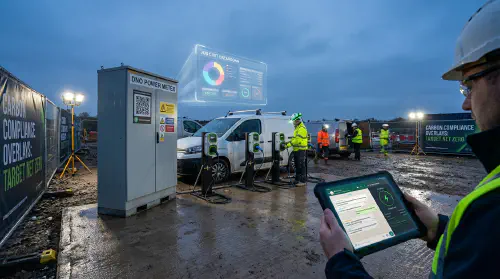
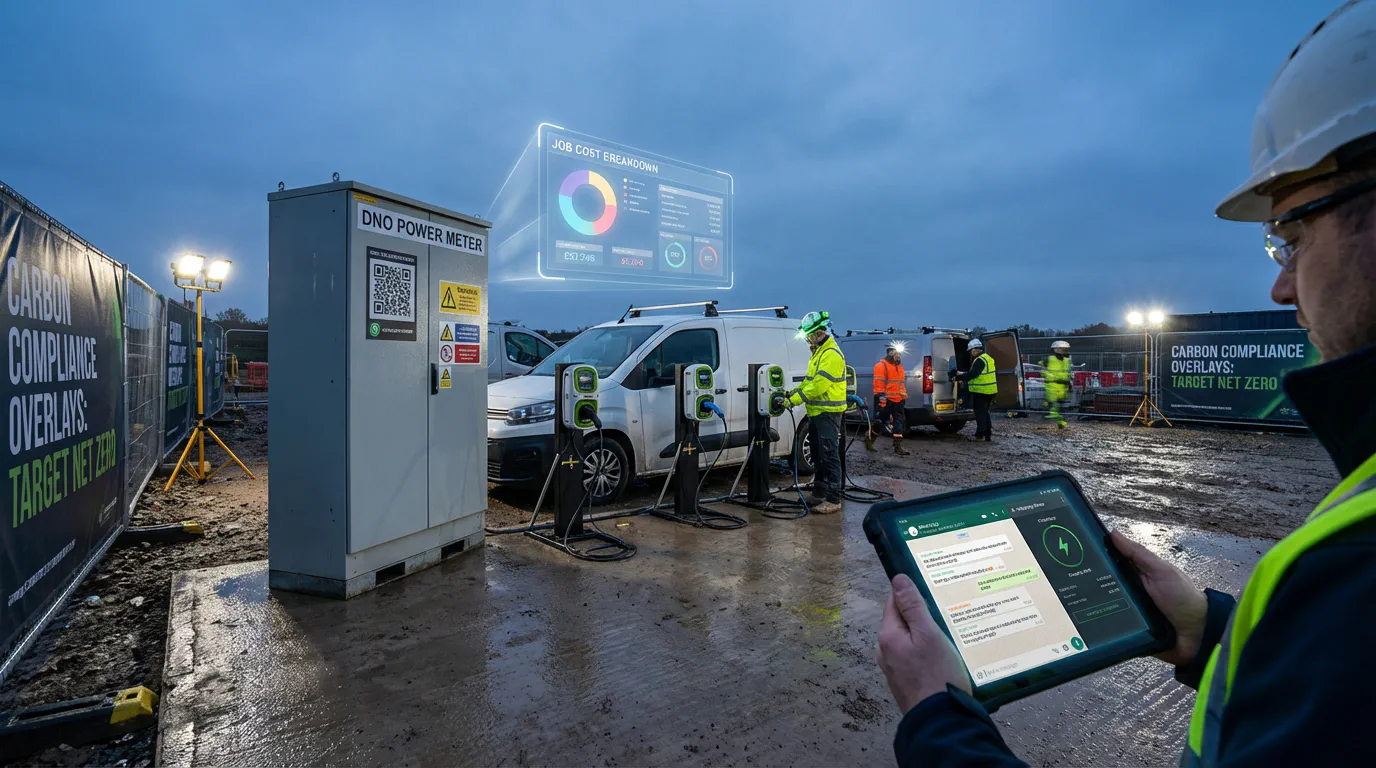
Modern UK site at dusk with vans on temporary EV chargers, QR signage and live cost overlays, capturing the real-world shift to mobile electrified fleets.
Who this is for
- UK main contractors, subcontractors and plant hire firms running or planning EV vans on building sites.
- QS, project managers and commercial leads responsible for site energy budgets and SECR/TCFD-style reporting.
- Electrical supervisors and approved contractors handling temporary LV site supplies and EV charger installs.
- Finance teams using Xero or QuickBooks who need EV charging costs tracked reliably to projects.
What this guide covers
- The 2026 UK regulatory landscape for temporary EV charging on sites: DNO, BS 7671, BS 7909 and smart charging rules.
- The AC/DC hardware options that actually work on muddy, security‑sensitive sites.
- How to design secure, vandal‑resistant charging compounds that don’t become a new theft hotspot.
- Realistic winter range planning for trade vans so you don’t strand crews.
- Concrete workflows for tagging EV energy costs to jobs in Xero and QuickBooks.
- Grants you can actually claim in 2026—and the paperwork that trips contractors up.
2026 rules of the game: DNO, smart chargers and wiring standards
By 2026, “just plug it into a board” is a compliance failure waiting to happen. Temporary EV charging is now squarely in the sights of DNOs, OZEV and insurers, and your site documentation needs to prove you took it seriously.
DNO and temporary supplies
As of early 2026, every temporary EV charging supply on a UK construction site must go through the local DNO or IDNO – there’s no informal workaround. Key points:
- Connection application:
You submit a temporary connection request with load (kVA), charger types and site drawings via your local DNO. See GOV.UK’s guidance on connecting EV chargepoints to the electricity network. - Reinforcement costs:
Since April 2023, general network reinforcement is no longer charged to the customer, but sole‑use assets and site works still are. Budget for trenching, cabinet bases and any private network upgrades. - Timescales:
Supply negotiation can be anywhere from 5–65 working days. For larger sites or constrained networks, assume the upper end and plan grid‑weak contingencies (battery or hybrid systems). - Temporary builder’s supplies:
Can legally last up to five years, but in practice expect stricter scrutiny on safe operation, PME handling and EV load.
For specific temporary connection details, check your DNO’s page (for example, Northern Powergrid’s guidance on temporary connections).
Smart charger and wiring regulations
All workplace/non‑public EV chargers on your site must comply with The Electric Vehicles (Smart Charge Points) Regulations 2021. That means:
- Default off‑peak charging behaviour
- Remote smart functionality and firmware updates
- Baseline cybersecurity requirements
See the official GOV.UK guide to the EV Smart Charge Points Regulations.
From the wiring side:
- BS 7671:2018+A2:2022 (with further amendments coming) and BS 7909:2023 underpin any temporary electrical systems on site.
- For construction environments, Section 704 of BS 7671 is critical:
- Robust IP‑rated enclosures (think IP66/NEMA 4 for open air).
- Adequate mechanical protection, typically armoured cable and protected routing.
- RCDs of the correct type (A or B) sized and segregated properly per circuit.
- With PME supplies, you must address open‑PEN risk:
- An integrated open‑PEN protection device, or
- A TT system or equivalent solution designed to current IET guidance.
The IET’s EV charging FAQs are a solid reference point for inspectors and designers alike: IET EV charging FAQs. For temporary systems, the Wiring Matters overview of BS 7909:2023 is also worth a read: Guide to temporary electrical systems.
Choosing temporary EV hardware that survives real sites
Most of the glossy EV marketing imagery assumes a clean depot, not a windswept, half‑lit compound next to the welfare unit. In practice, UK contractors in 2026 tend to converge on a few workhorse product families.
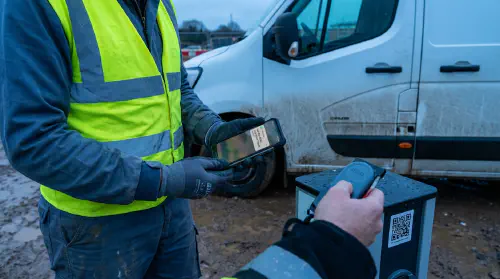
Think of this as the future site setup: an electrician scanning a QR‑tagged temporary charger in a rugged compound, with WhatsApp alerts and job‑costing on a tablet tying the hardware directly into your digital workflow.
AC portable pedestals
For day‑to‑day van charging where dwell time is overnight or a long shift:
- Rolec CubiCharge / BasicCharge / AutoCharge (7–22kW)
Widely used by UK main contractors; simple to deploy, with variants suited to both plug‑in and RFID/app‑based access. - IDE Systems IDEV SmartCharge (7–22kW)
Popular in the temporary market via hire providers like Sunbelt; proven compatibility with temporary builders’ supplies and BS 7909‑style setups.
AC is often the most cost‑effective baseline for fleet vans that return to site, particularly when you can leave them on charge for 8–10 hours.
Mobile and off‑grid DC
When you’re running heavier vans, doing back‑to‑back shifts, or have limited grid capacity:
- Kempower Movable (40kW DC) and Heliox Mobile DC (40kW)
Trailer or skid‑mounted units commonly specified for rapid top‑ups. Strong choice for larger sites or where you have multiple vans sharing assets. - FreeWire Boost Charger, ZPN ZAPME, Beam EV ARC, hybrid BESS systems
Ideal for grid‑weak or zero‑works locations: they use integrated battery storage (and sometimes solar) to smooth demand or avoid significant DNO upgrades.
Hiring from a specialist such as Sunbelt keeps capital off your balance sheet and ensures the units arrive with appropriate documentation and recent test certificates.
Designing a secure, vandal‑resistant charging compound
If you drop £50k of chargers and copper into a dark corner of the site and call it a day, you’ve just created a theft magnet. Security has to be designed in from the start, not bolted on after the first cut cable.
Use this kind of layout thinking as a prompt: a clearly defined charging compound tied into site fencing, CCTV and power distribution, with obvious routes for vehicles and people.
Physical placement and hardening
Aim to:
- Place chargers in high‑traffic, well‑lit areas, ideally visible from the site office or security cabin.
- Integrate LED floodlighting and CCTV coverage from day one – not as a later “extra”.
- Install steel bollards or barriers to protect pedestals from both impact and ram‑raid attempts.
- Use IP66/NEMA 4, IK10‑rated enclosures and armoured/underground cabling with minimal exposed lengths.
Consider adding:
- Deep‑set anchor bolts grouted into concrete bases.
- Tamper switches and accelerometers linked to your alarm system or WhatsApp group for the site.
- Clearly visible QR or NFC tags on each unit to link straight to defect reporting, manuals and asset records – this is where a platform like TrainAR works well alongside physical tags.
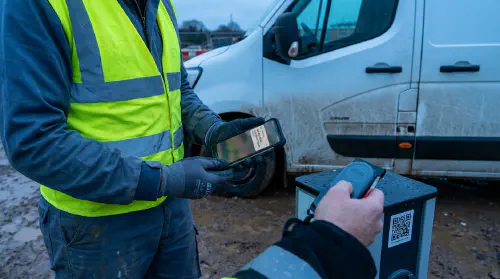
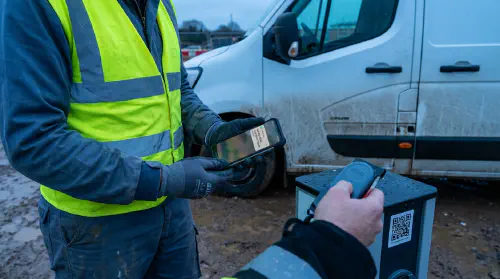
Zooming in on the detail—open‑PEN protection, armoured cable terminations, and QR labels feeding WhatsApp alerts—shows the level of finish and documentation that reduces call‑outs and keeps auditors happy.
Cybersecurity and payment protection
As more temporary chargers connect to back‑office systems, cyber risk stops being theoretical:
- Specify OCPP 1.6 or 2.0.1 with TLS encryption and signed firmware updates.
- Put chargers on a segregated VLAN with strict firewall rules; never leave installer laptops plugged into the same flat network as site admin machines.
- Change default admin credentials as part of commissioning and store them in a secure password manager, not on a laminated card in the cabin.
- Prefer app or NFC‑based payment over exposed contactless terminals. If you do use QR codes, brief staff to check for stick‑on overlays that redirect to phishing sites.
For on‑the‑ground practical tips on installs, the video “Tips on EV Charger Installs” by a UK electrician is worth a watch:
For driver behaviour, scheduling and winter etiquette, “5 Rules Every EV Owner Needs to Know” is a good briefing for your fleet:
Reddit communities like r/ElectricVehiclesUK and r/evcharging are also valuable for real‑world reports on theft attempts, vandalism patterns and what actually deters them in UK conditions.
Winter range reality for trade vans
The EV marketing line about “up to 200+ miles” doesn’t survive a January week on a stop‑start plumbing route with doors open every ten minutes.
Telematics data from large fleets (for example, Geotab’s EV temperature tool) shows:
- At around 0°C, expect 15–25% loss versus WLTP in mixed use.
- For trade vans with frequent stops, heater use and cold‑soaked batteries push losses to 20–30% routinely and up to 40% in harsh conditions.
- Vans with heat pumps (such as the newer Ford E‑Transit spec) consistently perform better, trimming perhaps 7–10 percentage points off the winter penalty.
What that means in practice:
- If your “paper” range is 160 miles, plan your operational winter range at 100–120 miles unless data proves otherwise.
- Build range buffers into job allocation. Two call‑outs too many on a cold day is how you end up with emergency recovery on your costs line.
- Schedule charging windows for vehicles with heavier loads or high‑priority jobs the following morning.
If you want to stress‑test your assumptions, talk to drivers in r/electricvehicles – there are plenty of threads from tradespeople and fleet drivers sharing real winter numbers.
Tagging EV charging costs to jobs in Xero and QuickBooks
Electrifying your fleet only pays off if you can see where the energy spend is going. In 2026, both Xero and QuickBooks are perfectly capable job‑costing platforms – but they won’t automate the whole workflow for you.
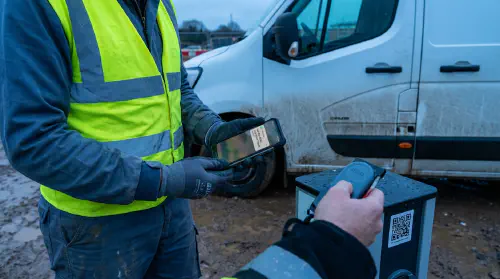
Use this type of workflow view as a checklist: DNO connection, charger choice, open‑PEN/winterisation checks and finally the job‑costing layer in Xero Projects or QuickBooks Projects.
Xero: Projects plus EV expense codes
In Xero:
- Set up dedicated accounts:
- Create an EV Charging – Site expense code and, if helpful, EV Charging – Public.
- Enable Xero Projects:
- Each job or site gets a Project, with clear naming conventions that match your job numbers.
- Capture spend via bills or bank spend:
- Every invoice or bank transaction from EV suppliers (Paua, Shell, Allstar, hire companies) is coded to the EV account.
- You then manually assign each line to the relevant Project – this cannot be fully automated in 2026. Bank rules can suggest the account, but not the project.
- Mileage allowances (company EVs):
- For drivers charging at home or public chargers, use HMRC’s Advisory Electric Rate (AER) (for example, 7p/mile home, 14p/mile public in late 2025/early 2026 – always check the current rate on GOV.UK).
Xero’s own training on Projects is a good baseline for your office manager: Create and track client projects.
For a broader look at how AI can sit on top of this data to forecast cash flow, see TrainAR’s “AI cash flow forecasting for trades: set it up with Xero or QuickBooks and GoCardless”:
https://academy.trainar.ai/ai-cash-flow-forecasting-for-trades-set-it-up-with-xero-or-quickbooks-and-gocardless
QuickBooks Online: Projects and customer tracking
In QuickBooks:
- Turn on Projects and “Track income and expenses by Customer.”
- Treat each site or job as a Project linked to the client.
- When EV charging invoices land (from your roaming provider or hire firm), you:
- Code them to the EV energy/plant account.
- Assign each line to the right Project – again, this is a manual click per transaction.
- Use monthly CSV exports from fleet card providers like Paua or Allstar, which often include job or vehicle tags you can mirror in your Project setup.
The key here is discipline: train whoever is doing the books that “coded” is not the same as “project‑assigned”. A week of missed assignments will leave a sizeable hole in your site P&L.
To tighten up the physical side of asset tracking – particularly for portable chargers and power blocks – TrainAR’s guide “Best asset tags and QR labels for tools and plant – what lasts on UK sites” walks through robust tagging that survives mud, sun and theft attempts:
https://academy.trainar.ai/best-asset-tags-and-qr-labels-for-tools-and-plant-what-lasts-on-uk-sites
Grants and compliance: what you can actually claim in 2026
There is no single “Fleet Green Grant” as of early 2026, despite what some older guides still suggest. Instead, SME contractors should focus on:
- EV Infrastructure Grant for Staff and Fleets (OZEV)
- For UK businesses with ≤249 employees.
- Up to £350 per socket plus £500 per enabled bay, across up to 5 sites.
- Runs to 31 March 2026 or until funds are exhausted.
- Workplace Charging Scheme (WCS)
- Up to 40 sockets per business, at £350 per socket.
- Can be combined with the infrastructure grant in many cases.
Official details and application routes are on GOV.UK – search for “EV chargepoint grant for staff and fleets” and “Workplace Charging Scheme” to get the latest terms and online forms.
To stay eligible:
- Use OZEV‑authorised installers only.
- Ensure full DNO sign‑off, test certificates and a serial number log for each charger.
- Keep all invoices, commissioning sheets and site ownership/lease documents in a folder ready for an OZEV spot audit.
On the reporting side, remember that:
- SECR remains in force for larger entities in 2026; it has not been quietly replaced.
- For PIEs and bigger groups, TCFD‑aligned reporting still expects you to have a handle on EV and site energy emissions.
Your EV charging records, when properly job‑costed, feed these disclosures instead of sitting in a mystery “utilities” bucket.
FAQs
Do I really need DNO approval for a couple of chargers on a temp board?
Yes. If you’re adding EV load to a temporary site supply, it must be part of the formal connection application and adequately documented. Cutting corners here is exactly what insurers and HSE investigators look for after an incident.
Can I just use a 13A socket with a granny charger for one van?
Under current BS 7671 and BS 7909 guidance, this is generally not acceptable for ongoing site use, particularly with PME and open‑PEN risks. Purpose‑built EV circuits and devices are the expectation.
What enclosure rating should I aim for outdoors?
For UK sites, IP66/NEMA 4 with good impact resistance (IK10) is the sensible baseline. Anything less tends to fail once dirt, wash‑downs and driving rain have had a few weeks to work on it.
Can Xero or QuickBooks automatically allocate every EV cost to the right job?
Not in 2026. Rules can suggest accounts but Projects/Jobs always need a manual assignment per transaction. Treat it as a daily discipline, not a “nice to have”.
Are winter range drops really as bad as 40%?
They can be, depending on duty cycle and conditions. Many UK trade users report 25–35% losses as “normal bad days” and 40%+ in the worst snaps. You’re safer planning for that bandwidth and being pleasantly surprised than the other way round.
Want to slash training times and increase revenue per Engineer? Join our Waitlist: https://trainar.ai/waitlist
Training and resources
Standards and regulations
- Connecting chargepoints to the electricity network – GOV.UK:
https://www.gov.uk/government/publications/connecting-electric-vehicle-chargepoints-to-the-electricity-network - Electric Vehicles (Smart Charge Points) Regulations – GOV.UK:
https://www.gov.uk/guidance/regulations-electric-vehicle-smart-charge-points - IET EV charging FAQs (BS 7671 Section 722 and PME/open‑PEN issues):
https://electrical.theiet.org/bs-7671/faqs/electric-vehicle-charging-installations-faqs/ - BS 7909: temporary electrical systems (Wiring Matters article):
https://electrical.theiet.org/wiring-matters/years/2025/105-may-2025/guide-to-temporary-electrical-systems-2nd-edition/ - HMRC Advisory Fuel Rates (including AER for EVs):
https://www.gov.uk/guidance/advisory-fuel-rates
Hardware and fleet performance
- Sunbelt Rentals temporary EV charger options:
https://www.sunbeltrentals.co.uk/energy-solutions/clean-energy/ev-chargers/ac-charger-for-electric-vehicles-1992/ - Geotab EV temperature tool (winter range impact):
https://www.geotab.com/fleet-management-solutions/ev-temperature-tool/
Accounting and job costing
- Xero Projects training – create and track client projects:
https://learning.xero.com/student/path/3991-create-and-track-client-projects
Community and practical insight
- r/ElectricVehiclesUK – UK‑focused EV installs, grants and fleet experiences:
https://www.reddit.com/r/ElectricVehiclesUK - r/evcharging – charger hardware, setup and troubleshooting:
https://www.reddit.com/r/evcharging - r/electricvehicles – global EV experiences, especially winter range threads:
https://www.reddit.com/r/electricvehicles
Video resources
- Tips on EV Charger Installs (site‑level installation and costing by a UK electrician):
- 5 Rules Every EV Owner Needs to Know (charging behaviour and winter operation):
TrainAR internal guides
- AI cash flow forecasting for trades: set it up with Xero or QuickBooks and GoCardless:
https://academy.trainar.ai/ai-cash-flow-forecasting-for-trades-set-it-up-with-xero-or-quickbooks-and-gocardless - Best asset tags and QR labels for tools and plant – what lasts on UK sites:
https://academy.trainar.ai/best-asset-tags-and-qr-labels-for-tools-and-plant-what-lasts-on-uk-sites
Ready to Transform Your Business?
Turn every engineer into your best engineer and solve recruitment bottlenecks
Join the TrainAR Waitlist