Accident book on site: what to write, who can see it, and when to RIDDOR report
Jump To...
- If you’ve 10 or more employees, you must keep an accident book or electronic equivalent. Smaller firms should still record accidents and near-misses.
- Record the basics: who, when, where, what happened, injury type, action taken, and who filled it in. Keep each record for at least 3 years.
- Only some incidents are RIDDOR-reportable to the HSE. Deaths, specified injuries, over-7-day incapacitation, certain injuries to non-workers that need hospital treatment, occupational diseases and listed dangerous occurrences must be reported within set timescales.
- Use HSE’s Accident Book BI 510 or an equivalent digital form. Remove completed sheets and store securely so other entries are not visible. Limit access and follow GDPR.
HSE accident book • RIDDOR types of reportable incidents
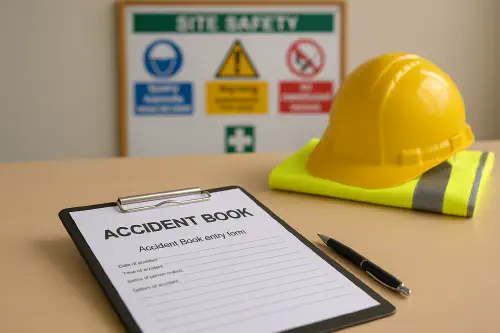
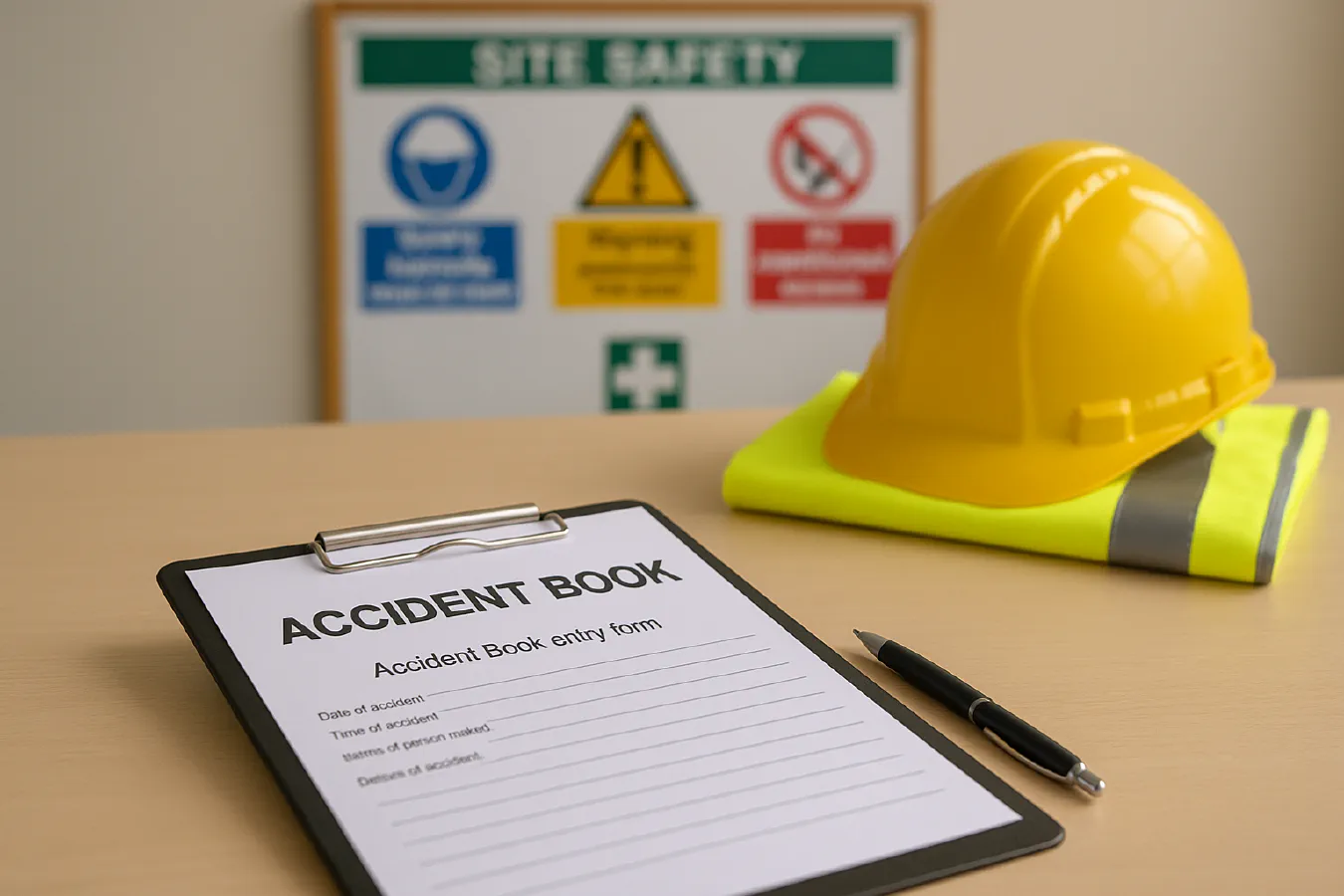
Accident Book entry form on a tidy UK site office desk with hard hat and hi-vis
Accident book: what to record and who needs one
- Who needs one: Under the Social Security (Claims and Payments) Regulations 1979, businesses with 10+ employees must keep an accident record system that’s readily accessible. Smaller firms are still strongly advised to keep records for risk management and claims.
- What to record: date/time/place, injured person’s details and role, what happened, nature of injury, treatment given, witness details if relevant, and who completed the entry.
- Format: Paper or digital is fine. HSE’s BI 510 book uses perforated pages so completed entries can be removed and stored securely away from the blank book.
- Retention: keep for at least 3 years. Many firms keep longer where claims are possible. For RIDDOR records, 3 years is a legal minimum.
Useful sources:
- HSE Accident Book BI 510 overview and purchase page: HSE accident book
- RIDDOR record-keeping minimum: HSE – what must I keep
RIDDOR: what must be reported and when
- Who reports: the responsible person (employer, self‑employed, or controller of the premises).
- What to report to HSE:
- Deaths
- Specified injuries to workers (eg fractures other than fingers, thumbs, toes; amputations; loss of sight; serious burns; crush injuries to head or torso; scalping requiring hospital treatment; injuries from enclosed spaces causing hypothermia or heat illness)
- Over‑7‑day incapacitation of a worker (report within 15 days)
- Non‑workers taken to hospital for treatment (not just checks)
- Reportable occupational diseases (on diagnosis)
- Dangerous occurrences listed in RIDDOR
- Timescales: report without delay and within 10 days for most events; within 15 days for over‑7‑day cases; diseases as soon as diagnosed. Note: HSE has updated its reporting forms in 2025 with clearer guidance, improved examples and more inclusive options, but legal requirements haven’t changed.
Helpful HSE pages:
Accident book vs RIDDOR: simple flow
The quick decision path your supervisors can follow on site.

Flowchart showing Accident Book vs RIDDOR decision for UK construction sites
GDPR on accident records: who can see what
- Remove completed sheets from the book and file them securely. Don’t leave past entries visible to everyone.
- Lawful basis: for workers’ accident data, you’ll usually rely on legal obligation under health and safety law. Where health information is included, you’ll also rely on the health and safety or legal claims conditions for special category data.
- Sharing: give only what’s necessary to HSE or local authority inspectors, insurers, solicitors and safety reps. Redact others’ personal data if the injured person requests a copy.
- Retention: minimum 3 years. Set a clear retention policy; keep longer if needed for potential claims or young persons.
Good guidance:
Set up a site-ready workflow in 20 minutes
Here’s a simple, repeatable setup any small trades firm can use.
- Put the accident book and first aid kit together in a known place.
- Add a laminated one-page prompt next to the book: what to write, who to call, RIDDOR triggers, and who to notify.
- Train supervisors and first aiders to remove completed pages and hand them to the office or store in a locked cabinet.
- Keep a simple spreadsheet index of incidents with date, site, internal reference and whether RIDDOR was assessed, without health details.
- Calendar reminders: set a weekly check to review the index and chase any missing details, and a monthly check to test that past entries are stored correctly.
- Add “RIDDOR check” to your incident investigation template. If reportable, submit online and file the confirmation with the accident record.
- Run a 10-minute refresher at toolbox talks quarterly using a real anonymised example.
Tip: If you already use a job management app, add an “Accident/incident” form and a RIDDOR decision checklist, then store copies in the job file.
Handy links
- HSE Accident Book BI 510: HSE accident book
- RIDDOR overview: RIDDOR explained
- Report online: How to make a RIDDOR report
- Types and thresholds: Types of reportable incidents
- Record keeping: What records do I need to keep
- ICO guidance: Handling workers’ sickness and injury records
Related TrainAR Academy articles:
- Near miss reporting on construction sites: simple steps, examples and a QR code setup
- Build an AI site diary from photos and voice notes: compliant records without the paperwork
- Construction site safety audit checklist: digitise it, assign actions and prove compliance
FAQ
Do I legally need an accident book?
If you’ve 10 or more employees you must keep an accident record system such as an accident book or an electronic equivalent. Smaller businesses should still keep accident and near-miss records to manage risk and for claims.
Can my accident book be digital?
Yes. You can use an electronic form or app as long as it’s accessible, secure, and you can export the record if HSE or an insurer asks. Keep the same details you would in a paper book.
How long do I keep accident records?
Keep them for at least 3 years. Many firms keep longer where claims are possible. RIDDOR records have a legal minimum of 3 years.
What’s the difference between accident book and RIDDOR?
The accident book is your internal record of any workplace accident or incident. RIDDOR is when you must report certain serious events to HSE. Most entries in the accident book are not reportable under RIDDOR.
Who can see the accident book entries?
Limit access to those who need it, like your H&S lead, the injured person, management, investigators, or regulators and insurers. Don’t leave completed entries in the book where everyone can read them. If the injured person asks for a copy, redact other people’s details.
Do I need to report minor cuts or first aid cases under RIDDOR?
No. First aid cases and over‑3‑day absences are record‑only. You report when the injury keeps a worker from their normal job for more than 7 consecutive days, or if it meets the other RIDDOR categories like specified injuries.
Ready to Transform Your Business?
Turn every engineer into your best engineer and solve recruitment bottlenecks
Join the TrainAR Waitlist