
Quick Answer
If you are renovating any building built or refurbished before 2000, a refurbishment and demolition (R&D) asbestos survey is a legal requirement before intrusive work begins. The job must be done by a UKAS-accredited inspection body operating under ISO 17020, with surveyors qualified to BOHS P402 or equivalent. A typical domestic R&D survey costs £300 to £800. Licensed asbestos work requires HSE notification through the ASB5 form at least 14 days before starting. The duty sits on the dutyholder, but once you accept the job, you carry liability too.
Table of Contents
- What the law actually says
- The two survey types and when each one applies
- Who pays for it and who commissions it
- What an asbestos survey costs in 2026
- The survey process from instruction to report
- How to choose a surveyor without getting burned
- What happens after the report lands
- Using AI to manage the compliance trail
- What tradespeople are saying
- Recommended videos
- Frequently asked questions
- My verdict
What the law actually says
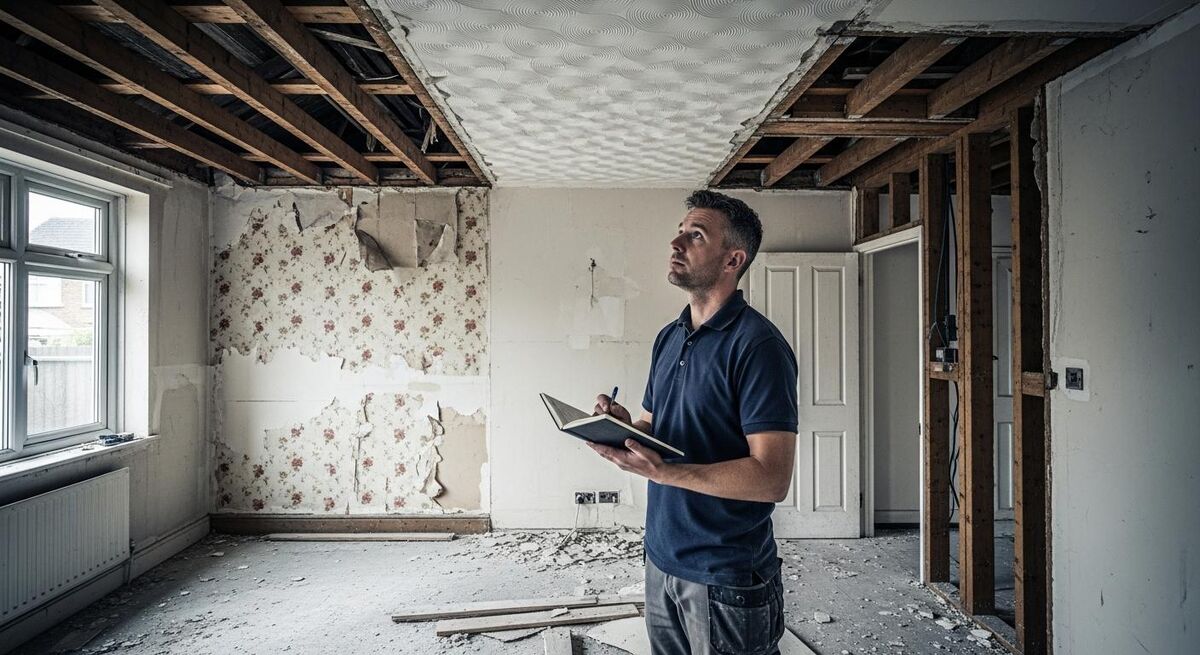
The Control of Asbestos Regulations 2012 sit at the heart of this. Regulation 4 places a duty to manage asbestos in all non-domestic premises on the dutyholder, usually the building owner, the landlord, or the person with maintenance responsibility under the lease. That duty includes finding out whether asbestos is present, recording it, assessing the risk, and sharing the information with anyone whose work could disturb it.
For renovation work specifically, Regulation 5 takes over. Before any work that might disturb asbestos can start, the person carrying out the work must identify the type of asbestos involved, or assume it is the worst kind and act accordingly. In practice that means a survey. A management survey is not enough. The HSE is clear: for refurbishment or demolition you need a refurbishment and demolition (R&D) survey, and it must locate every asbestos-containing material in the area being worked on. This goes hand in hand with building control notifications, which often run in parallel on renovation projects.
Once a tradesperson is on site, the Health and Safety at Work Act 1974 sits alongside CAR 2012. You have a duty to yourself, your team, and anyone else who could be affected by what you disturb. The duty does not transfer when the client hands you a key. It runs in parallel. For larger construction projects, the CDM regulations layer additional responsibilities on top of asbestos management.
The two survey types and when each one applies
There are two surveys under HSG264, the HSE's Asbestos: The survey guide. Picking the wrong one is one of the most common ways a job goes legally sideways before the first tool comes out of the van.
Management survey
A management survey identifies asbestos that is, or could be, disturbed during normal occupation. It is non-intrusive in most areas. The surveyor will lift ceiling tiles, look behind access panels, and inspect easy-to-reach voids. The output feeds an asbestos register and a management plan. This is the survey a building owner needs to comply with Regulation 4. It is not a survey you can renovate against.
Refurbishment and demolition (R&D) survey
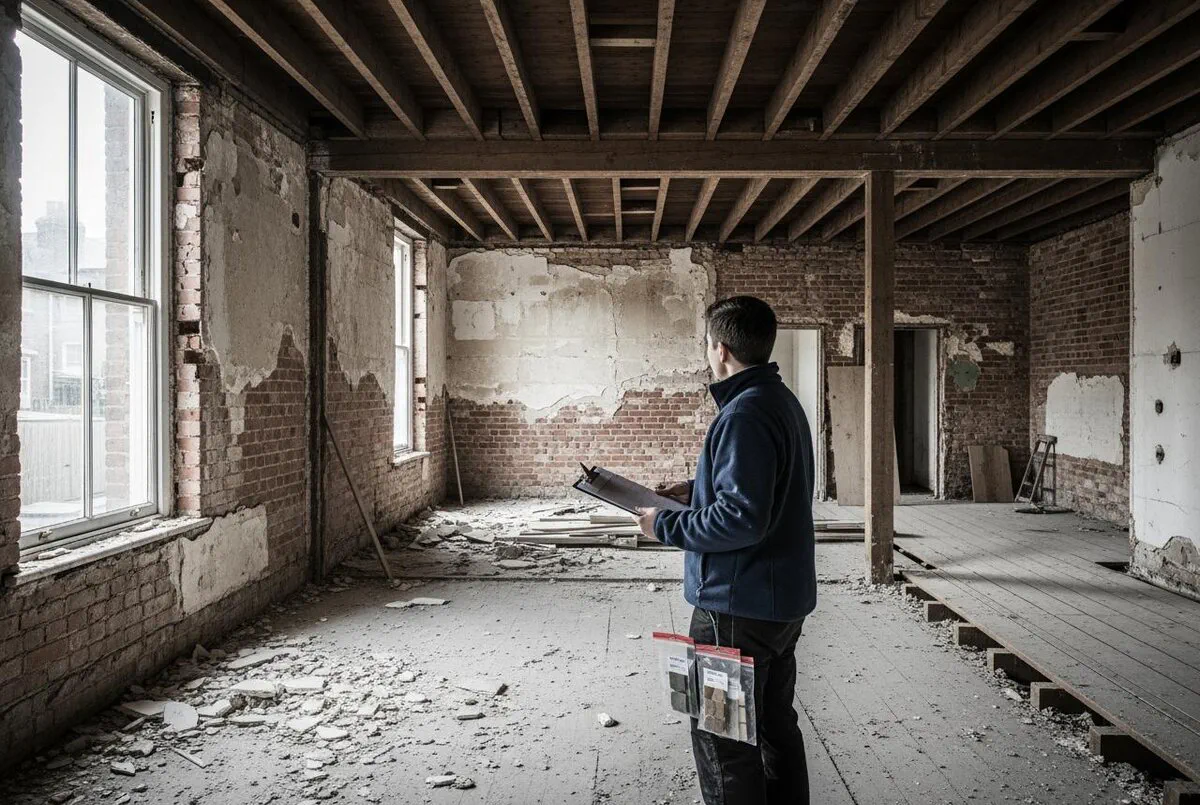
This is the survey that matters when work is planned. It is intrusive. Surveyors open up walls, lift floors, drop ceilings, drill into voids, and sample every suspect material they expect to be disturbed. The area being surveyed has to be empty during the work because dust gets released. The report tells you exactly what has to be removed, abated, or left in place before your tools touch the building.
The big mistake people make is treating a management survey as good enough for renovation. It is not, and the HSE has prosecuted on this basis. For a rewire alone, an R&D survey covering the affected areas is the minimum.
Who pays for it and who commissions it

The dutyholder pays in the commercial world. On a private home, the homeowner pays unless the contract pushes it elsewhere. Whoever signs the cheque, the smart move on your end is to commission the survey yourself if the client will let you, or at the very least to specify the scope in writing before it is booked.
Why? Because a survey commissioned by someone else, with no input from you, can come back with the wrong scope. The areas you need clear are not the same as the areas the owner wants surveyed. A survey done for a kitchen refit will not cover a loft conversion. If you arrive on day one to find materials you cannot work around, you stop, and you pay for the delay.
If the client refuses to commission a survey at all, you walk. That is not a moral position, it is a commercial one. The fines, prosecutions, and reputational damage from getting it wrong are larger than the job. Document the refusal in writing and move on to a client who takes it seriously.
What an asbestos survey costs in 2026
Prices move with property size, surveyor location, and how many samples come back from the lab. The figures below reflect typical UK pricing as of early 2026, drawn from Checkatrade, MyBuilder, and several UKAS-accredited surveyors.
| Property | Management survey | R&D survey | Typical samples |
|---|---|---|---|
| 2-3 bed terraced house | £250 to £350 | £300 to £450 | 5 to 8 |
| 3-4 bed semi | £300 to £400 | £400 to £550 | 8 to 12 |
| 4-5 bed detached | £350 to £450 | £500 to £750 | 10 to 18 |
| Small commercial unit | £400 to £700 | £600 to £1,200 | 15 to 30 |
| Factory or large building | £800 to £2,000+ | £1,500 to £5,000+ | 30 to 100+ |
Lab analysis sits inside those prices for most domestic surveys. Where it is itemised, expect £20 to £40 per sample on standard turnaround. Expedited next-day analysis runs £60 to £100 per sample. London and the South East tend to sit at the top of the range. Difficult access, lofts with no ladder, or basements without lighting, adds a half day's labour.
The survey process from instruction to report
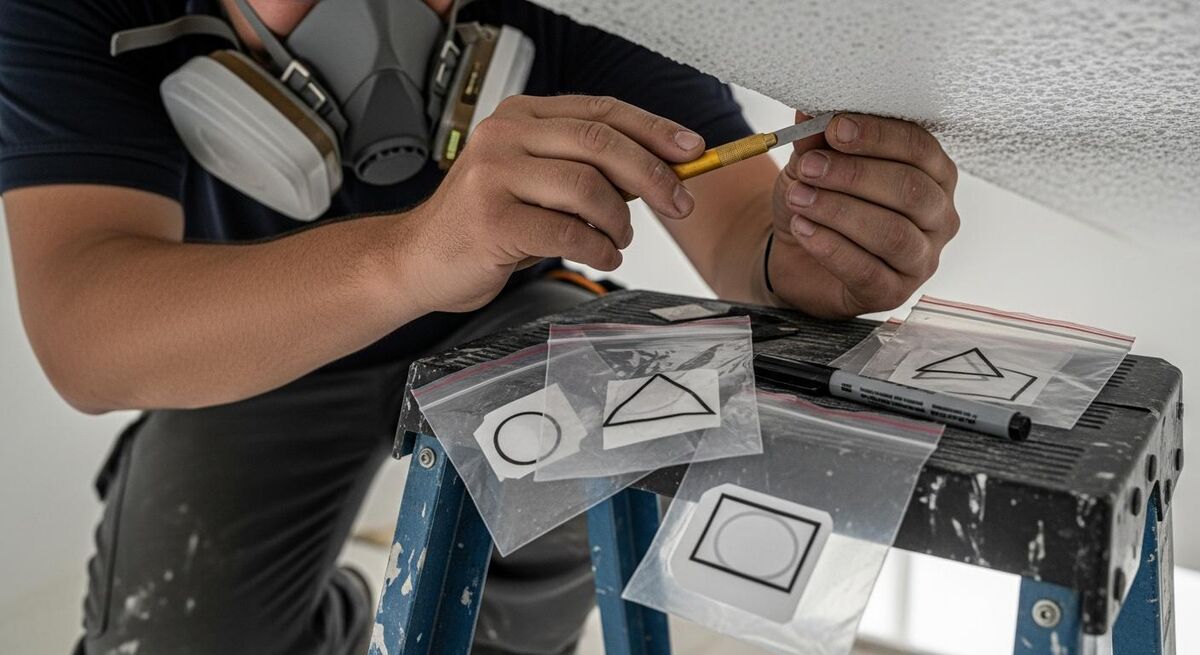
A typical R&D survey on a three-bed property runs to two visits and around five working days end to end. Larger commercial sites can stretch to a fortnight or more.
The first visit is the on-site inspection. The surveyor walks the property with the drawings or your scope of work, identifies suspect materials, and takes samples. Sampling is destructive: small pieces are cut from textured coatings, cement boards, pipe lagging, floor tiles, eaves, garage roofs, and anywhere asbestos was historically used. Each sample is bagged, labelled, and recorded against a plan.
The site is then off limits to anyone but the surveyor's team during sampling. That is a real cost the client should know about up front. Samples go to a UKAS-accredited laboratory for analysis under ISO 17025. Standard turnaround is 24 to 72 hours. The lab reports back to the surveyor, who pulls everything into a report that lists every ACM found, its location, condition, and the recommended action.
The report should include a photograph and location plan for each ACM, the type of asbestos (chrysotile, amosite, crocidolite), the percentage by volume, and the recommended priority for action. If the report does not include all of that, push back. A vague report leaves you exposed.
What happens if asbestos is found
Three options come out of the report. Leave it in place if it is in good condition and not in the way of the work. Encapsulate it if it can be sealed and protected. Remove it if it will be disturbed by the renovation.
Removal splits into two categories. Licensed work covers high-risk materials, mainly sprayed coatings, lagging, and most asbestos insulating board (AIB), and must be done by an HSE-licensed contractor. The contractor must notify the HSE at least 14 days in advance using the ASB5 form. Non-licensed work covers lower-risk ACMs in good condition, including some cement products, vinyl tiles, and bitumen. Non-licensed does not mean a free-for-all. Notifiable Non-Licensed Work (NNLW) still requires HSE notification and a trained workforce.
How to choose a surveyor without getting burned
The market is full of cowboys. Some of them have professional looking websites. The shortlist filter is short, and it is non-negotiable.
First, the surveying body must be UKAS-accredited to ISO 17020 for asbestos inspection. Check the UKAS register directly. Do not rely on the surveyor's own claim. Membership of UKATA or ARCA is fine, but neither body issues accreditation, and "ARCA member" is not the same as "UKAS accredited".
Second, individual surveyors should hold the BOHS P402 qualification or the RSPH/ATAC Level 3 equivalent. P402 is the standard surveying qualification recognised by UKAS.
Third, the lab analysing the samples must be UKAS-accredited to ISO 17025. Many surveying firms use third-party labs, which is fine if the accreditation is there.
Fourth, do not use a surveyor who is owned by, or routinely sells leads to, an asbestos removal contractor. The conflict of interest writes itself. Ask the question directly before you book.
What happens after the report lands

The survey report is not a one-off document. It joins the asbestos register for the property, which the dutyholder is legally required to keep current under Regulation 4. As the contractor, you should hold a copy for the duration of the works and for at least seven years afterwards. Civil claims under personal injury rules can land long after the job is done. The register has saved more than one trade business in court.
Before any work touches a surveyed area, the method statement and risk assessment for the job has to reflect what the report found. If the report flags AIB behind a section of plasterboard you were going to drill into, your method changes. You either reroute, abate, or stop. You do not "have a quick look".
If your work uncovers material the survey missed, stop and call the surveyor back. This happens. Old buildings hide pockets of cement board behind plasterboard skims, lagging inside boxed-in pipes, and floor tiles under three layers of vinyl. The legal position is that you cannot continue work that disturbs the material until a competent person has identified it. That call costs less than the prosecution that follows ignoring it.
Using AI to manage the compliance trail
The surveying itself is not an AI job. It needs a qualified human on site with sampling kit. The paperwork that follows, however, is where most jobs come unstuck, and that is exactly where AI tools shave hours off the week.
Three practical uses, none of them clever, all of them tested in real businesses.
First, document indexing. A typical asbestos survey report runs to 30 to 80 pages. Drop the PDF into an AI tool, ask it to extract every ACM location, type, condition, and recommended action into a spreadsheet, and you have a working version of the data in two minutes instead of an afternoon. Cross-reference the spreadsheet against your project Gantt and you can see where work hits a surveyed area before the labour shows up.
Second, method statement drafting. Feed the survey report and your standard method statement template into the AI and ask it to produce a project-specific method statement that calls out each ACM by location. A human still has to check and sign it off, but the first draft takes minutes. The same applies to risk assessments. The work is the review, not the typing.
Third, change-of-scope notifications. When work uncovers a new material, a clear note to the client and the surveyor matters more than the speed of the email. Voice-dictate the situation into a notes app on the way back to the van, hand it to the AI, and you get a clean, professional message to send. The audit trail builds itself.
None of this replaces the surveyor, the licensed removal contractor, or the trained operative. It removes the friction in the paperwork around them. We use the same pattern on the TrainAR platform for training compliance, and it is the proactive vs reactive maintenance argument applied to documentation. Spend the small effort up front, and the audit trail is there when you need it.
What tradespeople are saying
Recommended videos
The duty to manage asbestos in buildings
Health and Safety Executive
Preparing for a duty to manage asbestos inspection
Health and Safety Executive

What Does an Asbestos Survey Involve?
Oracle Solutions

Types Of Asbestos Survey (Which Do I Need?)
Oracle Solutions

How do I choose an asbestos surveyor?
Oracle Solutions

Is an Asbestos Survey a Legal Requirement?
Oracle Solutions
Frequently asked questions
Asbestos was banned in the UK in 1999, so buildings constructed entirely after 2000 are generally outside the scope. The catch is refurbishment: a 2010 extension on a 1965 house still sits over the original property. Treat the building age as the older of the two, and survey the area being worked on.
You can use it as context, but you cannot rely on it as your sole document. Survey reports are scope-specific. If the previous survey covered a kitchen and you are taking out a wall in the lounge, you need the lounge surveyed. Ask for the report, then ask the surveyor whether your scope falls inside their original brief.
ASB5 is the HSE notification form for licensed asbestos removal work. The licensed contractor doing the removal submits it at least 14 days before work starts. As the main contractor on the renovation, you do not file it, but you should see a copy in your project file before the asbestos team turns up.
NNLW covers higher-risk non-licensed work on lower-risk asbestos materials, such as substantial removal of textured coatings or work on cement products in poor condition. The employer still has to notify the HSE, keep health records for 40 years, and ensure workers have proper training. The HSE has been consulting on tightening the boundary between NNLW and licensed work, with the consultation closing in January 2026.
A report does not have a hard expiry. It is valid for the scope it covered, at the date it was carried out. If the property has been altered since, or if more than 12 months have passed and the building is in active use, get the report reviewed. For a renovation starting two years after the survey, commission an update on the affected areas.
If the property was built or refurbished before 2000, yes. Loft conversions disturb eaves, gables, water tank insulation, and original roofing felt. All four are classic locations for asbestos. An R&D survey covering the loft and any wall openings being made is the legal minimum.
Keep the survey report, your method statement and risk assessments, any ASB5 notifications, the licensed contractor's removal records, the clearance certificate from the four-stage clearance process, and waste consignment notes. Seven years is a sensible minimum. For workers who handled the material, health records have to be kept for 40 years under CAR 2012.
My verdict
An R&D survey on an average UK home costs three to five hundred pounds. The prosecution that follows skipping one starts at a few thousand and ends, in the worst cases, with a custodial sentence. The maths is not difficult. Commission early, specify your scope tightly, use a UKAS-accredited surveyor, and keep the paperwork in one place. Then get on with the job with confidence that the audit trail is solid. That is the proactive position. Reactive is what gets people prosecuted, and gets tradespeople killed twenty at a time, every week.