Construction phase plan made simple: CDM checklist, free template and how to brief the team
Jump To...
Construction phase plan document on clipboard in a site office
Who this is for
Small builders, plumbers, electricians, joiners and maintenance contractors who are asked for a Construction Phase Plan before works start. This guide keeps it simple and aligned to CDM 2015.
What is a construction phase plan
A Construction Phase Plan is the document that explains how you’ll manage health and safety on the job. Under CDM 2015, it must cover how you plan, manage and monitor the construction phase, the site rules, welfare, inductions and the controls for significant risks.
Helpful background:
- HSE overview of planning construction work: https://www.hse.gov.uk/construction/safetytopics/planning.htm
- CDM 2015 regulation 12 on the plan: https://www.legislation.gov.uk/uksi/2015/51/regulation/12
- CITB example plan GA26 PDF: https://www.citb.co.uk/media/ocsgdlyy/construction-phase-plan-example.pdf
When you must have one
- Every project requires a plan. CDM 2015 makes the CPP a requirement on all projects, domestic and commercial.
- Who prepares it: the principal contractor prepares it where there’s more than one contractor. On single‑contractor jobs, that contractor prepares it.
- Have it ready before the site is set up and keep it updated when things change.
- 2025 update: Even small jobs with no pre-construction info require a plan. The HSE expects you to prepare a tailored plan at the start, not just paste a generic one. If a principal contractor asks you for a CPP, you’ve a legal duty to provide one or not proceed with the work.
What to include
Keep it short and specific to the job. Use the headings below as your checklist.
- Project details: address, description of works, key dates, client and contacts.
- Management of the work: who is in charge, roles and responsibilities, supervision, site rules, consultation with workers.
- Welfare and site setup: toilets, wash, drying, rest area, first aid, fire points, access and segregation.
- Significant risks and controls: working at height, asbestos, live services, excavations, lifting, hot works, dust, noise, vibration, traffic, public interface. Reference RAMS where needed.
- Induction and briefings: site induction, toolbox talks, daily activity briefings.
- Emergency procedures: fire plan, spill response, nearest A and E, muster point.
- Monitoring and review: inspections, close calls, updating the plan when designs or methods change.
Reference material you can cite in your plan:
- HSE CIS80 leaflet on CPP: https://www.hse.gov.uk/pubns/cis80.pdf
- HSE principal contractor role: https://www.hse.gov.uk/construction/cdm/2015/principal-contractors.htm
Step-by-step setup
Follow this simple flow from pre‑start to handover.
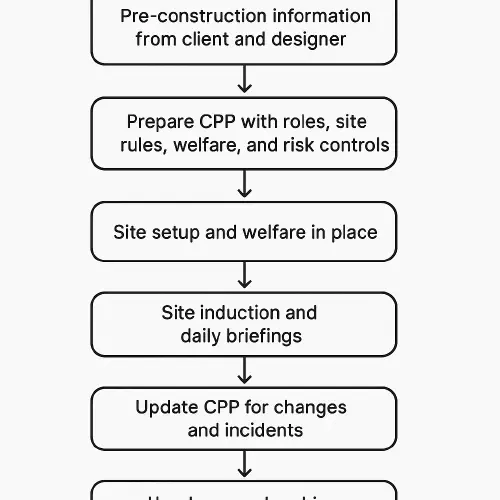
Flowchart of construction phase plan steps from pre-construction info to handover
- Gather pre‑construction information
- Ask the client or principal designer for drawings, surveys, services plans and any known hazards.
- Walk the site. Note access, neighbours, overheads, underground services and welfare options.
- Draft the plan
- Fill in the project details and contacts.
- Write the site rules in plain English relevant to this job.
- List the main risks and controls. Link to your RAMS where the detail sits.
- Set up the site
- Put welfare in place before work starts.
- Set up fencing, signage, fire points and first aid.
- Induct and brief
- Do a site induction for everyone. Record names and dates.
- Run a quick daily briefing to check tasks, risks and controls.
- Keep it live
- Update the plan if methods, design or people change.
- Record incidents and close calls with the actions taken.
- Handover and archive
- On completion, file the final plan with your job pack.
Brief your team
A 5 minute briefing script you can use on day one.
- Today’s work and sequence
- Key risks we control on this job
- Site rules and welfare location
- Fire point and muster point
- Who to call for first aid and supervision
- How we report close calls or changes
Tip: Keep briefings short and daily. Use toolbox talks for topic deep dives. See our toolbox talk guide for formats and scripts: https://academy.trainar.ai/toolbox-talks-uk-what-hse-expects-free-5minute-scripts-and-a-printable-signin-sheet
Keep it live
Your plan should change as the job changes. Update when:
- Scope or design changes
- New trades or subbies arrive
- A serious close call or incident happens
- Weather makes controls unworkable
Downloads
Free templates and examples you can copy.
- CITB example plan GA26: https://www.citb.co.uk/media/ocsgdlyy/construction-phase-plan-example.pdf
- HSE CIS80 short guide: https://www.hse.gov.uk/pubns/cis80.pdf
- Council example Word template: https://www.southtyneside.gov.uk/media/8205/Construction-phase-plan-template/doc/3.20_Appendix_Nvi_CPP_Template.docx
What are people saying on Reddit?
- Useful CDM documentation explainer video by Rebranding Safety: https://www.youtube.com/watch?v=lFZ4wMxXFew
- Builder software walkthrough on completing a CPP: https://www.youtube.com/watch?v=1_0PuC1Sa_Q
Related articles
- Lone worker check-in system for construction: QR and WhatsApp setup, intervals and HSE rules
- RAMS for UK construction: simple steps, free template and how to brief your team
- Near miss reporting on construction sites: simple steps, examples and a QR code setup
Ready to Transform Your Business?
Turn every engineer into your best engineer and solve recruitment bottlenecks
Join the TrainAR Waitlist