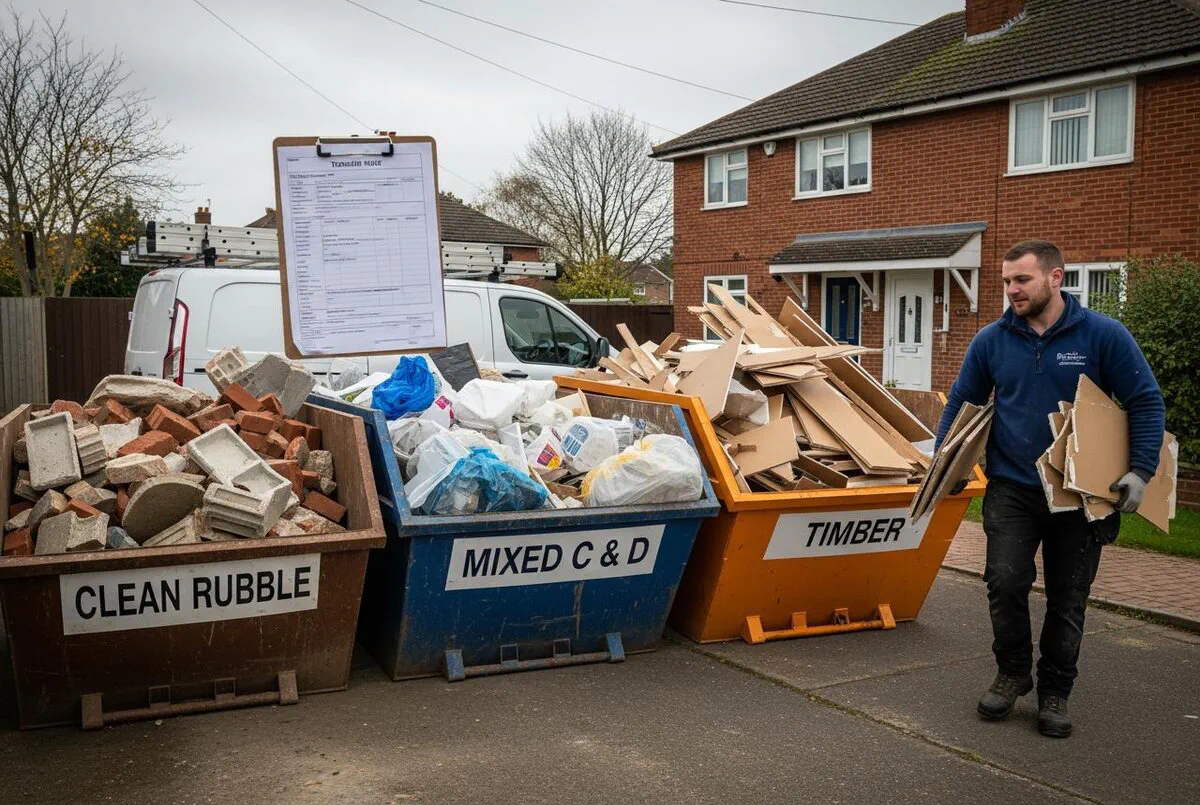

Quick answer
If your trade business produces, carries or hands over construction waste, you owe a legal duty of care under Section 34 of the Environmental Protection Act 1990. You need a waste carrier licence (free lower tier for own waste from non-construction trades, 184 pounds upper tier for construction and demolition waste). You must keep a signed waste transfer note for every load for two years, and a hazardous waste consignment note for three years. From October 2026 the new Digital Waste Tracking Service starts replacing paper notes at receiving sites, with carriers and brokers following in October 2027. Get it wrong and the fine is up to 50,000 pounds in the magistrates court, unlimited in the Crown Court, and up to five years inside.
Table of contents
- The law in one paragraph
- Your duty of care, in plain English
- Waste carrier licences: lower tier vs upper tier
- Waste transfer notes and hazardous waste consignment notes
- The Digital Waste Tracking Service: October 2026 and beyond
- The waste hierarchy on a real job
- Asbestos, paint, chemicals: the hazardous list
- Fines, prosecutions and the new enforcement powers
- The compliance pack every trade business should keep
- Industry voices on waste compliance
- Recommended videos
- Frequently asked questions
- My verdict
The law in one paragraph
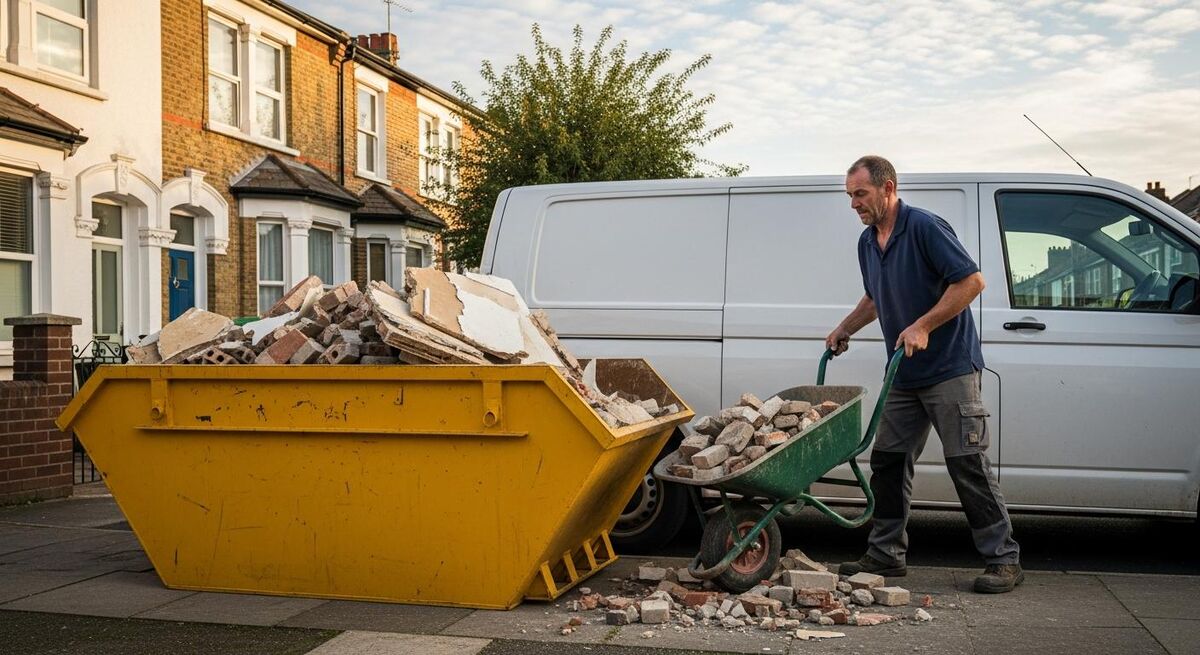
Construction waste in the UK sits inside one main piece of law: Section 34 of the Environmental Protection Act 1990, backed by the Waste (England and Wales) Regulations 2011 and the Hazardous Waste Regulations 2005. If you produce, carry, broker, treat or dispose of waste from a building or maintenance job, you have a legal duty to deal with it correctly and to prove on paper that you did.
That duty does not transfer when the skip leaves the drive. It does not transfer when the van pulls off the job. It stays with you until the waste reaches a legal destination, and the paperwork that proves where it went stays with you for two years (general waste) or three years (hazardous waste).
The rest of this guide is what that actually means on a Tuesday morning when you have got half a tonne of plasterboard, a roll of old felt, two tins of solvent and a customer asking what you are going to do with it.
Your duty of care, in plain English
The Environment Agency calls it "duty of care". On the ground it boils down to five questions. Get a clear yes to each and you are compliant. Miss one and you are exposed.
- Did you produce the waste lawfully? Stored separately where needed, contained so it cannot escape, labelled if hazardous.
- Is the person taking it away registered? Check the carrier on the Environment Agency public register before the first job, then every renewal.
- Did you describe the waste accurately? Type, EWC code if hazardous, quantity, any contamination.
- Did you both sign a transfer note? A waste transfer note for general waste, a consignment note for hazardous.
- Did you keep the paperwork? Two years for general, three for hazardous. Digital copies are fine.
You are liable for what your carrier does
If you hire a man-with-a-van who tips your rubble on a lay-by, the Environment Agency can prosecute you, not just him. Householders can be hit with a fixed penalty notice up to 600 pounds for the same mistake. The legal test is whether you took reasonable steps to check the carrier was registered. "He seemed alright" is not a reasonable step.
The five questions above are not bureaucracy for the sake of it. They are the structure the EA uses when it decides whether to issue a warning, a fixed penalty or take you to court. If you can answer all five with paper to back it up, an investigation usually ends in a conversation. If you cannot, it ends in a fine.
Waste carrier licences: lower tier vs upper tier

There are two tiers, set by the Environment Agency. The tier you need depends on what you carry, not what trade you are in.
Lower tier (free)
Free, no renewal, lasts indefinitely. Covers you only if you are carrying waste you produced yourself, and the waste is not construction or demolition waste. A plumber driving back to the yard with the contents of a customer's loft falls under the lower tier. A plumber driving back with the customer's old kitchen and a heap of plasterboard does not. The "C and D waste" exception is the trap, and it is the one most trades trip on.
Upper tier (currently 184 pounds for three years)
Required if you carry construction or demolition waste at all, or if you carry waste produced by someone else, or if you broker or deal in waste. Renewal is 125 pounds every three years. Apply directly on GOV.UK. Allow up to 20 working days but most applications come back within a week.
| Situation | Lower tier | Upper tier |
|---|---|---|
| Carrying own non-C&D waste | Sufficient | Not required (but allowed) |
| Carrying own C&D waste (rubble, plasterboard, timber off-cuts) | Not sufficient | Required |
| Carrying a customer's waste | Not sufficient | Required |
| Brokering or dealing in waste (arranging it for others) | Not sufficient | Required |
| Cost | Free | 184 pounds initial, 125 pounds renewal |
| Renewal | Indefinite | Every 3 years |
If you are a one-van trade and you ever carry anything off site that you did not arrive with, register for the upper tier and stop thinking about it. The maths is straightforward: 184 pounds across three years is 61 pounds a year. The fine for not having one starts at 300 pounds and can reach 5,000 pounds in the magistrates court, plus prosecution costs. The decision is not really a decision.
Check your subcontractors
Print or save a screenshot of the Environment Agency public register entry for every carrier you use, and refresh it once a year. If the carrier's registration lapses, your duty of care lapses with it. A 30-second check on register-renew-waste-carrier-broker-dealer at gov.uk is your defence if the EA ever asks.
Waste transfer notes and hazardous waste consignment notes
Every load of waste that leaves your control needs paperwork. There are two flavours.
Waste transfer note (WTN)
For general, non-hazardous waste. Must include: a description of the waste, the EWC code, quantity, container type, your details, the carrier's details and registration number, the destination, and signatures from both parties. Keep your copy for two years.
A WTN can cover a "season ticket" arrangement, a single transfer note that covers multiple movements of the same waste from the same place to the same destination over up to 12 months. Useful if you have a regular skip exchange on a long contract. The Environment Agency publishes a free template on GOV.UK and most skip companies issue compliant WTNs as part of the hire.
Hazardous waste consignment note (HWCN)
For hazardous waste only. More information than a WTN, including the consignment note code (a unique reference made up of your premises code plus a five-character ID), full EWC code, hazardous properties, container type, quantity by weight, carrier registration, destination permit number, and signatures at every stage. Keep your copy for three years.
Asbestos has its own rules
Anything containing more than 0.1% asbestos is hazardous waste in England and Wales and special waste in Scotland. It travels under a consignment note (HWCN01v112 in England), in UN-approved double-bagged or wrapped packaging, with the asbestos warning label visible, to a permitted facility licensed to accept it. Putting an asbestos cement sheet in a skip is a criminal offence with no real defence. If you are unsure, get a survey before the work starts. Our asbestos surveys guide walks through when one is legally required.
For most jobs the paperwork looks like this:
- Describe the waste accurately. "Mixed construction and demolition waste" is fine for a strip-out. If asbestos, hazardous coatings, or chemicals are present, say so and use a separate consignment note.
- Use the correct EWC code. The big ones for trades are 17 01 01 (concrete), 17 01 02 (bricks), 17 01 07 (mixed construction), 17 02 01 (timber), 17 02 03 (plastic), 17 03 02 (asphalt without tar), 17 04 (metals), 17 06 05* (asbestos containing materials), 17 08 02 (plasterboard, gypsum-based).
- Record the carrier's registration number. Not the carrier's company name. The number that starts CBDU for England, CBDL for Wales, WCR for Scotland, WCR/N for Northern Ireland.
- Both parties sign before the waste moves. Not after. Not "I'll bring it round later".
- File a digital copy. A photo of the signed note in your job management software is enough. Two years for WTNs, three for HWCNs.
The Digital Waste Tracking Service: October 2026 and beyond
Defra's Digital Waste Tracking Service (DWTS) is the biggest change to waste paperwork in 30 years. It replaces paper Waste Transfer Notes and Hazardous Waste Consignment Notes with a single online system where every waste movement gets logged in real time, validated against EWC codes, and made available to regulators across all four UK nations.
The rollout is staged. Here are the dates you need on your calendar.
| Date | Who is affected | What changes |
|---|---|---|
| 28 April 2026 | Anyone | Voluntary use begins. Public beta of the DWTS portal opens for early adopters. |
| 1 October 2026 | Around 12,000 permitted waste receiving sites in England (landfills, recycling centres, transfer stations) | Mandatory. All inbound loads logged digitally on the day they arrive. |
| January 2027 | Scottish receiving sites | Mandatory north of the border. |
| October 2027 | Waste carriers, brokers, dealers and exporters | Mandatory. The waste producer (you) sees the change here, because your carrier now logs the movement digitally rather than printing a WTN. |
If you are a small trade business that does not run a waste receiving site, the formal change for you arrives in October 2027 when your carrier switches over. In practice you will start seeing digital records from October 2026 onwards as receiving sites push the workflow back up the chain.
What this actually means for your van
You will not get a paper WTN handed back to you any more. You will get a digital record in your carrier's system, with a unique movement reference. You either log into the carrier's portal to pull it down or, if you use job management software, the carrier's API drops it into your job file automatically.
The big practical benefit is that the EA can now spot patterns. Twelve tonnes of waste leaving a site with no matching receipt at a permitted facility is a red flag the regulator can see in near real time. The big practical risk is that the same audit trail makes it much harder to argue you did not know your carrier was operating outside the rules.
What to do this year
Ask every regular waste carrier you use whether they have signed up to the DWTS public beta and what their go-live plan is for October 2026. If your carrier cannot answer, that is a flag. The compliant ones are testing now. Our environmental compliance guide for trades sets out the full F-Gas, waste and reporting picture in one place.
The waste hierarchy on a real job
The Waste (England and Wales) Regulations 2011 require you to apply the waste hierarchy. In practice that means you choose the highest viable option on this list before you commit any waste to disposal.
The five tiers (highest first)
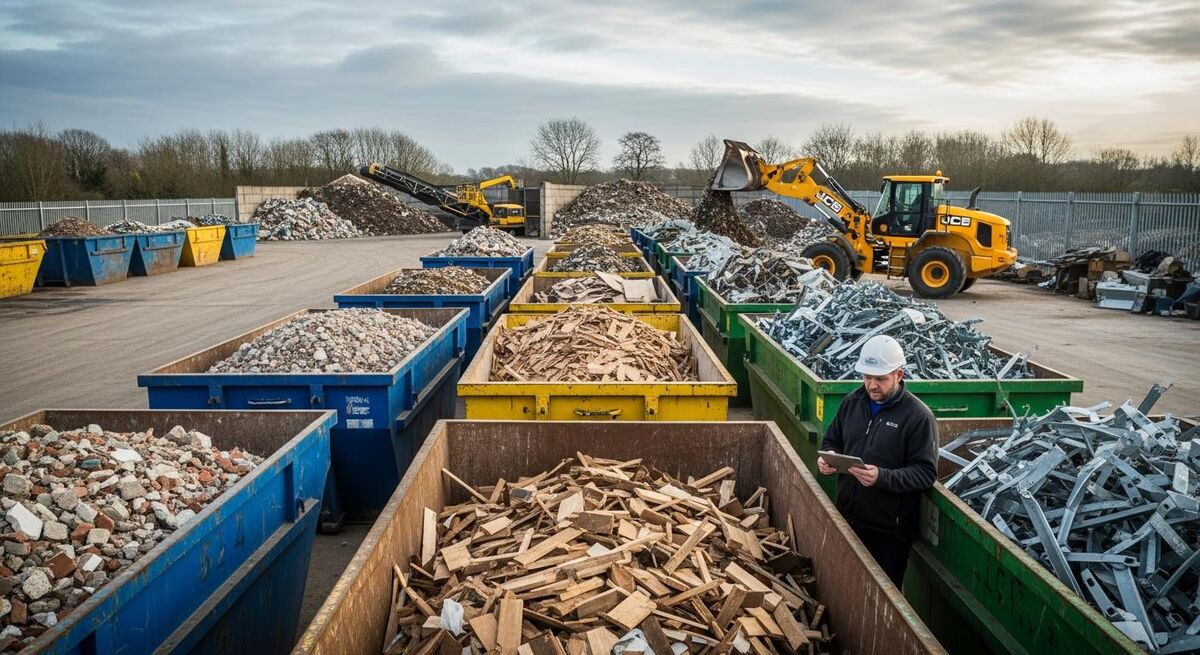
Prevent: design and order so the waste does not arise. Prepare for re-use: bricks back in the wall, slates back on the roof, a sound bath through eBay rather than down a skip. Recycle: metals, clean plasterboard, inert rubble, hardcore. Recover: energy from waste, refuse-derived fuel. Dispose: landfill, the last resort.
The 2008 Site Waste Management Plans Regulations were repealed in 2013, so the formal SWMP is no longer legally mandatory in England. The hierarchy duty did not go away with them. You are still required to apply it. The neat answer is to keep a one-page voluntary SWMP for any job above 50,000 pounds, recording planned waste streams and the route up the hierarchy for each. BREEAM and most large principal contractors require it anyway. If you ever end up in front of an EA officer, that single piece of paper does a lot of work.
What recycles, what does not
- Clean inert rubble (concrete, brick, hardcore) recycles easily. Most aggregate suppliers will take it for next to nothing or even pay for clean loads.
- Plasterboard must be separated from general waste. Mixed plasterboard releases hydrogen sulphide in landfill and now attracts a higher gate fee. Clean off-cuts can go back to suppliers who recycle gypsum.
- Timber goes to biomass or chipboard reprocessing. Treated timber (anything green, brown, or oily) is a separate hazardous stream.
- Metals always have a value. Copper, brass, lead, stainless. Build a scrap account with a SEPA or EA licensed yard and you get money back rather than paying disposal.
- Plasterboard mixed with cement or contaminated with paint will be downgraded to mixed C and D, which costs about 110 pounds a tonne to tip in most of England.
Asbestos, paint, chemicals: the hazardous list
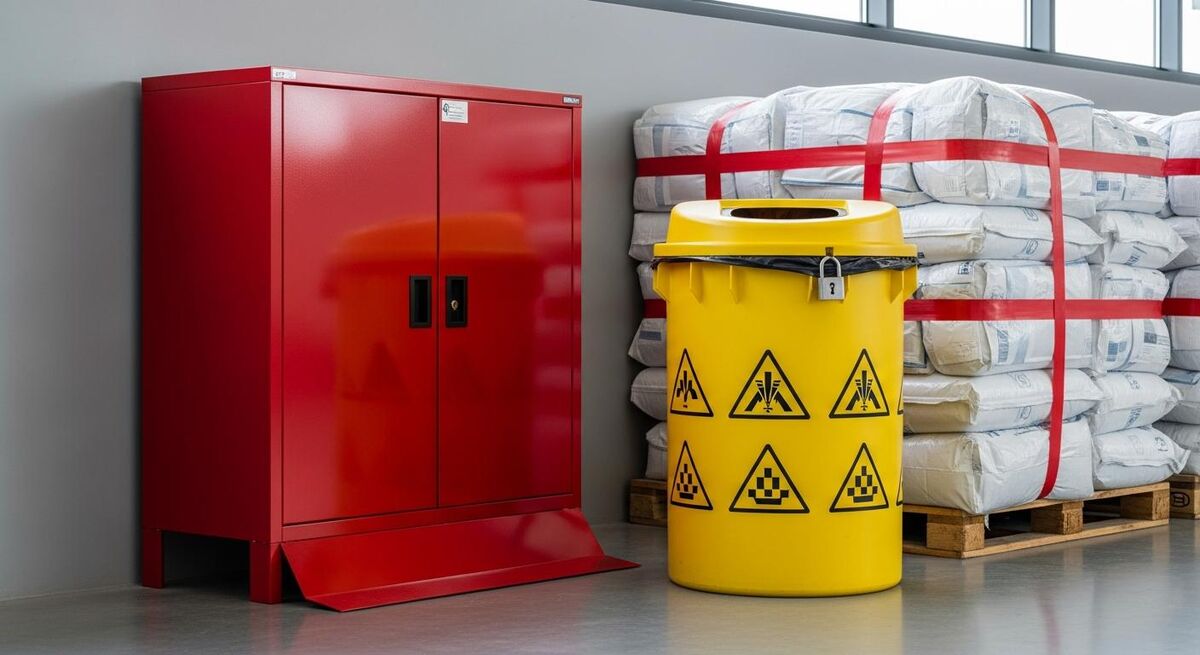
Some of the most common construction waste streams are classified as hazardous and need a consignment note, a permitted carrier, and a permitted destination. A skip down the side of the house is not it.
- Asbestos containing materials (HP7, EWC 17 06 05*): cement sheets, AIB, lagging, textured coatings containing chrysotile. Get a refurbishment and demolition survey before any pre-2000 building work.
- Lead-based paint debris from pre-1960 properties (HP6, HP10).
- Solvents, paint thinners, kerosene (HP3, HP4): cap, label, store dry, off to a permitted facility.
- Two-pack epoxy and isocyanate-based adhesives in any quantity.
- Treated timber (creosote, copper chrome arsenic, painted timber from pre-1980 properties).
- Fluorescent tubes, low-energy bulbs containing mercury (HP6).
- WEEE with hazardous components (old fridges with CFCs, lead-acid batteries).
- Refrigerant gas recovered from F-Gas work (HP14).
You keep HWCNs for three years. The carrier and the consignee keep their copies for three years too. Quarterly returns are required from anyone producing or holding hazardous waste in England, due within one month of the quarter end if you are a registered hazardous waste producer site. Most one-van trades are below the threshold, but principal contractors on bigger jobs are not.
Fines, prosecutions and the new enforcement powers
The Environment Agency has had a tough year on waste crime, in a good way for the regulator. Three changes give you the current 2026 enforcement picture.
What changed in March 2026: officers can stop and search vehicles suspected of carrying illegally moved waste and can enter premises without a warrant in defined emergency situations. The Joint Unit for Waste Crime now coordinates EA, police and HMRC investigations into organised waste crime. The drone squad photographs unauthorised tips from above, which is how a lot of small-scale fly-tipping is now caught.
The penalty ladder runs from a 400 pound fixed penalty notice for a small paperwork failure through to an unlimited fine and up to five years inside on indictment for organised waste dumping. The middle bracket, where most small-trade prosecutions land, is a magistrates court fine up to 50,000 pounds.
"I didn't know it was being fly-tipped" is not a defence
The defence under Section 34 is that you took "all reasonable measures" to ensure the waste reached a legal destination. Reasonable measures means: checked the carrier on the EA register, got a signed transfer note before the load left, asked where the waste was going, kept the paperwork. If any one of those is missing, the defence falls.
Sentencing is rising too. The Local Government Association called in March 2026 for a review of court fines for fly-tipping, after data showed the average court fine (539 pounds) is now lower than the average council fixed penalty notice (626 pounds). Expect that gap to close in the next 12 months, not widen.
The compliance pack every trade business should keep
Build this once, keep it on a shared drive, and a Section 34 investigation becomes a half-day inconvenience rather than a six-figure problem. The pack is six things.
- Your upper-tier waste carrier registration certificate. One PDF. Renewal reminder on your calendar 30 days before it expires.
- An EA register screenshot for each waste carrier you use. Refreshed annually. One sub-folder per carrier.
- Signed waste transfer notes for every load. Two years. Filed by date, job reference, and carrier.
- Hazardous waste consignment notes filed separately. Three years. EWC code on the file name.
- A one-page site waste management plan for any job above 50,000 pounds, even though SWMPs are not legally mandatory. Lists planned waste streams, hierarchy decisions, expected carriers.
- A short written waste procedure for your team. Two sides of A4. Names the carriers you use, the EWC codes you most commonly hit, what to do with asbestos suspicions, where to file the paperwork.
None of this needs special software. Google Drive or your job management system will do it. The point is that the structure exists before you need it, so when something goes sideways the answers are filed not invented. The same logic sits behind the RAMS document approach: build the framework once, reuse it on every job.
What this costs and what it saves
Direct cost: 61 pounds a year on the upper-tier registration, plus a few hours setting up the folders. Avoided cost: one 5,000 pound fixed penalty notice and the disqualification of your business from local authority and principal contractor pre-qualification questionnaires. If you cannot evidence duty of care, you stop winning work for anyone running a credible procurement process. The compliance pack is cheaper than the contracts you lose without it.
Industry voices on waste compliance
Two things make this topic feel heavier than it should. One: the language. "Duty of care" sounds abstract when you are stood on a wet driveway with half a kitchen in a van. Two: the enforcement is real and getting sharper. Here is what people running the regulator and the industry are actually saying right now.
Recommended videos

Five UK Waste Regulation mistakes to avoid
Mieru EHS
UK waste management basics explained
Compliance webinar

Health and safety legislation in the waste sector
Pinsent Masons LLP

New Industrial and Hazardous Waste Rules
IHW workshop series

10 Common Waste Materials in Construction
HSE Training

10 Tips to reduce waste disposal on construction sites
Environmental Training
Frequently asked questions
If it is construction or demolition waste, yes. The lower-tier exemption for "own waste" specifically does not cover C and D waste. Most trades doing strip-outs, refurbs or installations need the upper tier. 184 pounds for three years, register on GOV.UK.
Two years for general waste transfer notes. Three years for hazardous waste consignment notes. Digital copies are fine and the Environment Agency accepts them on inspection. Once the Digital Waste Tracking Service is in full use the retention period stays the same but the records live in the system rather than your filing cabinet.
You can be prosecuted, even though you did not tip it yourself. The defence is duty of care: you took reasonable steps to check the carrier was registered and the waste was going to a legal destination. If you checked the EA public register, got a signed transfer note, and kept the paperwork, you are protected. If you did not, you are exposed to a fine up to 50,000 pounds.
Not formally in England. The Site Waste Management Plans Regulations 2008 were repealed in December 2013. The underlying duty to apply the waste hierarchy still applies under the Waste (England and Wales) Regulations 2011, and most BREEAM-rated jobs and large principal contractors still require an SWMP as a contract condition. A one-page voluntary SWMP for any job above 50,000 pounds is sensible practice.
It is Defra's replacement for paper waste transfer notes and hazardous waste consignment notes. Live for voluntary use since 28 April 2026. Mandatory for waste receiving sites in England from 1 October 2026, Scotland from January 2027, carriers and brokers from October 2027. If you are a small trade business that does not run a waste site, you will start seeing the change in the autumn of 2026 as your carrier moves over.
Search the Environment Agency public register at environment.data.gov.uk by company name or registration number. The number starts CBDU in England, CBDL in Wales, WCR in Scotland, WCR/N in Northern Ireland. Save a dated screenshot for your records. Do the check before the first job with a new carrier and refresh once a year. If the carrier cannot give you a valid number, do not use them.
17 09 04 covers mixed construction and demolition wastes that are not separately listed and do not contain hazardous substances. 17 01 07 covers mixtures of concrete, bricks, tiles and ceramics. If asbestos, lead-based paint, treated timber or other hazardous materials are mixed in, the whole load reclassifies as hazardous and you need a consignment note and a permitted destination.
Yes, for the boring parts. Drop a photo of a signed transfer note into ChatGPT or Claude and ask it to extract the EWC code, carrier number and tonnage into a row of a spreadsheet. Use the same approach to log consignment notes and to keep your carrier register screenshots dated. The judgement calls (what is hazardous, which carrier to use, whether you need an asbestos survey) stay with the human. The clerical work does not.
Fly-tipping is the act of dumping waste at an unauthorised place, prosecuted under Section 33 of the Environmental Protection Act. A duty of care breach under Section 34 is the paperwork or process failure that lets fly-tipping happen, even if you did not do the dumping yourself. Both attract criminal penalties. Most trade prosecutions are duty of care charges, not fly-tipping charges, because the EA finds it easier to prove a missing transfer note than to prove who drove the load to the lay-by.
My verdict
Build the pack, register up-tier, get on with the job
Construction waste compliance is one of those topics where the law sounds harder than the practice. The actual work is 61 pounds a year for an upper-tier waste carrier registration, a 30-second carrier check on the EA register before the first job, a signed transfer note for every load, and a small filing system that holds it all for two or three years. Do that and the Environment Agency leaves you alone. Skip it and you are exposed to penalties that will swallow the profit on every job you priced this year. The new Digital Waste Tracking Service does not change the duty, only the format. The trades that handle compliance like any other documented system, with named people and clear retention, will not notice the change. The trades that handle it on a shrug will notice it loudly.