
Quick Answer
You do not need an agency, a videographer, or a £2,000 a month retainer to build a content engine for a trades business in 2026. You need your phone, a free Google Business Profile, two hours every week, and a simple weekly rhythm. This playbook walks through exactly how to do it. Three content pillars, two platforms, one solid local SEO foundation. Most trades businesses that follow it generate more enquiries from organic search and social within 90 days than they did from paid ads the year before.
Table of Contents
- Why content marketing matters for trades in 2026
- The 2-hour-per-week framework
- Your free toolkit (and what to skip)
- SEO on a budget: Google Business Profile is the foundation
- Video on a budget: smartphone-first, always
- Social on a budget: pick two platforms, not five
- The weekly content calendar that actually works
- Turning one job into 10 pieces of content
- Measuring what actually matters
- Common mistakes that waste your two hours
- Recommended videos
- What tradespeople are saying
- Frequently asked questions
- My verdict
Why content marketing matters for trades in 2026
When I ran Elite Heating and Plumbing, I spent a small fortune on paid Google Ads. The cost per click for "boiler installation near me" in our area was nudging £8, and the quality of leads was patchy. We were burning roughly £1,200 a month for results that we could have generated organically if we had known what we were doing.
That was the wake-up call. Search behaviour has shifted. 84% of UK adults search for local business information online every week, and 76% of "near me" searches lead to a visit within 24 hours. The Local Pack on Google appears in 93% of searches with local intent. If you do not show up in that pack, you do not exist to those customers.
And content is the cheapest way to show up. Businesses with a complete Google Business Profile get 7x more clicks than those with incomplete profiles, and 70% more customers contact them. On TikTok, plumbing-related posts have racked up more than a billion views. Carpentry alone has done 590 million. The audience is there, the tools are free, and the bar for what counts as good content is genuinely low.
The catch is that most trades businesses still treat content as a luxury. It is not. It is the foundation of every other marketing activity you will ever do, including the dynamic pricing playbook and building recurring revenue through maintenance contracts. Without content, you are paying to rent attention. With content, you build a compounding asset.
The 2-hour-per-week framework
The whole playbook is built on one constraint: two hours a week, every week. Not 10 hours one week and zero the next. Not "I will do it when work slows down." Two hours, blocked out on a Sunday evening or a Friday morning, treated like a paid job.
Here is how those two hours break down once you are in rhythm:
| Activity | Time | Output |
|---|---|---|
| On-site filming during the week (cumulative) | 30 min | 4 to 6 short clips, 2 to 3 photos per job |
| Editing two short videos (CapCut) | 30 min | Two 30 to 60-second videos, vertical format |
| Posting to Google Business Profile and two social channels | 20 min | Two video posts, one photo post, one GBP update |
| Replying to comments, DMs, and Google reviews | 20 min | Every message answered within 24 hours |
| Asking three recent customers for a Google review | 10 min | Three review request texts sent |
| Planning the following week's content theme | 10 min | One sentence per planned post in a Google Sheet |
Two hours. Six activities. Zero outsourcing. The 30 minutes of filming is not a single block, by the way. It is five minutes here, three minutes there, captured between cups of tea while the silicone sets. Most trades professionals already have those moments; they just do not press record.
Your free toolkit (and what to skip)

The tools that matter cost nothing. I have ranked them by impact, not by how clever they sound.
 Google Business Profile
 Instagram
 TikTok
 Facebook
 WhatsApp Business
 ChatGPT
Google Business Profile is the single most important tool in this list, and it is completely free. It is your storefront on Google Search and Google Maps. If you do nothing else from this playbook, do this.
CapCut is the free video editor used by most smartphone content creators worldwide. Auto-captions, transitions, music, all built in. The mobile app handles everything you will ever need for short-form vertical video.
Canva on the free plan gives you over a million templates for social posts, before-and-after frames, and quote graphics. Set up a brand kit with your company colours and logo once, and every future design takes 90 seconds.
ChatGPT or Gemini on the free tier writes your captions, hashtags, and SEO descriptions in seconds. Give it the photo, the job context, and your tone, and it returns a draft you can edit in a minute. The automation playbook for quote to invoice shows similar AI workflows for the operational side.
Skip the £80 a month "social media scheduler", the agency contract, and the bespoke website until you have proved that your content is generating enquiries. Most schedulers replicate functionality that Meta Business Suite already gives you for free.
SEO on a budget: Google Business Profile is the foundation

If you spend 80% of your first month on this one tool, you will be ahead of 90% of your local competitors. I am not exaggerating. The Local Pack captures 44% of all clicks on a Google search results page. That is the three businesses with the little map pin next to them. If you are not in there, you are invisible to most local searchers.
Setting it up properly is straightforward. Claim your profile at google.com/business, verify (postcard takes about a week, video verification a few days), and then fill in every single field. Not most fields. Every field.
The non-negotiable GBP checklist
- Primary category must match your core trade exactly. Plumber, Electrician, Heating Contractor, Bricklayer. Wrong category and you rank for nothing.
- Secondary categories up to nine. Use them all. Add Boiler Service Repair, Drain Cleaning Service, Bathroom Remodeler, whatever applies.
- Service area with every town and postcode you cover. Hide your home address if you work from home.
- Services list filled in with descriptions and prices where possible. This is the bit most trades skip and it is the bit Google reads.
- Business description mentioning your trade, your service area, your accreditations (Gas Safe, NICEIC, FMB, OFTEC).
- Photos uploaded weekly. Profiles with photos get 42% more directions requests and 35% more website clicks.
- Posts weekly. GBP Posts are like mini social updates on your listing. They drive traffic and signal activity to the algorithm.
- Reviews requested after every completed job. Reviews are the single biggest local ranking factor.
The one-line review request that gets a 40% response rate
Send this text within an hour of finishing the job, while the customer is still in the moment:
"Hi [Name], thanks for having me out today. If the work was up to scratch, would you mind dropping a quick Google review? It really helps small businesses like mine. Here is the direct link: [your GBP short link]. Cheers, [Your name]."
Generate your short link from your GBP dashboard. It opens straight to the review screen. No customer has to hunt for your business or work out how to leave a review. Friction kills response rates.
Video on a budget: smartphone-first, always
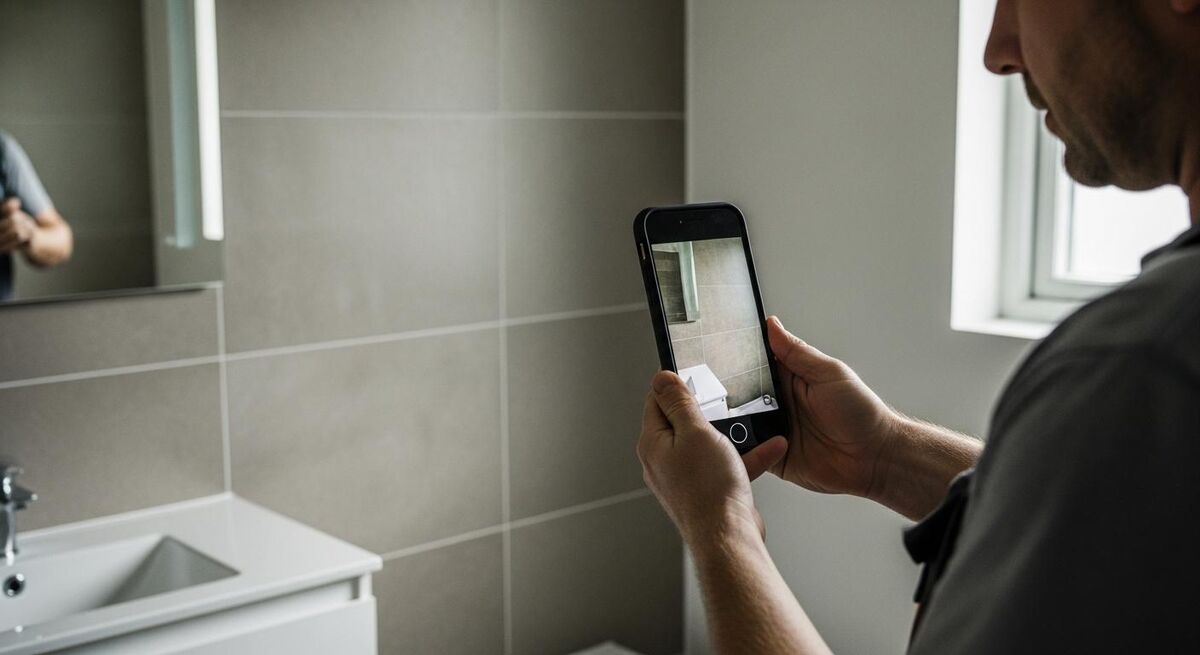
97% of LinkedIn videos are now vertical, and 78% are shot on a smartphone rather than professional kit. The bar for production quality has dropped because the platforms have raised the bar for authenticity. A polished video shot in a studio looks like an advert. A 45-second clip of you fixing a leak in a customer's airing cupboard looks like a tradesperson who knows what they are doing.
Three types of video work consistently well for trades:
| Video type | Length | Why it works |
|---|---|---|
| Before-and-after reveal | 15 to 30 sec | Pattern interrupt. Brain wants to see the difference. Highest save rate of any format. |
| "How to spot a problem" educational | 30 to 60 sec | Pure value. Builds authority. Customers save it and come back when the problem hits. |
| Behind-the-scenes day in the life | 45 to 90 sec | Humanises the business. Trust signal. Often the videos that go viral organically. |
Three rules for smartphone filming on site
- Always film vertical. 9:16 ratio. Every short-form platform uses vertical. Shooting landscape and re-cropping ruins the framing.
- Light from the side, not behind. Open a window or a door so the light is across the subject. Filming with the window behind you turns faces black.
- Talk while you work. Narrate what you are doing as you do it. The audio is half the video. Mumbled silence with on-screen text reads as low effort.
The other thing worth saying: you do not need to be on camera if it makes you uncomfortable. Voiceover, hands-only filming, and screen recordings of your job management app all work. Some of the best-performing trades accounts on TikTok never show a face. The work is the star.
Social on a budget: pick two platforms, not five

The biggest mistake I see trades businesses make is trying to be on every platform at once. Facebook, Instagram, TikTok, LinkedIn, YouTube, X, NextDoor. They post once on each, see no traction, and quit two months in.
Pick two. That is it. Two platforms, three months of consistent posting, then judge. Here is how to choose.
If your customers are mainly homeowners
Facebook and Instagram, in that order. Facebook because the demographic that pays for boiler swaps, rewires, and bathroom refits skews 35 to 65, and that is Facebook's bread and butter. Instagram because before-and-after photos work brilliantly there, and the algorithm still surfaces local content to local people.
If you want to reach younger homeowners and renters
TikTok and Instagram Reels. The UK TikTok user base is between 24.8 and 26.8 million monthly active users, and 1 in 4 Gen Z consumers now use social media as their primary way to find local services. The same video shot once and posted to both platforms doubles your reach with no extra effort.
If you do commercial or B2B work
LinkedIn and YouTube. LinkedIn for landing facilities managers, property managers, and commercial contracts. YouTube for the longer-form content that buyers research before they sign a contract. Both reward technical depth, which most trades genuinely have.
The weekly content calendar that actually works
Once you have your two platforms, your tools, and your GBP foundation, the rhythm of the week looks like this. I have tested versions of this with sole traders and 12-engineer firms. The structure does not change much.
| Day | Activity | Time |
|---|---|---|
| Monday | Post one before-and-after to both platforms and GBP | 10 min |
| Tuesday | Reply to comments and DMs | 10 min |
| Wednesday | Post one educational tip video (30 to 60 sec) | 10 min |
| Thursday | Send three review request texts to recent customers | 10 min |
| Friday | Post one behind-the-scenes clip or photo | 10 min |
| Saturday | Off. The business runs without your phone. | 0 min |
| Sunday | Block 90 minutes: edit two videos, plan next week, reply to anything outstanding | 90 min |
Total: 2 hours and 20 minutes spread across the week. The bulk happens on Sunday when you are not on the tools. The weekday touchpoints are 10-minute jobs you do over a cup of tea. None of it requires a quiet office or a desktop computer.
Turning one job into 10 pieces of content
The skill that separates trades businesses that grow from content from those that grind to a halt after six weeks is repurposing. One bathroom refit, captured properly, becomes a fortnight of content.
Here is the repurpose ladder, using a bathroom job as the example:
- Before photo on day one. Posted as an Instagram Story with a poll: "What would you change first?"
- Time-lapse of tile removal. 30-second clip on TikTok and Reels.
- "Watch out for this" educational clip showing a hidden leak or rotten joist behind the bath panel.
- Tool of the day photo of the cordless multi-tool you used and why.
- Materials breakdown photo carousel of the brassware, tiles, and underfloor heating spec.
- Mid-week progress clip showing first-fix complete.
- Behind-the-scenes photo of you and the apprentice having a cup of tea.
- After photo of the finished room, professionally lit if possible.
- Before-and-after side-by-side graphic in Canva. The single best converter on Instagram.
- Customer review screenshot with permission, framed in Canva with your brand colours.
Ten posts. One job. Two weeks of content. And every single one of them came from work you were doing anyway. The smartphone in your pocket is doing the heavy lifting.
Measuring what actually matters
Vanity metrics will lie to you. Followers, likes, and views feel good but they do not pay the bills. Three numbers matter for a trades business doing content on a budget.
Check GBP performance in your Google Business dashboard monthly. Track new reviews in a simple spreadsheet. Log every DM and tag it as either a tyre-kicker, a quote request, or a booked job. After 90 days you will know exactly which platform and which post format is generating actual revenue.
If a platform produces zero quote requests in 90 days, drop it. Move that time into the platform that is working. The whole point of the two-hour constraint is to force this discipline.
Common mistakes that waste your two hours
I have watched too many trades businesses pour effort into content marketing and get nothing back. The pattern is almost always one of these five mistakes.
Recommended videos

Marketing For Your Plumbing Company
Roger's Marketing Machine

Marketing For Your Plumbing Company: Google Reviews
Roger's Marketing Machine

Plumber Marketing Strategy 2026: Get 30 to 50 New Leads A Month
HVAC Grow
Google Business Profile Optimisation Tutorial for Beginners
Surfside PPC

CapCut Video Editing Tutorial Using Phone (Full Course for Beginners 2026)
Tutorials By Ms

Marketing Success for Trade Business: The Blueprint You Need
Matt Jones Tradie Coach
What tradespeople are saying
Frequently asked questions
For Google Business Profile, you can see lead increases within 30 days of optimising the listing properly. For social media, plan for 90 days of consistent posting before judging. Anyone telling you it works in two weeks is selling you something. The compounding starts in month three.
Not until your GBP is fully optimised and pulling in calls organically. Paid ads on a broken funnel waste money. Build the free foundation first. If you have spare budget after that, a tightly targeted Local Services Ads campaign is more cost-effective than standard Google Ads for trades.
Yes. Hands-only filming, voiceover, and before-and-after photo posts all work without showing your face. Some of the best-performing trades accounts on TikTok and Instagram never show the person behind the work. The job is the star, not you.
Not initially. Your Google Business Profile is effectively your website for the first 90 days. Once content is generating regular enquiries, a simple one-page website with your services, service area, and a contact form is worth building. Carrd, Squarespace, or a basic WordPress site will do the job for under £15 a month.
Always ask before you film anything that includes identifying features of the property. Add a line to your quote acceptance: "We sometimes share photos of completed work on our social media. Please tick this box if you would prefer we do not." Most customers are happy to be featured; a small minority are not, and you need to know which.
CapCut has templates that do the editing for you. Pick a template, drop in your clips in order, and the app handles cuts, music, and captions automatically. Most templates take under five minutes to populate. You do not need to know what a J-cut is.
Less than people think. Three to five relevant hashtags is enough on Instagram and TikTok. The algorithm now reads your video content and caption to categorise the post. Stuffing 30 hashtags signals spam. Use a mix of broad (#plumbing) and local (#cardiffplumber) tags.
One area is worth outsourcing once you are generating real revenue: video editing. A freelance editor on Fiverr or Upwork will edit four short-form videos for £40 to £80 a month. That gives you back an hour a week. Do not outsource the filming itself or the captions. Authenticity is the whole point.
My verdict
The trades businesses that win with content marketing in 2026 are not the ones with the slickest production or the biggest agency. They are the ones who show up consistently for 90 days, build a Google Business Profile that actually ranks, and let the work speak for itself in 30-second vertical clips. Tools cost nothing. Customers are already searching. The only real barrier is the discipline to block out two hours every week and treat it like a customer appointment. Do that, and within 12 months your business will run on enquiries you no longer have to pay to generate. That is the kind of compounding asset that makes a trades business genuinely scalable. Looking to scale further? The team-of-five scaling playbook covers what to do once the enquiries start landing faster than you can quote them.