

Quick Answer
If you are VAT-registered, CIS-registered, and your customer is another VAT and CIS-registered business who is not the end user, you do not charge them VAT. You issue an invoice that states the domestic reverse charge applies, show the VAT amount that would have applied, and the contractor accounts for it on their VAT return. The subbie loses the cash float that used to live in their bank account between invoices and quarterly returns, often £15,000 to £35,000 of working capital. HMRC's light-touch period is over. From April 2026, directors face penalties of up to 30 percent of lost tax for fraudulent supply chains. Get the paperwork right or pay for it.
Table of Contents
- What the domestic reverse charge actually is
- When it applies: the four-part test
- End user and intermediary supplier declarations
- How to write a reverse charge invoice
- How it lands on your VAT return
- The cash flow hit nobody warned you about
- Setting it up in Xero and QuickBooks
- HMRC's 2026 enforcement crackdown
- Using AI to keep the paperwork tidy
- What tradespeople are saying
- Recommended videos
- Frequently asked questions
- My verdict
 HMRC
HMRC Xero
Xero QuickBooks
 Sage
Sage Claude
What the domestic reverse charge actually is
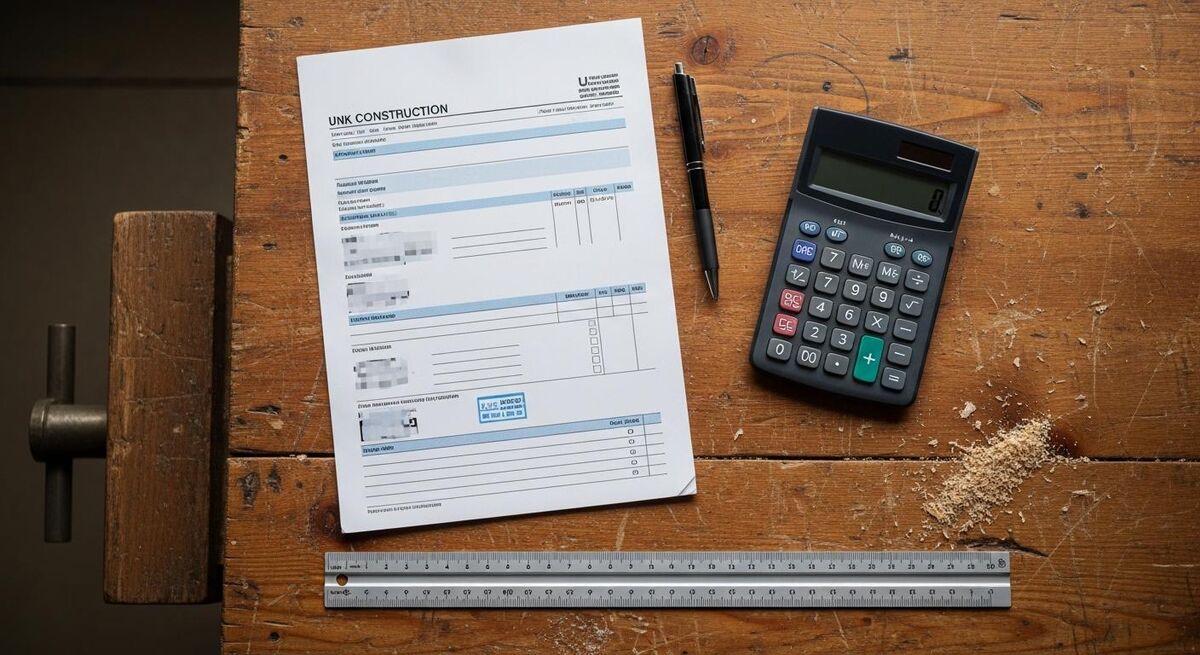
The domestic reverse charge for construction services, the DRC, is a VAT accounting rule that flips who hands the VAT money to HMRC. Before 1 March 2021, a subbie invoicing a main contractor charged 20 percent VAT on top of the labour and materials. The contractor paid the gross figure. The subbie sat on the VAT for up to ninety days, then paid it to HMRC on their next VAT return. The contractor reclaimed the same number as input VAT. HMRC got their money. Everyone moved on.
Then HMRC noticed that quite a lot of subcontractors were collecting the VAT and disappearing before the quarterly return came due. That is missing trader fraud, and HMRC reckoned the construction sector was losing them roughly £120 million a year to it. The fix was to take the VAT cash out of the supply chain altogether between two VAT-registered businesses. The subbie no longer charges VAT. The contractor self-accounts for both the output VAT and the input VAT on the same return, and the net cash flow on that side is zero.
That last sentence is doing a lot of work. For the contractor, reverse charge is paperwork. For the subbie, it is the loss of the working capital float that used to live in their bank account. A subcontractor turning over £1.8m a year used to have £25,000 to £35,000 of VAT cash on their balance sheet at any moment. That cushion is gone. I have watched perfectly profitable heating subbies hit a cash wall four months into the new rules, because nobody walked them through what was about to happen.
When it applies: the four-part test

The DRC only kicks in when every one of the following is true at the same time. If even one part fails, you charge VAT in the normal way.
- The supply is within the scope of the Construction Industry Scheme (CIS). HMRC's list of construction operations runs to dozens of activities: building, demolition, alteration, repair, decoration, painting, installation of heating, lighting, drainage, electrical systems, and the cleaning of buildings as part of construction.
- Both the supplier and the customer are VAT-registered in the UK.
- Both are CIS-registered. This is the part that catches some merchants and ancillary businesses out: VAT registration alone is not enough.
- The customer is not an end user or an intermediary supplier, and has not given you a written declaration to that effect.
The rate that would have applied has to be standard rate (20 percent) or reduced rate (5 percent). Zero-rated supplies, such as a new build for a private residence, stay outside the DRC. You charge zero VAT in the normal way. That is the carve-out housebuilders rely on.
One area where I see plumbers and heating engineers slip up: when you supply and fit, the materials travel with the labour as a single supply. The whole invoice is in scope, even if the materials sit at 60 or 70 percent of the value. Splitting the invoice into a separate "supply" line and "fit" line does not change the answer. HMRC treats the whole thing as one construction service.
| Situation | Reverse charge? | Why |
|---|---|---|
| VAT-registered electrician invoicing a VAT-registered main contractor on a commercial fit-out | Yes | All four tests pass |
| VAT-registered plumber invoicing a homeowner direct | No | Homeowner is the end user, not in CIS |
| VAT-registered builder invoicing a developer for a new build dwelling | No | Zero-rated supply, not in DRC scope |
| VAT-registered subbie invoicing a VAT-registered main contractor on an extension to a private dwelling that is standard rated | Yes | All four tests pass |
| VAT-registered subbie invoicing a contractor who is NOT VAT-registered | No | Customer fails VAT test |
| Subbie installing solar PV in a customer's home under the reduced-rate ESM regime | Maybe | Depends on end user status of the householder |
End user and intermediary supplier declarations
The trickiest part of the rule is end user status, and it is the part HMRC enquires on most often. An end user is the final consumer of the construction service. They are not selling the building work onwards. A property owner who hires a builder to extend their own home is an end user. A property developer building a unit to sell is not, because they sell the construction work on as part of the building.
Intermediary suppliers sit between end users and contractors and are connected to the end user (same group of companies, or landlord-tenant of the same building). They get the same treatment as end users: you charge them VAT in the normal way.
The system only works if the end user tells you they are the end user. The legal instruction is they should give you a written declaration, in a letter, an email, or on the contract terms. The HMRC suggested wording is:
Without that declaration, you should apply the reverse charge by default. The risk runs both ways. If you charge VAT to a customer who turns out not to be an end user, you have to refund the VAT and reissue under reverse charge, and the contractor may have already filed using the wrong figures. If you reverse charge a real end user, you have under-collected and HMRC will eventually want their money. Keep the declarations. File them by customer. When a job runs over multiple phases, get a fresh declaration if anything changes.
How to write a reverse charge invoice

A reverse charge invoice looks almost like a normal VAT invoice. It includes the same compulsory fields: your name and address, customer's name and address, an invoice number, the date, your VAT number, the supply description, the rate that would have applied (usually 20 percent), and the VAT amount that would have been due. Where it differs is in two places. First, the VAT amount is not added to the cash total the customer pays. Second, the invoice carries a clear statement that the reverse charge applies.
HMRC's three accepted wordings, in order of how often I see them used, are:
- "Reverse charge: Customer to pay the VAT to HMRC"
- "Reverse charge: S55A VATA 94 applies"
- "Reverse charge: VAT Act 1994 Section 55A applies"
Pick one and use it everywhere. Mixing wordings across invoices for the same customer is not technically a problem but it gives the contractor's bookkeeper a headache and you do not want to be the supplier they have to chase.
Here is a clean reverse charge invoice line, written out the way a sole trader heating engineer might issue it:
| Item | Net | VAT rate | VAT to be accounted for by customer |
|---|---|---|---|
| Supply and install Worcester 30kW boiler, including system flush and commissioning | £2,450.00 | 20% | £490.00 |
| Two replacement radiators, supply and fit | £280.00 | 20% | £56.00 |
| Total payable | £2,730.00 | £546.00 (to be accounted for under reverse charge) |
Note the total payable. The customer pays £2,730. The £546 is shown for the contractor's records and to satisfy the VAT invoice rules, but no cash moves for that amount on this side.
How it lands on your VAT return
The boxes change depending on which side of the invoice you are on. As the subcontractor supplying the work, you record the net value in Box 6 of your VAT return (total value of sales excluding VAT). You do not put anything in Box 1, because no output VAT is due. As the contractor receiving the work, you record the output VAT in Box 1 and, assuming you can reclaim it in full (which most contractors can), the same number in Box 4. The net cash impact for the contractor is zero. The net value of the purchase goes in Box 7.
| VAT return box | Subcontractor (supplier) | Contractor (customer) |
|---|---|---|
| Box 1: VAT due on sales and other outputs | Nil | Add the VAT amount from the reverse charge invoice |
| Box 4: VAT reclaimed on purchases | n/a | Add the same VAT amount (if recoverable) |
| Box 6: Total value of sales (ex VAT) | Include the net invoice value | n/a |
| Box 7: Total value of purchases (ex VAT) | n/a | Include the net invoice value |
If you are on the Flat Rate Scheme, this is where the wheels come off. You still owe HMRC your flat rate percentage on your gross turnover, but you have collected zero VAT from the customer. The £546 of VAT in the worked example above never lands in your account, but you owe HMRC 9.5 percent of the gross on your flat rate return. For most CIS subbies the right answer is to leave the Flat Rate Scheme. We covered the maths in detail in our flat rate vs standard VAT decision guide.
The cash flow hit nobody warned you about

The Federation of Master Builders ran a survey in early 2021 that found 66 percent of builders either anticipated a moderate or significant cash flow impact from the DRC, or were unclear on the details, or had never heard of it. Brian Berry, the FMB chief executive, called it "a damaging policy being introduced at the worst possible time for builders". He was not wrong about the timing or the impact.
The arithmetic is straightforward. A subcontractor invoicing for a £10,000 job used to receive £12,000 (£10,000 plus £2,000 VAT). Under reverse charge they receive £10,000. The £2,000 was never theirs to keep, but it was on their balance sheet for an average of sixty to ninety days before being paid over to HMRC, and many businesses had quietly built that float into their working capital plan. Take it away and you have to find that money somewhere else.
Three practical changes have softened the blow. First, you can apply to move to monthly VAT returns instead of quarterly. That speeds up the repayment cycle, because most subbies on heavy DRC work end up in a net VAT reclaim position. HMRC pays the refund within ten working days for monthly filers. Second, tighten payment terms with end-user customers who you still charge VAT to: the gap between collecting their VAT and paying it to HMRC is now one of your few remaining floats. Third, recut your cash forecast. Our 90-day rolling forecast playbook is built for trades that have just lost a cushion they used to take for granted.
I will say it bluntly. The DRC did not change anyone's profit. It changed their working capital. The businesses that struggled were the ones running on a thin margin and using HMRC's money as an interest-free overdraft. The businesses that adapted were the ones who already had a real cash forecast and access to a short-term facility. Pick which one you want to be.
Setting it up in Xero and QuickBooks

In Xero, the path is Settings > Advanced settings > Tax rates. The two codes you will need are "Domestic Reverse Charge @ 20% (VAT on Income)" and "Domestic Reverse Charge @ 20% (VAT on Expenses)". The 5 percent reduced-rate equivalents are there if you need them. On a sales invoice for a reverse-charge customer, change the tax rate at the line level to the income code. Xero strips the VAT off the total, holds the VAT amount in the background, and posts it to Box 6 only. Statement text including the reverse charge wording can be added under Settings > Invoice settings > Branding for use on this customer's invoices.
For purchases, the expenses code makes Xero post the VAT to both Box 1 and Box 4 on your return, and the net value to Box 7. The settings are correct out of the box on the standard cash and accrual VAT schemes. They do not work on the Flat Rate Scheme, because the scheme itself is incompatible with DRC accounting.
In QuickBooks, turn on VAT and CIS first under Taxes > VAT, then on a sales invoice or bill select the reverse-charge VAT code from the rate dropdown. The codes are labelled "Reverse Charge CIS 20%" or "Reverse Charge CIS 5%" depending on rate. QuickBooks handles the line-level netting and the VAT return mapping the same way Xero does. The reverse charge wording does not appear on the invoice template by default. Add it as a footer note under Settings > Custom form styles.
In Sage 50 Cloud, the tax codes are T21 (CIS reverse charge standard rate) and T26 (CIS reverse charge reduced rate). Sage Business Cloud Accounting handles the same logic through its DRC settings panel. Whichever package you run, the rule is the same: use the supplied tax code, do not bodge it with a custom 0 percent code, because the VAT return mapping will go wrong and your return will not reconcile.
HMRC's 2026 enforcement crackdown
The first two years of the DRC ran on what HMRC called a light-touch period. Officers reviewed returns, picked up errors, and asked taxpayers to fix them. Penalties were rare. That period is over. New powers announced in the Autumn Budget 2025 take effect from 6 April 2026 and give HMRC two new tools.
The first is the ability to immediately cancel a business's Gross Payment Status under CIS where the business "knew or should have known" it was involved in a fraudulent supply chain. The second is a directors' penalty regime: HMRC can impose penalties of up to 30 percent of the lost tax on directors personally where fraud is identified. The point is that DRC errors are no longer just a corporate paperwork issue. They can attach to a named individual on a named return.
Tony Cochrane at Anderson Anderson & Brown put it as plainly as anyone has: "HMRC has clearly run out of patience. For businesses operating anywhere in the construction supply chain, now is the moment to get DRC compliance in order." The enforcement teams are not asking, they are assessing.
| Pre-April 2026 | From 6 April 2026 |
|---|---|
| Light-touch enforcement | Active enquiries, assessments, penalties |
| Errors corrected with reminder | Penalties of up to 30% of lost tax for fraud |
| GPS cancellation possible but slow | Immediate GPS cancellation power |
| Director liability limited | Personal director penalties for supply-chain fraud |
The single biggest red flag in the new regime is mismatch between what subbies report in Box 6 and what contractors report in Boxes 1 and 4. HMRC can cross-reference the two without leaving the desk. If you are a contractor and the totals you are accounting for under reverse charge do not match what your subbies are declaring in Box 6, expect a letter.
Using AI to keep the paperwork tidy
DRC compliance is an accounting problem with two boring requirements: get the test right on every invoice, and keep the end user declarations on file. Both are well-suited to AI assistance, provided you keep a human in the loop on the final calls.
For the four-part test, I have a Claude project set up with HMRC Notice 735 loaded as context and a simple prompt. When my heating business takes on a new commercial customer, I paste the contract details (VAT number, CIS number, whether they will sign an end user declaration, the rate that applies to the work) into the project. The output is a one-paragraph DRC analysis and a recommended invoice wording. It is not a substitute for an accountant signing off on edge cases, but for the bread-and-butter B2B subbie invoice it removes a lot of friction. The analysis goes into the customer file alongside any signed declarations.
For the end user declarations, the trick is making sure you actually have them. A simple AI workflow checks every new sales invoice against your customer database, flags any reverse-charge invoice where no declaration is on file, and queues an email asking for one. I built this with Claude and a Google Sheets export from Xero. It catches about one mistake a month in a busy heating business, and any one of those mistakes could cost £500 to £2,000 in back-VAT under the new enforcement regime.
One caution that applies to all AI tax work. The model is a junior bookkeeper, not your accountant. Use it to sort, summarise, and flag. Use a qualified accountant to sign off on registrations, edge cases, and anything that involves an HMRC letter. Our monthly management accounts template with Claude Cowork bakes a DRC reconciliation check into the routine. Once a month is enough to catch most problems before they compound.
What tradespeople are saying
Recommended videos

CIS VAT IS CHANGING! (Domestic Reverse Charge Explained)
Heelan Associates
Mastering the CIS Reverse Charge VAT for Construction Business Owners
MDH Chartered Certified Accountants

What You Need to Do in Xero: CIS Reverse Charge VAT
Heelan Associates
What You Need to Do in QuickBooks: CIS Reverse Charge VAT
Heelan Associates

VAT Reverse Charge Explained in 90 Seconds (Builders & Contractors UK)
E2E Accounting

Domestic Reverse Charge VAT for the Construction Industry
Pink Pig Financials Ltd
Frequently asked questions
No. Both parties have to be VAT-registered for the DRC to apply. If your customer is not VAT-registered, you charge VAT in the normal way. You do still need to verify their position before issuing the invoice. A copy of their VAT registration certificate, or a check on the HMRC VAT number checker, takes thirty seconds and saves an enquiry later.
The reverse charge only applies where both parties are within CIS. If you are not registered with CIS, the DRC cannot apply to your supplies and you charge VAT normally. That said, most main contractors will deduct CIS at the higher rate when paying a non-registered subbie, so the cash hit lands somewhere else. Get registered with CIS unless you have a very specific reason not to.
You can change your pricing however you like, but you cannot turn a VAT cash float into permanent margin. The money was never yours, it was always going to HMRC. The honest answer is to recut your cash forecast on the new structure, move to monthly returns if it helps, and price on real margins. Pretending the VAT was profit is how subbies got into trouble in the old regime.
Apply the reverse charge by default. Without the declaration, HMRC's position is that you treat the supply as in scope. The customer cannot then reclaim VAT they were never charged. If they later prove they were the end user, you reissue under standard VAT and they can claim it back. Document the conversation in writing either way.
No. A pure supply of goods is outside CIS and outside the DRC. The moment you supply and fit, the whole invoice becomes a supply of construction services and the DRC applies if the other four tests are met. Be careful of how you describe the job on the invoice. "Supply only" wording on a job you actually fitted will not save you under enquiry.
You apply through your HMRC online account under Manage VAT account > Change registration details. The change usually takes effect from the start of the next VAT period. Monthly returns are sensible if you are in a repayment position because of heavy DRC work, because HMRC pays the refund within ten working days for monthly filers. You can move back to quarterly later if your position changes.
Issue a corrected invoice immediately. If you charged VAT and should not have, credit the original and reissue under reverse charge, then make a VAT adjustment on your next return. If you applied reverse charge and should have charged VAT, you need to either issue a new invoice for the VAT or refund and reissue. HMRC's penalties for honest mistakes corrected promptly are much lower than for mistakes you sat on.
No. The 30 percent personal penalty regime only applies where HMRC can show that a director knew or should have known they were involved in a fraudulent supply chain. Genuine mistakes still attract corporate penalties under the existing inaccuracy rules, which are lower and rarely personal. The change matters most if you are bidding for work from new contractors whose VAT compliance history you do not know. A bit of due diligence on your supply chain is sensible.
My verdict
The domestic reverse charge is not complicated, it is just unforgiving. The four-part test (CIS scope, both VAT-registered, both CIS-registered, not an end user) decides every invoice. The wording on the invoice is one of three short sentences. The VAT return mapping is one tax code in Xero or QuickBooks. If you keep the end user declarations on file and reconcile your reverse charge totals against your subbies' Box 6 figures every quarter, you will not have an HMRC problem under the new 2026 enforcement regime. What you do have is a working capital problem, because the VAT float that used to sit in your bank account between invoices and quarterly returns is gone. The businesses that adapted to the DRC are the ones who treated it as a cash flow project, not a paperwork project. Move to monthly returns if you are in a repayment position, get a rolling cash forecast in place, and price your work on real margins. Spend an hour with your last twelve months of invoices and check the DRC has been applied correctly on every one. The cost of getting it right is small. The cost of getting it wrong is now personal.