
Quick Answer
Can a sub-£1,000 drone replace a £2,500-a-week scaffold hire for roof inspections? Yes, and the economics are hard to argue with. The DJI Mini 4 Pro (from around £475-575; prices have dropped significantly since launch) is the sweet spot: under 249g so it sits in the lightest regulatory category, 4K camera good enough for detailed defect spotting, and 34 minutes of flight time per battery. Add a CAA Operator ID (£12.34/year), a free Flyer ID, and a basic subscription to Hammer Missions for AI-powered inspection reports, and you are operational. A drone survey charges £200 to £450 residential; scaffolding for the same job costs £1,000 to £2,500 a week minimum. Your drone pays for itself on the first job. The trades gave me everything, and technology like this is how you take what you already know and turn it into a new revenue stream.
Table of Contents
- Why drones are replacing scaffolding for roof surveys
- UK CAA regulations: what you need before you fly
- The kit: building your setup for under £1,000
- DJI Mini 4 Pro: the right drone for the job
- Hammer Missions and Pix4D: turning footage into reports
- Drone roof survey earnings for UK trades (2026)
- Typical UK drone survey fees by job type
- Finding drone survey clients as a UK tradesperson
- My verdict
- Drone survey community feedback from Reddit, TikTok and Instagram
- Drone roof inspection video tutorials and walkthroughs
- Drone roof survey FAQ for UK trades
Why drones are replacing scaffolding for roof surveys
We are still putting up scaffolding just to look at a roof. Scaffolding is expensive, slow, and annoying for homeowners. It takes a day to erect, costs £1,000–£2,500 a week to hire, and often sits idle while you wait for a clear weather window. For a simple visual inspection, it is overkill. A drone changes the economics completely.
You can survey a standard 3-bed semi in under 30 minutes. You get 4K footage you can review frame by frame, share with the homeowner, and attach to a professional report. Insurance assessors, estate agents, and property managers now expect this kind of documentation. Roofers who can offer drone surveys are winning jobs that traditional firms can't touch.
The other advantage is safety. You're not sending anyone up a ladder or onto a potentially unstable roof surface. That matters for your insurance and your peace of mind. And for clients, not having a scaffold tower blocking their driveway for a week is a genuine selling point. Investing in a drone is part of a broader shift towards technology-led trades work, and our digital transformation roadmap for UK trades businesses covers the wider picture.
UK CAA regulations: what you need before you fly
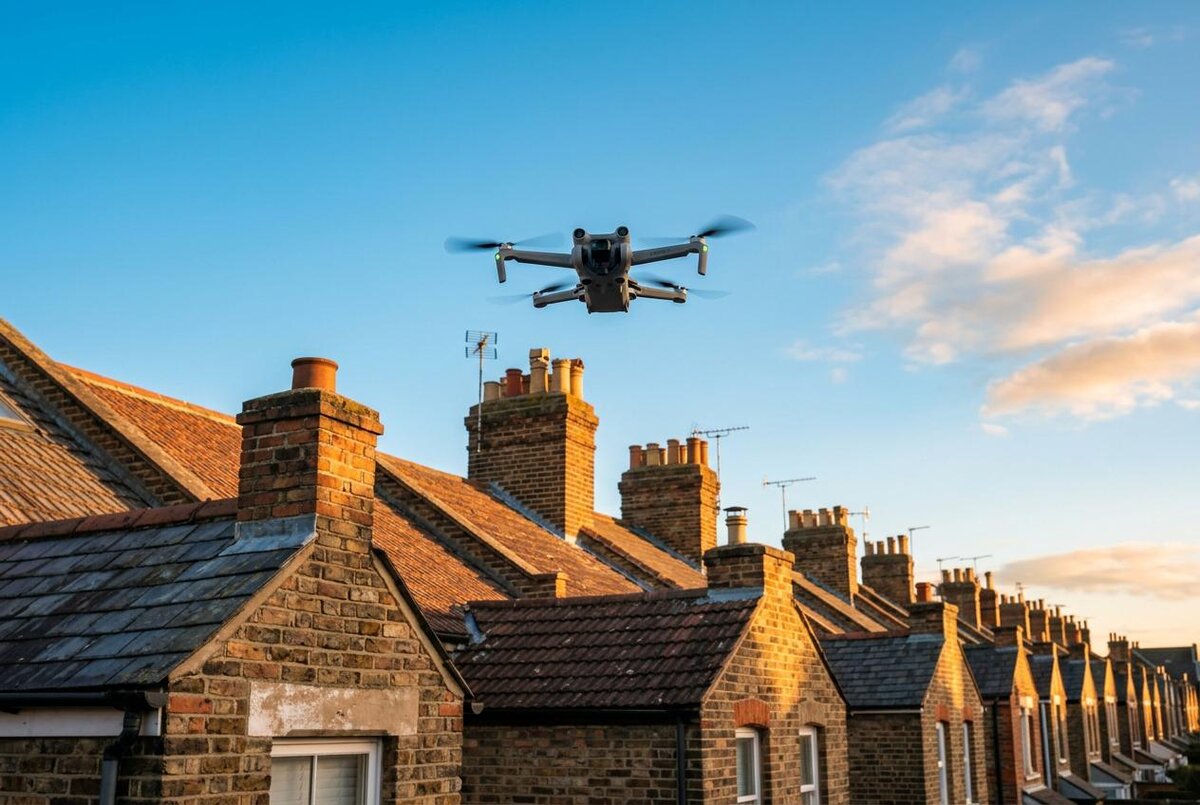
The Civil Aviation Authority overhauled UK drone rules in January 2026. A drone under 249g like the DJI Mini 4 Pro sits in the Open Category A1 subcategory, which has the most relaxed rules. You still need two things before you fly commercially, but neither is difficult.
Two things you must have before flying commercially
1. Flyer ID: Free from the CAA. You pass a 40-question multiple-choice theory test online. Takes about an hour of study. Valid for 5 years.
2. Operator ID: £12.34 per year from the CAA. This is the registration that says you are responsible for the drone. Required for any drone 250g or over, or any drone fitted with a camera. Flyer ID is required for drones 100g or over. You label your drone with your Operator ID number.
Flying for commercial gain (i.e., charging clients) doesn't require an additional licence in the Open Category, but you should declare it to your public liability insurer and check your policy covers commercial drone use.
The CAA theory test covers airspace rules, weather, emergency procedures, and safe flying. It's not difficult if you read the CAA's free study material first. The pass mark is 75% and you can retake it if you fail. Most people pass first attempt.
Restrictions that catch new pilots out
Even in the A1 subcategory with a sub-250g drone, you cannot fly within 150 metres of congested areas (town centres, busy parks) without specific authorisation. You also can't fly within 5km of an airport or aerodrome without checking airspace maps first. Use the NATS Drone Assist app (free) before every flight to check for temporary restrictions.
For most residential roof surveys, you're flying over or adjacent to a private property, often in suburban areas. This is straightforward in A1 as long as you don't fly directly over uninvolved people. Brief the homeowner, get written consent for flying over their property, and keep a short log of each flight. That's all the paperwork you need for a standard survey job.
The kit: building your setup for under £1,000
This is the kit list I recommend to every tradesperson who asks about drone surveys. Current UK retail prices as of early 2026.
| Item | Recommended | Price (UK) | Notes |
|---|---|---|---|
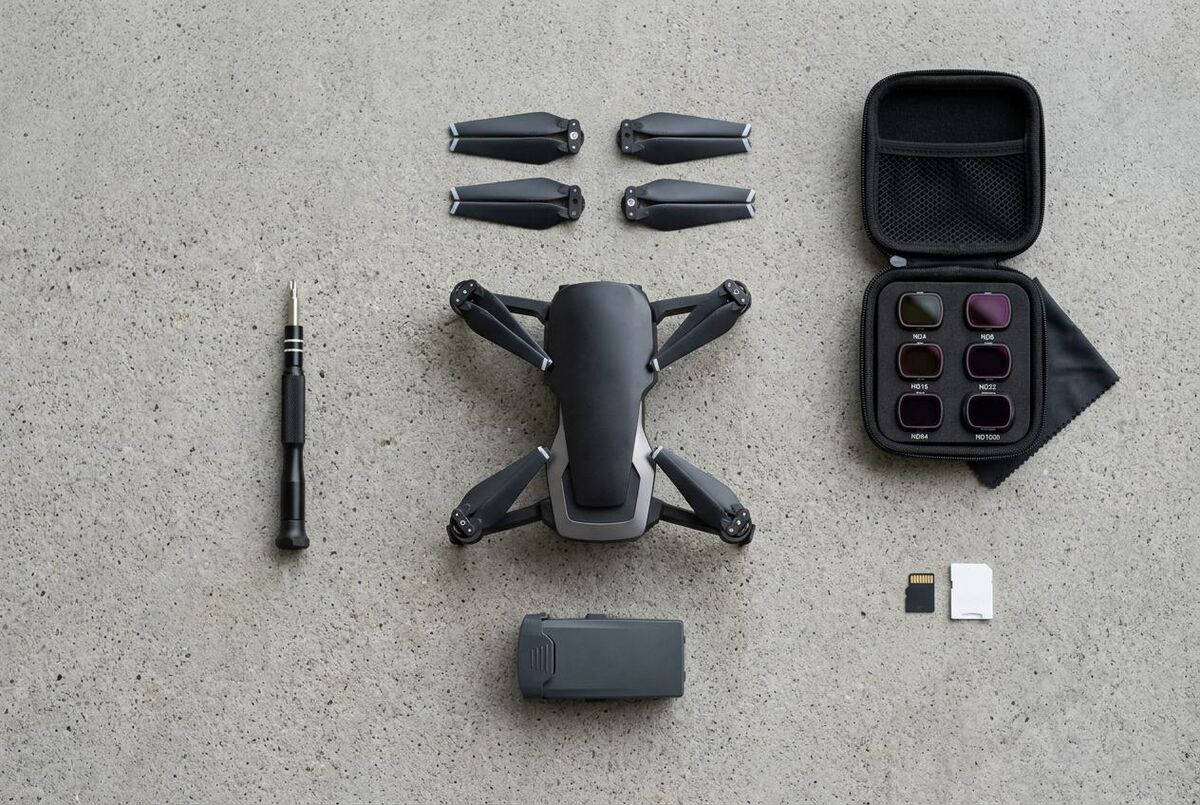
| Drone | DJI Mini 4 Pro (standalone) | from around £475-575 | Under 249g, 4K/60fps, 34-min battery |
| Extra battery | DJI Mini 4 Pro Intelligent Flight Battery | ~£55 | One extra gives you 60+ min total. Essential. |
| MicroSD card | SanDisk Extreme 64GB (V30/U3) | ~£12 | Don't cheap out here. Slow cards drop frames. |
| ND filter set | DJI ND Filters Set (ND64, 256) or third-party | ~£35 | Reduces overexposure on bright roofs |
| CAA Operator ID | Civil Aviation Authority | £12.34/yr | Required for commercial use |
| CAA Flyer ID | Civil Aviation Authority | Free | Online test, 40 questions |
| Insurance | Coverdrone or Hull & Brown (commercial) | ~£120–£180/yr | Commercial liability cover. Check your existing trades policy first. |
| Software | Hammer Missions (Starter) | £39/month | Automated flight paths + AI report generation |
Total hardware cost (drone + extra battery + memory + filters): approximately £800. First-year running costs including CAA IDs, insurance, and software subscription add roughly £600–£750. You're fully set up and legal for under £1,600 all-in, and the drone pays for itself in two residential survey jobs. Keep the kit secure between jobs with a proper van security system, because a drone is exactly the kind of high-value item opportunistic thieves target.
One thing I always tell people: register the drone's serial number with your insurer on day one. I had a roofer in Darlington who had his kit nicked out of the van three weeks after buying it and nearly could not claim because the serial was not on the policy. Took him two months to sort out. Fifteen seconds of admin on day one saves you that headache. And if you are running multiple vehicles, a proper van management and GPS tracking system helps you know where the drone kit is at all times.
Buy the Fly More Combo instead if you do more than 5 surveys a month
The DJI Mini 4 Pro Fly More Combo costs £829–£979 depending on which controller you choose. It comes with two extra batteries and a charging hub, saving you around £80 compared to buying them separately. If you're doing regular work, the convenience of three fully-charged batteries on site is worth paying for.
DJI Mini 4 Pro: the right drone for the job
 DJI
DJI Hammer Missions
 Pix4D
Pix4DThere are cheaper drones. There are more capable ones. For UK roof survey work, the Mini 4 Pro hits the right combination of weight, camera quality, and ease of use.
248.3 grams. That is the number that matters.
UK CAA regulations treat drones under 249g far more leniently than those above. You can fly closer to people, in more locations, with less paperwork. Go over 249g and you move into A2 or A3 subcategory with stricter distance-from-people rules and often the requirement for a more complex training certificate. DJI engineered the Mini 4 Pro specifically to stay below that threshold.
What makes it suitable for roof surveys
The camera is a 1/1.3-inch CMOS sensor shooting 4K at up to 60 frames per second. For inspection work you'll normally shoot 4K/30fps and slow it down in editing if you need to examine a specific section frame by frame. The lens is wide enough to capture full roof sections in context but sharp enough to identify cracked tiles, failed pointing, blocked gutters, and chimney damage from the sort of working distances you'd use for a residential property.
O4 video transmission gives you a clean live feed up to 20km line-of-sight (you'll never use that range in practice, but it means strong signal in cluttered urban areas with lots of Wi-Fi interference). The 34-minute battery life is enough to complete a thorough survey of a 3-bed semi with footage to spare for reshooting anything you want a second look at.
DJI Mini 4 Pro specs relevant to survey work
- Weight: 248.3g (including battery). Stays under 249g CAA threshold.
- Camera sensor: 1/1.3-inch CMOS, f/1.7 aperture, 24mm equivalent focal length
- Video: 4K/60fps, 2.7K/60fps, 1080p/120fps
- Max flight time: 34 minutes (no wind, standard conditions)
- Transmission range: Up to 20km (O4 transmission)
- Internal storage: 2GB (always use a fast MicroSD instead)
- Wind resistance: Up to 39 km/h (suitable for most UK survey conditions)
- Obstacle sensing: Four-directional (front, rear, left, right)
- Intelligent flight modes: Spotlight, Point of Interest, Hyperlapse, MasterShots
For indoor or confined space inspections, the Mini 4 Pro is less useful, as its obstacle sensors need some room to work. But for standard UK roofing work: pitched roofs, flat roofs, chimney stacks, guttering, valley checks. It's the tool for the job. The Point of Interest mode is worth knowing about: you set the drone to orbit a chimney stack automatically while you adjust the camera angle. You can get a full 360° inspection of a chimney in 90 seconds without manually flying it.
Hammer Missions and Pix4D: turning footage into reports
Footage alone is not a deliverable. Your clients want a report: annotated screenshots, defect locations, recommendations. Two software platforms handle this well.
From the field
The drone captures data. AI flags the anomalies. But the value your client pays for is your professional judgement: looking at a flagged defect and saying "that needs fixing now" or "that is cosmetic, monitor it." That hands-on knowledge, the stuff you only get from years on site, is what turns a data dump into a trusted recommendation. I have seen tradespeople adopt every new tool under the sun and still lose jobs because they could not explain the findings to a homeowner in plain English. The tool is never the deliverable. Your expertise is.
Hammer Missions: built for inspection work
Hammer Missions is a London-based drone inspection platform that covers both flight planning and report generation. Their Spector AI system analyses your footage automatically and flags potential defects: cracked tiles, missing mortar, blocked gutters, water pooling, damage to ridge lines. In testing, the company claims Spector identifies up to five times more anomalies than a human reviewing the same footage manually.
For practical purposes, that means you get a first-pass automated defect log you can then review and edit before sending to the client. You're not replacing your professional judgement, you're speeding up the review process. A footage review that might take 45 minutes manually can be cut to 15 minutes when you're correcting an AI-generated list rather than building it from scratch. Hammer Missions is just one example of how AI is reshaping trades workflows; our complete guide to AI tools for tradespeople covers more options worth exploring.
Hammer Missions pricing (early 2026)
Hammer Missions offers a free tier for basic mission planning and a paid Starter tier from around £39/month that includes Spector AI defect detection and professional report templates. Enterprise pricing for larger operations is available on request. Check hammermissions.com for current plans as pricing does change.
Pix4D: for photogrammetry and 3D mapping
If you want to move into more advanced survey work, Pix4D is the industry standard for turning drone images into 3D models, orthomosaics, and point clouds. This is useful for structural surveys, large commercial roofs, or any project where a client wants measurable 3D data rather than video footage alone.
PIX4Dmapper processes multiple overlapping images into a 3D model you can measure inside. This is how engineers produce accurate roof area calculations, volume measurements for materials, and as-built documentation. It's more complex to use than Hammer Missions and has a steeper learning curve, but it opens the door to higher-value commercial survey contracts.
Drone roof survey earnings for UK trades (2026)
These are current UK market rates, not best-case scenarios from a vendor's marketing deck.
A roofer doing two residential surveys a week is adding £2,000–£3,500 a month in revenue. That's with minimal additional overhead: your drone is already paid for after the first few jobs, the software subscription is covered by the first survey of the month, and your CAA costs are under £200 a year including insurance.
The higher-value opportunity is pairing survey work with quote follow-through. You find the defects, you write the report, you're the one who quotes for the repair work. If writing professional quotes is not your strongest skill, ChatGPT can draft one from your survey notes in 30 seconds. Clients who've just paid for a professional survey and received a documented list of issues are warm leads for the repair job. Conversion rates on that pipeline are much better than cold enquiries. If you want to automate the follow-up emails and booking reminders, our n8n automation stack for trades shows how to wire it all together without hiring admin staff.
ROI calculation: drone vs scaffolding for a roof check
Scaffolding approach: £1,000–£1,500 minimum hire, 2 days to erect and strike, traffic management potentially required, client inconvenienced for a week.
Drone approach: £250–£350 to the client, 30 minutes on site, no disruption, full 4K footage and written report delivered same day.
The drone wins on cost, speed, and client experience. On any property where a visual inspection is the goal, there's no good argument for scaffolding.
Finding drone survey clients as a UK tradesperson
The fastest route to first bookings is existing relationships. If you are already a roofer, surveyor, or builder, your current client base is your pipeline. A simple message to past clients saying you are now offering drone surveys for property inspections, insurance claims, and pre-purchase checks will get responses. I have seen this work in practice across the trades: a joiner in Stockton sent 40 WhatsApp messages to old customers on a Sunday evening and had three bookings by Tuesday morning. No advert, no website, just existing trust.
Estate agents are a strong B2B target. They need condition surveys on properties before valuation and before listing, and they want them done quickly. A 24-hour turnaround on a professional drone survey report is a real competitive advantage for them. Get in front of three or four local agencies and you have a repeatable referral source. A website that actually generates leads helps, and a 30-minute monthly local SEO routine will keep you visible in Google Maps when property managers search for survey services near them.
- Insurers and loss adjusters: drone footage is compelling evidence for claims involving storm damage, subsidence, or disputed defects
- Property management companies: regular inspection schedules on commercial and residential portfolios
- House buyers: pre-purchase roof inspection as part of a homebuyer report
- Local councils: public building inspections, council housing stock checks
- Solar installers: roof condition assessment before panel installation (see our guide on scaling a solar installation business for how survey data feeds into operations)
Price your surveys confidently. Undercutting the market to win work is a trap: you attract price-sensitive clients, devalue the service, and make the economics marginal. At £250–£350 for a residential survey you're already charging less than scaffolding costs for a single day. You have room to hold your price. If you are weighing up whether to charge per project or per day, our comparison of project-based, day-rate, and per-square-metre pricing models will help you decide.
My verdict
Buy the drone. Get your CAA IDs this weekend. Call three estate agents on Monday. Your first month of survey fees will cover the entire kit and then some.
I have recommended the DJI Mini 4 Pro to dozens of tradespeople, and the ones who pulled the trigger all said the same thing: they wished they had done it six months earlier. The 249g weight keeps the paperwork simple, the camera is sharp enough for professional reports, and Hammer Missions turns your footage into a deliverable without you needing a desk. Two residential surveys at £300 each and the drone has paid for itself. Everything after that is margin. The only people I have seen fail with this are the ones who bought the drone, stuck it in a drawer, and never made those first three phone calls.
DJI Mini 4 Pro: the right drone. Under 249g, 4K camera, 34-min battery, strong obstacle sensing.
CAA registration: straightforward. Operator ID and Flyer ID sorted in under 2 hours online.
Hammer Missions: the right software for inspection work. AI defect detection cuts report writing time in half.
Return on investment: strong. Two residential surveys at £300 each cover the drone cost in the first week.
Drone survey community feedback from Reddit, TikTok and Instagram
I searched Reddit, TikTok, and Instagram to find real voices from roofers, drone pilots, and tradespeople who have made the switch to drone survey work. Note: some TikTok content is US-based, so regulatory details differ, but the practical workflows and business outcomes translate well to the UK market.
Drone roof inspection video tutorials and walkthroughs
These YouTube videos are from real drone pilots and roofers who cover everything from first flights to commercial survey workflows.
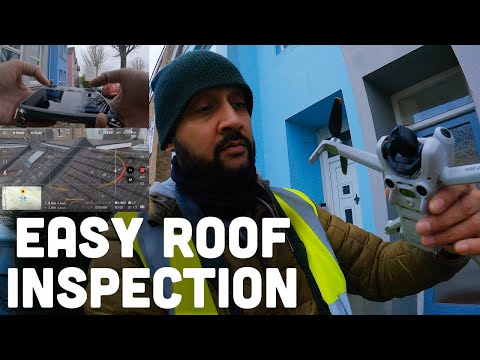
How to Inspect a Roof with DJI Mini 4 Pro Drone
Droneologist · 8,146 views
How Much I Actually Make Doing Drone Roof Inspections
Droneologist · 6,504 views
How to Perform Roof Inspections with Drones
Hammer Missions · 13,097 views
Drone Roof Inspections Part 1 of 2
Altitude University · 7,029 views
This is the Best Drone for Roofing Inspection and Sales
Roofing Innovators · 39,010 views
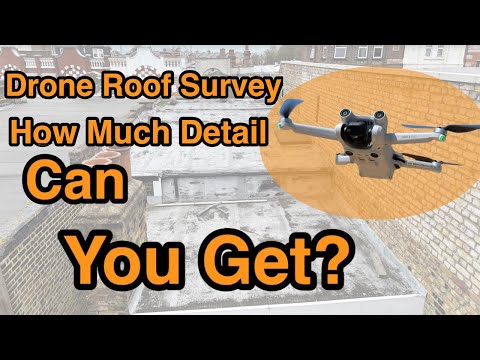
Drone Roof Survey: How Much Detail Can You Get?
London Roof Surveys · 2,676 views
Precision Drone Mapping on a Budget: DJI Mini 4 Pro + Litchi + WebODM
Avios Media · 14,248 views
Roof Inspection With a Drone
InterNACHI · 56,533 views
Ready to add drone surveys to your toolkit?
TrainAR Academy has more guides on AI tools for tradespeople and building a digital transformation roadmap for your trades business.
Explore TrainAR AcademyDrone roof survey FAQ for UK trades
Not in the traditional sense. For the Open Category (which covers the DJI Mini 4 Pro), you need a CAA Operator ID (£12.34/year) and a free Flyer ID obtained by passing a 40-question online theory test. There is no separate commercial operations licence required for Open Category flying. However, you should declare commercial drone use to your insurer and confirm your public liability policy covers it.
Yes. Under 249g you're in A1, which allows flight near residential properties with the owner's consent. Check the NATS Drone Assist app before every flight.
20–30 minutes on site for a standard 3-bed semi. Bigger or more complex roofs, 40–60 minutes. The report writing afterwards is what takes the real time, unless you're using Hammer Missions.
The Mini 4 Pro is rated for wind resistance up to 39 km/h. Light rain may be manageable for short periods but the drone is not rated as weatherproof and flying in rain risks water damage to the electronics. Fog or low cloud reduces visibility and means your footage won't show what you need it to. In practice, you'll reschedule in heavy rain, fog, or winds above 30 km/h. Build a flexible cancellation policy into your terms of service and clients will understand; it's no different from roofing work itself.
You need public liability insurance that explicitly covers commercial drone operations. Many standard trades insurance policies exclude aerial work or have limitations on altitude. Specialist drone insurers like Coverdrone and Flock (pay-per-flight) offer policies designed specifically for this. Expect to pay £120–£200 a year for a commercial drone policy with £1–2 million public liability. Always read the policy small print on what's covered if a drone falls and causes damage.
No blanket ban from the CAA. Your standard A1 permissions apply. Some local councils have their own bylaws, so if you're surveying anything near a scheduled monument, check with Historic England and the local planning authority first. For a normal residential survey it almost never comes up.