EICR codes explained: C1, C2, C3 and FI with real examples
Jump To...
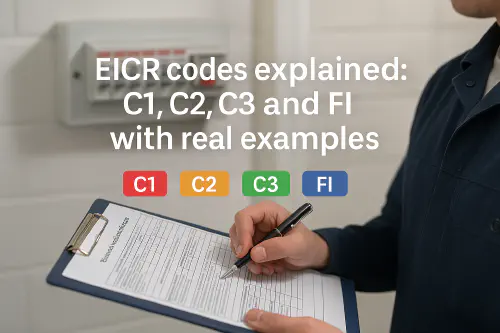
Electrician holding an EICR inspection sheet with a consumer unit in the background and a legend showing C1, C2, C3 and FI
Quick answer
EICR observation codes classify the risk level found during an inspection:
- C1 Danger present. Make safe before you leave site.
- C2 Potentially dangerous. Urgent remedial work required.
- C3 Improvement recommended. Not an immediate risk.
- FI Further investigation required without delay.
For authoritative definitions and examples, see Electrical Safety First Best Practice Guide 4 Issue 7.2, aligned to BS 7671:2018+A3:2024. Download the guide from Electrical Safety First.
Note on Amendment 3:2024: BS 7671:2018+A3:2024 came into effect 31 July 2024 and covers renewable energy installations and bi-directional protective devices (solar, battery storage, EV charge points). You’ll now mark a Code C3 if an RCD isn’t bi-directional where it should be. Make sure your test kit and cert software are updated for Amendment 3 compliance.
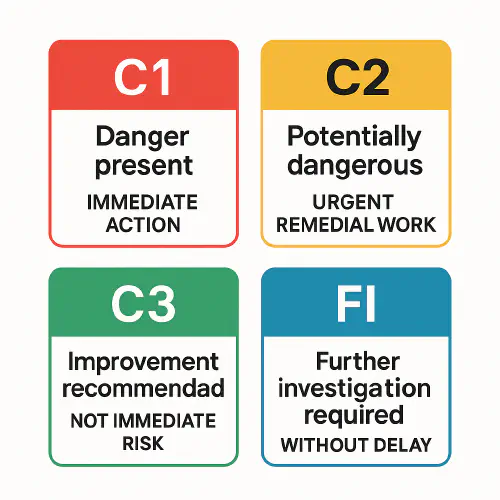
4-box cheat sheet showing C1 red, C2 amber, C3 green, FI blue with plain-English definitions
When you see each code
Use your judgement on site. The same observation can code differently based on context. These rules of thumb are consistent with Best Practice Guide 4:
C1 danger present
- Exposed live parts or damaged equipment with accessible live conductors
- Reversed polarity on a socket or circuit in use
- No main earth present where the installation is energised
- Signs of overheating with clear risk of ignition at a CU or connection point
Immediate action: make safe before leaving. That could be isolating a circuit, fitting a temporary blank, or urgent repair.
C2 potentially dangerous
- Missing or inadequate main protective bonding to gas or water
- No RCD protection where required for sockets reasonably expected to supply outdoor equipment
- A cracked socket face exposing internals but not live parts
- DIY alterations creating risk if another fault occurs
Action: urgent remedial work. Book in repairs quickly and advise the client the report is unsatisfactory until fixed.
C3 improvement recommended
- Plastic consumer unit in a non-domestic location where not prohibited but a metal enclosure would improve fire containment
- Labelling missing or outdated schedule of circuits
- RCD protection absent on a circuit where current regs would require it, but legacy arrangement remains safe
Action: advise upgrade. C3 items alone don’t fail the report.
FI further investigation
Use FI if there’s reasonable doubt about safety that you can’t resolve within the scope of the inspection and test. Examples:
- Inconsistent test readings suggesting a hidden defect
- Signs of damage or overheating that need dismantling beyond the agreed limitations
- Circuits added with no records, requiring trace and verify
Action: specify what to investigate, where, and the timeframe.
Examples you can reuse
These sample wordings help you stay clear and consistent. Tailor to the installation and reference Best Practice Guide 4 where relevant.
- Observation: Ring final continuity fails R1+R2 figure on kitchen circuit. Likely spur off spur and loose terminations. Code: C2. Action: Investigate and re-terminate. Provide updated test results.
- Observation: Meter tails damaged with exposed copper strands at main switch. Code: C1. Action: Isolate supply and replace tails.
- Observation: No main protective bonding to gas service within 600 mm of meter. Code: C2. Action: Install 10 mm bonding conductor and label.
- Observation: No RCD protection to socket outlets in ground floor utility, likely to supply outdoor equipment. Code: C2. Action: Provide 30 mA RCD protection.
- Observation: Consumer unit constructed of combustible material located under wooden stairs in escape route, no signs of thermal damage. Code: C3. Action: Recommend replacement with non-combustible enclosure to current standard.
- Observation: Thermal damage noted on MCB 3 with discolouration to busbar. Full removal of CU cover and investigation outside agreed scope today. Code: FI. Action: Further investigation to determine root cause and extent.
What makes a report pass or fail
- Unsatisfactory: any C1, C2, or FI present. You must advise remedial work.
- Satisfactory: only C3 items recorded.
Landlord context: In England, landlords must have a valid EICR and act on unsatisfactory findings within the required timeframes. See NRLA guidance and the government guidance for landlords.
How to explain results to clients
Keep it plain English and link codes to actions and timeframes.
- C1 make safe now: “There’s an immediate danger. We’ve isolated/repaired before leaving.”
- C2 fix urgently: “There’s a safety issue that could become dangerous. We will quote and book remedial work.”
- FI check quickly: “We need to open up further or trace circuits to confirm safety.”
- C3 plan upgrade: “Not dangerous, but recommended to meet modern standards.”
Tip: attach photos, mark-up of the consumer unit schedule, and a short remedial plan with costs and dates. It reduces back-and-forth and wins trust.
Useful references
- Electrical Safety First Best Practice Guide 4 Issue 7.2 PDF: Download
- NRLA overview for landlords: Electrical safety inspections
- Learn Electrics explainer video: Observation codes for EICR on YouTube
What are people saying on Reddit?
- EICR expiry and compliance issues discussed: LegalAdviceUK thread
- Applying with unsatisfactory EICR debate: r/uklandlords thread
- Electricians rant about inconsistent coding: r/ukelectricians thread
Related TrainAR Academy articles:
- NICEIC assessment checklist: paperwork, test gear and on‑site examples
- Electrical certificate software for UK electricians: best options, setup, and a no‑double‑entry workflow
- Bluetooth multimeter logging: how to capture and export readings (Fluke Connect, Megger MFT-X1, Kewtech, UNI-T)
Ready to Transform Your Business?
Turn every engineer into your best engineer and solve recruitment bottlenecks
Join the TrainAR Waitlist