
Quick Answer
For most UK trades doing under 120 miles a day with a driveway charger, the Ford E-Transit Custom is the van that makes sense in 2026. The Fiat E-Ducato wins on payload and pure carrying space if you run a multi-drop or bigger jobs; the VW ID. Buzz Cargo is a marketing tool that happens to drive, brilliant for service businesses with light loads. None of them touch a loaded diesel for long-distance work yet. Mate, the maths only stacks up if you can charge overnight at home.
Table of Contents
- The three vans on test
- At a glance: the numbers that matter
- Real-world range loaded with tools
- Charging speed and the depot question
- Ford E-Transit Custom: the safe pick
- Fiat E-Ducato: the payload king
- VW ID. Buzz Cargo: the brand statement
- Three-year total cost of ownership
- The Plug-in Van Grant, BIK, and the 2030 ban
- AI route planning and smart charging
- What tradespeople are saying
- Recommended videos
- Frequently asked questions
- My verdict
The three vans on test
 Ford E-Transit Custom
 Fiat E-Ducato
 VW ID. Buzz Cargo
The Zero Emission Vehicle mandate is in full effect in 2026. Thirty-three percent of every manufacturer's new sales has to be electric, the Plug-in Van Grant is still paying up to £5,000 on large vans, and ULEZ now stings non-compliant diesels for £12.50 a day across all thirty-two London boroughs. Add the 2030 ban on new non-zero-emission vans and the question for trades is no longer if, but when.
I ran a heating business for years before TrainAR. A Transit was my office, my workshop and my stock cupboard. So when I looked at the current crop of electric vans I wanted to know one thing. Loaded with the tools and stock a real trade runs, on a cold British morning, with a customer waiting at half eight, what actually happens.
These three vans cover the spread. The Ford E-Transit Custom sits in the medium-van sweet spot most UK trades buy. The Fiat E-Ducato is the only large electric van here that actually competes with a diesel for cargo. And the VW ID. Buzz Cargo is the wildcard, a small-payload, big-image van that turns the daily school run into free advertising.
At a glance: the numbers that matter
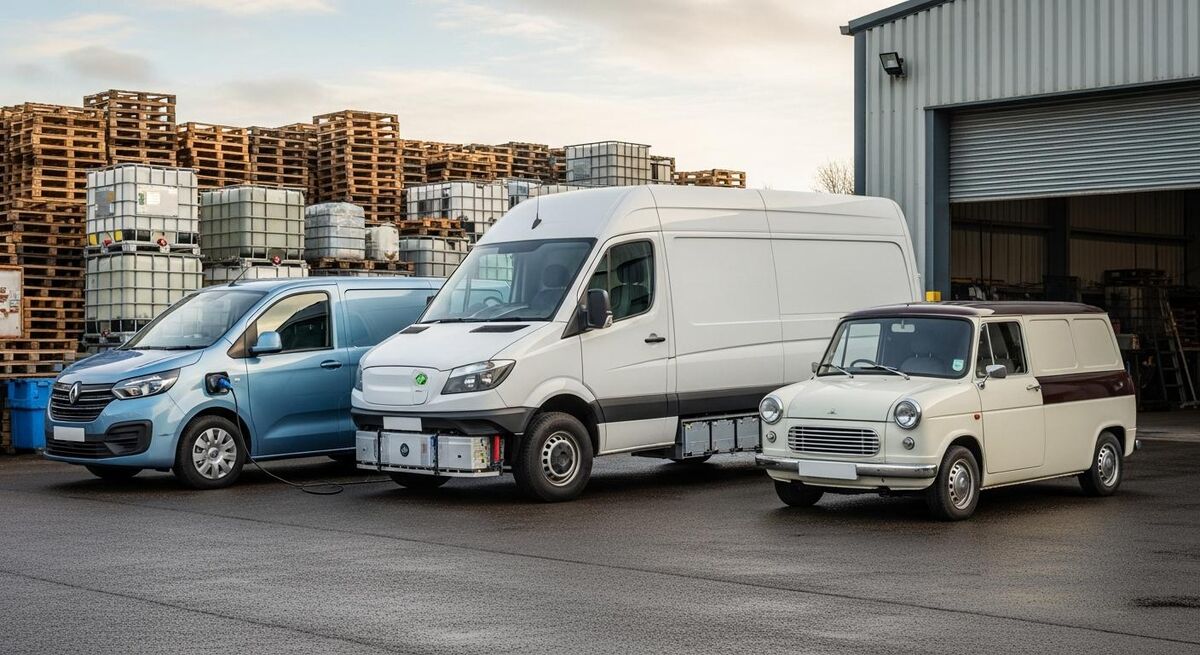
Manufacturers love a WLTP figure. WLTP is a lab test. It is useful for comparing one van against another, but the number on the brochure is not the number you will hit at seven in the morning with a tank of compressors, a cold cab, and the heater on full.
For a working trade, six numbers actually matter. Starting price, real-world range loaded, payload, charging speed on a 50kW rapid, cargo volume, and the warranty on the battery. The rest is noise. Here is how the three vans line up before we touch any of them.
The Ford undercuts the Fiat on entry price by some margin. The VW undercuts both, but only if you accept the small battery and the modest payload. The Fiat is the only one of the three that replaces a diesel large van without giving up cargo. Keep that hierarchy in mind for the rest of the article.
| Spec (entry trim) | Ford E-Transit Custom | Fiat E-Ducato | VW ID. Buzz Cargo |
|---|---|---|---|
| Starting price (ex VAT) | ~£45,000 | ~£50,235 | ~£35,960 |
| Usable battery | 64 kWh | 79 or 110 kWh | 59 or 79 kWh |
| WLTP range | 209 miles | 261 miles (110 kWh) | 200–275 miles |
| Max payload | 1,088 kg | 1,695 kg | 710 kg |
| Cargo volume | 5.8 to 9.0 m³ | 10 to 17 m³ | 3.9 m³ |
| Rapid charge (15–80%) | 41 min @ 125 kW | 55 min @ 150 kW | 30 min @ 170 kW |
| Battery warranty | 8 yr / 100,000 mi | 8 yr / 100,000 mi | 8 yr / 100,000 mi |
| Onboard 230V power | 2.3 kW ProPower | Optional | Optional V2L |
One thing the table does not show. The Ford runs Ford Pro telematics out of the box, including a feature that calculates the cost of overnight home charging and exports it straight into your accounting software. For a sole trader filling in an HMRC mileage claim that is no small thing.
Real-world range loaded with tools
Here is where the brochure falls apart. Independent testing tells a consistent story. Knock fifteen to twenty-five percent off the WLTP number for a warm summer day, lightly loaded. Knock another ten to twenty percent off for a cold winter morning with full payload and the heater running. That is not pessimism, that is the published data.
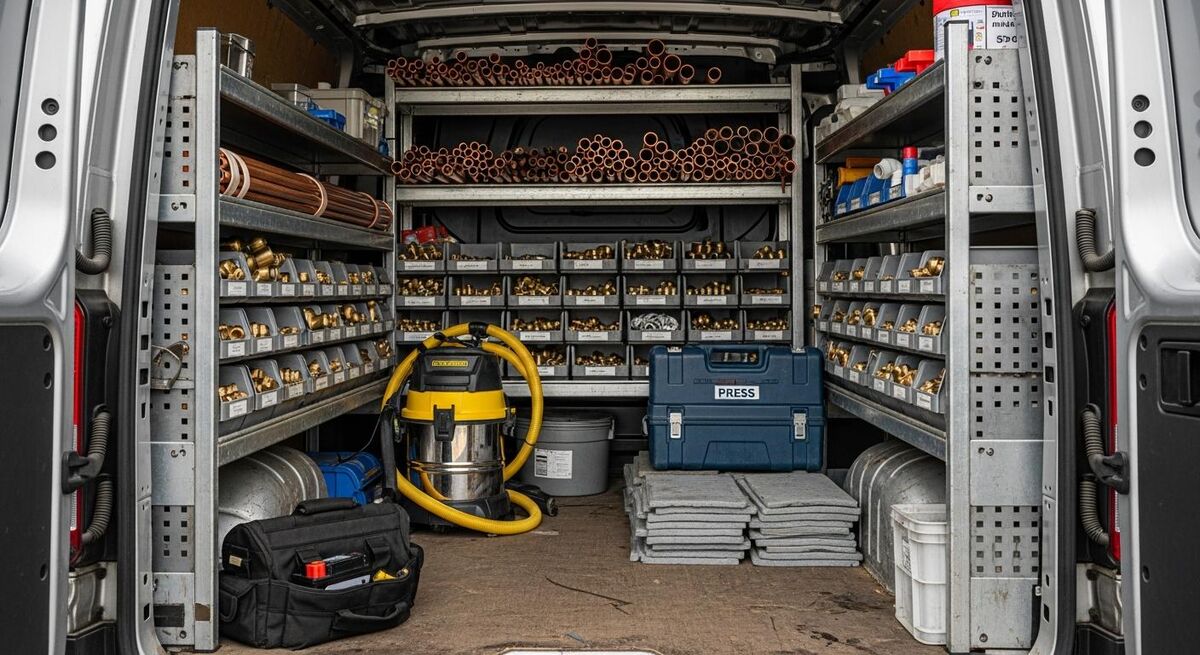
EV Pulse loaded a Ford E-Transit to its maximum gross vehicle weight rating with rubber matting and ran the same highway loop they use for unladen testing. They saw 1.4 miles per kWh. On the 68 kWh battery that works out at a real-world range of 95 miles. Honest John's group test for 2026 settled on roughly 160 to 170 miles for the E-Transit in typical UK winter use with a modest load. Both numbers are honest, they just measure different things.
For the Custom, real-world tests at part-laden weights average 2.8 kWh per mile. That puts the 64 kWh battery at around 175 miles in mild weather and somewhere between 120 and 140 miles on a cold day with tools in the back. The Fiat E-Ducato with the 110 kWh battery has the headroom that the Ford does not. Even loaded and cold you should clear 180 miles. The ID. Buzz Cargo with the 79 kWh battery is the surprise here. Owners on UK forums consistently report 3.2 miles per kWh as a long-term average, theoretical 246 miles, real-world 200 in summer and 165 in winter.
None of that gets you north of 300 miles. So the question is not "can it do my route". The question is "what happens on day two". If you can plug in at home overnight and start the day at one hundred percent, all three work. If your route is unpredictable and you cannot rely on home charging, none of them does. That is the honest answer.
Charging speed and the depot question
The cost of charging is the bit most diesel-to-electric switchers underestimate, in both directions. Done at home off-peak it is the cheapest the trade has ever had it. Done at a public rapid charger on a cold morning when you forgot to plug in, it is the most expensive it has ever been.
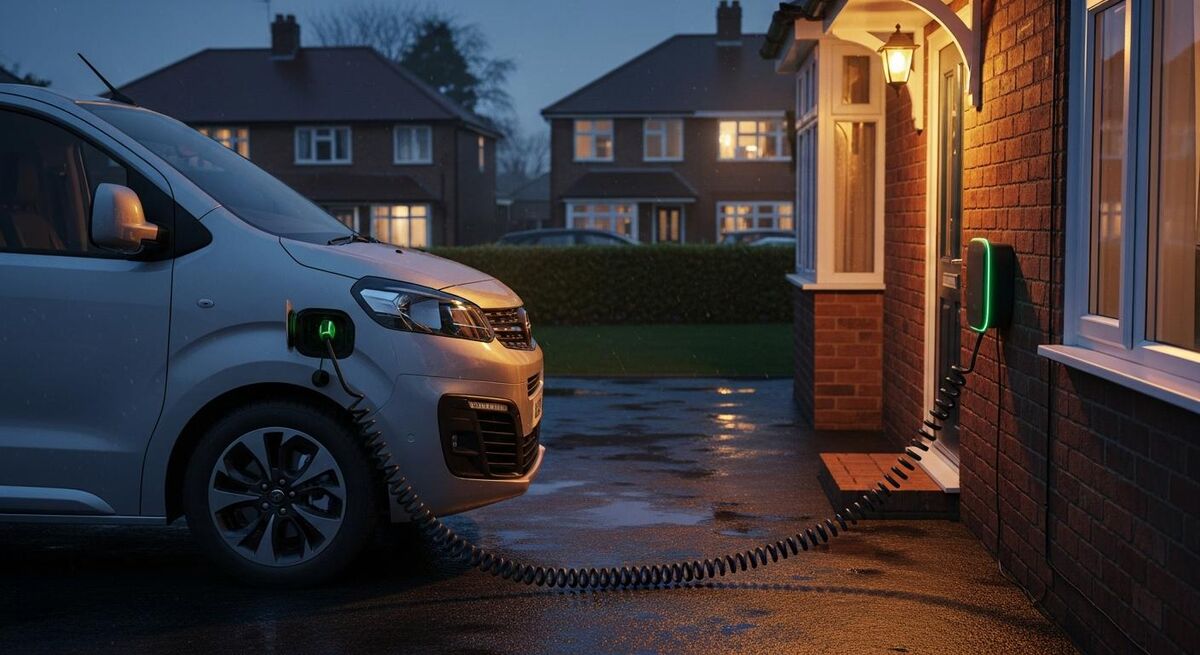
An off-peak EV tariff prices electricity at around 9.5p per kWh in 2026. The average UK public rapid charger sits at 79p per kWh, the standard public charger at 54p per kWh. For a van doing 100 miles a day at 3 miles per kWh, that is roughly £3.17 a day at home or £26.33 a day on rapids. Over a year that is a £6,000 swing. That is not a rounding error.
The Ford E-Transit Custom charges at 125 kW peak. From 15 to 80 percent on a true 125 kW DC charger it takes 41 minutes. The Fiat E-Ducato manages 150 kW and gets to 80 percent in 55 minutes despite the bigger battery. The ID. Buzz Cargo is the surprise winner here. With 170 kW peak and a smaller battery, it goes from five to eighty percent in just thirty minutes.
For most of you the rapid charger is the back-up plan. The first plan is a 7 kW wallbox on the workshop or driveway. A full charge on the E-Transit Custom takes eight and a half hours on a 7 kW unit. That is the overnight reality you are buying into. Whether you have the parking and the off-street install depends on where you live and how your workshop is set up. If you cannot get a wallbox installed at base, the maths is brutal at public chargers and you should walk away from electric for now.
Ford E-Transit Custom: the safe pick
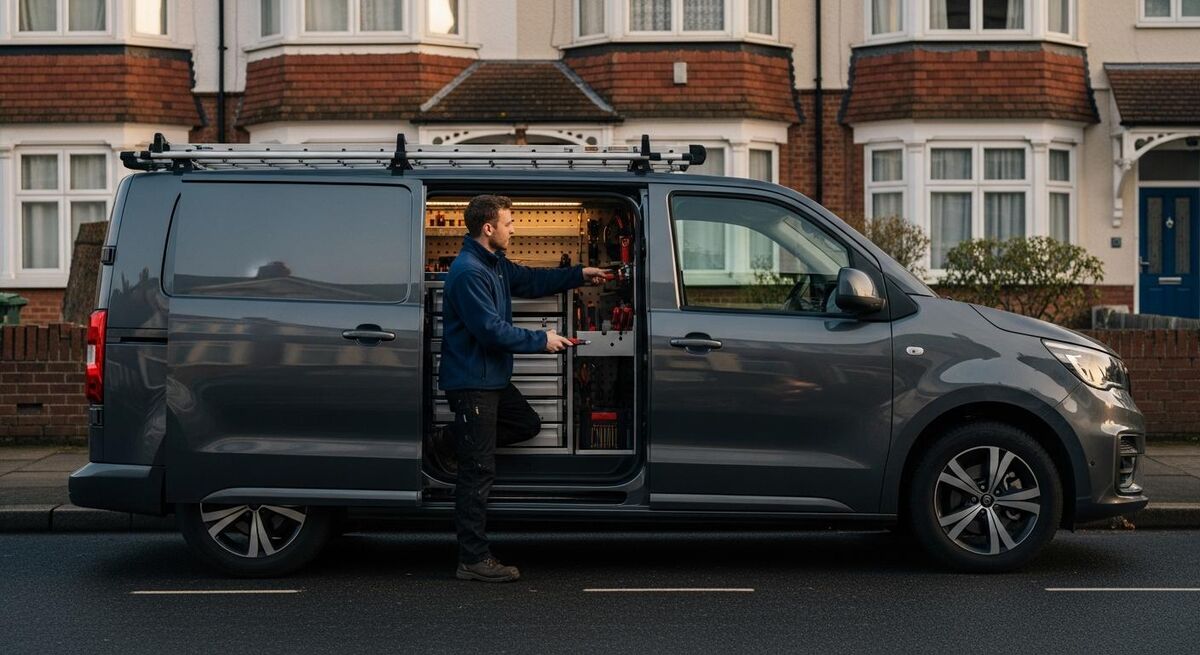
The E-Transit Custom is the van Ford built for the trade that already drives a Transit Custom. Same footprint, same load bay, same dashboard, no learning curve. The 64 kWh battery is on the small side, but you get 209 WLTP miles, a 1,088 kg payload at the high-spec end, and the very useful ProPower 2.3 kW onboard 230V socket. That last one matters. Running a 110V transformer, a SDS drill, a JCB site light or charging a battery pack off the van means you can leave the petrol genny at home.
What is good. The Custom drives better than the diesel. Lower centre of gravity from the battery, sharper steering, smoother ride. Ford Pro is the best fleet telematics package in the trade right now. The 41 minute rapid charge on a 125 kW unit is competitive. Build quality matches the diesel Custom, which is to say the cab feels grown up. The 8-year battery warranty and Ford's claim of 40 percent lower service and maintenance cost versus diesel is now backed by enough fleet data to take seriously.
What is not. The battery is small for the price. At £45,000 ex VAT entry, you are paying medium-large van money for a 64 kWh pack that the bigger Fiat undercuts on capacity. The 1,088 kg payload is also lower than the equivalent diesel Custom on the same trim. Range degrades quickly with the heater on. And the driver assistance kit will drive you mad. Customer reviews on Honest John consistently flag the bongs, beeps and lane-assist nags as worse than dangerous on the urban runs the van was built for.
Fiat E-Ducato: the payload king
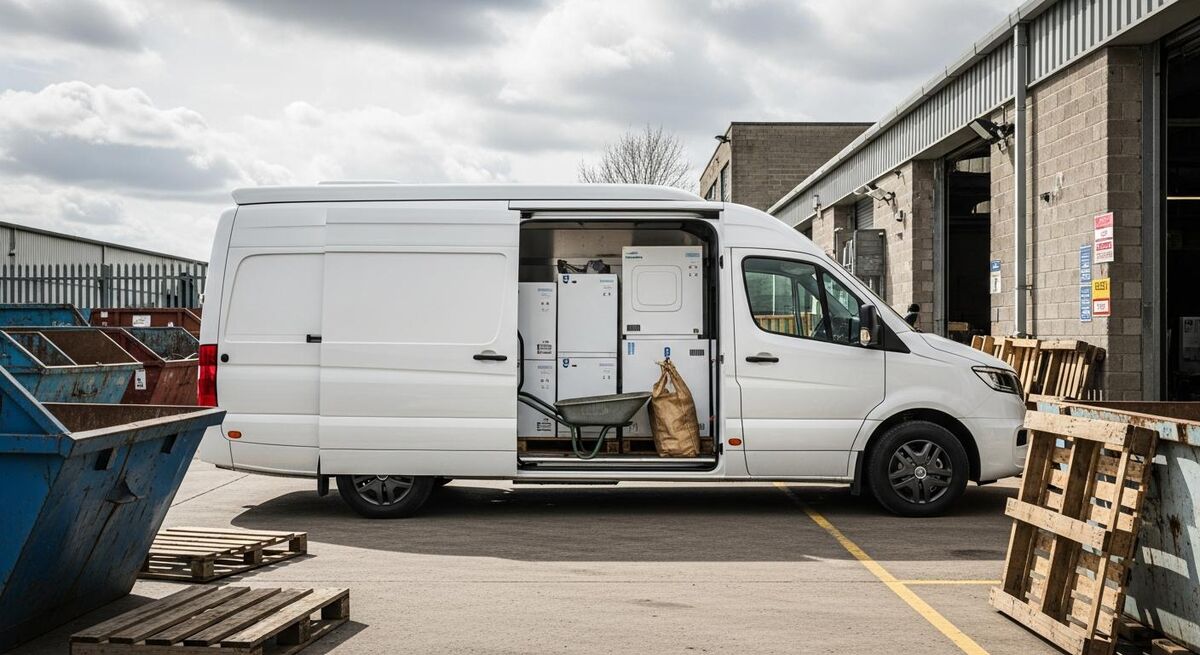
The Fiat E-Ducato is the only van in this test that replaces a large diesel Ducato or Sprinter without giving up what you can carry. 110 kWh battery, 261 mile WLTP range, up to 1,695 kg payload, up to 17 cubic metres of cargo. For a kitchen fitter moving cabinets, a flooring contractor, a boiler installer doing multi-system jobs, this is the van that the maths starts to work for.
What is good. Payload is right there with the diesel Ducato. The 110 kWh battery is the biggest in this comparison and delivers usable range when loaded. 150 kW rapid charging on the bigger battery means a coffee-break top-up is realistic between morning jobs and afternoon ones. The 3.5 tonne version sits on a regular UK driving licence and the 4.25 tonne version still does thanks to the alternatively-fuelled vehicle dispensation, so you keep your payload without forcing engineers onto a C1 ticket.
What is not. Entry price stings. £50,235 ex VAT for the entry panel van, £68,175 for the big-battery 110 kWh version. The cab is an old design even after the latest refresh, and the quality of switches and trim does not match the Ford. The infotainment and driver tech is functional rather than impressive. Stellantis fleet support exists but does not feel as joined-up as Ford Pro.
It is also the heaviest van here, and that has knock-on effects. Tyre wear on the front is real, and you need to plan for a 1,200 kg battery pack pushing down on the front axle. Get the front geometry checked at every service and budget for an extra set of front tyres versus the diesel.
VW ID. Buzz Cargo: the brand statement
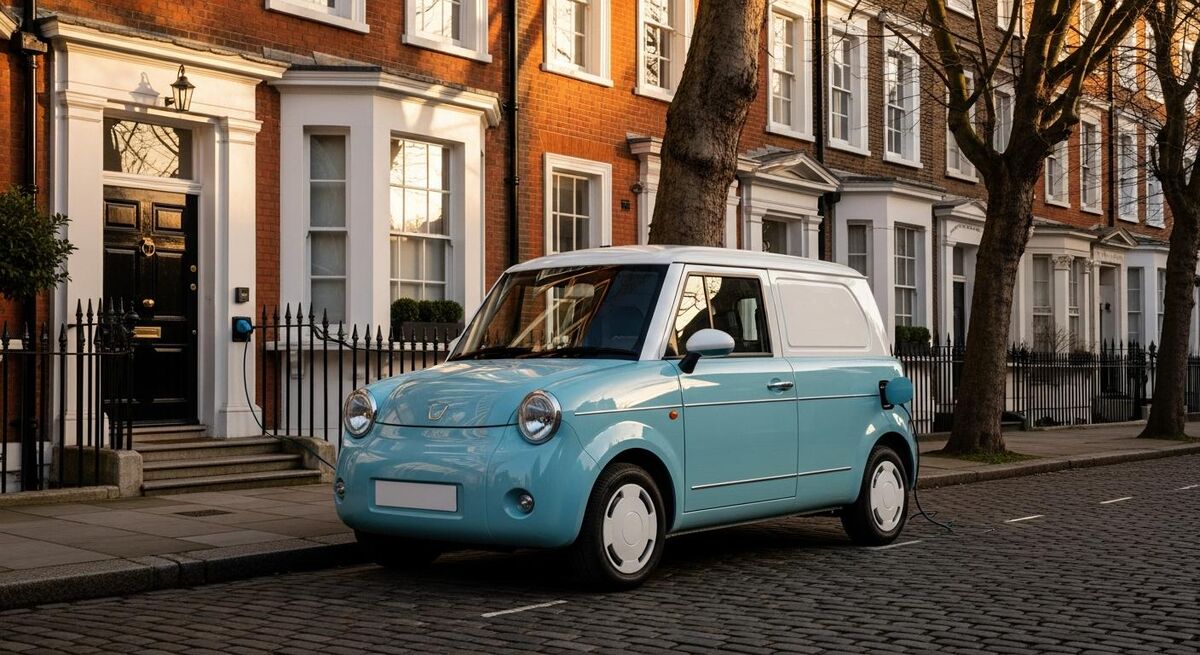
The ID. Buzz Cargo is a marketing vehicle that happens to drive. That is not a criticism. For a service business where the van is the face of the brand, an upholstery cleaner, a smart home installer, a high-end electrician, an aerial installer, the ID. Buzz parked outside a customer's house earns you future jobs in a way no Transit ever will. Mitie ordered 650 of them in early 2024 for exactly this reason.
What is good. Range is the standout. 275 miles WLTP on the 79 kWh battery, and owners report a long-term real-world average of 3.2 miles per kWh which translates to a theoretical 246 miles. The 170 kW rapid charging is the fastest here. The cab drives like a car, the ride is smooth, and the build quality is what you would expect from VW. Bi-directional charging means you can power tools off the van or, if you ever needed to, run the house off it. Cargo space is 3.9 cubic metres which fits two Euro pallets.
What is not. Payload. 710 kg on the standard van, 592 kg on the entry-level Commerce trim. That is well below the Ford E-Transit Custom and a long way below any large van. For a tool-heavy electrician or a plumber carrying a couple of boilers, you will run out of payload before you run out of space. The price is also high once you add the bigger battery and Plus trim, with the Style spec hitting £48,541 OTR. And the infotainment screen, the same one as the ID.4, has a reputation for being slow to respond and frustrating to navigate.
The other consideration is image. The ID. Buzz looks fantastic for the right business. For a roofer with a ladder rack and a load of slate offcuts, it looks faintly absurd. Match the van to the brand or it works against you.
Three-year total cost of ownership
The headline price is the lie. Total cost of ownership is the truth. Here is what three years on the road looks like for a typical small trade running 15,000 miles a year, charging eighty percent of the time at home and twenty percent on public rapids, currently in the 4% BIK band for 2026/27.

| Three-year cost (15,000 mi/yr) | E-Transit Custom | E-Ducato 110kWh | ID. Buzz Cargo 79kWh | Diesel Custom (reference) |
|---|---|---|---|---|
| Price after grant (ex VAT) | £42,500 | £63,175 | £43,541 | £33,995 |
| Three year fuel/charge | £3,150 | £3,420 | £3,200 | £8,820 |
| Three year service | £720 | £920 | £780 | £1,800 |
| Three year road tax / VED | £0 | £0 | £0 | £885 |
| BIK at 40% rate (3 yr) | £480 | £480 | £480 | £4,128 |
| Wallbox install | £1,000 | £1,000 | £1,000 | £0 |
| Residual at 36 months | −£14,875 | −£19,000 | −£17,400 | −£14,500 |
| Three year cost | £32,975 | £49,995 | £31,601 | £35,128 |
Two things jump out. First, the ID. Buzz Cargo ends up cheaper than the diesel Transit Custom over three years despite costing more upfront, because of strong residuals, low charging cost and zero VED. Second, the E-Ducato looks expensive until you remember it carries 1,695 kg and a diesel equivalent at the same payload is £5,000 to £7,000 more than the basic Custom you are comparing against.
The figures assume off-peak home charging at 9.5p per kWh and public rapids at 79p per kWh. Service costs are based on Ford's published 40 percent lower than diesel claim and equivalent figures from the other manufacturers. Residual values are conservative trade-in estimates from late 2025 industry data. Adjust for your own mileage, your own grid contract, and whether you can actually charge at home.
The Plug-in Van Grant, BIK, and the 2030 ban
The government incentives stack matters. Get them wrong and you leave thousands on the table. Get them right and the electric van pays for itself faster than the brochure suggests.
The Plug-in Van Grant runs as follows in 2026. Small vans up to 2.5 tonnes get up to £2,500 off at point of sale. Large vans 2.5 to 4.25 tonnes get up to £5,000 off. The grant is applied automatically by the dealer, you do not claim anything back. The Fiat E-Ducato qualifies for the full £5,000 on its larger variants. The Ford E-Transit Custom and VW ID. Buzz Cargo qualify for the small van £2,500 grant on their smaller configurations and the £5,000 grant on the larger ones.
Benefit in Kind on a fully electric van is 4% for 2026/27. The taxable value is just the list price multiplied by that 4%. For a £45,000 van that is £1,800 a year of taxable benefit, which works out at £720 of tax for a higher-rate payer. Compare against the £3,960 flat-rate van benefit charge for diesel and the gap is significant.

Other carrots and sticks. Electric vans pay zero VED. ULEZ across all 32 London boroughs costs £12.50 a day for a non-compliant van, so a Croydon-to-central daily commute adds £3,250 a year to a diesel that fails Euro 6. Birmingham, Bristol, Bradford, Sheffield, Tyneside, Portsmouth, Glasgow and others now run Clean Air Zones with similar charges. By the end of 2026 around twelve million UK residents live inside an active charging zone.
The 2030 ban applies to the sale of new petrol and diesel vans only. Anything you buy before then remains legal to own, drive and sell. The used market for diesel vans will sour as the 2030 date approaches, which is why the residual figures in the TCO table are sliding now. If you are buying a new van in 2026 with a three or five year hold, factor that into the diesel option, not the electric one.
AI route planning and smart charging
This is where the software side of running an electric trade van starts to matter. The brochure does not tell you about it because the brochure is from 2018. The reality in 2026 is that AI-based route planning and smart charging schedulers turn an electric van from a constraint into a tool.
Three things are now possible that were not when the first E-Transit shipped. First, Google Maps, Waze, A Better Route Planner and the in-cab navigation in all three vans here will plan a route accounting for the van's current state of charge, the weight in the back, the elevation profile, the weather and any required charge stops. If you start the day at 80 percent and have a 140 mile run with a heavy tool load and a cold morning, the planner will tell you upfront that you need a 20 minute top-up at a specific service station, and the cab will pre-condition the battery on approach to maximise the charge speed.
Second, smart wallboxes paired with off-peak tariffs handle the overnight schedule automatically. You plug in when you get home, set "leave at 7:00" in the app, and the wallbox times its charging to finish at full at the moment you walk out the door, with the battery pre-warmed for maximum range. Octopus Intelligent Go takes this further and lets the utility optimise across thousands of vehicles to balance the grid.
Third, fleet telematics like Ford Pro and Vodafone's commercial offering give you visibility on every van in your operation. State of charge, location, expected arrival time, driver behaviour. For a multi-van trade firm that is operational intelligence you do not get on a diesel without paying extra for it.
If you are running multiple vans, integrate the telematics with your job management software through tools like our trades business software stack guide covers. The companies that win the next decade in trades will not be the ones with the fanciest vans. They will be the ones who use the data the vans produce.
What tradespeople are saying
Recommended videos
Ford E-Transit Long Term Review: 4,000 Miles in a Small Business Fleet
Out Motorsports
EV Van vs Reality: My Brutal Opinion, Ford eTransit Custom
Artisan Electrics
The future of hard work? Ford Transit Custom 2024 Review
Chasing Cars
Is ID.Buzz Cargo the new benchmark for vans?
Chasing Cars
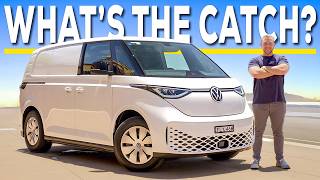
2025 VW ID Buzz Cargo Review: It's THE MOST EPIC Work Van
CarSauce
New 2024 Boxer, Ducato, Jumper and Movano: Stellantis Large Vans
Planet Car News
Frequently asked questions
Yes, but it absolutely massacres your range. Expect to halve the figure you would get unloaded. The Ford E-Transit Custom tows up to 2,000 kg, the E-Ducato tows up to 2,500 kg, the ID. Buzz Cargo up to 1,000 kg. For occasional trailer work it is fine. For daily towing of a plant trailer, stick with diesel for now.
The 8-year, 100,000 mile warranty covers loss of capacity below 70 percent. Real-world data on the first generation E-Transit suggests most packs are still north of 80 percent at 100,000 miles. After warranty you can pay for a refurbished pack or sell the van on. Used electric van prices are wobbly right now, but commercial battery replacement cost is dropping fast as supply scales up.
The cabin heater is the biggest single drain. Vans with a heat pump, like the ID. Buzz, lose roughly 25 percent of range in winter. Vans with resistance heating lose closer to 34 percent. Pre-conditioning the cab while plugged in claws a lot of that back. Plug in overnight, set departure time, get into a warm van without spending battery on the warm-up.
The Ford E-Transit Custom comes with a 2.3 kW 230V socket in the load bay called ProPower. That runs almost any standard mains tool comfortably. The ID. Buzz Cargo has optional vehicle-to-load. The E-Ducato has it as an optional extra. If site power matters, factor this in. It can save you a generator and a bag of cables.
Three-year residuals on electric vans softened in 2024 then stabilised in 2025 as fleet demand picked up. Current trade-in values from Cap HPI put the E-Transit at around 35 percent of new price at 36 months, the Ducato at 30 percent, the ID. Buzz at 40 percent. The Buzz holds best because the brand image keeps demand high. The diesel Custom is around 43 percent. Closer than the doom-mongers will tell you.
Then electric is not for you yet, full stop. The economics fall apart at public charger prices. Look at workplace charging schemes, depot charging if you are part of a fleet, or local destination chargers near where you live. If none of those work, run a clean Euro 6 diesel for now. Honest answer.
My verdict
Mate, it is not a perfect van. The battery is small for the money, the driver assistance kit is intrusive, and the range loaded on a cold day is the same as a diesel doing a quarter of the fuel. But the familiar Transit footprint, the very useful ProPower socket, Ford Pro telematics, the 41 minute rapid charge and the trade-grade build quality make it the easiest switch from diesel for plumbers, electricians and gas engineers running under 120 miles a day with a home or depot charger.
If you need genuine large-van payload and cargo, the Fiat E-Ducato is the only one of these three that gets you there. Expensive on day one, but the only electric option that actually replaces a Sprinter or Boxer without a compromise.
And if you run a high-touch service business where the van is the brand, the ID. Buzz Cargo is a marketing tool that pays for itself in customer conversation. Just be honest about the 710 kg payload before you spec it.
The wider truth. All three only work if you can charge overnight at home or at base. If you cannot, walk away and run a clean diesel for another three years while the infrastructure catches up. When it does, and it will, the maths will be obvious.