

Quick Answer
Most subcontractor disputes come down to five things: unclear scope, late payment, uncontrolled variations, missing insurance requirements, and no agreed dispute resolution process. Get those five clauses right in writing before any work starts, and you prevent roughly 80% of the arguments that drag trades businesses into costly legal battles. The Housing Grants, Construction and Regeneration Act 1996 already gives you statutory protections on payment and adjudication, but only if your contract does not accidentally sign them away.
Table of Contents
- The scale of subcontractor disputes in UK construction
- The five disputes that cost trades businesses the most
- Clause 1: Scope of works and exclusions
- Clause 2: Payment terms and the Construction Act
- Clause 3: Variation and change control
- Clause 4: Insurance and indemnity requirements
- Clause 5: Dispute resolution and adjudication
- The retention question: 2026 reforms and what they mean
- CIS and employment status: the clauses that protect you from HMRC
- What tradespeople are saying
- Recommended videos
- Frequently asked questions
- My verdict
The scale of subcontractor disputes in UK construction
When I was running Elite Heating and Plumbing with half a dozen engineers, I learned something about subcontractor relationships the hard way. We had about a thousand overdue invoices at one point, roughly forty grand sitting in the overdue column. Our average invoice value was around thirty pounds, so you can imagine the daily chase that created. That experience taught me that most disputes are not about bad people. They are about bad paperwork.
The numbers bear this out. Late payment costs UK businesses an estimated £11 billion a year and contributes to around 14,000 business closures annually. Construction has the highest insolvency rate of any UK sector, with 17% of all insolvencies in England and Wales between September 2024 and August 2025 being construction companies. Three in every five subcontractors report being underpaid by main contractors, even when they have delivered the work to specification.
These are not abstract statistics. Behind every one of those numbers is a plumber who cannot pay their material supplier, an electrician whose van lease is overdue, a heating engineer whose family holiday got cancelled. And in most cases, a proper written contract would have prevented the dispute entirely, or at least given the subcontractor the legal standing to resolve it quickly.
The five disputes that cost trades businesses the most

Before getting into specific contract clauses, it helps to understand what actually goes wrong. After speaking with solicitors, adjudicators, and dozens of trades business owners, the pattern is consistent. Five types of dispute account for the vast majority of subcontractor problems in UK construction.
1. Scope disputes. The subcontractor thought they were doing X. The main contractor assumed they were also doing Y. Nobody wrote it down clearly enough. This is the single most common cause of arguments on site, and the easiest to prevent.
2. Payment disputes. Late payment, partial payment, deductions without proper notice, and the old favourite: "I will pay you when the client pays me." That last one has been illegal since 1996, but it still happens daily across UK construction.
3. Variation disputes. The client changes their mind. Extra work is needed. The subcontractor does the work assuming they will be paid. The main contractor says it was included in the original price. Without a written variation process, proving who is right becomes a coin toss.
4. Insurance and liability disputes. Something goes wrong on site. Damage, injury, defective work. Who pays? If the contract does not specify insurance requirements and indemnity provisions, the answer usually involves lawyers.
5. Termination disputes. One party wants to walk away. Was the termination lawful? What happens to partially completed work? What about materials already purchased? Without clear termination clauses, both sides lose.
Each of these disputes has a corresponding contract clause that prevents it. The rest of this article covers each one in detail.
Clause 1: Scope of works and exclusions
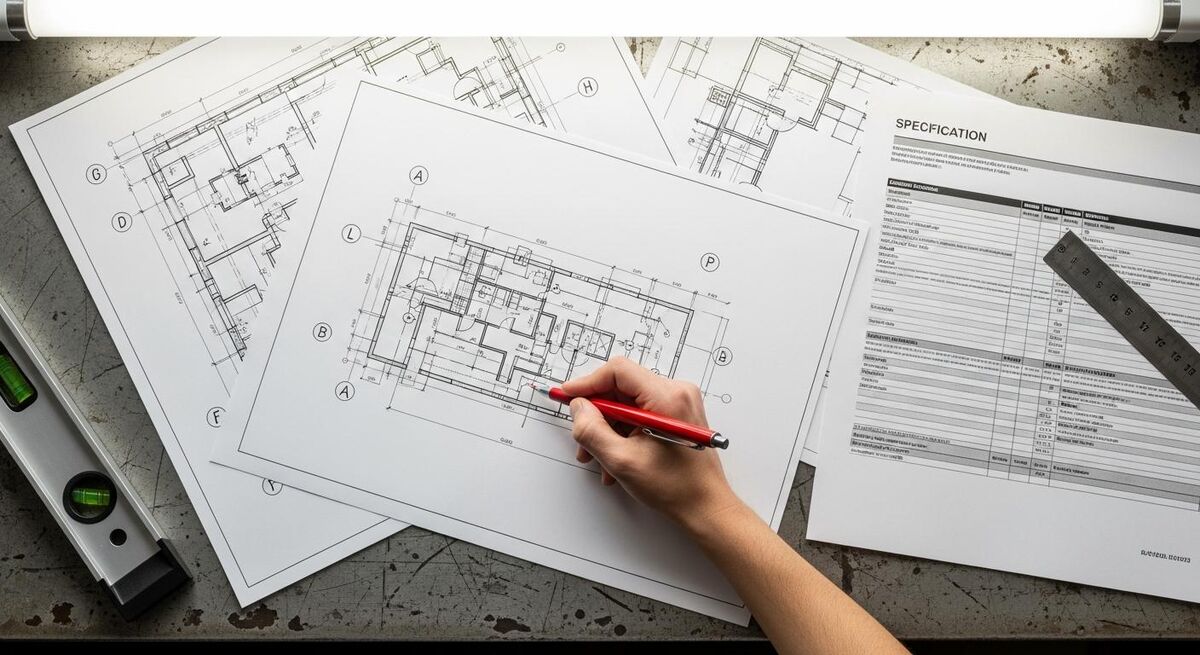
A trade is a craft. And when it comes to contracts, the scope of works is where that craft meets commercial reality. This clause defines exactly what the subcontractor will do, what they will not do, and what standards they will work to. Get it wrong and everything else in the contract is built on sand.
Your scope clause needs to answer five questions unambiguously:
What work is included? List every task. Not "plumbing works" but "first fix plumbing to kitchen and two bathrooms per drawing Rev C, including all pipe runs, waste connections, and valve installations." Attach the drawings. Reference specific specifications. Leave nothing to assumption.
What work is excluded? This is where most disputes start. If you are doing the first fix but not the second fix, say so. If you are supplying labour but the main contractor supplies materials, spell that out. Exclusions matter as much as inclusions.
What standards apply? Reference the relevant British Standards, Building Regulations, and any manufacturer requirements. For electrical work, reference BS 7671. For gas work, reference Gas Safe requirements. For general construction, reference the Building Regulations applicable to the project.
What are the completion milestones? "Complete by end of March" is vague. "First fix complete and tested by 28 March 2026, second fix complete by 18 April 2026" gives both parties something measurable to work from.
What happens if defects are found? The subcontractor should have the right to return and remedy defective work at their own cost within a reasonable period. Without this clause, the main contractor might hire someone else and send you a bill at twice the price.
For trades businesses working on domestic projects, the scope can be simpler. But it still needs to be written. A clear email confirming "I will install a Worcester Bosch 8000 Life combi boiler, relocate the flue to the east wall, and decommission the existing system. Does not include removal of old radiators or any pipework beyond the boiler connections" is infinitely better than a handshake.
Clause 2: Payment terms and the Construction Act
Payment is where most subcontractor relationships either work or fall apart. The good news is that UK law already provides significant protections through the Housing Grants, Construction and Regeneration Act 1996 (commonly called "the Construction Act"). The bad news is that many trades businesses do not know these protections exist, let alone how to use them.
Here is what the Construction Act gives you by default on any construction contract lasting 45 days or more:
Right to interim payments. You are entitled to stage payments as work progresses, not just a lump sum at the end. The frequency should be agreed between the parties, but if you cannot agree, the default is 28-day intervals.
Payment notices. The paying party must issue a payment notice within five days of each payment due date, stating the amount they intend to pay and how it was calculated.
Pay less notices. If the contractor wants to pay less than the notified amount, they must issue a separate "pay less notice" before the final date for payment. This notice must state the amount they intend to pay and the basis for the calculation. No valid pay less notice means the full amount is due.
No "pay when paid" clauses. Any clause that makes your payment conditional on the contractor receiving payment from their client is void. Full stop. It has been illegal since 1996 and the 2011 amendments reinforced this.
Right to suspend work. If you have not been paid a sum due under the contract, you can suspend your work after giving at least seven days' written notice. During suspension, the clock stops on your contractual obligations.
Beyond the statutory minimums, your payment clause should specify:
Payment amount and schedule. Fixed price, day rate, or measured work? Monthly applications or stage payments? The clearer this is, the fewer arguments you will have.
Invoice process. When to submit invoices, what format, who to send them to, and what supporting documentation is required. Many payment delays start because the invoice did not reach the right person or was missing a purchase order number.
Late payment interest. Under the Late Payment of Commercial Debts (Interest) Act 1998, you can charge interest at 8% above the Bank of England base rate on overdue invoices. Include this in your contract so nobody can claim they did not know.
The government's 2025 consultation has proposed a maximum payment term of 60 days across all commercial contracts, with statutory interest becoming mandatory. These reforms are expected to take effect in 2026, and they represent the most significant change to UK payment legislation in over 25 years. For trades businesses already struggling with changing business models, getting payment terms right is more important than ever.
Clause 3: Variation and change control

Variations are a fact of life in construction. Clients change their minds. Site conditions differ from what was expected. Building control requires modifications. The question is not whether variations will happen, but whether you have a process for handling them when they do.
A proactive approach to variation control is always going to pay dividends compared to the higher cost of sorting things out after the event. Your variation clause should cover four things:
How variations are instructed. Variations should only be valid if instructed in writing by an authorised person. Not a text message from someone on site. Not a verbal instruction from the client's architect's assistant. A written instruction, from a named person, with a description of the changed work.
How variations are priced. Options include: using rates from the original contract, agreeing a price before the work starts, or pricing on a daywork basis (time and materials). Whatever method you choose, agree it in advance. The worst time to negotiate a price is after the work is done.
How variations affect the programme. If extra work adds two weeks to the programme, the completion date should move by two weeks. Without this clause, the main contractor can instruct additional work and still hold you to the original completion date.
What happens to disputed variations. If you cannot agree on the price of a variation, the work should proceed (to avoid delaying the project) and the pricing dispute should be referred to the agreed dispute resolution process. This prevents a pricing disagreement from stopping work on site.
The key principle is documentation. Every variation should be recorded in writing before the work starts. A simple form with the date, description of changed work, price, time impact, and signatures of both parties is sufficient. Keep copies. If a dispute arises months later, that piece of paper is worth its weight in gold.
Clause 4: Insurance and indemnity requirements
Insurance clauses are not glamorous. Nobody got into the trades because they love reading about professional indemnity cover. But when something goes wrong on site, and eventually something always does, these clauses determine who picks up the bill.
Your subcontractor contract should specify the following insurance requirements as a minimum:
Public liability insurance. Covers damage to third-party property and injury to third parties. Most main contractors require a minimum of £2 million, with £5 million or £10 million on larger commercial projects. The subcontractor should provide a copy of their current certificate before starting work.
Employer's liability insurance. Legally required if the subcontractor has employees. Minimum cover is £5 million, but most policies provide £10 million. Even if the subcontractor is a sole trader, confirm their status in the contract.
Professional indemnity insurance. Required if the subcontractor has any design responsibility. This matters more every year as design-and-build contracts push design work down the supply chain to specialist subcontractors.
All risks / contractor's all risks insurance. Covers damage to the works themselves, including materials on site. Clarify who is responsible for insuring the works, as this varies between JCT and NEC contract suites.
The indemnity clause works alongside insurance. It says: "If your work causes damage or loss, you will compensate me for it." The insurance provides the money to fulfil that promise. Without both, you have either a promise without funding (indemnity without insurance) or funding without obligation (insurance without indemnity).
Check your subcontractor's insurance before every project, not just at the start of your relationship. Policies lapse. Cover amounts change. A certificate from eighteen months ago tells you nothing about today. Many CIS-registered contractors build insurance verification into their onboarding process, and that is exactly the right approach.
Clause 5: Dispute resolution and adjudication

The best contract clause is one you never need to use. But if a dispute does arise, your contract should set out a clear, affordable process for resolving it. Litigation (going to court) should always be the last resort. It is slow, expensive, and unpredictable.
The Construction Act gives every party to a construction contract the right to refer disputes to adjudication. This is a legally binding process that delivers a decision within 28 days. It is faster, cheaper, and less formal than court proceedings, making it well suited to trades businesses that cannot afford to wait 12-18 months for a court date.
A well-drafted dispute resolution clause typically follows a tiered approach:
Step 1: Direct negotiation. The parties attempt to resolve the dispute themselves within 14 days. Most disputes are resolved at this stage if both parties are acting in good faith and the contract terms are clear.
Step 2: Mediation. If negotiation fails, the parties appoint a mediator. Mediation is voluntary, confidential, and non-binding. The mediator helps the parties reach an agreement but cannot impose one. It typically costs £1,000-3,000 per party for a one-day mediation, which costs a fraction of adjudication or litigation.
Step 3: Adjudication. If mediation fails (or either party wants a binding decision), the dispute is referred to adjudication under the Construction Act. The adjudicator's decision is binding until the dispute is finally determined by litigation or arbitration. In practice, most adjudication decisions are accepted by both parties and the matter ends there.
Step 4: Litigation or arbitration. The final step. Arbitration is private and the parties choose their arbitrator. Litigation is through the courts. Both are expensive and time-consuming. The goal of steps 1-3 is to avoid ever reaching step 4.
One practical point. Adjudication works on a "pay now, argue later" principle. If the adjudicator decides that money is owed, it must be paid even if the losing party disagrees and intends to challenge the decision in court. This is deliberate. It keeps cash flowing through the supply chain while disputes are resolved. For subcontractors, this is the most important protection in UK construction law.
The retention question: 2026 reforms and what they mean
Retentions have been one of the most contentious issues in UK construction for decades. The practice involves withholding a percentage (typically 3-5%) of each payment as security against defects, releasing half at practical completion and the remainder at the end of the defect liability period.
The problem is straightforward. Around £4.5 billion is tied up in retentions across UK construction at any given time. And 44% of contractors have lost retention payments due to the insolvency of the party holding them. When a main contractor goes bust, your retention money disappears into the administration process alongside every other unsecured creditor's claim.
The government's July 2025 consultation proposed banning retention payments entirely from construction contracts. This would be a significant change. Until that legislation arrives, your contract should address retentions carefully.
If the contract includes a retention clause, ensure it specifies: the percentage held (and push for the lowest possible), the trigger for releasing the first half (practical completion of your works, not the whole project), the trigger for releasing the second half (end of your defect liability period), and what happens to retention money if the paying party becomes insolvent.
Some contractors now offer retention bonds or escrow accounts as alternatives. A retention bond is an insurance-backed guarantee that replaces cash retention. The subcontractor pays a small premium (typically 1-2% of the retention value) and keeps their cash. If defects arise, the bond pays out. This protects both parties, since the main contractor has security against defects and the subcontractor's cash is not at risk if the main contractor fails.
CIS and employment status: the clauses that protect you from HMRC

The Construction Industry Scheme (CIS) and employment status are not technically "dispute" clauses, but getting them wrong in your subcontractor contract creates problems with HMRC that make payment disputes look trivial. A clear contract helps establish the true nature of the working relationship and protects both parties.
Your contract should include clauses that confirm:
The subcontractor is self-employed in reality, not just on paper. This is not just about what the contract says. HMRC will look at the reality of the relationship. But a contract that reflects genuine self-employment supports your position. Key indicators include: the subcontractor provides their own tools and equipment, they can send a substitute, they bear financial risk (fixed price work rather than hourly pay), and they work for multiple clients.
CIS registration and verification details. The contractor must verify the subcontractor with HMRC before making the first payment. Include the subcontractor's UTR number and HMRC verification status (gross payment, standard deduction at 20%, or higher deduction at 30% for unverified subcontractors). From April 2026, contractors must also file nil returns in months with no subcontractor payments or notify HMRC of inactivity in advance.
CIS deduction responsibilities. State clearly who is responsible for making CIS deductions (the contractor), at what rate, and confirm that the subcontractor will receive a payment and deduction statement for each payment. This is a legal requirement, not optional.
If you are a subcontractor, our complete guide to CIS for contractors and subcontractors covers the scheme in detail, including the April 2026 changes and how to apply for gross payment status.
The relationship between financial distress in construction and contract compliance is direct. Businesses that cut corners on CIS compliance, insurance verification, and contractual documentation are disproportionately represented in insolvency statistics. Proper contracts are not bureaucracy. They are business survival.
What tradespeople are saying
Recommended videos

Construction Contracts: Key Clauses to Protect Your UK Business
LegalVision UK

How UK Construction Adjudication Works
Martin Burns

Common Methods for Resolving Construction Disputes
Legal and Practical Insights

What Causes Subcontractor Payment Disputes in Construction?
Construction Jobs

Why Construction Adjudication Works
No Disputing That

Avoiding Contract Disputes in Construction Projects
Contract Management Webinar
Frequently asked questions
Legally, no. A verbal agreement is binding. Practically, yes, every single time. Proving what was agreed verbally costs thousands in legal fees. A written contract costs nothing and prevents the dispute from happening in the first place. Even a detailed email exchange is better than a handshake.
The Housing Grants, Construction and Regeneration Act 1996 applies to virtually all construction contracts in England, Wales, and Scotland, including oral agreements since 2011. It gives you the right to interim payments, adjudication for disputes, and the ability to suspend work for non-payment. It does not apply to residential occupier contracts (where a homeowner directly employs someone to work on their own home).
No. "Pay when paid" clauses have been void since the Construction Act was introduced in 1998. Your right to payment is independent of the main contractor's relationship with their client. If your contract includes such a clause, it is unenforceable.
Adjudicator fees typically range from £2,000 to £5,000 for straightforward disputes, though complex cases can cost more. You will also need to prepare your case, which might involve a solicitor. Total costs for a straightforward adjudication are usually £5,000-15,000. Expensive, but a fraction of what litigation costs, and you get a binding decision within 28 days.
JCT contracts are used on about 70% of UK building projects, so most trades businesses encounter them more often. NEC contracts are more common on infrastructure and public sector projects. For smaller trades businesses, a bespoke subcontract or an industry template from the FMB or an equivalent trade body is often more practical than either standard form.
First, check whether you have received a valid pay less notice. If not, the full amount is due. Send a formal letter before action giving 14 days to pay. If that fails, give seven days' written notice and suspend work. If the amount is under £10,000, consider small claims court. For larger amounts, adjudication is your fastest route to a binding decision.
Currently, yes. Retention deductions are legal if the contract provides for them. However, the government's July 2025 consultation proposed banning retentions entirely from construction contracts. Until that legislation arrives, you can negotiate lower retention percentages, push for retention bonds instead of cash retention, and ensure your contract specifies clear release triggers.
My verdict
Scaling is a funny thing. Scale too quickly and the cracks show. Scale without the proper resourcing and you lose people and clients. The same applies to subcontractor relationships. Every trades business that grows beyond a one-person operation will eventually rely on subcontractors. And the difference between the businesses that grow smoothly and the ones that get dragged through disputes comes down to whether they had proper contracts in place.
I have seen trades businesses lose tens of thousands to disputes that a two-page written agreement would have prevented. The five clauses in this article are not complicated. Scope, payment, variations, insurance, dispute resolution. Get those right, get them in writing, and you eliminate the vast majority of arguments before they start.
The Construction Act already gives you strong statutory protections. Use them. Do not let anyone contract you out of them. And if you are not sure whether your contracts are fit for purpose and above board, spend five hundred pounds on a solicitor review. That is the cheapest insurance you will ever buy.
Book the checks now while you still have options.
Ready to Transform Your Business?
Turn every engineer into your best engineer and solve recruitment bottlenecks
Join the TrainAR Waitlist