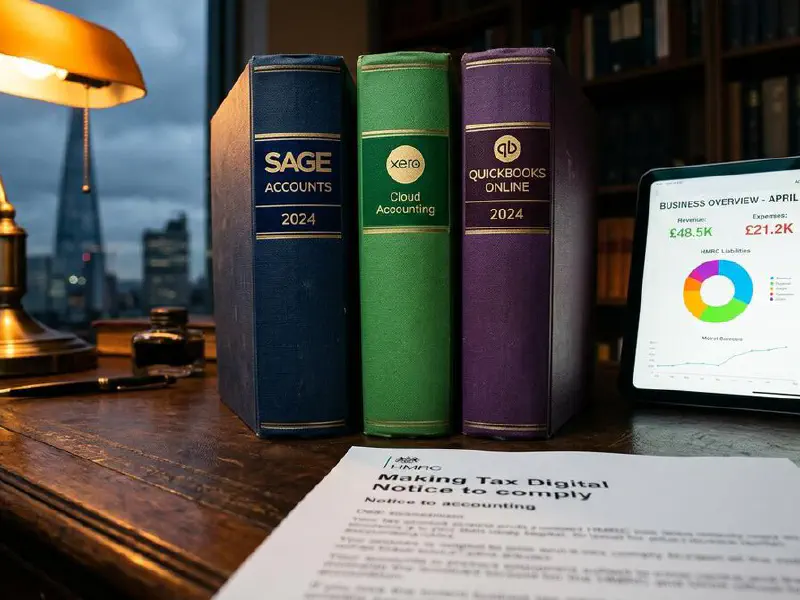

Quick Answer
If you spend less than about 12 percent of turnover on materials, flat rate VAT can save you a few hundred to a couple of thousand pounds a year. If you buy a van, tools, or carry stock at any real scale, standard VAT wins, often by £2,000 to £5,000 a year. The 16.5 percent limited cost trader rate kills the scheme for labour-heavy trades. Run both numbers on twelve months of real invoices before you tick the box.
Table of Contents
- What has actually changed in 2026
- Flat rate and standard VAT, side by side
- The 2026 flat rate percentages for trades
- The decision calculator (with three worked examples)
- The limited cost trader trap that catches most sole traders
- Domestic reverse charge: why most CIS subbies should leave
- Setting up flat rate in Xero and QuickBooks
- Using AI to analyse your actual expenses
- What tradespeople are saying
- Recommended videos
- Frequently asked questions
- My verdict
 HMRC
HMRC Xero
Xero QuickBooks
 Sage
Sage Claude
What has actually changed in 2026
Not much, which is the first thing worth saying. The VAT registration threshold stays at £90,000 from 1 April 2026, and the deregistration threshold sits at £88,000. The flat rate joining threshold remains £150,000 of taxable turnover, with the exit threshold at £230,000 of VAT-inclusive turnover. The sector percentages have not moved. The 16.5 percent limited cost trader rate, introduced in April 2017, is still in force.
What has changed is HMRC's appetite. From April 2026 new powers from the Autumn Budget 2025 allow HMRC to cancel Gross Payment Status under CIS and impose penalties on directors linked to fraudulent supply chains. Enforcement of the construction domestic reverse charge has moved from light-touch to active enquiries. If your flat rate paperwork has been a bit rough, this is the year to clean it up.
The other thing that has changed is the cost of getting the choice wrong. With material prices still climbing and margins thin, leaving £2,000 to £5,000 a year on HMRC's side of the table is a real number. I have seen sole trader heating engineers do exactly that for three years running, because flat rate "felt simpler" and nobody ran the comparison.
Flat rate and standard VAT, side by side
Standard VAT is straightforward in principle. You charge 20 percent on your sales. You add up the VAT you have paid on your purchases. You pay HMRC the difference each quarter. The admin is in the input tax: every fuel receipt, every parts invoice, every Screwfix run has to be captured and coded.
Flat rate is a shortcut. You still charge customers 20 percent on the sale. You then pay HMRC a fixed percentage of your gross, VAT-inclusive turnover. You do not separately reclaim VAT on day-to-day purchases. The percentage depends on your trade sector and is supposed to bake in an average for the input tax you would otherwise have claimed.
The maths is simpler than the marketing makes it sound. On £100,000 plus VAT (£120,000 gross), a general builder on 9.5 percent pays HMRC £11,400. On standard VAT, the same builder paying £15,000 of VAT on materials and overheads would pay HMRC £5,000. The flat rate path costs £6,400 more in this case. For a labour-only carpenter with hardly any input VAT, the maths swings the other way.
| What you do | Standard VAT | Flat rate VAT |
|---|---|---|
| Charge customers | 20% on every sale | 20% on every sale |
| Pay HMRC | Output VAT minus input VAT | Fixed % of gross turnover |
| Reclaim VAT on purchases | Yes, line by line | No (except single capital items over £2,000 inc VAT) |
| Joining threshold | None once registered | £150,000 taxable turnover |
| Exit threshold | £88,000 to deregister | £230,000 VAT-inclusive turnover |
| Admin burden | Higher: every receipt coded | Lower: sales only |
| Risk | Errors in input tax claims | Wrong sector code; LCT rule |
There is one other quiet advantage to flat rate that nobody mentions. In your first 12 months of VAT registration you get a 1 percent discount on whatever sector rate applies to you. A general builder pays 8.5 percent instead of 9.5 percent for that first year. On a £120,000 gross turnover that is £1,200 of free money, assuming the scheme makes sense for you in the first place.
The 2026 flat rate percentages for trades
HMRC publishes about 55 sector rates in VAT Notice 733. Most trades fall into one of four lines on that table. Pick the wrong one and HMRC will, eventually, find you. They have been clearer than usual in their guidance updates: use ordinary English, choose the sector that most closely describes what your business does in the coming year, and document why you picked it.
| Trade | Flat rate | First-year rate | Notes |
|---|---|---|---|
| General building or construction (materials >10% of turnover) | 9.5% | 8.5% | Plumbers, electricians and heating engineers who supply parts |
| Labour-only building or construction services | 14.5% | 13.5% | Materials less than 10% of turnover |
| Carpentry (materials <10%) | 12% (any other activity) | 11% | Or 9.5% if materials are 10% or more |
| Repairing personal or household goods | 10% | 9% | Locksmiths, appliance repair, small handyman work |
| Decorating | 12% | 11% | Falls under "any other activity" unless materials >10% |
| Architect, civil and structural engineer or surveyor | 14.5% | 13.5% | Highest sector rate |
| Limited cost trader (any sector) | 16.5% | 15.5% | Goods spend below 2% of turnover OR below £1,000/year |
The 10 percent materials threshold is the one that catches people out. A heating engineer who fits boilers and runs jobs on a supply-and-fit basis will be well over it. A heating engineer who does service calls on a "you buy the boiler, I'll fit it" basis is on the wrong side, and lands at 14.5 percent labour-only.
If you cannot honestly say which side of 10 percent you are on, that is your answer. Take the calculator from our cash flow forecasting guide and back into the number from twelve months of bank statements. A practitioner I worked with in Reading was certain he was a "general builder" until he counted up materials at 7 percent of turnover. He had been declaring the wrong rate for two years.
The decision calculator (with three worked examples)
The decision is arithmetic, not opinion. You need four numbers from your last 12 months:
- Gross VAT-inclusive turnover (sales including the 20 percent VAT charged)
- Total input VAT paid (the VAT element of every purchase you would otherwise reclaim)
- Your sector flat rate (from the table above)
- Whether you are in your first year of VAT registration (1 percent discount applies)
The calculation is simple. Flat rate cost is the gross turnover multiplied by the flat rate percentage. Standard scheme cost is the output VAT (turnover divided by 6 if your gross is VAT-inclusive) minus the input VAT. Whichever is lower wins. Here are three worked examples for trades I see most often.
Example 1: Solo gas engineer supplying boilers
Mike runs a one-man heating business in Coventry. He bills £108,000 plus VAT (£129,600 gross). He fits roughly 35 boilers a year at an average parts cost of £1,400 plus VAT, so his material VAT is around £9,800. He spends another £3,200 on tools, fuel, accounting, software and van running costs (VAT element).
| Calculation | Standard VAT | Flat rate (9.5%) |
|---|---|---|
| Output VAT collected (20% on £108,000) | £21,600 | n/a |
| Input VAT reclaimed | £13,000 | £0 |
| Flat rate calculation (9.5% of £129,600) | n/a | £12,312 |
| VAT paid to HMRC | £8,600 | £12,312 |
Mike is £3,712 a year worse off on flat rate. Standard VAT wins clearly. The materials-heavy nature of boiler installs means his input VAT is sizeable, and 9.5 percent of gross does not come close to compensating.
Example 2: Self-employed electrician, mostly maintenance
Sarah does domestic maintenance and small commercial jobs in Bristol. Gross turnover £84,000 plus VAT (£100,800), so she has just registered voluntarily to charge VAT to her commercial clients. Materials are roughly 12 percent of turnover. Total input VAT, including £3,400 on a van purchase, comes to £4,800.
| Calculation | Standard VAT | Flat rate (8.5% first year) |
|---|---|---|
| Output VAT collected (20% on £84,000) | £16,800 | n/a |
| Input VAT reclaimed (excl. van) | £1,400 | £0 |
| Van VAT reclaim (single capital item over £2,000) | £3,400 | £3,400 |
| Flat rate calculation (8.5% of £100,800) | n/a | £8,568 |
| VAT paid to HMRC | £12,000 | £5,168 |
Sarah saves £6,832 in her first year on flat rate. The 1 percent discount alone is worth £1,008. In her second year at the full 9.5 percent rate she would save £5,800, still a clean win. Note that the van VAT is reclaimable on both schemes because it is a single capital item over £2,000 including VAT.
Example 3: Decorating sole trader, mostly labour
Tom paints and decorates in Leeds. Customers supply most materials. Gross turnover £75,600 plus VAT (£90,720). Input VAT for the year, including paint, dust sheets, brushes, accountancy and fuel, totals £820. He spends less than 2 percent of turnover on goods, which puts him in limited cost trader territory.
| Calculation | Standard VAT | Flat rate (16.5% LCT) |
|---|---|---|
| Output VAT collected (20% on £75,600) | £15,120 | n/a |
| Input VAT reclaimed | £820 | £0 |
| Flat rate calculation (16.5% of £90,720) | n/a | £14,969 |
| VAT paid to HMRC | £14,300 | £14,969 |
Tom loses £669 a year on flat rate, plus admin time he does not get back. The 16.5 percent rate, designed to remove the benefit for labour-only traders, does exactly that. Three years ago a calculation like this would have shown a labour-only decorator saving £3,000 on the old 12 percent rate. The rules now make that impossible.
The limited cost trader trap that catches most sole traders
The 16.5 percent rate exists because HMRC noticed that thousands of consultants, IT contractors and labour-only trades were quietly making £3,000 to £5,000 a year on the scheme. The Treasury wanted that money back. They got it.
The rule is straightforward but unforgiving. Each VAT period (usually each quarter), you check your goods spend. If your spend on "relevant goods" is either less than 2 percent of your VAT-inclusive turnover for that quarter, or more than 2 percent but less than £250 (the £1,000 a year pro-rated), you fail the test and pay 16.5 percent for that quarter.
Relevant goods does not include services, fuel (unless you are in transport), food and drink for you or your staff, capital assets, or goods bought for resale not used by your business. It is a narrower definition than the everyday meaning of "goods". A subscription to Xero is a service, not goods. Your phone bill is a service. Your accountant's invoice is a service. The £2,000 power tool you bought for one job is a capital asset.
For most labour-only trades, painters and decorators, jobbing carpenters, handymen, gardeners, mobile beauty therapists doing house calls, the LCT test is hard to pass. If you are passing it some quarters and failing others, your VAT bill swings between 9.5 percent and 16.5 percent, and the admin saving you joined the scheme for evaporates. At that point standard VAT is simpler.
Domestic reverse charge: why most CIS subbies should leave
If you are CIS-registered and most of your work is for other VAT-registered contractors rather than end users, the domestic reverse charge applies. You do not charge VAT on those invoices. The contractor accounts for the VAT on their own return.
This is a problem for flat rate. Under the scheme you still owe HMRC 9.5 percent (or whatever your sector rate is) of your gross turnover, even though you collected no VAT from your customer. You are paying VAT out of your own pocket on every reverse-charge invoice. The AccountingWEB and ContractorUK forums are full of sole trader subbies who realised this six months too late.
HMRC's official guidance for builders affected by reverse charge is: review the scheme. In practice that means leave it. The few who stay are those whose work splits roughly 50/50 between reverse-charge B2B work and end-user direct work where they still charge VAT. Anything heavier than 60 percent reverse charge, and the scheme actively loses you money.
The exit is simple. Write to HMRC, state the date you want to leave (you cannot backdate), and switch your software to standard VAT for the next return. You cannot rejoin the scheme for 12 months afterwards, so it is not a decision to flip on a hunch.
Setting up flat rate in Xero and QuickBooks

In Xero, the switch is under Settings > General Settings > Financial Settings. Set VAT scheme to "Flat rate cash" or "Flat rate accrual" depending on how you currently account, and enter your sector percentage. Xero handles the calculation automatically when you run a VAT return through the Making Tax Digital (MTD) interface. Bridges to HMRC are baked in.
In QuickBooks, the path is Taxes > Edit VAT > Edit settings. Pick "Flat rate" and enter the percentage. QuickBooks splits a "flat rate adjustment" out automatically so your profit and loss reflects the scheme. Both platforms handle the 1 percent first-year discount if you tell them your registration date.
One detail worth catching: under flat rate you should not be reclaiming input VAT on day-to-day expenses. Both Xero and QuickBooks will still let you mark a bill as "VAT applicable" and the system will quietly add it to a reclaim that never happens. Switch your default to "no VAT" on expenses to avoid clutter. The exception is single capital items over £2,000 including VAT, which both packages handle as a separate line.
If you are still picking the right software for this, our Xero vs QuickBooks vs Sage comparison for trades walks through MTD Phase 2 readiness and pricing for sole traders.
Using AI to analyse your actual expenses
This is where I lean on AI more than I used to. A year of bank statements is 2,000 to 4,000 transactions for an active sole trader. Categorising them by hand to work out what is materials and what is overhead is a Sunday afternoon you do not get back.
I drop a CSV export from my bank into Claude with a prompt along the lines of: "Categorise every transaction by VAT-relevant goods, services, fuel, capital assets over £2,000, or non-business. For each, estimate the VAT element where the supplier is likely VAT-registered." It is not perfect. You will still want to eyeball the output before you trust it. But it cuts an eight-hour job to about forty minutes.
The output gives you the two numbers you need: total input VAT for the standard scheme calculation, and total goods spend for the LCT test. From there the flat rate decision becomes arithmetic. I do this every six months for my own businesses and recommend the same cadence to anyone I work with.
For a more formal monthly review, our monthly management accounts template using Claude Cowork bakes the VAT scheme check into the routine. Once a quarter is enough for the decision. Once a month is enough to spot a quarter where you have drifted into limited cost trader territory.
What tradespeople are saying
Recommended videos

VAT Flat Rate Scheme Explained (Basics)
Heelan Associates
Flat Rate VAT Explained: Is It Still Worth It?
Small Business Toolbox

Save Money On Your VAT: Flat Rate Scheme
Tony D | The Chief Finance Officer

How the Flat Rate Scheme for VAT Works in Xero
Xero

How to Register for VAT in the UK (2025-26 Guide)
My Tax Advisor

The Secrets of Flat Rate VAT
1st Formations
Frequently asked questions
Only if most of your customers are themselves VAT-registered businesses. They reclaim the VAT you charge so it costs them nothing, and you start reclaiming on your purchases. If you mainly serve homeowners, voluntary registration is a 20 percent price rise you cannot pass on. Stay below the threshold for as long as you can.
You can leave flat rate at any time by writing to HMRC. You cannot rejoin for 12 months. In practice, most sole traders pick one scheme and stick with it for at least a year because the admin of switching mid-period is not worth small savings.
Yes. The flat rate scheme lets you reclaim VAT on single capital items where the total invoice (including VAT) is more than £2,000. A £18,000 plus VAT van comfortably qualifies. The same rule does not apply to lots of small items that together exceed £2,000.
HMRC can reassess you back to the date you joined the scheme and charge the difference. They can also charge interest and penalties. Document your reasoning when you pick a sector and keep that note. If you switch what you do (move from labour-only to supply-and-fit, for example), update your sector and tell HMRC in writing.
You still need MTD-compliant software to file VAT returns. Both Xero and QuickBooks handle flat rate inside their MTD bridges. You cannot file flat rate returns on paper or through the old HMRC portal.
Almost certainly not. Domestic reverse charge applies to most CIS subbie work, which means you do not charge VAT but still owe flat rate on your gross. You are paying HMRC out of your own pocket. Run the numbers, but most CIS subcontractors should leave the scheme.
Yes. The rules are the same for sole traders, partnerships and limited companies. Many micro businesses run as a Ltd with a director and one or two employees and use flat rate for the admin savings. Run the same calculation.
HMRC assesses the back-VAT (the difference between 16.5 percent and your declared rate) for every affected quarter. Default surcharge applies if you have other VAT issues. Deliberate inaccuracies get higher penalties. The realistic worst case for two years of wrong returns is £4,000 to £10,000 for a sole trader at the higher end of the threshold.
My verdict
Flat rate VAT is not simpler. It is a different kind of complexity, with one big benefit (less receipt-coding) and three real risks (wrong sector, limited cost trader, reverse charge). The decision is arithmetic, and you only need four numbers from your last twelve months to make it. If you are a materials-heavy supply-and-fit trade, standard VAT almost always wins. If you are labour-only and do not buy enough goods to clear the 2 percent test, the 16.5 percent rate makes the scheme pointless. The middle band, light on materials, not a limited cost trader, not a reverse-charge subbie, is where the scheme earns its keep and can save you £2,000 to £5,000 a year. Spend an hour with last year's invoices, an AI assistant, and the calculator in this guide. Then talk to an accountant. The cost of getting this right is one hour. The cost of getting it wrong runs for years.