
Quick Answer
If you employ five or more people in a trades business, you need a written employee handbook. Not because it looks professional (though it does), but because UK employment law now requires written health and safety policies at that threshold, and the new Employment Rights Act 2025 has changed sick pay, dismissal rules, and record-keeping obligations from April 2026. This free template gives you every section a growing trades business needs, from van use policy to disciplinary procedures, all updated for 2026 law. Download it, customise it to your trade, and get it signed.
Table of Contents
- Why your trades business needs an employee handbook
- 2026 employment law changes that affect your handbook
- The 12 sections every trades handbook needs
- Trades-specific policies other templates miss
- How to customise the template for your trade
- Using AI to draft handbook sections
- What tradespeople are saying
- Recommended videos
- Frequently asked questions
- My verdict
Why your trades business needs an employee handbook

I built Elite Heating and Plumbing to six engineers and three apprentices before I had anything resembling an employee handbook. Looking back, that was a risk I would not repeat.
The reality for most trades businesses is the same. You take on your first lad, then a second, then suddenly you have got five or six people on the books and no written record of how things work. The rules are all in your head. That is fine until someone does something you did not expect, or until someone takes you to tribunal.
Employment tribunal single claims hit 10,424 in Q3 2025/26. That is a 61% increase year on year. Unfair dismissal claims alone jumped 72%. These are not big corporate disputes. Small businesses with no written procedures are the ones getting caught out.
The legal position is straightforward. Any business with five or more employees must have a written health and safety policy under the Health and Safety at Work Act 1974. Every employee must receive a written statement of employment particulars from day one. And if you end up at tribunal without documented disciplinary or grievance procedures that follow the ACAS Code of Practice, the tribunal can adjust your award by up to 25% against you.
An employee handbook pulls all of this together into one document. It protects you and it protects your staff. It sets expectations clearly so nobody is guessing.
2026 employment law changes that affect your handbook

The Employment Rights Act 2025 received Royal Assent on 18 December 2025 and the first wave of changes landed in April 2026. If your handbook was last updated before then, it is already out of date.
The changes that matter most for trades businesses fall into three areas.
Statutory sick pay from day one. SSP is now payable from the first day of sickness absence, not the fourth. The lower earnings limit has been removed entirely, so part-time and lower-paid workers who previously got nothing now qualify. The new calculation is the lower of 80% of average weekly earnings or the statutory weekly rate of £123.25. Your handbook needs to reflect this. No more three waiting days.
For trades businesses with engineers who pick up minor injuries on site, this is a real cost increase. The government estimates £450 million a year in additional SSP costs across all employers. Your sickness absence policy needs updating.
Holiday record keeping. From April 2026 you must retain holiday records for six years. Failure to do so is a criminal offence with unlimited fines, enforced by the new Fair Work Agency. If your current system is a whiteboard in the office or a WhatsApp group, that will not cut it anymore.
The Fair Work Agency. Launched on 7 April 2026, this new enforcement body consolidates several existing regulators. It has powers to enter premises with a warrant, compel production of documents, and bring civil proceedings in the Employment Tribunal on behalf of workers. For trades businesses that have been a bit relaxed about documentation, this changes the calculation.
More changes are coming in October 2026 and January 2027. Fire and rehire becomes automatically unfair dismissal. The unfair dismissal qualifying period drops from two years to six months (applied retrospectively from January 2027, meaning anyone hired on or before 1 July 2026 will be covered immediately). The government estimates an additional six million workers will gain unfair dismissal rights.
The 12 sections every trades handbook needs
Generic employee handbook templates from HR websites cover the basics, but they miss the policies that trades businesses actually need. Here are the 12 sections this template includes, and why each one matters.
1. Welcome and company overview. Keep it short. Who you are, what you do, and what you expect from the team. Two paragraphs maximum.
2. Employment terms. Hours, pay frequency, overtime arrangements, and probationary period. Reference the written statement of employment particulars (which every employee must receive from day one under Section 1 of the Employment Rights Act 1996).
3. Health and safety policy. Legally required for businesses with five or more employees. Must include a statement of intent signed by the business owner, the organisational structure for health and safety responsibilities, and the practical arrangements including risk assessments, COSHH, and first aid.
4. Disciplinary and grievance procedures. Must align with the ACAS Code of Practice. The five steps: investigate, inform in writing, hold a meeting, allow accompaniment, decide and provide right of appeal. If your procedure does not follow this code and you end up at tribunal, your award could be adjusted by 25% against you.
5. Absence and sickness policy. Updated for 2026: SSP from day one, no lower earnings limit, new calculation method. Include your reporting procedure (who to contact, by when), return-to-work process, and trigger points for formal absence management.
6. Holiday and leave. Statutory minimum of 5.6 weeks (28 days for full-time). Include your booking process and any restricted periods. Critically, state how records are kept, because from April 2026 you must retain them for six years.
7. Equal opportunities and anti-discrimination. Required under the Equality Act 2010. Cover the nine protected characteristics and state clearly that discrimination, harassment, and victimisation will not be tolerated.
8. Data protection and GDPR. Required under UK GDPR. How you collect, store, and use employee data. Particularly important for trades businesses using GPS tracking in vans or monitoring software on company devices.
9. Company vehicle and van use policy. This is where generic templates fall down completely. Most trades businesses provide vans. You need rules on personal use, maintenance reporting, fuel management, licence checks, smoking, passengers, insurance, and what happens if an employee picks up penalty points.
10. PPE and uniform policy. What you provide, what they must wear, replacement procedures, and who pays for what. The Personal Protective Equipment at Work Regulations (updated 2022) require employers to provide PPE at zero cost to all workers, including casual and agency staff.
11. Social media and communications. What employees can and cannot post about the company. Whether they can use their phones on site. Rules around photographing client properties. This one saves arguments.
12. Whistleblowing policy. From April 2026, sexual harassment is a qualifying disclosure under whistleblowing law. Every employer needs a clear reporting mechanism. Include who to report to and a commitment to no retaliation.
Trades-specific policies other templates miss
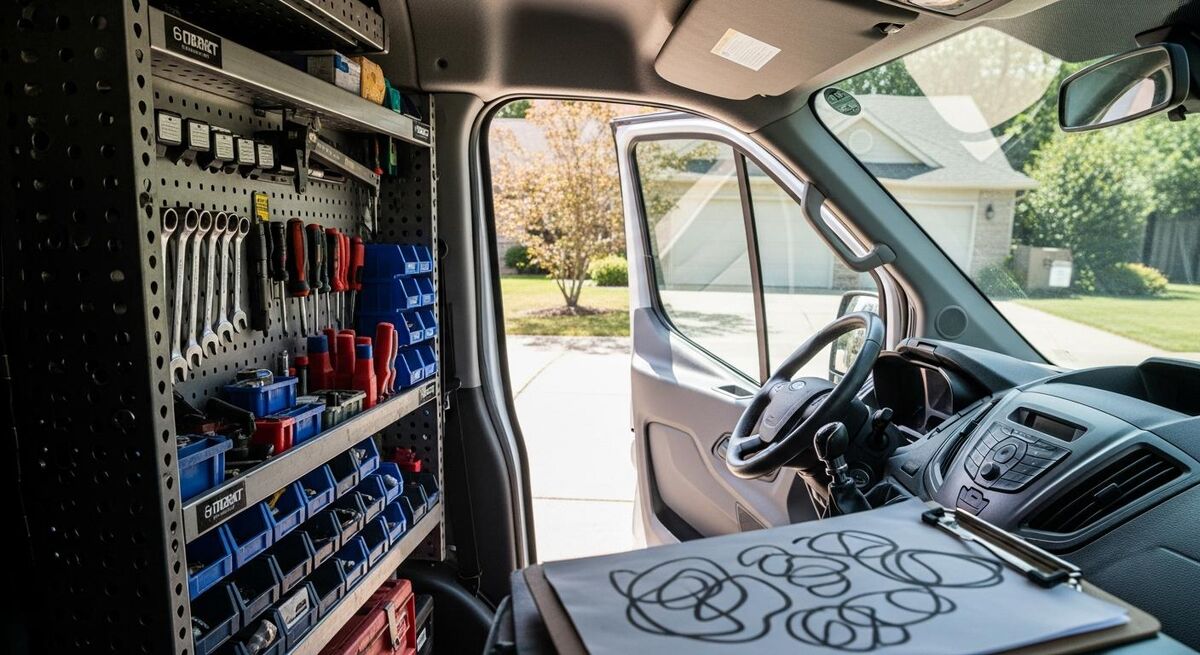
Every employee handbook template on the internet covers sickness absence and holiday entitlement. None of them cover what to do when an engineer puts diesel in the petrol van, or when someone leaves a customer's house without cleaning up.
The template included with this article has dedicated sections for trades-specific situations.
Van use policy. Covers eligibility, personal use rules (and tax implications), maintenance and defect reporting, fuel cards, dashcam use, smoking and vaping, passengers, private mileage, and the disciplinary consequences of misuse. Also covers what happens if an employee loses their licence. For a plumbing or electrical business with four or five vans on the road, this section alone can save thousands in disputes and insurance complications.
Tool and equipment accountability. Who is responsible for company tools issued to an employee. What happens when tools go missing. Whether employees can use their own tools on company jobs (and the insurance implications). Return procedures when someone leaves.
Site conduct and customer property. How engineers should conduct themselves in a client's home. Rules on footwear, dust sheets, tidying up, and communication. This ties directly to your reputation. One bad review from a messy job site can cost you more than any tribunal claim. As I have always said, when you are in someone's home fixing something they depend on, there is a trust element. The handshake, the diagnosis, the eye contact. That is your brand.
Working time and travel. How you handle travel between sites. Whether travel time counts as working time (the answer is often yes, under the Working Time Regulations 1998). Overtime rules. The 48-hour weekly limit and opt-out process. Rest breaks (20 minutes after six hours, 11 hours between shifts).
Drugs and alcohol. Construction has specific issues here. Around 20-30% of workplace accidents in safety-critical industries are associated with alcohol. Your policy should cover expectations, testing (if applicable), and the consequences. The Construction Leadership Council endorses a template drugs and alcohol policy which is worth referencing.
If you are looking for a structured way to get new starters up to speed on all these policies, our 5-day onboarding guide for new engineers walks through the process step by step.
How to customise the template for your trade
A plumber's handbook will not look identical to an electrician's. The template is designed to be edited, not used as-is.
Electrical businesses need to add sections on safe isolation procedures, permit-to-work systems, and the specific qualifications required (ECS card, BS 7671 compliance). Reference NICEIC or NAPIT registration requirements where applicable.
Gas and heating businesses should include Gas Safe registration requirements, annual competence assessments, and procedures for reporting unsafe situations (the Gas Industry Unsafe Situations Procedure). If you are completing CP12 landlord gas safety certificates, your handbook should reference the quality standards you expect.
General building and construction firms need CSCS card requirements, CDM Regulations awareness, and site-specific induction procedures. If your work involves working at height, confined spaces, or asbestos-containing materials, each of these needs its own section.
Multi-trade businesses running plumbing, electrical, and building divisions should have a core handbook plus trade-specific appendices. This keeps the main document manageable while covering specialisms properly.
Whichever trade you are in, print the handbook, give a copy to every employee, and get a signed acknowledgement form. That signed form is your evidence that they received it. Keep it in their personnel file. Digital signatures work too, as long as you can prove delivery and receipt.
Using AI to draft handbook sections

The template gives you the structure and the legally required wording. But if you want to customise sections further, AI tools like Claude or ChatGPT can speed up the drafting process considerably.
Give the AI your business type, number of employees, and the specific policy you need. Ask it to write in plain English suitable for a trades workforce. Be specific about UK employment law, because most AI tools default to US legal frameworks if you do not tell them otherwise.
A prompt like "Write a van use policy for a UK plumbing business with 8 employees and 5 company vans. Cover personal use, fuel cards, maintenance reporting, and disciplinary consequences. Use UK employment law and plain English" will give you something usable in about 30 seconds.
But here is the important bit. AI-generated content has no legal privilege. If you paste employee performance notes, disciplinary records, or complaint details into an AI tool, that data has left your control. Use AI for generic policy drafting, not for anything containing personal employee information.
And always, always get the final document reviewed by someone who knows employment law. An AI can draft a solid policy. It cannot tell you whether that policy would survive a tribunal challenge specific to your circumstances. Peninsula, Citation, and BrightHR all offer handbook review services starting from around £6-9 per employee per month. For a business with 5-10 staff, that is a small price for peace of mind.
What tradespeople are saying
Tools to help with your handbook
Recommended videos
What should be included in an employee handbook?
Silk Helix

2026 UK employment law changes: what your business needs to know
LegalVision

Disciplinary procedures: why and how (ACAS Code of Practice)
Silk Helix

April 2026 employment law changes, are you ready?
Jodie Hill

Essential HR policies for small businesses
Breathe HR

Why your business needs an employee handbook
Hammer and Grind Podcast
Frequently asked questions
Not the handbook itself, no. But several things that go inside one are legally required: a written statement of employment particulars (day one), a written health and safety policy (five or more staff), and documented disciplinary and grievance procedures if you want tribunal protection. Putting them all in a handbook is the sensible approach.
On day one, alongside their written statement of employment particulars. Get a signed acknowledgement form back. That signature is your evidence they received it. I always build this into the first morning of any new starter's induction.
You could, but you would be missing the trades-specific sections that actually matter. Van use, tool accountability, site conduct, PPE. Generic templates from HR websites cover the basics but not the things that cause real disputes in trades businesses. Use the template as a starting point, then customise it.
For a bespoke handbook from scratch, budget £1,500 to £3,000. But you do not need to start from zero. Use this template, customise it with AI tools, and then pay an employment law specialist £200 to £500 for a one-off review. That gives you 90% of the protection at a fraction of the cost.
The tribunal will ask what procedures you followed. If you did not follow the ACAS Code of Practice (because you did not have documented procedures), the tribunal can increase the award against you by up to 25%. Having a handbook with a clear disciplinary procedure is your baseline defence. Without it, you are starting from behind.
At minimum, annually. But with the Employment Rights Act 2025 rolling out changes through 2026 and into 2027, you should review it every time new legislation takes effect. April 2026, October 2026, and January 2027 are the key dates right now.
My verdict
Scaling is a funny thing. Scale too quickly and the cracks show. Scale without the proper resourcing and you lose people and clients. An employee handbook is part of that resourcing. It is not glamorous. It is not the reason you got into the trades. But it is the document that protects your business when things go sideways, and with unfair dismissal rights expanding to six million more workers in January 2027, the window for getting this sorted is closing. Download the template, spend a weekend customising it, get it reviewed, and hand it to every member of your team. If your business is serious about growing, your people deserve to know the rules.
Get more free templates for your trades business
The TrainAR Academy has free templates for invoices, job reports, subcontractor agreements, and more. All designed for UK trades businesses.
Browse all templates