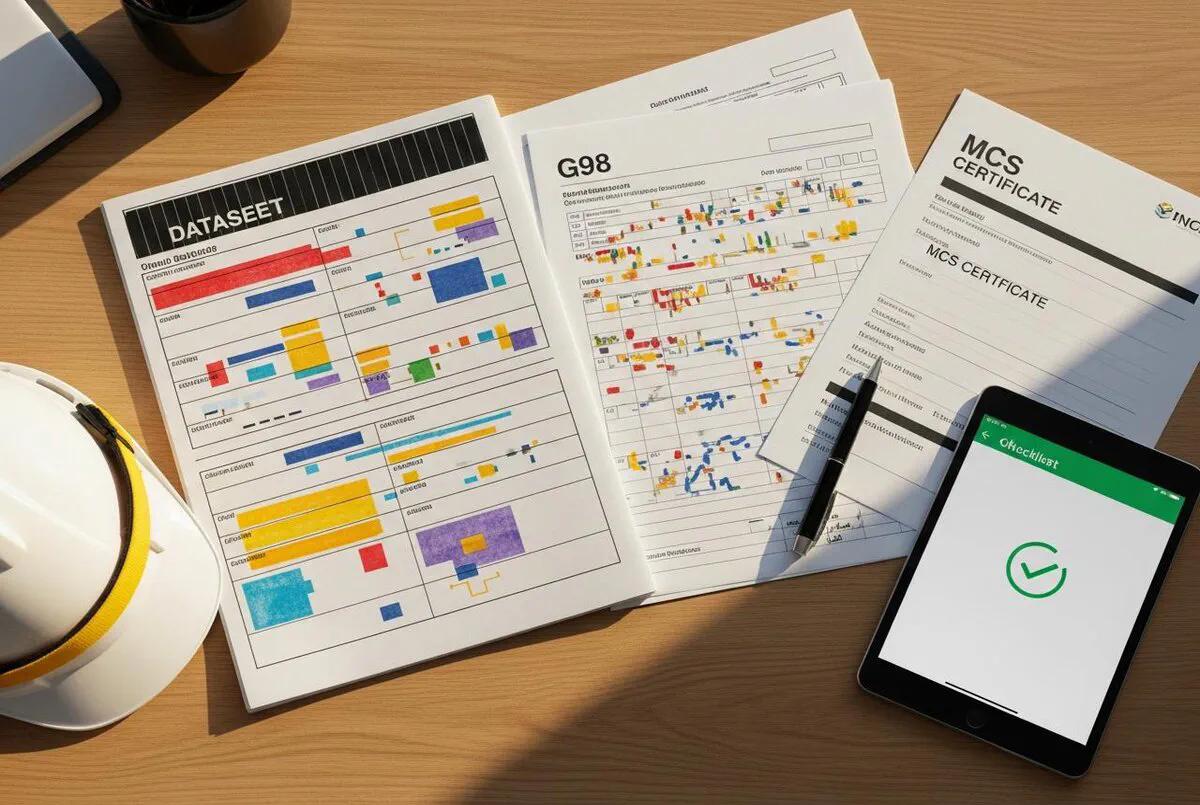

Quick Answer
This free checklist pack covers the four main compliance areas every renewable energy installer in the UK needs to get right: MCS certification documents, DNO notification (G98/G99), Part P electrical safety, and Part L energy efficiency. Print them, stick them in the van, and tick each box before you leave site. Missed paperwork causes roughly one in five failed inspections, and that costs you time and money you will not get back.
Table of Contents
 Payaca
What this checklist pack covers
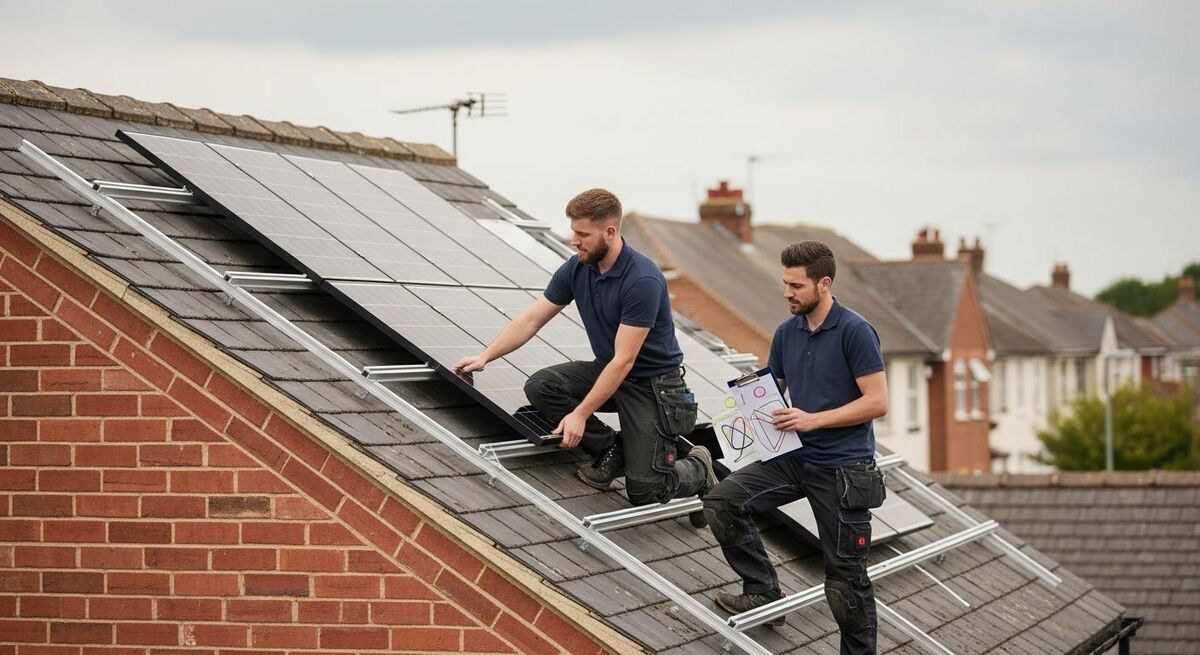
Renewable energy installations in the UK sit at the intersection of multiple regulatory frameworks. A single solar PV job can trigger MCS certification requirements, DNO notification obligations, Part P electrical safety compliance, and Part L energy efficiency standards. Miss any one of them and you risk failed inspections, delayed payments, or worse.
This pack bundles four separate checklists into one resource. Each checklist maps directly to a specific regulatory body or standard, so you know exactly who requires what and when. The checklists cover solar PV, air source heat pumps, ground source heat pumps, battery storage, and EV charger installations.
They are designed to be printed and used on site, or loaded into field service software like Payaca as digital forms. Either way, the goal is the same: nothing gets missed.
Solar installers, heat pump engineers, EV charger installers, and any renewable energy business that needs to stay compliant with MCS, DNO, Part P, and Part L requirements. Whether you are a sole trader or running a team of 20, the paperwork obligations are the same.
MCS compliance checklist
The Microgeneration Certification Scheme is the UK's quality mark for small-scale renewable energy. If your customers want access to the Smart Export Guarantee or other government incentives, MCS certification is not optional. The redeveloped MCS:2025 scheme, approved under the Clean Heat Market Mechanism from December 2025, raises the bar further.
Every MCS-certified installation requires a Nominated Technical Person (NTP) with an approved, in-date qualification. You need a minimum of two million pounds public liability insurance, and if you do any design work, 250,000 pounds professional indemnity cover on top. Your Quality Management System (QMS) needs to be documented, maintained, and audit-ready at all times.
The MCS audit itself runs in two stages. Stage one is office-based, where they review your QMS against MCS 001. Stage two is on-site, checking completed installations against the relevant technology standard, whether that is MIS 3002 for solar PV or MIS 3005 for heat pumps.
Per-installation MCS documentation
For every job, you need to produce and retain:
- MCS installation certificate (issued within 10 working days of commissioning)
- Commissioning record with test results
- System performance estimate with methodology
- Module layout drawing
- Product datasheets for all major components
- Electrical Installation Certificate (BS 7671 compliant)
- DNO notification confirmation
- Consumer code documentation
- Warranty details and maintenance requirements
- Financial protection product confirmation
- Customer handover pack with all of the above
Alongside these compliance documents, you will need to manage job reports, invoices, and safety certificates for every installation. Use our templates for job report forms, invoices, and gas safety certificates to streamline your documentation workflow.
Under the redeveloped MCS scheme, you must purchase an MCS-approved financial protection product for every domestic installation. This is a new requirement. Check the MCS directory for approved products before your next job.
MCS checklist summary
| Item | When required | Who checks |
|---|---|---|
| NTP qualification (in-date) | Always | Certification body |
| PL insurance (min. 2m) | Always | Certification body |
| PI insurance (min. 250k) | If doing design | Certification body |
| QMS documentation | Always | Annual audit |
| Installation certificate | Per job | MCS database |
| Commissioning record | Per job | Site audit |
| Performance estimate | Per job | Customer handover |
| Financial protection | Per domestic job | MCS directory |
| Consumer code membership | Always | CTSI-recognised code |
DNO notification checklist (G98/G99)
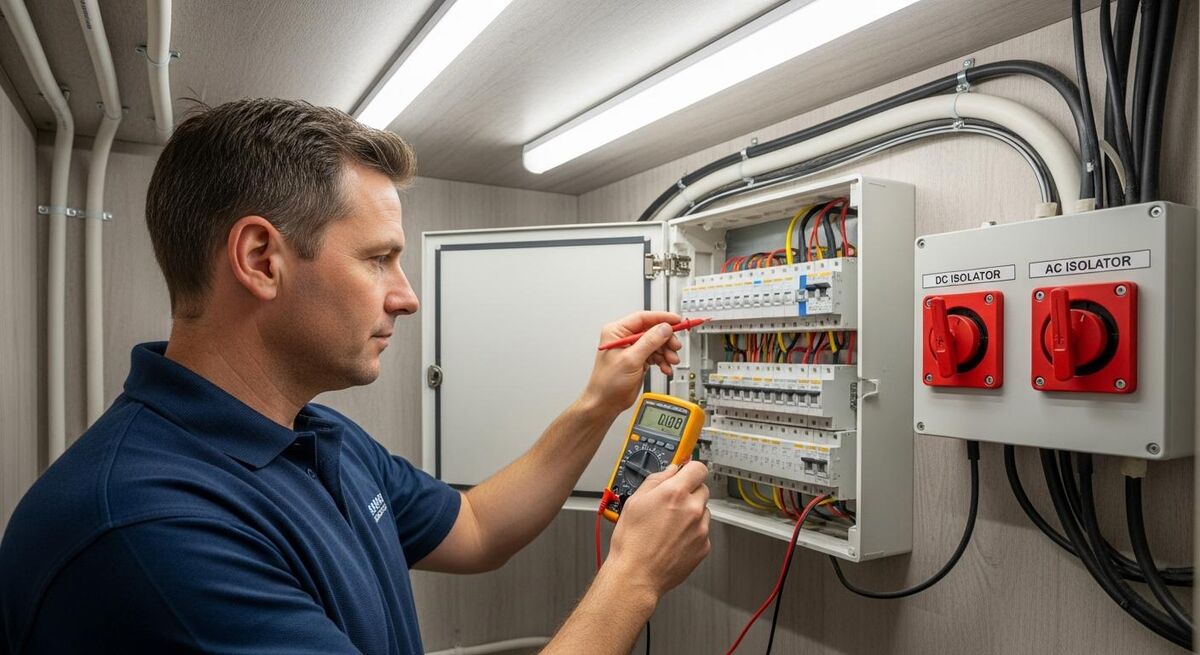
Every grid-connected renewable energy system must be notified to your local Distribution Network Operator. The process depends on system size, and getting it wrong can delay export payments or, in some cases, leave you personally liable.
For systems with inverter capacity up to 3.68 kW per phase, you follow the G98 process. This is "connect and notify", meaning you install the system first, then submit the completed G98 form to the DNO within 28 days of commissioning. The DNO then has up to four weeks to assess compliance.
Systems above 3.68 kW per phase require G99 approval. This is "apply then connect", and you must have DNO approval before installation begins. The G99 Fast Track route can return approval in 15 to 20 working days, but a full application can take 45 days or longer.
G98 checklist (systems up to 3.68 kW per phase)
- Confirm inverter maximum output is within G98 threshold
- Install and commission the system
- Complete the G98 notification form
- Include single-line diagram of the installation
- Include inverter ENA type test reference
- Submit to DNO within 28 days of commissioning
- Retain confirmation of DNO receipt
G99 checklist (systems above 3.68 kW per phase)
- Determine whether Fast Track or Full Application applies
- Complete the G99 application form with full system details
- Include single-line diagram and site layout
- Include protection settings and relay configurations
- Submit to DNO and await written approval
- Do not begin installation until approval is received
- After commissioning, submit the G99 commissioning confirmation
- Retain all correspondence and approval letters
Installing any heat pump adds significant demand to the local grid. Your DNO needs notifying either before installation (apply to connect) or within 28 days after commissioning (connect and notify), depending on the load. Do not assume heat pumps are exempt because they do not export.
Part P electrical compliance checklist
Part P of the Building Regulations covers electrical safety in dwellings. Any electrical work associated with a renewable energy installation, including the connection of solar inverters, battery storage systems, and EV charger circuits, falls under its scope.
If you are registered with a Part P competent person scheme (NICEIC, NAPIT, ELECSA, or similar), you can self-certify and notify building control directly. If you are not registered, you must notify your local building control body before starting work and pay for their inspection.
Part P requirements for renewable installations
- New circuit installation from consumer unit to inverter or charger
- Electrical Installation Certificate issued to BS 7671
- Building control notification (automatic if Part P registered, manual if not)
- Minor works certificate for modifications to existing circuits
- Verification of earthing and bonding arrangements
- Testing and inspection to BS 7671 Section 712 (solar PV specific)
- Confirmation of RCD protection where required
- Labelling of AC and DC isolators per BS 7671
The critical distinction: MCS covers installation quality and consumer protection. Part P covers electrical safety. You need both. A Part P-registered electrician can supply and certify the electrical circuit work, while an MCS-certified installer handles the renewable technology elements. Or one person does both if they hold both certifications.
Part L energy efficiency checklist
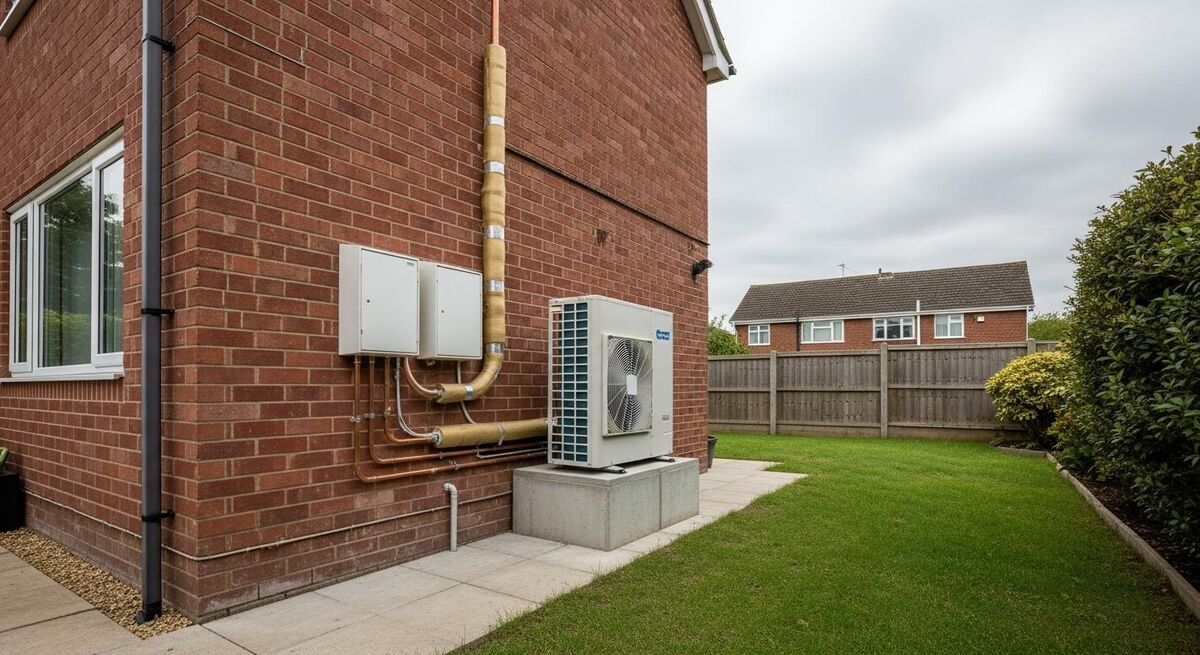
Part L of the Building Regulations deals with the conservation of fuel and power. For renewable energy installers, it matters most when you are working on new builds or major renovations. The Future Homes Standard, published in March 2026, pushes Part L requirements much further from 2027 onwards.
Under the current Part L (2021 edition with 2023 amendments), new homes must produce 31% less CO2 than the previous standard. Solar PV and low-carbon heating are the only realistic way to meet this target. Gas boilers in new builds will struggle to comply without massive PV arrays bolted on to compensate.
The 2026 update (effective from March 2027) goes further still. Heat pumps become the only realistic heating option for new-build compliance. SAP 10.3 is confirmed as the assessment methodology. Flow temperatures must be no higher than 55 degrees Celsius, and waste water heat recovery on all showers becomes mandatory.
Part L compliance checklist for installers
- Confirm whether the project is a new build, existing dwelling, or non-domestic
- Check which Part L edition applies (2021/2023 or 2026 when in force)
- Verify SAP or SBEM calculation has been completed
- Confirm heat pump flow temperature does not exceed 55 degrees C (new builds)
- Check solar PV array sizing against the 40% ground floor area guideline
- Ensure waste water heat recovery is specified (new builds from 2027)
- Retain EPC documentation showing compliance
- Confirm building control sign-off for any notifiable work
The tightening of Part L is good news for your order book. Every new-build project will need heat pump installation and many will need solar PV. Installers who can demonstrate Part L knowledge alongside MCS certification will be in strong demand from housebuilders and developers.
How Payaca helps with compliance tracking
Payaca is a field service management platform built specifically for renewable energy installers. Based in Bristol, it serves over 500 installers across the UK, from 10-person local businesses to national energy companies managing hundreds of technicians.
For compliance, the platform offers MCS-compliant proposal generation, document storage per project, and digital form creation for on-site checklists. You can attach commissioning records, certificates, and handover documents directly to each job. When your MCS audit comes around, everything is in one place rather than scattered across email threads and filing cabinets.
Payaca integrates with design tools like EasyPV, OpenSolar, and HeatPunk, so your proposals pull accurate system specifications rather than relying on manual data entry. It also supports DNO documentation by keeping all grid connection paperwork linked to the relevant project.
Pricing starts at 299 pounds per month on the Core plan, which includes proposal building, scheduling, CRM, invoicing, and basic automation. The platform also integrates with Xero and QuickBooks for accounting.
What installers are saying
Recommended videos
DNO Registration Made Simple: G98 & G99 Forms
DIY Solar UK
What is DNO Approval for Solar, Wind and Battery Storage
Grid Connection Guide

DNO Approval Explained for Solar and Home Batteries
Solar Explained
Get Started in Solar PV and Battery Storage: G99, G98 and MCS
NAPIT Training
Frequently asked questions
Not legally. You can install solar panels without MCS certification. But your customer will not be able to claim Smart Export Guarantee payments, and many finance products require MCS. In practice, being MCS-certified is table stakes for any serious renewables business.
The DNO can require you to disconnect the system until notification is completed. In practice, most DNOs will still accept a late notification, but it creates an unnecessary headache for you and your customer. Just build it into your commissioning process and it never becomes an issue.
Yes. Many solar installers are both MCS-certified and registered with a Part P competent person scheme like NICEIC or NAPIT. It means you can handle the full installation, from the renewable technology through to the electrical connections, without needing to sub out the electrical work.
Part L primarily affects new builds. For retrofits, you are more likely to deal with Part P (electrical) and possibly building control if the work involves structural changes. That said, if a retrofit triggers a material change of use or a major renovation, Part L requirements can kick in.
No. There are other field service platforms that can store documents and manage jobs. Payaca stands out because it was purpose-built for renewable energy installers and integrates with design tools like EasyPV and HeatPunk. But the checklists in this pack work regardless of what software you use.
My verdict
The renewables sector is growing fast and the regulatory framework is growing with it. MCS:2025, tightening Part L standards, DNO notification requirements; the paperwork is not going to get simpler any time soon. A structured checklist approach is the most reliable way to make sure nothing falls through the cracks. Print these, load them into your field service software, or tape them to the dashboard. Whatever works for you. The important thing is that every box gets ticked before you leave site.