Quick Answer
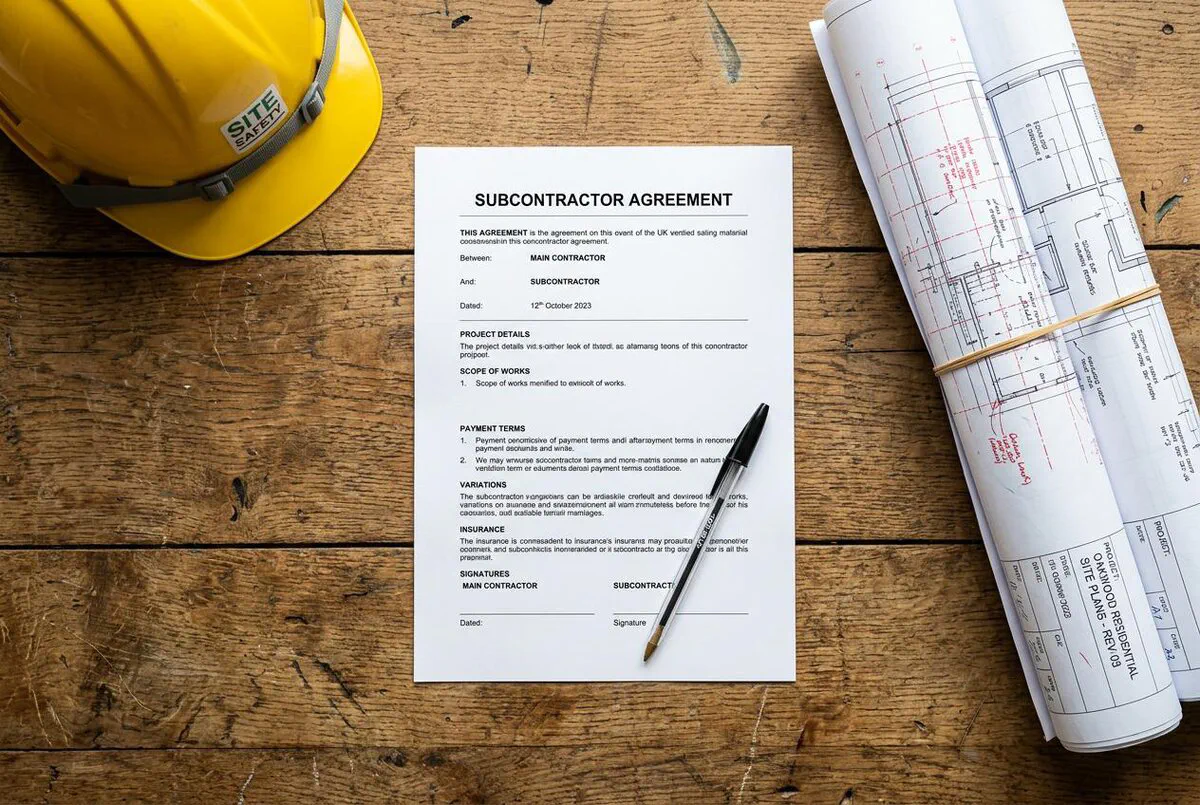
A subcontractor agreement protects both the contractor and the sub on every job. This free UK-specific template covers scope of works, payment terms (in line with the Construction Act 1996), CIS deduction status, employment status, health and safety, insurance requirements, defects liability, and adjudication rights. Download the Word document below, fill in the blanks, and get it signed before any work starts.

Table of Contents
Why every builder needs a written subcontractor agreement
Most payment disputes in UK construction come down to the same root cause: no written agreement, or one so vague it could mean anything. A handshake might feel fine when you are on good terms, but it is worth nothing when a main contractor stops returning your calls or starts raising contra-charges you never agreed to.
The Housing Grants, Construction and Regeneration Act 1996 gives subcontractors legal protections on payment, but only if you have a construction contract in place. Without one, you are relying on implied terms and goodwill. That is a risky position to be in.
A written agreement does several things at once. It pins down the scope of works so there is no "I never agreed to that" argument later. It sets clear payment dates, which triggers your adjudication rights if the contractor misses them. It records the CIS deduction rate, protecting both parties from HMRC disputes. And it confirms your self-employed status, reducing IR35 risk for everyone.
The good news: you do not need a solicitor to draft a solid working agreement for most trades jobs. The template below covers the essentials. If the job is large (say, over £100,000) or involves unusual risks, it is worth getting it reviewed. For everyday subcontracting work, this template will serve you well.

Download the free template
The template below is a Word document (.docx) that you can edit on any device. It covers all the key clauses for UK construction subcontracting, updated for 2026. Download it, fill in the highlighted fields, and get both parties to sign before work starts.
Important disclaimer
This template is a starting point, not legal advice. It is suitable for most straightforward UK subcontracting arrangements in construction and allied trades. For high-value contracts, specialist works (gas, electrical sign-off, structural), or anything with unusual risk, have a construction solicitor review it first. A few hundred pounds for a legal review is cheap compared to a £20,000 dispute.
Word Document (.docx)
Fully editable UK subcontractor agreement. Fill in the highlighted fields, add your logo, and print for signing. Compatible with Microsoft Word and Google Docs.
Word (.docx) · 40 KB · Updated March 2026 ↓ Download Word TemplateWhat this template covers
- Parties and CIS status
- Scope of works and programme
- Payment terms (Construction Act compliant)
- CIS deduction obligations
- Employment status and IR35
- Health and safety (CDM 2015)
- Insurance requirements
- Defects liability period
- Adjudication rights
- General provisions
- Signature block
How to use this template
Download the Word document and open it in Microsoft Word or Google Docs. Every blank you need to fill is marked with underscores (e.g. ______). Search for "______" to jump between fields. Once complete, print two copies, sign both, and each party keeps one original. Store your copy somewhere safe, ideally with photos of the signed page on your phone.
What each clause does
Here is a plain-English breakdown of every section in the template, what it covers, and what to watch out for.
Clause 1: Parties and CIS status
Records the contractor and subcontractor details including company names, addresses, and UTR (Unique Taxpayer Reference) numbers. Crucially, it captures the CIS payment status: gross (0% deduction), net (20% deduction), or unregistered (30% deduction). Both parties should verify this with HMRC before signing. The contractor is legally required to check and cannot take your word for it.
Clause 2: Scope of works
Defines exactly what the subcontractor is being paid to do. Be as specific as possible here. Vague descriptions like "groundworks" cause disputes when the main contractor argues it included something it did not. Reference drawings, specifications, and bill of quantities numbers. Include any exclusions too, for example "excludes concrete supply" or "excludes disposal of contaminated material".
Clause 3: Programme and completion
Sets the start date, completion date, and working hours. The template includes an optional liquidated damages clause, which fixes the cost per day for delay. Be careful here: liquidated damages are only enforceable if they represent a genuine pre-estimate of loss, not a penalty. If you include them, make sure the daily rate is realistic. If you are a subcontractor being asked to sign a contract with LDs, negotiate the rate down if possible.
Clause 4: Payment terms (Construction Act)
This is the most important clause. The Housing Grants, Construction and Regeneration Act 1996 requires a written construction contract to include adequate payment mechanisms. The template includes payment application dates, a payment notice period, and a final payment due date. It explicitly makes "pay when paid" clauses unenforceable, which they are under UK law (with one narrow exception: the employer's insolvency). Late payment interest is set at 8% above Bank of England base rate under the Late Payment of Commercial Debts Act 1998.
Clause 5: CIS obligations
Covers the contractor's obligations under the Construction Industry Scheme, including verifying the subcontractor's registration with HMRC before first payment and providing a CIS Payment and Deduction Statement within 14 days of the end of each tax month. This statement is your evidence for reclaiming CIS deductions at the end of the tax year, so make sure you always get it in writing.
Clause 6: Employment status
States clearly that the subcontractor is self-employed and not an employee. This reduces IR35 risk for the main contractor and confirms the sub is responsible for their own tax and NI. The template includes several of the factors HMRC looks at: the right to substitute workers, providing your own equipment, financial risk, and working for multiple clients. These should genuinely reflect the arrangement, not just be words on paper; a contract that misrepresents the real working relationship will not protect you from HMRC.
Clauses 7 and 8: Health and safety, and insurance
Sets out CDM 2015 compliance obligations and minimum insurance requirements. Most main contractors will require at least £2 million public liability; many now specify £5 million or more. Employers' liability insurance (£10 million minimum) is a legal requirement if you employ anyone. Make sure your policy covers the type of work you are doing, as some high-risk activities (asbestos removal, working at height, structural work) may need additional cover or endorsements.
Clauses 9 and 10: Defects liability and dispute resolution
The defects liability period (typically 6-12 months) is the period after practical completion during which the subcontractor must fix any defects at their own cost. It is directly linked to the release of retention. Clause 10 covers adjudication: the fast-track dispute resolution process that is statutory under the Construction Act. Either party can refer a dispute to an independent adjudicator at any time, and their decision is temporarily binding while the works proceed. Adjudication is far cheaper and quicker than court.

CIS: what goes in the agreement
The Construction Industry Scheme (CIS) applies to most construction work in the UK. If you are a main contractor bringing in a sub, you are legally required to verify their CIS status with HMRC before paying them. You cannot simply take the sub's word for it.
There are three possible deduction rates:
- Gross payment status (0% deduction): The subcontractor has applied for and been granted gross payment status by HMRC. You pay them the full invoice amount (less VAT, which is handled separately). They pay their own tax and NI through their self-assessment or corporation tax return.
- Net (standard) deduction (20%: The subcontractor is registered with CIS but does not have gross status. You deduct 20% from the labour element of their invoice (not materials, not VAT) and pay it directly to HMRC. The sub reclaims it through their tax return.
- Unregistered deduction (30%): The subcontractor is not registered with CIS at all. You deduct 30% from the labour element and pay it to HMRC. This is the worst outcome for the sub, as 30% is a heavy hit to cash flow, especially if their actual tax rate is lower.
The agreement should record which rate applies and confirm that this has been verified with HMRC. If the sub's status changes during the contract, the rate must be updated. Keep HMRC verification reference numbers on file in case of an inspection.
CIS domestic reverse charge
Since March 2021, most construction services between VAT-registered businesses are subject to the domestic reverse charge (DRC). Under DRC, the main contractor pays the VAT to HMRC directly rather than paying it to the subcontractor. Make sure your invoices and this agreement both reflect whether DRC applies to your arrangement. If you are unsure, speak to your accountant before raising your first invoice.
How to customise this template
The template has been designed to work for most straightforward UK construction subcontracting arrangements. Here is how to make it yours.
- Download and open: Download the Word document and open it in Microsoft Word or Google Docs. The file is fully editable with no locked sections.
- Fill in the parties section: Add both parties' full legal names, company registration numbers (if applicable), registered addresses, CIS UTR numbers, and VAT registration numbers. Check the CIS deduction status with HMRC via the CIS online service (Government Gateway) before completing this field.
- Define the scope of works: This is the most important part to get right. Be as specific as you can: include drawing references, material specs, exclusions, and any provisional sums. Attach any spec documents as an appendix and reference them here.
- Set the programme: Add the start date, completion date, and working hours. If the job is weather-dependent or if there are known risks to the programme, consider adding specific extension of time provisions or a note about programme risk allocation.
- Agree payment terms: Decide on payment application dates, the payment notice period, and the final payment due date. Remember: the Construction Act requires at minimum a payment notice within five days and a final date for payment no later than 17 days after the payment notice. Most contracts work to monthly applications with 30-day payment terms.
- Adjust insurance levels: Fill in the required public liability insurance minimum. Check what your policy covers and that the limit matches or exceeds what you are writing into the contract.
- Set the defects liability period: Typically 6-12 months. Shorter for straightforward trades work; longer for structural, waterproofing, or specialist finishes.
- Print, sign, retain: Print two copies, sign both in the presence of each other, and each party keeps an original. Photograph the signed page with your phone and store it in the cloud. If a dispute ever arises, you need your copy quickly.

What happens if there is no written agreement
A lot of tradespeople still work on handshake agreements, especially with subbies they have used before. This is understandable but risky. Here is what you are exposed to without a written contract:
Working without a written agreement
Without a signed written contract, you lose your automatic right to adjudication under the Construction Act (the Act creates an implied term, but it is harder to enforce without a clear written document). You cannot prove what scope was agreed, so any dispute becomes your word against theirs. There is no agreed payment date, so you cannot issue a default payment notice or pay-less notice, and you have no trigger date for late payment interest. CIS deduction rates become a verbal claim with no written record. You have no agreed defects liability period, meaning liability arguments are open-ended. And if the relationship ever looks like employment to HMRC, there is nothing written down to defend your self-employed status.
Even for jobs you have done many times with the same contractor, a short agreement or even a letter of intent reduces exposure on both sides. It does not have to be formal; even a one-page scope of works with payment terms and signatures is better than nothing.
Helpful videos on subcontractor agreements and contracts
Contracts for Subcontractors
Blackstone Solicitors Ltd
UK construction law firm explains the key clauses every subcontractor needs

Construction Contracts: Protection for Subcontractors
The Tender Trainers
How the contract protects your right to get paid on time

How the Construction Act Protects Subcontractors' Payments
RJH Commercial Consulting
Your statutory rights to payment and adjudication explained

CIS: Everything You Need to Know
MDH Chartered Certified Accountants
16K views · 6 min

Protect Your Business From HMRC, IR35 & Employment Rights Claims
EEBS The CIS Payroll Specialists
553K views · 1 min explainer

Construction Industry Scheme (CIS) Explained: Complete 2025-26 Guide
Pro Tax Accountant
Published 3 months ago · 8 min
What the community says
Subcontractor payment disputes are one of the most common topics in UK trade forums. Here is what tradespeople are actually saying.
Frequently asked questions
You do not legally need a written agreement for every job, but the Housing Grants, Construction and Regeneration Act 1996 requires construction contracts (including sub-contracts) to include adequate payment mechanisms. Without a written document, those mechanisms are harder to enforce. A written agreement also creates a clear record of what was agreed, which is essential if a dispute goes to adjudication. For any job of significant value, a written agreement is strongly recommended.
Yes. The template works for sole traders, partnerships, and limited companies on both the contractor and subcontractor side. If you are a sole trader subcontractor, make sure your CIS UTR number is included and that your self-employed status is clearly stated. The employment status clause is particularly important for sole traders, as it helps demonstrate to HMRC that you are genuinely self-employed and not a disguised employee of the main contractor.
Adjudication is a fast-track dispute resolution process created by the Construction Act 1996. Either party can refer any construction dispute to an independent adjudicator at any time. The adjudicator has 28 days to reach a decision (extendable to 42 days with consent). Their decision is temporarily binding, meaning the losing party must pay up while the works continue, even if they intend to challenge the decision later in court or arbitration. Adjudication is far cheaper and quicker than court, making it the go-to option for most payment disputes in construction. You cannot contract out of adjudication rights in UK construction contracts.
Generally no. The Housing Grants, Construction and Regeneration Act 1996 makes "pay when paid" clauses unenforceable in most circumstances. The only exception is where the employer (the client at the top of the chain) has become insolvent. This means the main contractor's obligation to pay you is not conditional on them receiving payment from the client. If a contract you are asked to sign contains a pay-when-paid clause, it is likely unenforceable and you can still exercise your Construction Act payment rights. The template in this article explicitly states this position.
This is very common. Main contractors often use their own standard forms, which may be weighted heavily in their favour. Before you sign, look carefully at: payment periods (anything over 45 days is worth pushing back on); retention rates and release conditions; liquidated damages rates and triggers; indemnity clauses (make sure you are only liable for your own failures, not the whole project); and any restrictions on your right to adjudication. You can negotiate. Even large main contractors will amend unreasonable clauses if you ask firmly and in writing. If you are unsure about what you are signing, the RJH Consulting website and Streetwise Subbie are good free resources for subcontractor contract advice.
Key takeaways
- A written subcontractor agreement protects both parties. Without one, your rights under the Construction Act are harder to enforce.
- CIS deduction rates must be verified with HMRC before first payment. The contractor cannot rely on your word; they must check it themselves through the Government Gateway.
- "Pay when paid" clauses are unenforceable in UK construction contracts (except in cases of employer insolvency). Do not accept one.
- Adjudication is your fastest route to resolving payment disputes. It is faster and cheaper than court and the decision is temporarily binding.
- The defects liability period and retention release conditions should be written into the agreement before work starts, not argued about after practical completion.
- Always keep a signed copy of your agreement, ideally photographed and stored in the cloud. You may need it quickly if a dispute arises on site.