

Quick Answer
A team training record is the one document that lists every engineer on your books, every card and certificate they hold, and when each one runs out. For a UK trades business, that means CSCS, ECS, Gas Safe ACS, first aid, asbestos awareness, manual handling, and the trade-specific qualifications your guys need to get on site. The free Excel template colour-codes anything expiring in the next 90 days, so you stop finding out a card lapsed on the morning of the job. Download the Word, Excel, and PDF versions below. Add your team, set the expiry dates once, then review it on the first of every month.
Table of Contents
- Download the free template
- Why a written training record matters
- What is inside the template
- The cards and certs every UK trades business should track
- How to fill it in, the first time and every month after
- Using AI to plan training and budget renewals
- Common mistakes we see
- What other trades are saying
- Training videos on matrices and renewals
- Frequently asked questions
 Microsoft Excel
 Google Sheets
 Claude AI
Download the free template
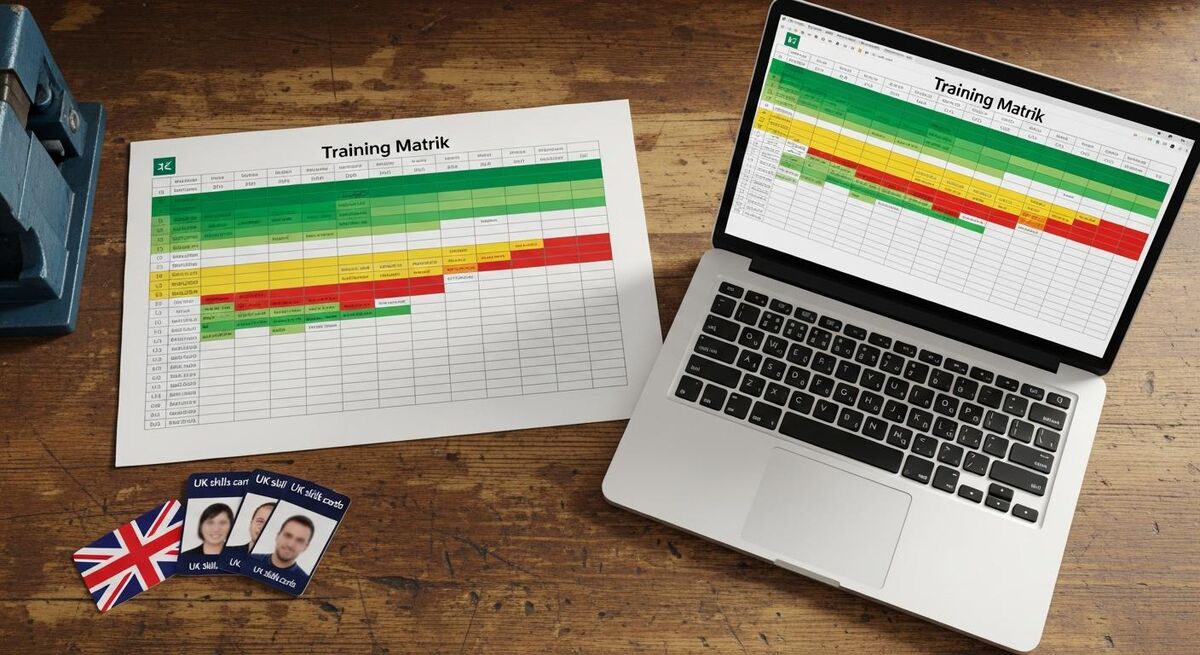
The template comes in three formats. Excel for the live tracker on your laptop. PDF for printing and pinning on the workshop noticeboard. Word for editing the layout if you want to add columns for trade-specific qualifications we have not pre-loaded.
One template. Three files. Same content.
The TrainAR Team Training Record opens in any version of Excel from 2016 onwards and in Google Sheets. The Word version is for editing the layout. The PDF prints to two A4 sheets in landscape. All three versions ship with five fictional engineers pre-loaded so you can see the colour coding work before you delete the dummy data and add your own team. Section headings match the ones HSE inspectors look for during a site visit.
If you are looking for the rest of the paperwork pack, the CP12 gas safety certificate template covers the customer-facing record, and the job report form handles the on-site write-up. The employee handbook template sits alongside this one as the internal HR pack.
Why a written training record matters
Three reasons. None of them are about ticking boxes.
Reason one is the gate. A worker without a valid card does not get on a CDM site. The principal contractor will not let them through the gate. You will not get paid for the day. If a job runs five days and one of your engineers turns up on day two with a lapsed CSCS card, that is your problem to fix and your van turning round. A written record means you spot the lapse three months out, not on the morning of the job.
Reason two is the law. The Health and Safety at Work etc. Act 1974 and the Management of Health and Safety at Work Regulations 1999 require employers to provide adequate training for the work being done. HSE expect a written record. CDM 2015 Regulation 13 goes further on construction sites: the principal contractor must provide each worker with suitable site-specific information, instructions, and training before they begin work. If an inspector turns up after an incident, the first thing they ask for is the training matrix and the certificates behind it.
Reason three is the money. ACS reassessment for one gas engineer is roughly £300 to £600 depending on the categories. CSCS Blue Card renewal is £36. First aid at work refresher is £200 to £250. If you have five engineers and three of them all need ACS reassessment in the same month because nobody planned ahead, the cash flow hit lands all at once. A training record spreads renewals across the year and lets you book courses early when slots are cheaper.
What is inside the template

The template is a single sheet. One row per engineer. Eighteen columns grouped into five blocks. Set up the engineers once, then the only thing you update each month is the expiry dates and status.
Block 1: Identity. Full name, role (gas engineer, electrician, joiner, labourer), employment status (employee, sub-contractor, apprentice), date of joining, mobile, emergency contact.
Block 2: General health and safety cards. CSCS card type and number, expiry date, CITB HS&E test date, first aid at work certificate, manual handling refresher, asbestos awareness refresher.
Block 3: Trade-specific qualifications. Gas Safe ACS expiry by category (CCN1, CENWAT, CKR1, HTR1, MET1, CPA1), ECS NICEIC for electricians, ECS JIB grade, F-gas certificate for refrigeration, MCS card for renewables, PASMA for mobile scaffold, IPAF for powered access.
Block 4: Site-specific. SMSTS or SSSTS for supervisors, SSSTS expiry, COSHH awareness, working at height refresher, harness inspection date, abrasive wheels.
Block 5: Status and notes. Auto-calculated days until expiry, traffic light status (green over 90 days, amber 30-89 days, red under 30 days or expired), last reviewed date, next training booked, cost budgeted.
The cards and certs every UK trades business should track

Different trades, different cards. The template ships with the columns most trades businesses need, but the renewal cycles are the bit that catches people. Get these wrong and the cash flow stings.
| Card or certificate | Validity | Approximate renewal cost (per person) |
|---|---|---|
| CSCS Blue Card (Skilled Worker) | 5 years | £36 plus retake of CITB HS&E test (£22.50) |
| Gas Safe registration (annual) | 12 months | £188.40 online plus £31.18 per additional engineer |
| Gas Safe ACS qualification | 5 years | £300 to £600 depending on categories |
| ECS Gold Card (Electrician) | 3 years | £36 plus ECS test if knowledge gap |
| First aid at work | 3 years (annual half-day refresher recommended) | £200 to £250 for the two-day refresher |
| Asbestos awareness | 12 months | £25 to £50 online, £80 to £120 classroom |
| SMSTS (site managers) | 5 years | £250 to £350 for the two-day refresher |
| SSSTS (site supervisors) | 5 years | £150 to £200 for the one-day refresher |
| Manual handling | Recommended every 2 to 3 years | £20 to £80 depending on format |
| Working at height | Recommended every 2 to 3 years | £40 to £120 |
| PASMA (mobile tower) | 5 years | £140 to £180 |
| IPAF (powered access) | 5 years | £180 to £240 |
The two-yearly bracket for manual handling and working at height is HSE guidance, not a fixed legal rule. The exact frequency depends on your risk assessment. Two years is the practical default most trades businesses use because it lines up neatly with the matrix.
If you are scaling up and bringing on apprentices, look at our guide to CITB grants and skills bootcamps for the funding routes. We also break down the wider ROI calculation in our staff training ROI guide.
How to fill it in, the first time and every month after

The first fill takes an hour for a team of five. Every month after takes twenty minutes. The discipline is doing it on the same day each month so it does not slip.
Step 1. List every person on your books. Employees, apprentices, regular sub-contractors. Anyone who turns up to a job in your van or under your business name. Sub-contractors are on your matrix because the principal contractor will ask for their cards too, and you carry the corporate manslaughter risk if a subbie hurts themselves on your job.
Step 2. Collect every certificate they hold. Ask each engineer to send photos of every card and certificate to a shared WhatsApp or email thread. Front and back. The back has the issue and expiry dates. File the photos in a folder named "Training Records" with one subfolder per person.
Step 3. Type the expiry dates into the matrix. Use the DD/MM/YYYY format the template is set up for. The status column will auto-update as you type. Leave a cell blank if the engineer does not hold that qualification rather than putting N/A. The status logic treats blank as "not applicable" and N/A as "missing".
Step 4. Cross-check against the matrix on the first job site. Print the matrix and take it on the first big job. Ask each engineer to show you the card matching what is in the matrix. About one in five times you find a discrepancy. The card was renewed but the office never got told. Or the engineer thought he had renewed but had not.
Step 5. Set the monthly review. First of every month. Calendar reminder. Twenty minutes. Open the matrix. Anything amber (30 to 89 days) gets a booking made now. Anything red (under 30 days or expired) gets dealt with the same day, no excuses.
Step 6. Update after every booking. When a course is booked, log the date in the "Next training booked" column. When the certificate arrives, update the expiry date and the status cell flips back to green. File the new certificate photo in the engineer's folder.
Step 7. Budget the renewals at the end of each quarter. Look six months out. Add up the costs. That goes into the cash flow forecast as a known outgoing. No surprises.
Using AI to plan training and budget renewals

The matrix tells you what is expiring. The hard part is the planning. Which courses to book together. Which months to avoid. How to spread the cost across the year. AI tools are useful here because they will hold the whole picture at once without you having to keep flicking between tabs.
Export the matrix as a CSV. Paste it into Claude 4.7 or GPT-5.1. Ask the model to group renewals by quarter, flag clashes where two engineers would be off training the same week, suggest cheaper combined bookings where possible, and produce a quarterly cash flow figure. The output is a table you can paste straight back into your forecast.
"You are a UK trades business operations manager. I am sharing a team training matrix as CSV. Group the upcoming renewals across the next 12 months by quarter. Flag any week where more than one engineer would be off-site for training. Suggest combined course bookings where two or more engineers need the same refresher within 90 days of each other. Calculate the quarterly training spend assuming standard UK 2026 prices for CSCS, Gas Safe ACS, ECS, first aid, asbestos awareness, SMSTS, SSSTS, PASMA, and IPAF. Output a table with columns: Quarter, Engineer, Course, Booking deadline, Estimated cost."
For the wider training operations workflow including SOPs and skills assessment, our guide to building a training library with Claude covers the day-to-day side. The matrix is the inventory. The library is the delivery.
Common mistakes we see
We have looked at training records from dozens of trades businesses over the years. The same handful of mistakes show up every time.
1. Tracking it in someone's head. The single most common gap. The owner or the office manager remembers most of the dates. Then they go on holiday or get pulled onto a big job and a card lapses. Written down beats remembered every time.
2. Forgetting the sub-contractors. Regular sub-contractors are on your site, in your van, in your branded clothing. The matrix needs them too. If a subbie loses a card mid-job, the principal contractor calls you, not them.
3. Only tracking the cards, not the courses. Asbestos awareness and manual handling are not cards. They are certificates with shorter cycles. Twelve months for asbestos. Two to three years for manual handling. Easy to forget because there is no plastic in your wallet to remind you.
4. Not building in the lead time. Some courses have six week waiting lists, especially SMSTS and ACS. If your matrix shows red on the day, you are already too late. Amber at 90 days is the buffer that makes the system work.
5. Letting the apprentice fall behind. Apprentices need a clear progression matrix as much as the qualified engineers. Off-the-job training hours have to hit 20 percent under the funding rules. If you are claiming an apprenticeship levy or any of the new funded routes, the record is the audit trail.
6. Throwing the old certificates away. Hand-arm vibration syndrome, occupational asthma, and occupational dermatitis claims can land years after the exposure. The training record is part of your defence. Keep the certificate photos and the matrix for at least seven years after an engineer leaves.
What other trades are saying
Training videos on matrices and renewals

Training Matrix Management Excel Template: Step by Step
Simple Sheets
Skills Matrix Excel Tutorial: Build a Professional Competency Tracker
Excel Skills Matrix

How to Create a Training Matrix in Excel
SkillsTrain

Industry Accreditation Withdrawal: NVQ to Renew Your CSCS Card
CSCS

SSSTS Refresher: Renew Your CITB Site Supervisors Training
Hurak

CSCS Card Grandfather Rights End: Industry Accreditation Withdrawal
NVQ Direct
Frequently asked questions
Not for an employee record under the Health and Safety at Work Act, no. But you still need a record of your own qualifications to prove competence on site. The matrix works as a one-row personal CV: your CSCS card, your Gas Safe ACS, your asbestos awareness refresher, and so on. Principal contractors ask for it before they let you on a CDM site. Keep it. Even a sole trader has a corporate manslaughter risk if a customer is hurt on a job.
Seven years minimum. Civil personal injury claims can land three years out. Industrial disease claims (HAVS, asthma, dermatitis) can land decades later. The HSE-recommended retention for training records linked to high-risk activities is seven years from the date of leaving or longer where the work involved exposure to long-latency hazards like asbestos or vibration. Keep the matrix and the certificate photos in cold storage. They cost nothing to hold.
Up to about 15 engineers, Excel is fine and free. The colour coding in this template does most of what specialist software does. Beyond 15 engineers, or if you run multiple sites with different supervisors, specialist tools like Competency Cloud, BrightHR, or the embedded matrix in Commusoft, Tradify, or Simpro start to pay for themselves. The decision point is not headcount. It is whether more than one person needs to update it at once.
The person who runs the office. Not the owner. Not the senior engineer. The office manager or whoever processes the weekly timesheets sees every engineer's name every week and is the natural fit. Give them edit access. Give the owner and supervisors view access. Engineers see their own row only if you go down the specialist software route. In Excel, give them the printed PDF after each monthly review.
Apprentices need a parallel sheet for off-the-job hours, mentor reviews, and end-point assessment milestones. The funding rules require 20 percent of paid time on off-the-job training and you have to evidence it. Use the same matrix template but add columns for the apprenticeship standard reference, planned EPA date, and on-programme progress percentage. Most apprenticeship providers give you their own log too. Keep both.
They expect you to produce it within an hour. The matrix itself, the certificate photos behind it, the booking confirmations for any upcoming renewals, and the dated minutes of the last review. If anything is amber or red, they want to see the booked replacement training. A clean matrix with one upcoming renewal flagged red but a course booked next week is a perfectly acceptable answer. A clean matrix with three reds and no plan is not. Inspectors look for the system, not the perfection.
Yes, and you should. NICEIC, NAPIT, MCS, OFTEC, HETAS, and the various Competent Persons Schemes have their own annual fees and audit cycles. Add a column. The renewal dates matter for the same reason: a lapsed NICEIC membership means you cannot self-certify electrical work for Building Regulations. That hits the customer side, not just the site side, and it hits the same week the renewal letter goes in the bin.
Key takeaways
- Every UK trades business needs a written training record. HSE expect one, principal contractors ask for it before site entry, and the cost of finding out about a lapsed card on the day of a job is paying-the-van-to-turn-round expensive.
- The matrix tracks five blocks: identity, general H&S cards (CSCS, first aid, asbestos awareness, manual handling), trade-specific qualifications (Gas Safe ACS, ECS, F-gas, MCS), site-specific tickets (SMSTS, SSSTS, PASMA, IPAF), and status with colour-coded expiry warnings.
- Twenty minutes on the first of every month is the entire job. Anything amber gets a booking made. Anything red gets dealt with that day.
- Plan ACS reassessments and SMSTS refreshers six months ahead. Slot pricing drops outside peak summer and you avoid clashes where two engineers are off-site the same week.
- Keep records for at least seven years after an engineer leaves. Indefinitely if the work involved asbestos, vibration, or other long-latency hazards.
- Use AI to plan the quarterly renewal calendar and budget. Paste the matrix as CSV into Claude 4.7 or GPT-5.1 and ask for a quarter-by-quarter cash flow table.