
Quick Answer
A 15-minute Monday-morning huddle beats a 45-minute meeting nobody wants to be at. Run it through four headings: pipeline, priorities, problems, praise. Two minutes per heading, plus a 7-minute working section. The template below gives you the agenda, the prompts to read out, and the bits your job-management software can pre-fill so you stop turning up empty-handed.
Table of Contents
- Why most trade business meetings fall apart
- The 4Ps: a 15-minute agenda you can actually finish
- Pipeline (3 minutes)
- Priorities (4 minutes)
- Problems (5 minutes)
- Praise (3 minutes)
- Let your software prep the agenda
- An AI workflow that does the donkey work
- Download the template
- Common mistakes that creep back in
- What tradespeople are saying
- Recommended videos
- Frequently asked questions
- My verdict
 ServiceM8
 Commusoft
 BigChange
Why most trade business meetings fall apart
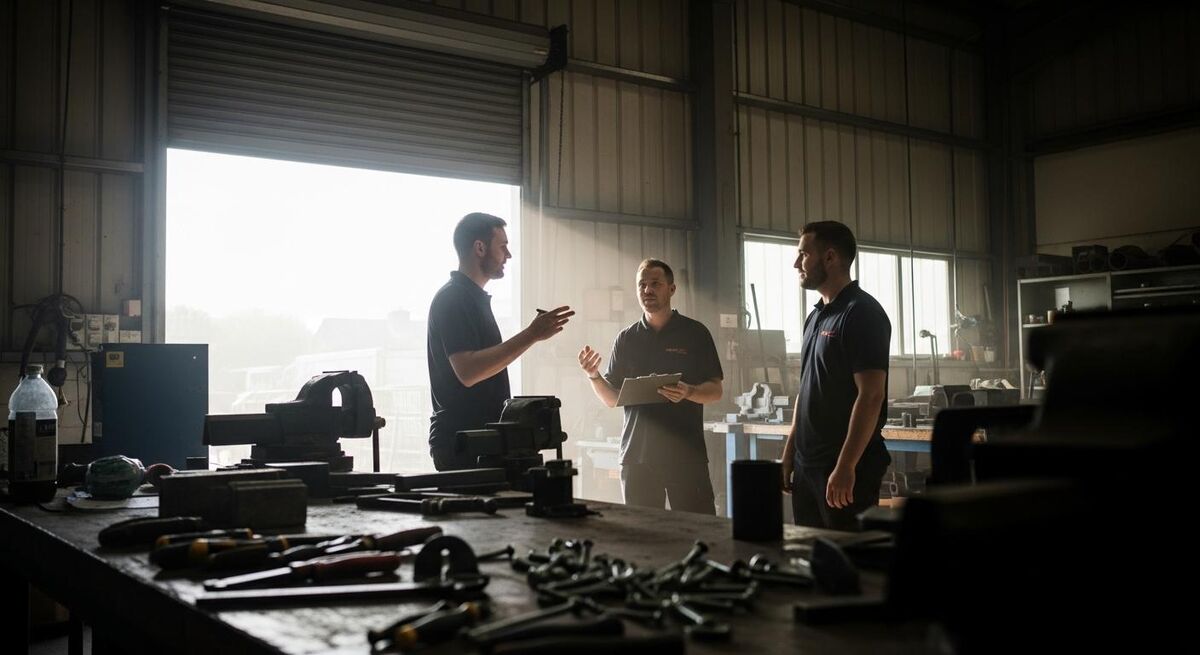
Most trade business meetings drift because there is no agenda, or the agenda is borrowed from a corporate template that assumes everyone has a desk. So you end up with someone's job sheet on a clipboard, three side conversations about a leaking radiator in Romford, and the apprentice quietly scrolling TikTok.
The pattern is familiar. You start at 7:30, the engineers want to get out by 8, and by 8:15 you have covered one job out of fifteen. People stop turning up. The good ones rebook themselves a customer call to avoid it. The meeting becomes a tax, not a tool.
The fix is structure. The Lean Construction Institute, which has been quietly running this experiment for decades on real building sites, reports that organisations using a daily huddle are about 30% more productive than the ones that wing it. That is not magic. It is the simple discipline of saying the same four things every week and letting the team know what to expect.
And when you scale past five people, you stop having the option of catching everyone in the van park. Information falls between vans. Jobs get double-booked. Materials turn up on the wrong street. A 15-minute structured huddle is the cheapest fix for that I have ever come across.
The 4Ps: a 15-minute agenda you can actually finish
The agenda I have used since the Elite Heating and Plumbing days runs on four headings. Pipeline. Priorities. Problems. Praise. Each one earns its place. None of them is filler.
Time it to the second. If pipeline runs to 5 minutes, priorities only gets 2. That trade-off is a feature, not a bug. The discipline of finishing on time is what makes people show up next week without grumbling.
| Heading | Time | Who leads | What you cover |
|---|---|---|---|
| Pipeline | 3 min | Owner / office | This week's job count, anything quoted, anything chasing |
| Priorities | 4 min | Each engineer | Top job each, materials needed, customers to brief |
| Problems | 5 min | Whole team | Anything broken, blocked, or about to be. One issue per person, max. |
| Praise | 3 min | Owner / team | Wins from last week. Customer compliments. New hires settling in. |
Pipeline (3 minutes)
This is the office-side update. Whoever runs the diary stands at the front and reads the numbers.
Three things to cover: how many jobs are in this week, what got quoted last week that has not come back, and what customers we are waiting on for a deposit, a date, or an answer.
Keep it to numbers. If you have ServiceM8 or Commusoft pulling the data, screenshot the dashboard and put it on the wall. If you do not, write it on a whiteboard in marker pen the night before. Either is fine. The point is that everyone hears the same numbers, in the same order, every week.
Priorities (4 minutes)
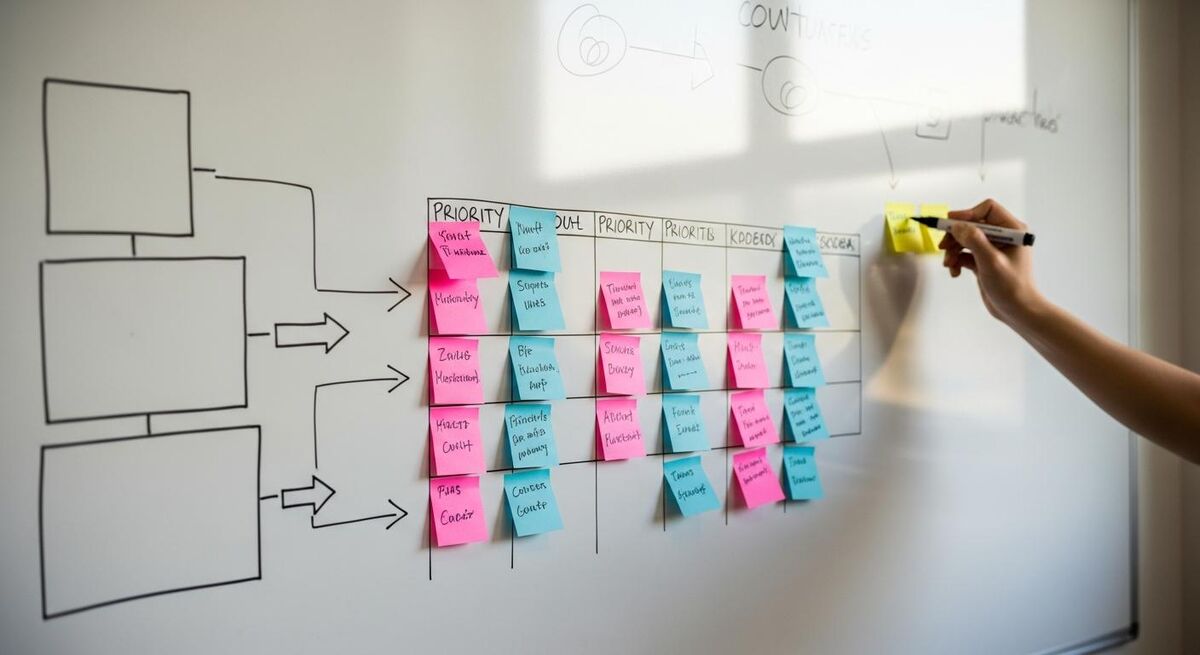
Now the engineers go round the room. Each one says their top job for the week and the one thing that could derail it. That is the whole rule.
Not their whole calendar. Not every job on their van. Top job, plus the risk. If they have a complicated commercial install on Thursday and they need the part to land on Wednesday, that is what gets said out loud. If they are stitching together five small jobs in one postcode, they say the postcode and the time-window concern.
This bit only works if you keep it short. A useful trick: hold a timer on the desk. When it goes off, the next person speaks. People get used to it within two weeks and they start arriving with their answer ready. That is the win.
For apprentices, change the prompt slightly. Ask them what they are working on, and what they are stuck on. The stuck-on part is where the senior engineers can offer a quick tip. You are mentoring without anyone calling it mentoring.
Problems (5 minutes)
The biggest single slot. Five minutes for the whole team to raise anything that is broken, blocked, or about to be. One issue per person, no story-telling.
The job is to surface, not to solve. If a problem needs more than 90 seconds of discussion, it does not belong in the room. Park it. Assign an owner. Move on.
A simple format I lift from Lean Construction practice: each person says the problem in one sentence, names the impact in one sentence, and proposes an owner. Three sentences. Done. The owner takes it away and reports back next week. If it is still on the list three weeks later, that is a conversation for the leadership.
If nobody raises a problem, do not be flattered. It usually means people have stopped trusting the room. Ask one open question yourself: "What did we get wrong last week?" Someone will answer eventually. Reward the first person who does, in front of the rest.
Praise (3 minutes)

Three minutes, never less. End every meeting on what went well.
Read out customer compliments by name. Name the engineer who handled the tricky job. If a junior tech stayed late to cover a callout, say so. If an apprentice finally got their first lead-flashing right, the whole team should hear it.
You think this is soft. It is not. In trades, where the work is physical and the days are long, the only currency that competes with money for retention is being respected by your peers. Praise in the huddle is free, and it compounds.
One ground rule. Praise is specific or it is nothing. "Sam, good work on the Pattens job, the customer rang in to say you cleaned up better than the last firm" lands. "Well done everyone for working hard" does not. If you cannot name a person and a thing, do not bother.
Let your software prep the agenda
You should not be hand-typing this every week. If you are running ServiceM8, Commusoft, or BigChange, most of the agenda already exists inside the platform. The job is to pull it out the night before.
Pipeline numbers come from the scheduler. In ServiceM8 the weekly job count sits on the dashboard. In Commusoft, the diary view filtered by status gives you the same picture. In BigChange, the planner shows you jobs by engineer for the week. Screenshot, save to a folder called "Monday meeting," print or project on Monday morning.
Open quotes are easy. Run a saved filter for "quoted but not won, last 14 days" and the list is your chase pile. Read out the top five names. The engineers will often have context the office does not, like "the customer was at her dad's funeral, leave her another week."
For the problems slot, your job-management software is less helpful, because problems live in people's heads, not in a database. But you can pull a list of jobs marked "complete" that did not collect feedback, or jobs that were rescheduled twice, and use that as a prompt.
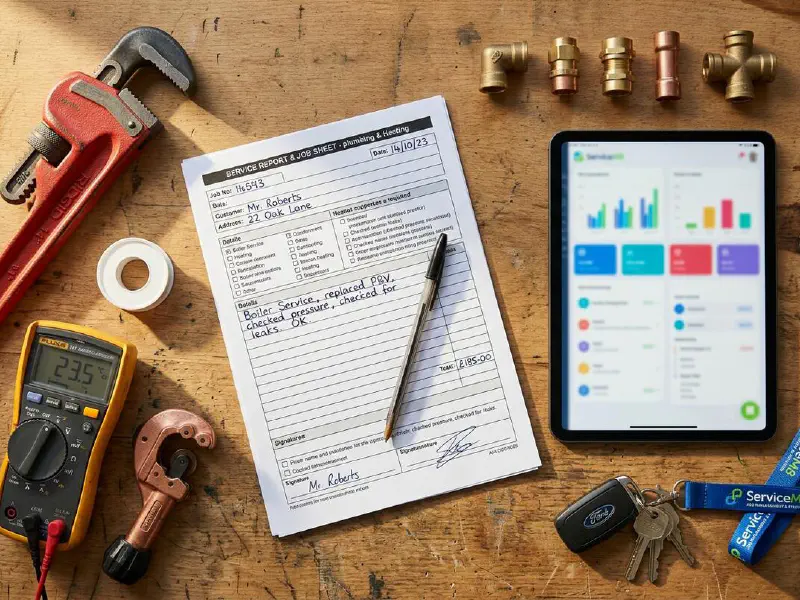
A clean job report form helps with this. If your engineers fill in a structured form at the end of each job, you can scan them on Friday evening and walk into Monday with a clear list of issues already.
An AI workflow that does the donkey work
This is the bit that has changed in the last 12 months. You can now get an AI model to read your job-management data and draft the agenda for you. I run a version of this for our office and it saves about 30 minutes of prep time each week.
The pattern is simple. Export last week's jobs and next week's diary into a CSV. Feed that into Claude or ChatGPT with a prompt along the lines of:
"You are an operations manager for a small UK trades business. Given the job data attached, draft a 15-minute Monday-morning team huddle agenda using the 4Ps structure: pipeline, priorities, problems, praise. Identify which jobs likely need to be discussed, which engineers had a difficult week, and any obvious customer-service wins from last week's complete jobs. Keep it under 300 words."
The model will not be perfect. It will miss the political context, like the customer you swore at on Tuesday. But it will give you a starting draft that is 80% of the way there, and you spend five minutes editing rather than 30 minutes building from scratch.
For a more automated version, you can wire this into n8n or Make. Pull the data from your job-management platform on Sunday night, send it to Claude with a system prompt, drop the output into a Google Doc, and email the team the agenda by 7am Monday. That setup runs unattended once it is built. If you are already exporting compliance forms, you are most of the way to having the data pipeline you need.
Download the template
Here is the agenda, in plain text, ready to paste into a Google Doc, a Word file, or a printable A4 sheet for the office wall:
| Time | Section | Prompts to read out |
|---|---|---|
| 0:00 to 3:00 | Pipeline | Job count this week. Quotes outstanding. Customers waiting on us. "Anything we are about to over-promise?" |
| 3:00 to 7:00 | Priorities | Each engineer: top job + one risk. Apprentices: what you are working on, what you are stuck on. Timer on the desk. |
| 7:00 to 12:00 | Problems | One issue per person. Problem in one sentence, impact in one sentence, owner named. Park anything that runs past 90 seconds. |
| 12:00 to 15:00 | Praise | Customer compliments by name. Engineer who handled a tricky job. Apprentice wins. Specific or nothing. |
Print it. Stick it on the wall. Run it for four weeks before you tweak anything. If it still does not work for your business after four weeks, then change one variable at a time so you know what made the difference.
Common mistakes that creep back in
You will run this for three weeks and it will be brilliant. Then something will slide. Watch for these.
The meeting expanding to 30 minutes. Someone has a story to tell and you let them. By week six you are back to where you started. Fix: timer on the desk, audible, and the owner enforces it without apology.
The same person dominating problems. One engineer always has three issues. The rest have none. That is a sign you have an unhappy engineer or a structural problem with their patch. Take it offline, do not let them turn the meeting into their therapy session.
Praise becoming generic. "Well done everyone, great week" is worse than no praise at all. If you cannot name a person and a thing, skip the praise slot that week. The team would rather have an honest silence than vague flattery.
The owner skipping the meeting. If you, the business owner, do not turn up, the meeting dies within a month. Even if you have nothing to add, sit in the room. Your presence signals that the meeting matters. Your absence signals the opposite.
Problems with no owner. An issue without a named owner is a wish. Every problem leaves the room attached to a person. If nobody will take it, the owner takes it themselves and reassigns it later.
What tradespeople are saying
Recommended videos

What's in a Weekly Team Meeting Agenda? (Example for Small Businesses)
Small business meeting structure walkthrough

How to Lead Weekly Team Meetings That Aren't a Waste of Time
Leadership best practices for short, useful meetings

How to Run a Daily Morning Worker Huddle
Construction site huddle format, transferable to trades

Effective Leadership Meetings: Run a Level 10 Meeting
EOS Worldwide framework, well-known weekly meeting structure

Team Huddles Explained: Types, Tips & Why They Work
Background on huddle formats and when each fits
How to Create a Meeting Agenda for a Small Business
Practical agenda template-building walkthrough
Frequently asked questions
Weekly works for most trades businesses under 15 staff. Daily huddles suit bigger crews, busy commercial work, or anywhere there is a lot of overlap on the same site. If your engineers all start from different houses every morning, weekly is plenty.
7:30am on a Monday, ending by 7:45am, works for most teams. Earlier than 7:30 punishes the engineers who travel in. Later than 8am eats into your billable day. If your team starts on site at 7am, do it at 4pm on a Friday instead, which means no Sunday-night anxiety either.
Ideal, but not essential. A WhatsApp or Teams video call works if everyone joins from their van. The discipline is what matters, not the venue. The one rule: cameras on. Voice-only meetings drift faster.
Pull them in for the pipeline section, then let them go. Office staff do not need to hear every engineer's priority for the week. If they want to listen in, fine, but their time is better spent prepping the chase list during the rest of the meeting.
Pay them for the 15 minutes if they are otherwise on hourly. Most resistance is about unpaid time, not the meeting itself. If someone still refuses after that, the problem is the engineer, not the meeting.
For the first six weeks, yes. After that, rotate. Letting a senior engineer chair a meeting once a month is a cheap way to develop leadership and a useful test of who has the temperament for it. The owner still attends. They just stop being the centre of attention.
My verdict
Run the 4Ps. Time it to the second. Let your software prep the pipeline numbers and let an AI model take the first pass at the agenda. If you do it consistently for two months, the team starts to self-correct between meetings because they know they will have to say it out loud on Monday. That is the real win. Not the meeting itself. The behaviour it builds in the four days that follow.