
Quick Answer
The Future Homes Standard becomes mandatory on 24 March 2027. New homes must produce at least 75% less carbon than a 2013 home, which makes gas boilers impossible to specify in practice. Heat pumps and solar PV become the default, airtightness targets tighten, and most builders will install MVHR instead of dMEV to manage the new fabric. There is a 12 month transitional period to 24 March 2028 for projects that started under Part L 2021. If you are a builder, plumber, heating engineer or electrician working on new homes, the next 18 months are about training, supply chain and getting one heat pump install under your belt before the rush.
Table of Contents
- What the Future Homes Standard actually requires
- The 24 March 2027 deadline and what the transition covers
- Heat pumps: from optional to default
- The fabric-first numbers you need to hit
- Solar PV at 40% of ground floor area
- MVHR, dMEV and the new ventilation reality
- Hot water storage: the space problem nobody is talking about
- The installer shortage that is already biting
- What this means for your business this year
- What tradespeople are saying
- Recommended videos
- Frequently asked questions
- My verdict
What the Future Homes Standard actually requires
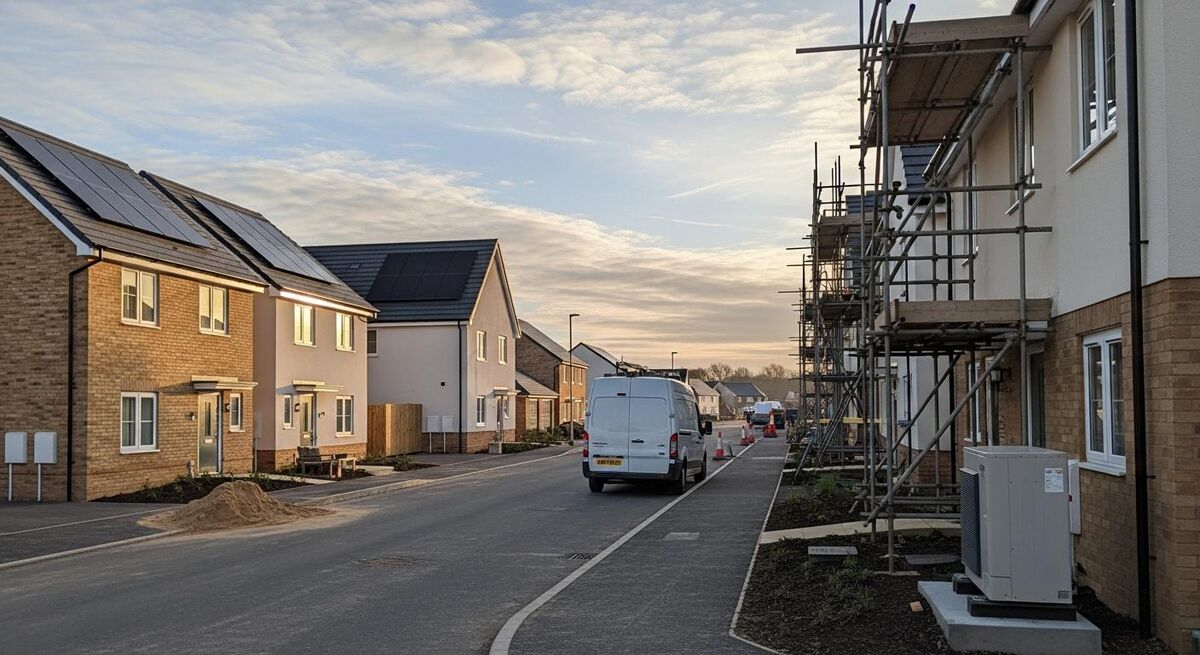
The Future Homes Standard is the 2026 update to the Building Regulations for England. It sits on top of Part L (Conservation of Fuel and Power), Part F (Ventilation) and a new functional requirement called L3 covering on-site renewable electricity generation. The Ministry of Housing, Communities and Local Government published the final Approved Documents on 24 March 2026.
For builders and installers working on new homes the practical effect is straightforward, even if the documents are long. From 24 March 2027 every new home in England must achieve at least a 75% carbon reduction against the 2013 Part L baseline. That target is set by a notional dwelling. The notional dwelling runs on a heat pump, has a rooftop PV array, and has tighter walls, floors, roofs and windows than anything Part L 2021 demanded. Gas boilers cannot meet the target on a typical plot. Hybrid systems and hydrogen-ready boilers cannot meet it either.
What changes for the trades is not just the kit. It is the way trades sequence on site and how compliance gets evidenced. Airtightness tests, BREL reports with geotagged photos and on-site renewable generation checks all sit alongside the usual building control sign-off. Smaller jobs do not escape the change. From late 2026 most new electric heating products, including heat pumps and hot water cylinders, must meet smart functionality and grid stability requirements as Energy Smart Appliances.
The 24 March 2027 deadline and what the transition covers
The dates matter and they are not as generous as they look. The Approved Documents were published on 24 March 2026, giving the industry a year of head time. The regulations come into force on 24 March 2027 for non-higher-risk building work. Higher-risk buildings, broadly anything over 18 metres or seven storeys with two or more residential units, follow on 24 September 2027.
The 12 month transitional period runs from 24 March 2027 to 24 March 2028. Any project where a building notice, initial notice or full plans application has been submitted before 24 March 2027 can build to Part L 2021, provided work has commenced before the deadline and the work is finished within the transitional window. Projects submitted on or after 24 March 2027 must comply with the FHS immediately. There is no grace period for those.
The phrase “commenced work” is doing real work in this sentence. Building control bodies have already signalled that a bit of token excavation on a corner of the plot will not be enough. They want a real start: foundations dug, oversite prepared, formal site inspections logged. Late plot registrations followed by stalled builds will pull the developer onto the new standard mid-job. That is when the costly rework starts. For more on how to handle the early-stage paperwork, see our guide to building control notifications and when you need them.
Heat pumps: from optional to default
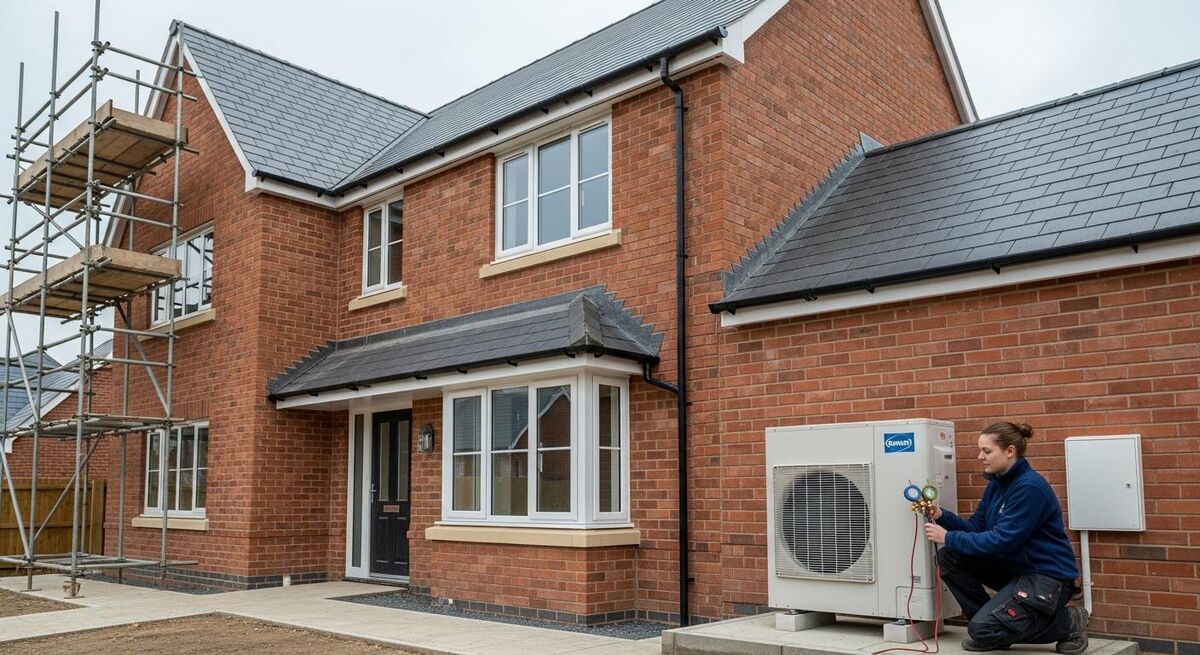
The FHS does not contain the word ban. It does not need to. Its carbon targets are set at a level no gas boiler can meet on a typical new build calculation. New homes will use low-carbon heating: an air-source heat pump in most cases, a ground-source heat pump where the plot allows, or a connection to a communal or district heat network. Direct electric panel heaters can technically pass on small flats with very tight fabric, but they are the exception, not the rule.
For installers this means three things. First, heat pump work on new build is no longer a retrofit add-on. It becomes the core of the heating package on every job. Second, the design work happens up front. Heat loss calculations, room-by-room emitter sizing and single low flow temperature design all need to be settled before first fix. Third, the equipment in the airing cupboard changes. You are not bolting a heat pump onto an existing system. You are designing the system around the heat pump from day one.
The good news is that new builds suit heat pumps better than the average retrofit. Fabric is tight, design temperatures are realistic and there is no legacy pipework to wrestle with. The bad news is that the volume housebuilders will not always specify the system you would specify yourself. Some will go for the cheapest compliant kit. Some will undersize the cylinder to save space. If you are sub-contracting on volume work, get the design pack early and price for what you would actually want to commission.
The fabric-first numbers you need to hit
The FHS lives or dies on fabric. If the building does not hit the airtightness target and the U-values, no amount of heat pump kit will get the dwelling over the carbon line. The notional U-values are sharper than Part L 2021 demanded. External walls move from 0.26 W/m²K under previous regulations to 0.15 W/m²K under the FHS notional. Floors and roofs tighten to 0.11 W/m²K. Windows and doors stay broadly where they were.
The bigger shift is airtightness. The FHS notional dwelling targets 3 m³/h·m² at 50 Pa. Part L 2021 used 5 as the notional figure with 8 as the worst legal value. Three is achievable, but only if every trade on site treats sealing as part of their work. One unsealed soil pipe penetration, one row of unmarked sockets without back boxes parged, one careless top plate on a stud wall, and the air test will fail. For the full breakdown of fabric numbers and what they mean trade by trade, read our deeper guide to the Part L 2026 changes and what every builder and installer needs to know.
This is where coordination between trades stops being a nice-to-have. The plumber, the sparks, the chippy and the plasterer all share the same air test result. The principal contractor needs an airtightness strategy in the construction phase plan that names who is sealing what. Get this wrong on a 20 plot site and the rework cost will eat the margin on three of them.
Solar PV at 40% of ground floor area

The headline change under the new regulations is a brand new functional requirement called L3, covering on-site renewable electricity generation. Almost every new home will need rooftop solar PV. The guidance specifies a PV array sized to cover at least 40% of the dwelling's ground floor area, calculated and shown on the SAP or Home Energy Model output. There is some flexibility for heavily shaded plots and for higher-rise apartment blocks, but for a typical two-storey detached or semi-detached home, the array goes on.
For electricians this is a permanent shift in the workload mix. You are not bolting on a PV system as an extra five years after handover. You are wiring the system as part of first fix on every plot. Inverter location, cable routes from the consumer unit, isolators and labelling all need to be designed in. Most plots will also have an Electric Vehicle Chargepoint under Part S, plus a heat pump on a high amperage circuit. The load on the consumer unit is climbing fast.
Battery storage is not currently mandated. It is strongly encouraged in the Approved Documents and most volume builders will offer it as an upgrade. Expect that to change over the next revision cycle. Worth pricing in now so you are not learning battery installs on the first job that needs it.
MVHR, dMEV and the new ventilation reality
At 3 m³/h·m² airtightness the house will not breathe on its own. Mechanical ventilation becomes a non-negotiable. The FHS notional dwelling specifies decentralised mechanical extract ventilation, dMEV, in each wet room. Many builders will choose mechanical ventilation with heat recovery, MVHR, instead. MVHR is more expensive to fit but recovers heat from the extract air and improves the dwelling's energy balance, which makes the carbon target easier to hit.
Part F has also tightened. Specific fan power figures drop across the board: intermittent fans stay at 0.5 W/l/s, dMEV is now 0.3 W/l/s, MEV 0.5 W/l/s and MVHR 1.4 W/l/s for new build. Ducting standards have moved against flexible duct. For continuous MEV or MVHR the guidance calls for rigid or smooth semi-rigid ducting throughout. For intermittent extract and dMEV, rigid duct should be used with the run kept under two metres where possible.
The on-site implication is that ventilation now needs to be designed by a competent person and signed off by one. There is fresh guidance on system design, including airflow performance, ductwork resistance and a maximum design pressure for MEV and MVHR depending on flow rate. This is not work you guess your way through any more.
Hot water storage: the space problem nobody is talking about
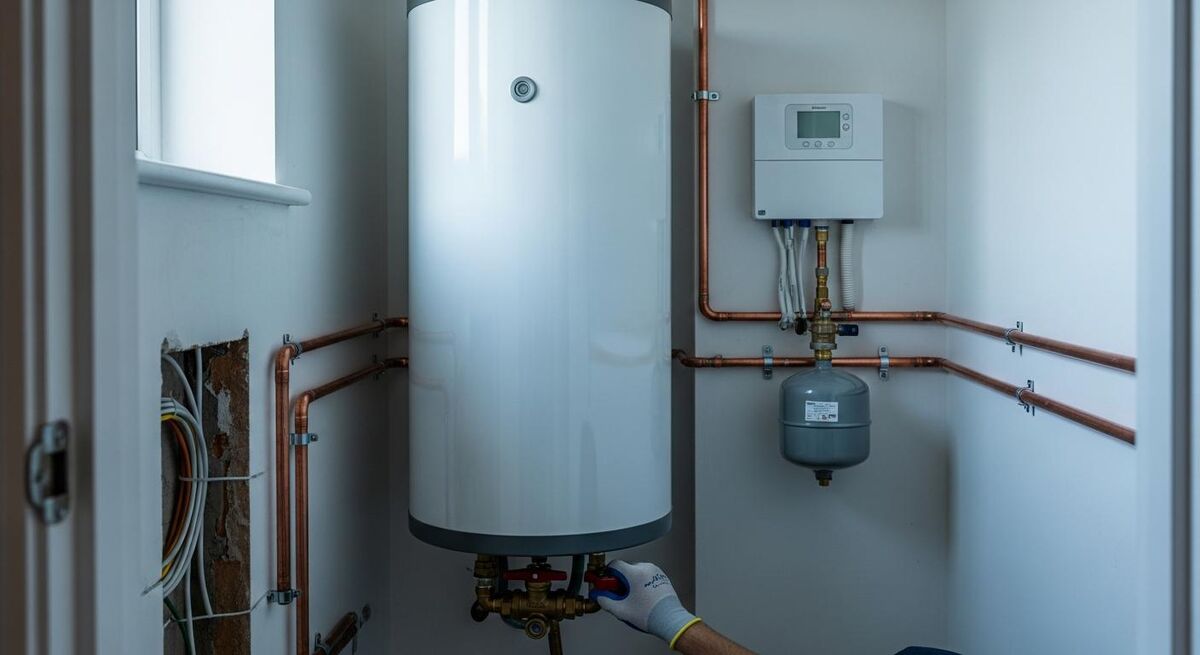
Combi boilers are out, so cylinders are back. A heat pump heats hot water at lower flow temperatures than a gas boiler. To deliver a hot shower at the tap you need stored hot water. For a typical three-bed house that means a 180 to 250 litre unvented cylinder, plus the heat pump indoor unit, plus the controls and a vessel for system expansion. That is more kit than most modern airing cupboards have ever held.
Most architects working on FHS-ready plans are now allocating a dedicated plant room rather than an airing cupboard. The space is roughly 1.2 by 1.5 metres for a heat pump system with cylinder, controls and expansion. If you are pricing the plumbing first fix on a job designed for a combi, raise the space issue early. The customer or developer will need to give up wardrobe or store cupboard space, or move the cylinder onto the landing or into the utility room.
There is also a smart functionality dimension. From late 2026, hot water cylinders that are part of an electric heating system will need to be Energy Smart Appliances capable of responding to grid signals. Most reputable brands are already there. The cheaper imports will not be. Make sure the cylinder you specify is on the list before you book the install.
The installer shortage that is already biting
The Heat Pump Association estimates around 9,000 trained MCS heat pump installers in the UK today, with roughly 3,000 actively installing systems on any given week. The government target is 600,000 heat pump installations a year by 2028. The gap between those numbers is the FHS delivery risk that everyone in the industry is quietly worried about.
The training infrastructure exists. HPA member training sites have capacity for around 80,000 individuals a year. The issue is conversion. A recent industry study found that around 39% of trades who complete heat pump training do not go on to install a heat pump within the year. The gap between qualifying and installing is where the workforce shortfall is being baked in. Only 27% of newly qualified installers complete an installation within twelve months of finishing the course.
If you are a gas-trained heating engineer the route across is well established. MCS-accredited training courses are available from manufacturers (Daikin, Mitsubishi, Vaillant, Worcester) and from independent providers. The Heat Training Grant offers a £500 discount on heat pump training courses, running until March 2026. After that grants will continue but at lower amounts. Apprentices coming through the trade now will be heat pump first, gas second, which is a healthy shift but takes time to feed through.
What this means for your business this year
The FHS is the biggest single shift in residential building regulations in a generation. The temptation is to treat 24 March 2027 as a future problem. It is not. By the time the deadline lands, every volume housebuilder will already be locked into the supply chain, training and design choices they made in 2026. The work is shifting now, plot by plot, ahead of the rush. If you want to be the heating engineer, electrician or builder picked for a phase three release, the design pack conversations are happening this year.
A short list of what to do this year, in roughly the order I would do it:
- Book your heat pump training. MCS-accredited course plus a manufacturer commissioning course. Use the £500 Heat Training Grant before it tapers. Plan to install at least one heat pump in 2026 even if it is a small retrofit, so you have a real install behind you when new build work picks up.
- Get clear on what you can sign off. MVHR, MEV and PV all have new competency expectations. Check whether your existing scheme membership covers the work, and book the gap courses now.
- Map your developer relationships against the timeline. Which sites you currently work on will hand over before 24 March 2028? Which will be FHS-regulated? The new sites are where your training pays back.
- Refresh your asbestos and refurbishment process for retrofit work. The FHS only touches new build but the retrofit market is busier than ever, and an asbestos surprise on a heat pump retrofit can stop the job dead. Our piece on asbestos surveys before renovation is worth a read.
- Price for design time. An FHS job is a designed job. Heat loss calculations, single flow temperature design and PV sizing all take time before the first connector goes on. Build it into the quote.
For the broader business impact, including how the FHS reshapes pricing, lead times and customer expectations, our companion piece on how the FHS will change trades business models goes deeper. And if you want a one-page compliance prompt for new build jobs, we have a free FHS compliance checklist template you can print and use on site.
What tradespeople are saying
The Future Homes Standard has been a live forum topic since the consultation in 2023, and the new regulations have brought a wave of installer commentary. These are some of the more useful posts I have come across:
Recommended videos
If you want to go deeper on any of the above, these are the videos I have found most useful when training the team on FHS work:

How Britain Plans to Catch Up. Future Homes Standard
Skill Builder

What's around the corner with the new Future Homes Standard
Chartered Association of Building Engineers
Part L and the Future Homes Standard
AECB: Association for Environment Conscious Building
Future Homes Standard Discussion Webinar
BBACerts

Are Heat Geek Still The Gold Standard Heat Pump Installer?
Skill Builder

How Developers Are Ruining The Heat Pump Market
Urban Plumbers
Frequently asked questions
24 March 2027 for non-higher-risk building work in England. Anything submitted to building control before that date can be built to Part L 2021, provided work has commenced before the deadline and completes by 24 March 2028. Higher-risk buildings get an extra six months and apply from 24 September 2027.
The regulations do not use the word ban. They set a carbon target a gas boiler cannot meet on a typical new build. The result is the same. From 24 March 2027 you will not be specifying a gas boiler as the primary heat source on a standard new home. Hybrid systems and hydrogen-ready boilers will not comply either.
No. The FHS targets new homes. Existing homes, extensions and conversions are covered by other parts of the Building Regulations and the Warm Homes Plan. That said, the skills you build for new build heat pump work transfer directly into the retrofit market.
The FHS Impact Assessment puts the additional build cost at roughly £4,350 per dwelling, weighted average in 2025 prices. That covers the heat pump, the rooftop PV, the tighter fabric and the mechanical ventilation. Smaller builders and one-off plots will land at the higher end. Volume housebuilders should be at or below that figure once supply chain deals settle.
Not strictly. The notional dwelling specifies decentralised mechanical extract ventilation (dMEV). In practice, at 3 m³/h·m² airtightness many builders will fit MVHR because the heat recovery helps the carbon calculation and the indoor air quality. Both routes are legal. MVHR costs more to install but tends to perform better.
Book MCS-accredited heat pump training while the £500 Heat Training Grant is still available, do a manufacturer-specific commissioning course on top, and partner with an established MCS installer to get one or two real installations under your belt. The course gives you the certificate. The first install gives you the confidence.
That is the headline figure in the Approved Documents. There is some flexibility for heavily shaded plots or roof geometries where 40% is not achievable, but the developer has to show the design has been optimised. Treat 40% as the planning number unless you have hard evidence the plot cannot take it.
My verdict
The FHS is the most consequential change to residential building regs in twenty years. It is also the most predictable. The dates are public, the technology is known and the supply chain is gearing up. The trades who get one heat pump install behind them in 2026, who book the MVHR and PV competency courses while the grants are healthy, and who price design time into their FHS quotes will be the trades who get picked when volume work ramps up. The trades who wait will be sub-contracting cheap to people who got there first.
If you do nothing else after reading this, book the heat pump course this week. Get one real install commissioned this year. Map your existing developer clients against the 24 March 2027 deadline, and have the conversation about which plots fall where. The rest of the FHS, the fabric work, the PV sizing, the MVHR design, all builds on that one foundation. Get that done and the standard becomes a paid opportunity rather than a deadline panic.