

Quick Answer
Commusoft's planned preventative maintenance module automates the bits that kill most service-contract programmes: scheduling the next visit, sending the SMS reminder, generating the recurring invoice, and rolling the contract over at renewal. The end result for the firms running it properly is a book of 40 to 60 percent gross-margin work that lands like clockwork, not a stack of forgotten spreadsheets. Set up one asset type, one contract template and one monthly direct debit. Then let the software run the rest while you sell the next one.
Table of Contents
- Why PPM is the lever most UK trades businesses ignore
- What Commusoft's PPM module actually does
- Setting up your first PPM contract in Commusoft
- Auto-scheduling: the bit that earns its keep
- Auto-invoicing and the monthly direct debit
- Renewals: where most firms leak revenue
- Where AI is actually helping (and where it is not)
- The 90-day rollout: from zero to a renewing book
- Pitfalls and what to watch out for
- What UK tradespeople and Commusoft customers are saying
- Recommended videos
- Frequently asked questions
- My verdict
 Commusoft
 Joblogic
 Simpro
 BigChange
 ServiceM8
Why PPM is the lever most UK trades businesses ignore

I spent twelve years running Elite Heating and Plumbing before I moved fully into software. The single biggest shift in how the business felt to run was not better marketing, faster vans, or a cleaner CRM. It was a small, growing book of planned maintenance contracts. The first year we hit 40. Then 80. By the time I sold the business we had over 240 active service plans, and the summer revenue dip that used to keep me awake had quietly disappeared.
Most UK trades businesses still run reactive. There are real reasons. A callout pays well per hour. A worried customer is easy to convert. A direct debit feels less satisfying than a tap on the card machine for £180. But reactive work is the wrong shape for a business you want to grow, sell, or just stop worrying about. You cannot pay a wage in November with revenue you might earn in February.
The economics of PPM are not subtle. A reactive boiler callout in 2026 earns most UK firms 15 to 25 percent gross margin once you strip out diesel, the unpaid quote, and the part the apprentice fetched twice. A planned service on the same boiler earns 40 to 60 percent. You did it on a Tuesday in August, you carried the right filter the first time, and there was no emergency premium on parts. Multiply that across 200 customers and you have a base of revenue that pays the wages whether the phone rings or not.
And then the second-order effects start. Customers on plans call you first when something breaks. You are the only quote in the building. Pull-through repair work runs at £1 to £3 of additional revenue for every £1 of contract value. The book is the asset a buyer actually pays a multiple for. None of that happens with reactive callouts alone.
What Commusoft's PPM module actually does
Commusoft is one of the better UK platforms for running planned maintenance at scale, and it is the one I most often recommend to firms with a residential book that is starting to grow into commercial work. Their service contract module handles the end-to-end lifecycle, not just the diary entry.
Six things matter when you assess any PPM tool, and Commusoft does each of them properly.
1. Asset-level scheduling, not job-level
The contract is attached to the boiler, the AC unit, the fire alarm panel, the unvented cylinder. Each asset has its own service frequency. You can have a monthly filter change, a quarterly inspection, and an annual deep service on the same site, all under one contract, all generating their own jobs when due. This sounds obvious until you try to do it in a simpler tool that only schedules at the customer level.
2. Recurring job generation
Once you have set the frequency, Commusoft creates the jobs automatically and drops them onto the diary at the right point in the cycle. You do not have to remember to do it. The engineer sees the visit pop up. The customer gets the SMS reminder. The office only intervenes if something goes wrong.
3. Flexible invoicing engine
You can bill monthly, quarterly, annually, or on any custom cycle. The same module handles the recurring direct debit setup, the receipt, the SLA tracking. A serviced boiler at £15 a month bills itself for as long as the customer stays on the plan. The first time you watch a month's invoices land without anyone in the office touching a button, you wonder why it took you so long to set up.
4. Customer portal
Commusoft's customer portal is the bit residential firms underestimate. Customers log in 24/7 to book their next visit, download their Gas Safety record, accept a quote, pay an invoice, see what is covered by their plan. Every action they take in the portal is one less phone call your office has to answer.
5. Asset history and compliance certificates
Every service generates a digital certificate stored against the asset. When the customer rings asking for their last Gas Safety record, you do not search a filing cabinet. They click a link. For commercial work this matters even more because the SLA reporting and compliance trail is what wins you the next contract renewal.
6. Reporting on contract profitability
This is the one most firms ignore until it bites them. Commusoft will run a profit-and-loss against every contract, separating labour, parts, callbacks and overhead. After six months you can see which contracts are earning their keep and which are quietly losing money on unbillable callbacks. Then you adjust the pricing at renewal.

None of this is magic. It is just the right primitives in the right order. Most one-engineer firms can stand up the first PPM contract in Commusoft inside a working week. The harder part is selling the next 50 of them, and the software does not do that for you.
Setting up your first PPM contract in Commusoft
I will walk you through the actual sequence, because every demo I have seen skips over the fiddly bits. This is the setup I use when helping a small heating firm roll PPM out from scratch.
Step 1: Build the contract template
In Commusoft, create a Service Contract Type. Name it something specific: "Residential Boiler Service Plan, Silver" rather than just "Service Plan". You will end up with three or four templates over time, and naming matters. Set the term length (12 months). Set the renewal behaviour (auto-renew or manual approval). Set the cancellation notice (30 days is standard for residential).
Step 2: Add the assets and frequencies
Inside the template, define the assets the plan covers. For a Bronze tier on a domestic combi, that is one asset: the boiler. Set the service frequency: one visit per year, scheduled within a 14-day window of the customer's anniversary. For commercial work, add the unvented cylinder, the unvented expansion vessel, the gas meter, and any commercial heating controls. Each gets its own frequency.
Step 3: Define the visit task list
This is the bit most firms cheat on. Write the visit out in concrete tasks: combustion analysis, expansion vessel pressure check, flue gas safety test, condensate trap clean, filter change, magnetic filter flush. If your engineer cannot read the task list back to you in 30 seconds, it is too vague. Commusoft will generate the task list inside each scheduled job, and the engineer ticks each one off in the mobile app on site.
Step 4: Set the invoicing rules
This is where the money lives. Choose the billing cycle (monthly direct debit is what you want for residential, quarterly invoice for small commercial). Set the price. Set whether parts up to a value are included. Set the labour discount on non-covered repairs. Commusoft will generate the invoice on the cycle date and post it to your accounting integration. If you have Xero, QuickBooks or Sage wired up, it lands as a reconciled invoice without anyone typing it in.
Step 5: Add the customer and activate
Now attach the template to a customer, plug in their direct debit details, and switch the contract on. Commusoft schedules the first job for the start date and the recurring invoice for the cycle date. You can have the first plan live in 45 minutes from a standing start.
For a deeper rundown on how to plan the wider rollout before you log into the software, the PPM contract design playbook covers the pricing, exclusions and contract structure in detail. Get that right first. The software setup is the easy bit.
Auto-scheduling: the bit that earns its keep
The single feature that pays for the Commusoft licence is automatic job generation. Once you have the contract running, the system creates the next visit job at the right interval, drops it into the diary, and assigns it based on engineer skills, geography or workload.
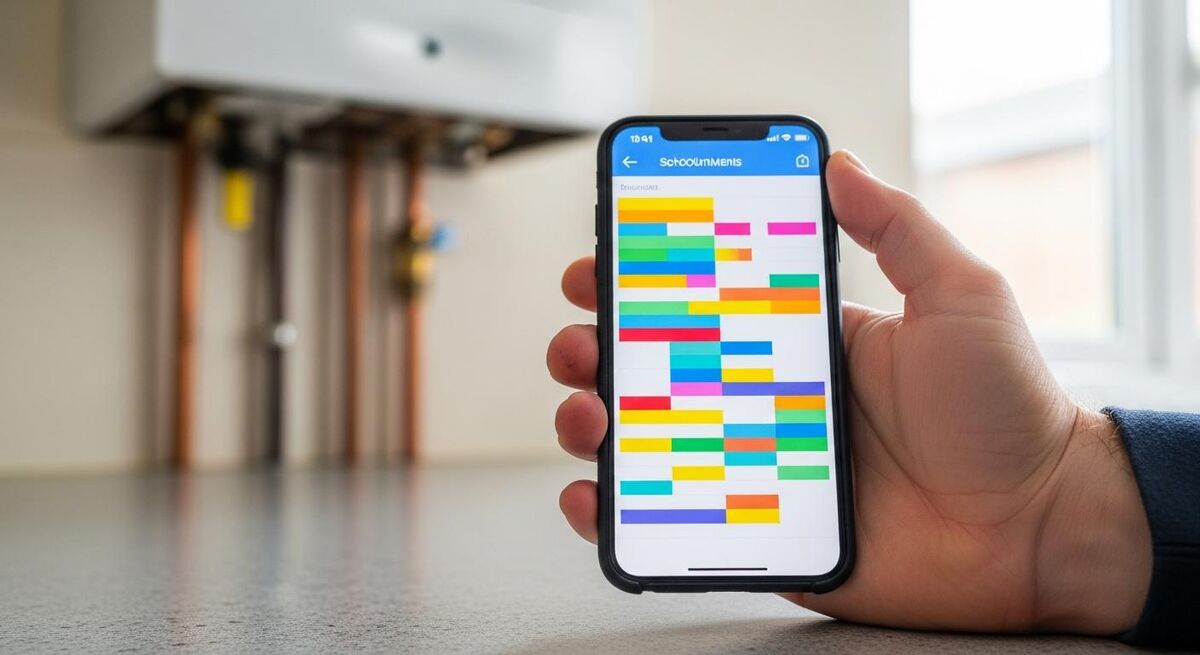
The drag-and-drop scheduler is the bit most engineers will see day to day. You can pull a job from the unscheduled queue, drop it on an engineer's calendar, and Commusoft recalculates the route and the travel time. Premier Heating Solutions, a Commusoft customer for nearly a decade, brought their average travel time down to 10 to 15 minutes between jobs by tightening this workflow. That is half an hour of paid engineer time back, per engineer, per day.
For PPM specifically, the value compounds. The annual service visits are scheduled six to twelve months in advance, so you can plan around them. Reactive callouts slot into the gaps. You stop double-booking. You stop missing visits. You stop discovering at the end of December that the customer you signed up in January 2025 has not had a service yet.
The mobile app is where most of the engineer's day actually happens. The visit task list is on the screen, the customer history is one tap away, the asset record is attached, and the digital Gas Safety certificate generates itself at the end of the visit. The customer signs on the engineer's phone. The job closes. The invoice posts to the accounting system. None of that needed the office.
Auto-invoicing and the monthly direct debit
This is where a planned maintenance programme either makes you money or quietly bleeds you dry. Most firms that try PPM and abandon it do so because the invoicing got messy. A customer's direct debit failed and nobody chased it. A renewal got missed. The accounts team ended up running a spreadsheet alongside the FSM and the figures stopped matching.
Commusoft handles the invoicing in one place. The recurring billing engine generates the invoice on the cycle date, posts it to your accounting integration, takes the direct debit through GoCardless or Stripe, and marks the contract as paid. A failed payment triggers a retry sequence and a workflow notification to the office. You do not have to remember to chase. The system does.
The numbers stack quickly. Two hundred residential plans at £15 a month is £3,000 a month, or £36,000 a year, generated by software you have already paid for. Three hundred plans is £54,000. A four-engineer firm with a 500-contract book is sitting on £90,000 of base revenue that processes itself, plus £150,000 to £450,000 of pull-through repair work that lands because those customers call you first.
| Billing approach | Manual spreadsheet | FSM auto-invoicing | Commusoft + accounting integration |
|---|---|---|---|
| Time per invoice cycle (200 plans) | 4-6 hours | 30-60 min | 5-10 min review only |
| Failed payment chasing | Manual, often missed | Semi-automated | Workflow notification, retry sequence |
| Renewal scheduling | Easy to miss | Reminder triggered | Auto-renew with customer portal opt-out |
| Accounting reconciliation | Manual entry | CSV import | Direct sync to Xero / QuickBooks / Sage |
| SLA and compliance tracking | Separate spreadsheet | Within FSM | Per-contract, reportable |
| Realistic admin saved (per month) | 0 | 4-6 hours | 10-14 hours |
The savings look modest line by line. They are not modest when you stack them across a year. A firm doing 500 active contracts on Commusoft with the accounting integration saves roughly 130 hours of office admin annually compared to a manual spreadsheet workflow. At £20 an hour for an office manager that is £2,600 a year, before you count the missed renewals and failed payments that would otherwise leak.
For a wider comparison of how the auto-invoicing stack maps across the other major UK platforms, the FSM scaling comparison walks through the operational and cost differences at 5, 15 and 50 engineers.
Renewals: where most firms leak revenue
Renewals are the silent killer of every service-contract business. You sign up 100 customers in year one. You celebrate. By year two, 25 of them have lapsed because nobody reminded them, the direct debit changed bank accounts, or the customer thought they had cancelled. Suddenly your "200 active plans" is actually 152, and the recurring revenue you budgeted for has a £4,000-a-year hole in it.

Commusoft handles renewals in three ways. The first is automated reminder messaging. You set the message at 60 days, 30 days, and 7 days out. SMS, email, or both. The customer gets a nudge they can act on, and the system tracks who has opened, clicked, or replied.
The second is the customer portal. The customer logs in, sees their contract, and can renew, upgrade or cancel in a couple of clicks. For a residential book, the portal does roughly a third of your renewals without any office involvement at all.
The third is the office-managed flow. For commercial contracts, the system flags the renewal 90 days out and routes it to the right account manager. They get the contract history, the SLA performance for the year, the contract profitability, and a one-page renewal proposal that auto-generates from the template. The conversation gets cleaner. The renewal rate goes up.
The firms running this workflow well are pulling renewal rates of 85 to 92 percent on residential contracts. Manual chasing typically sits between 70 and 78 percent. That 8 to 14 percentage-point gap is the difference between a flat book and a growing one. On a 300-contract book, it is 36 contracts retained that would otherwise have lapsed. At £180 average annual value, that is £6,480 a year that simply stays in the business.
Where AI is actually helping (and where it is not)
I am going to be straight with you. Most of what is marketed as "AI predictive maintenance" in 2026 is rules-based scheduling with a chatbot stuck on the front. That is not nothing, but it is not the magic the vendors imply. Let me walk through where the AI layer in Commusoft is actually earning its keep, and where it is a marketing word.
Predictive renewal timing
The model looks at when a customer historically opens emails, what time of day they convert, and how long they wait before they reply. It then schedules the renewal nudge at the moment they are most likely to act. The renewal rate uplift on a well-tuned model is 8 to 14 percentage points over a fixed schedule. That is real. On a 300-contract book it is 36 extra retained plans. The model is not pretending to be a doctor. It is doing one job and doing it well.
Asset failure pattern detection
If you have smart sensors on the equipment, the system can spot the pattern that precedes a failure. Pressure drop, rising flue gas temperature, cycling rate increase. It flags it and pushes a maintenance visit forward by a fortnight. The customer thinks you are a wizard. You think the visit was on the schedule anyway. Both are right and the relationship strengthens.
Conversational renewal AI
An AI agent handles the renewal conversation in the way your office would. Confirms the address, confirms the boiler is the same one, updates the direct debit if it changed, answers questions like "what does the £150 parts allowance cover". This used to take 12 minutes of your office manager's time per renewal. Done well, it now takes 90 seconds with no human involvement at all. Commusoft's Aiden AI handles the simple renewals and escalates anything actually tricky to a human.
For a longer look at how AI is reshaping the operating economics of a UK trades business, the FSM switching cost analysis sets out what the next three years look like for firms who automate the back office versus those who do not.
The 90-day rollout: from zero to a renewing book
Here is the rollout sequence I run with small UK heating and plumbing firms who want to go from zero to a working PPM book in a quarter.
Days 1 to 14: Build the foundation
Build one contract template inside Commusoft. Residential boiler service, Silver tier. £15 a month. One annual visit, £50 parts allowance, 15 percent off non-covered labour, 48-hour priority callout. Set up your GoCardless or Stripe direct debit integration. Write the visit task list. Print the one-page comparison sheet customers will see on the doorstep.
Days 15 to 30: Sell to the warm list
Pull every customer who has paid you for a boiler-related job in the last 18 months. Anyone who had an annual gas safety. Anyone who had a breakdown. Send them all a one-page proposal with a payment link. Email and post, not just email. Expect a 15 to 25 percent conversion on the warm list. On a list of 200 previous customers that is 30 to 50 plans signed inside two weeks.
Days 31 to 60: Embed the doorstep workflow
Train your engineers to make the offer at the end of every paid job. The conversation is "while I'm here, has anyone ever talked you through a service plan for this boiler? Not a sales pitch. We have a few options that work out cheaper than a one-off call if something goes wrong." Leave the sheet. Office calls back on Friday. Conversion sits at 18 to 32 percent across firms that run it consistently.

Days 61 to 90: Layer on commercial and tune the renewals
By day 60 you should have 60 to 100 active plans. Now layer on small commercial. A cafe with one boiler and one walk-in chiller, a dentist with a small heating system, a corner shop with a refrigeration cabinet. Single price per year, quarterly visits, fixed monthly direct debit. The conversation is different (compliance and certainty, not peace of mind) but the software workflow is identical.
Set the renewal automation up before any of the first cohort hit their 12-month mark. Two 60-day reminders, one 30-day reminder, one 7-day reminder, then the auto-renew with the portal opt-out. If you wait until the first renewal lands to set this up, you have already missed the moment.
Pitfalls and what to watch out for
I have helped enough firms set this up to know where it goes wrong. The software is rarely the issue. The setup discipline is.
Pricing on autopilot
The most common error is letting plan pricing drift for years. You set £120 in 2022 and never adjust it. Three years later your part costs are up 18 percent, your engineer labour cost is up 22 percent, and your gross margin has compressed from 55 percent to 38 percent. Commusoft will show you this in the contract profitability report. The fix is annual indexation written into the contract terms, usually CPI plus one percent, so renewals adjust automatically.
Bundling complex assets too early
I see this on every commercial book. The first contract is "boiler plus unvented cylinder plus underfloor heating plus the smart thermostat the customer fitted themselves". You priced it for an average and you will lose money on the complex ones. Start with a single asset per contract. Only bundle when you have run a year of profitability data on each asset type separately.
Skipping the engineer mobile training
If your engineers are not entering the visit data on the mobile app, you do not get any of the value. The reports are wrong. The certificates are wrong. The customer portal is wrong. The renewals are wrong. Half a day of paid training in the first week is the cheapest investment you will make in the system.
Forgetting the customer communication template
Commusoft can send your booking confirmation, reminder, on-the-way notification, and post-visit summary. Most firms set up the first one and forget the rest. The compounding effect of consistent, branded comms on retention is real. Set them all up in week two. You will not touch them again for years.
What UK tradespeople and Commusoft customers are saying
Recommended videos

Creating a Contract in Commusoft: A Timelapse
Commusoft - Software for the Trades

Service Reminders and Invoicing Software with Commusoft
Commusoft - Software for the Trades

Commusoft Customer Journey Plan: Custom Heat Testimonial
Commusoft - Software for the Trades

Commusoft Demo: Field Service Management Tutorial
How to Hippo

Commusoft Tutorial for Beginners
How to Simple

Grow Your Trades Business with Commusoft
Commusoft - Software for the Trades

How to Set Up Service Agreements for Your Plumbing Company
Tony Gee
Frequently asked questions
About 45 minutes from a standing start if you know what you want the contract to look like. Most of the work is deciding the price, the visit task list and the renewal terms. The software setup itself is fast. The hard bit is selling 100 of them, not building the template.
Commusoft does not publish public pricing, so expect a sales call. Realistic UK budget for a four-engineer firm is £45 to £95 per user per month after the demo, with monthly rolling licences for seasonal staff and daily licences for subcontractors. There is usually a £500 to £2,000 implementation fee. Insist on a 30-day pilot before you sign anything longer term.
You can run your first 20 contracts in almost anything, including a spreadsheet. The point you outgrow ServiceM8 or Tradify on planned maintenance is around 50 to 80 active contracts, when asset-level scheduling, contract profitability reporting and renewal automation start to matter. Commusoft, Joblogic and BigChange are built specifically for that point.
The middle tier sits between £15 and £20 a month, or £180 to £240 a year, billed monthly by direct debit. Bronze is around £9 to £11 a month for service-only. Gold sits at £30 to £40 for the priority callout and parts allowance. About 60 to 70 percent of customers pick the middle option. The Bronze tier exists so Silver looks reasonable. Silver is the product.
Yes. Direct integrations with Xero, QuickBooks Online and Sage are part of the core platform. Recurring invoices generated by Commusoft post straight into the accounting tool, reconcile against the direct debit payment, and update the contract status. You stop double-entering invoices, which is the biggest source of admin error in most small firms.
Eighty-five to 92 percent on residential plans with the automation properly set up. Manual chasing typically sits at 70 to 78 percent. That 8 to 14 percentage point gap is the difference between a flat book and a growing one. On a 300-contract book it is 36 contracts retained per year that would otherwise have lapsed.
Predictive renewal timing earns its place. Pattern detection on sensor-equipped commercial kit earns its place. Conversational renewal AI is the closest the current crop gets to magic, and it works. "AI failure prediction" on a 14-year-old sensor-free residential boiler is marketing fluff. Treat any vendor claim about predicting failures without sensor data with healthy scepticism.
Half a day of paid training in the first week. Make the workflow non-negotiable. Pay the on-site time it takes to enter the data. Once an engineer realises the digital Gas Safety record generates itself and they do not have to fill in a paper sheet at 9pm at the kitchen table, they stop pushing back. Adoption is a leadership problem, not a software one.
My verdict
Commusoft's PPM module does the heavy lifting on the bits that always break under manual workflow. Scheduling, recurring invoicing, renewal automation, customer portal, asset-level reporting. None of it is glamorous. All of it compounds. The firms I have seen go from 0 to 300 active plans in two years did it because they treated the rollout like a 90-day discipline, not a software project. Build one tier, sell it consistently from the doorstep, let the software run the back office, and adjust pricing at renewal once you have profitability data. The book that comes out the other end is the most valuable asset a UK trades business will ever build.
Commusoft is not the cheapest tool on the market and it is not the simplest. For a sole trader doing five PPM contracts a year, it is overkill. For a firm growing from 30 to 300 contracts, it is the right shape of system, and the AI layer makes the back-office work even less painful than it was three years ago. If you are still running planned maintenance in a spreadsheet at over 50 active contracts, you are already losing money on missed renewals and your engineers are doing more admin than they need to.
Start with the contract design. Set up one template in Commusoft. Sell the first 50 from your warm list. Then let the software do its job while you sell the next 50.