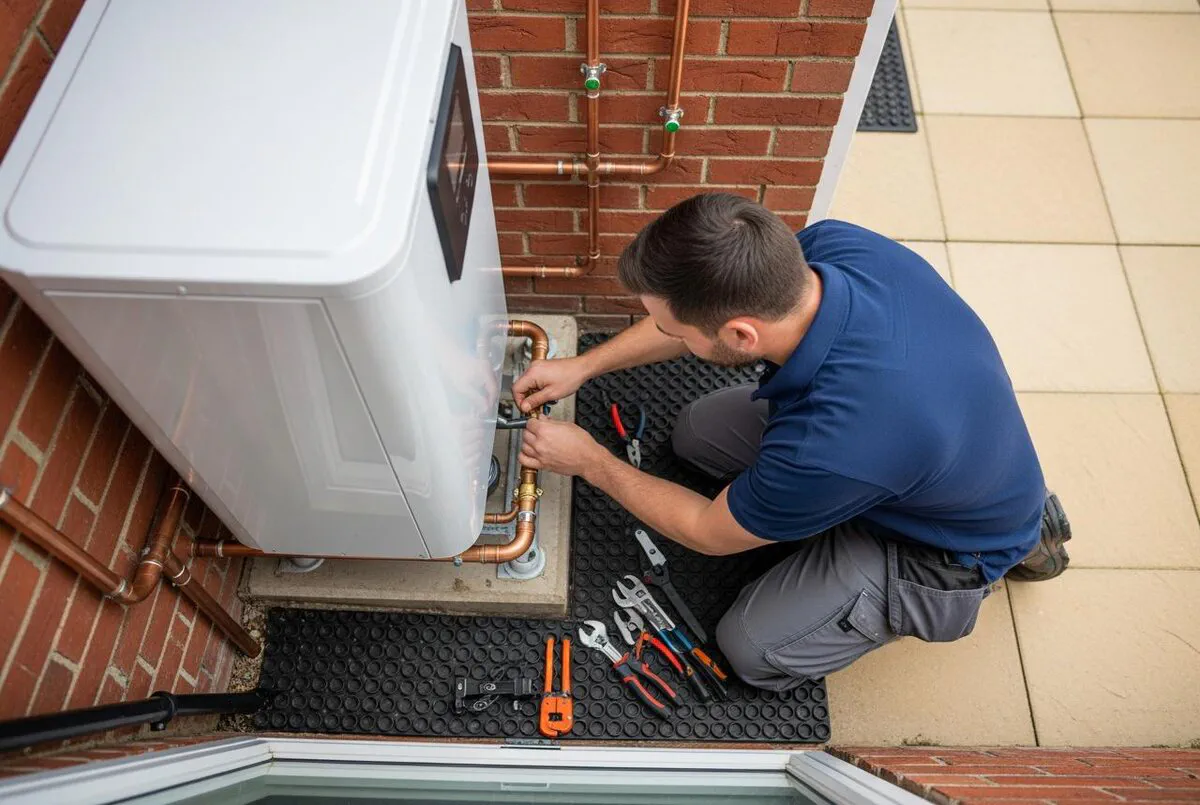

Quick Answer
You need a Level 3 heat pump qualification (City & Guilds 2924, LCL Awards, or BPEC), then MCS certification through an approved body like NICEIC or Napit. Training takes 3-5 days and costs £585-£1,300 plus VAT, with up to £500 covered by the government's Heat Training Grant. MCS certification adds another 2-3 months and roughly £1,090 in the first year. Total investment sits under £2,000 after grants. With 125,000 heat pumps sold in the UK last year, the BUS grant rising to £9,000 for off-grid homes from July 2026, and 450,000 annual installs targeted by 2030, the demand for certified installers is outstripping supply by quite some margin.
Table of Contents
- Why heat pump certification matters in 2026
- The qualifications you actually need
- Training routes and courses
- The MCS certification process step by step
- AI tools for heat loss calculations
- The business case: costs, earnings, and ROI
- Government grants and policy support
- The Future Homes Standard and what comes next
- What installers and homeowners are saying
- Recommended videos
- Frequently asked questions
- My verdict
Why heat pump certification matters in 2026

The heat pump market in the UK has shifted from niche to mainstream. Over 125,000 units were sold in 2025, up 27% on the previous year. MCS recorded 57,918 certified installations in 2024, a 75% jump on the previous record of 32,927 in 2023.
The government's Warm Homes Plan, published in January 2026, targets 450,000 heat pump installations per year by 2030. The Future Homes Standard will require low-carbon heating in all new builds from late 2027. The Clean Heat Market Mechanism, now in its second year, obliges boiler manufacturers to deliver 8% of eligible boiler sales as heat pump installations.
For plumbers, gas engineers, and HVAC technicians, this creates an opportunity that is hard to ignore. The installer base needs to grow substantially. MCS currently has just over 5,250 certified contractors. The Heat Pump Association estimates 33,700 full-time installers will be needed to hit deployment targets. We are nowhere near that number.
I spent about twenty years as a hands-on heating engineer in both commercial and domestic gas. I installed a handful of air source heat pumps under contract for an umbrella company early in my career. Nobody asked for evidence of competence or quality. I was not given design support or guidance beyond the manufacturer's installation manual in the box. That experience shaped my view on certification: it matters, but it needs to be about performance, not just paperwork.
The Future Homes Standard is accelerating the timeline for every heating business in the country. Getting certified now puts you ahead of a wave that is only building.
9,062 individuals completed recognised heat pump training qualifications in 2024, a 15% increase from 2023. But with 33,700 full-time installers needed, the industry requires roughly nine times more heat pump engineers than currently exist. Source: MCS and Heat Pump Association.
The qualifications you actually need
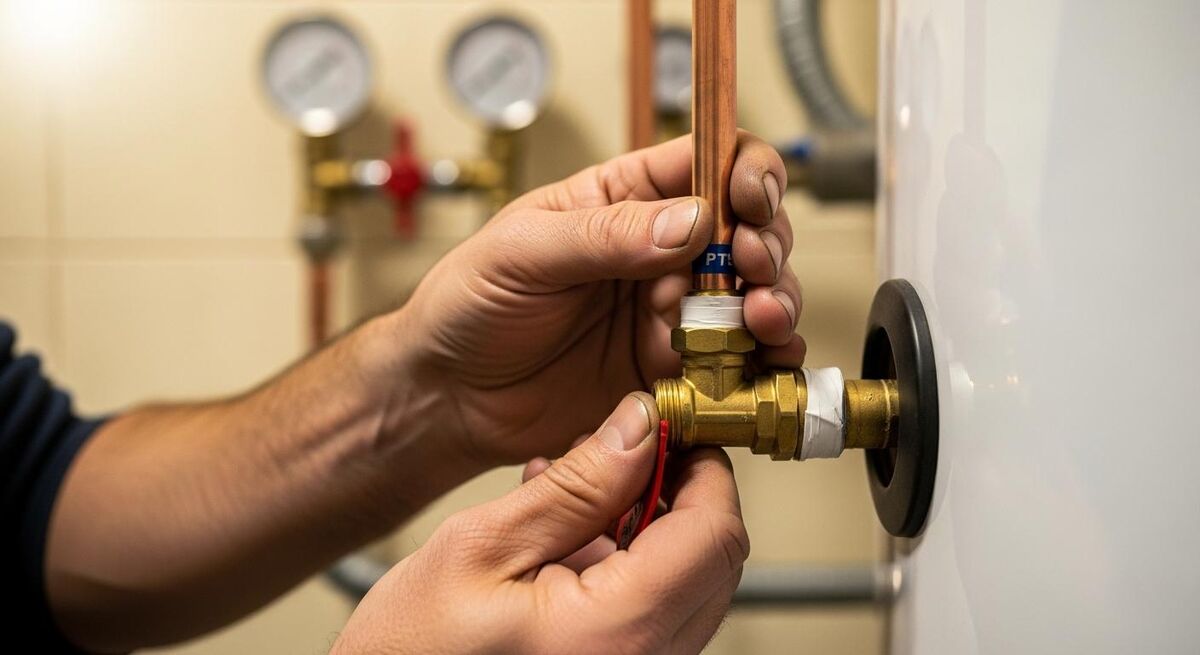
Before you can apply for MCS certification, you need specific qualifications. The pathway is more structured than most people expect, but it builds on skills you likely already have.
Prerequisites
You need one of the following as a baseline:
- Level 2 or Level 3 NVQ/SVQ in plumbing, heating and ventilation, gas, or oil installation and maintenance
- OR a valid Core Gas Safety certificate (CCN1) with CENWAT
On top of that, you need:
- WRAS Water Regulations qualification
- Minimum 2 years of verifiable experience installing heating and hot water systems
Electrical work on heat pump installations must be completed by a qualified electrician. You do not need to hold electrical qualifications yourself, but you need access to someone who does.
The WRAS Water Regulations qualification is mandatory for MCS certification and is the one requirement most gas engineers miss. If you do not already hold it, factor in the additional course time and cost. It is a straightforward qualification but you cannot skip it.
The core heat pump qualification
You need a Level 3 Award in Air Source Heat Pump Systems. Three main routes lead to this:
- City & Guilds 2924 – Level 3 Award in Design, Installation, Commissioning and Maintenance of ASHP Systems
- LCL Awards Level 3 – Award in the Installation and Maintenance of Heat Pump Systems (non-refrigerant circuits)
- BPEC Level 3 – Domestic Air Source Heat Pump Systems
All three are MCS-recognised. The choice often comes down to which training provider is nearest to you and which qualification they deliver. There is no meaningful hierarchy between them for MCS purposes.
Training routes and courses
Several providers deliver heat pump training across the UK. Costs vary, but the government's Heat Training Grant of up to £500 makes many courses free or nearly free. Here is how the main options compare.
| Provider | Qualification | Duration | Cost | Locations |
|---|---|---|---|---|
| Logic4training | LCL Awards Level 3 | 3-5 days | £585 + VAT | Multiple UK centres |
| BPEC | BPEC Level 3 ASHP | 4 days | Varies by college | Colleges across UK |
| City & Guilds 2924 | C&G Level 3 ASHP | 5 days | £1,300 + VAT | Approved centres |
| Worcester Bosch | LCL Level 3 | 3-5 days | Free (grant-funded) | Worcester, West Thurrock, Wakefield |
| Vaillant Aspire | Manufacturer training | Self-paced | Free | Online + Centres of Excellence |
| Daikin | LCL Level 3 | 3-5 days | Grant-eligible | Woking, Birmingham |
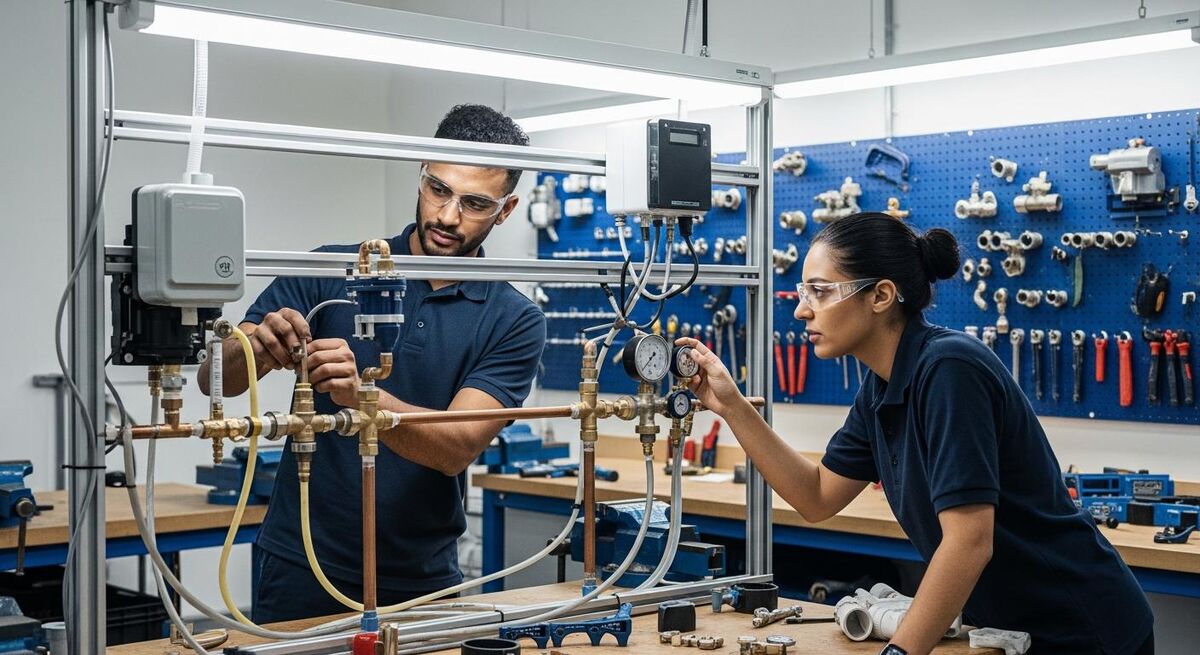
Logic4training is one of the most popular routes. Their LCL Awards Level 3 course covers design, installation, and commissioning of air source heat pump systems. At £585 plus VAT, the Heat Training Grant of £500 brings the out-of-pocket cost close to zero. They also offer a combined ASHP and Low Temperature Heating package.
BPEC delivers a 4-day course covering both air and ground source systems. The BPEC qualification is valid for 5 years and is accepted by MCS as demonstration of competence. Available at colleges across the UK, including Glasgow Clyde, West Lothian, and North East Scotland.
City & Guilds 2924 is the most comprehensive option at 5 days, covering design, installation, commissioning, and maintenance. It is also the most expensive at £1,300 plus VAT. The extra cost buys you a recognised brand name on your qualification certificate, but the MCS acceptance is identical to the other routes.
Worcester Bosch offers free heat pump training at their centres in Worcester, West Thurrock, and Wakefield. The Heat Training Grant covers the qualification cost entirely. This is a smart option if you are considering Worcester Bosch equipment for your installations.
Manufacturer-specific training from Vaillant (their Aspire Programme), Baxi, and Daikin complements the formal qualifications. These programmes teach you the specific equipment you will be installing, which matters when you are on site and need to commission a system correctly.
The government's £5 million Heat Training Grant covers up to £500 per eligible installer towards accredited heat pump training. Apply through the Midlands Net Zero Hub. One grant per installer. Available until at least March 2027, targeting 10,000 trainees.
The MCS certification process step by step
Once you hold your Level 3 qualification, the next step is MCS certification itself. This is the part that unlocks the BUS grant for your customers and gets you listed on the MCS certified installer directory.
Step 1: Preparation (2-6 weeks)
Build your Quality Management System. This is the documentation that proves your business has proper processes for design, installation, commissioning, and aftercare. You need written procedures, risk assessments, customer complaint handling, and evidence that your team meets qualification requirements.
If you have been running a gas business with Gas Safe registration, you already have the bones of a QMS. The MCS version requires additional documentation specific to renewable technologies, but the structure is similar.
Step 2: Choose a certification body
Several organisations are approved to assess MCS applications:
- NICEIC
- Napit
- APHC
- Amtivo (formerly British Assessment Bureau)
Compare fees, assessment timelines, and what ongoing support they offer. NICEIC charges approximately £738 including VAT for a single technology extension to scope, or £1,476 for three technologies.
Step 3: Submit your application
Complete the application with all documentation. This includes your QMS, staff qualification evidence, insurance certificates, and business registration details.
Step 4: Documentation review and on-site audit
The certification body reviews your paperwork, then conducts an on-site audit. They check your premises, equipment, documentation, and talk to your designated Technical Supervisor about procedures and standards.
Step 5: Address any non-conformities
If the auditor identifies issues, you get a window to fix them. Minor non-conformities are common on first applications. Resolve them promptly and submit evidence of correction.
Step 6: Certification granted
Once everything passes, certification is typically granted within 10 working days. You are listed on the MCS directory and can begin applying for BUS grants on behalf of your customers. If you are planning to scale a renewable energy business after certification, the solar installation operations playbook covers MCS compliance workflows and growth strategies that apply equally to heat pump businesses.
MCS certification is not a one-off. You are reassessed on a risk-based cycle, with higher-risk installers audited more frequently. Maintain your QMS, keep qualifications current, and ensure every installation meets MCS standards. Annual costs run to approximately £890 plus £30 plus VAT per installation certificate lodged on the MCS database.
AI tools for heat loss calculations
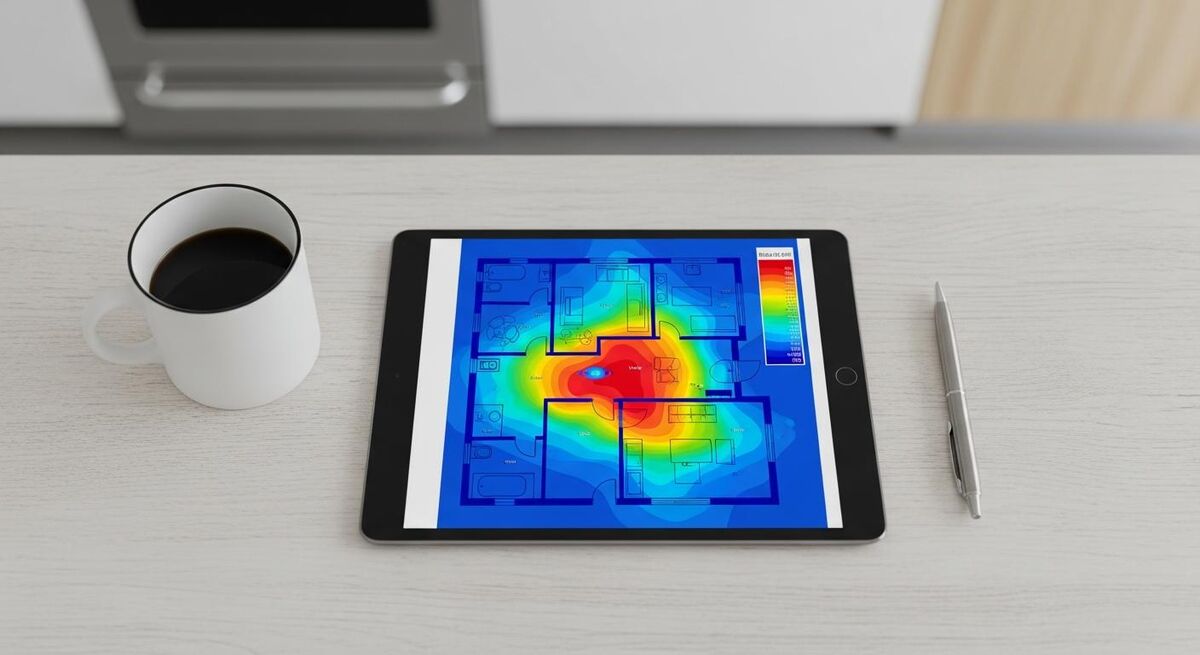
Heat loss calculations are the foundation of every heat pump installation. Get them wrong and the system undersizes or oversizes, the customer gets cold rooms or inflated bills, and your reputation takes the hit. The good news is that technology has transformed this process. AI-powered tools now do in minutes what used to take hours with a spreadsheet.
Heatpunk by Midsummer is a free online tool that produces full room-by-room heat loss calculations to MCS standards. It follows CIBSE Domestic Heating Design Guide and BS EN 12831. You draw the floor plan, input construction details, and it generates the MCS-required performance estimate. There are Pro and Enterprise tiers for larger businesses, but the free version handles most domestic installations.
Heat Engineer takes it further with a mobile app and web platform. Version 3 features LiDAR-assisted room capture, which slashes survey times to minutes. Enter a property address and it automates MCS 031 standard compliance. Their partnership with Magicplan enables 3D room scanning with dimensions automatically imported. It also integrates with Commusoft for field service management.
Heat Geek (Zero Disrupt Software) uses AI to design heat pump systems from smart meter connected property surveys. Their augmented reality feature lets you virtually place a heat pump to check clearances and calculate noise impact before committing to a position. They are the only company to guarantee system efficiency with their "Heat Geek Guarantee", backed by data from thousands of installations.
Spruce combines estimating, surveying, and design in one platform with LiDAR scanning for instant floor plans. It handles MCS compliance and QMS management, works offline, and covers the workflow from lead qualification through to reporting.
MCS also provides its own Heat Load Calculator, a free official tool supporting MIS 3005-D. It launched in December 2024 and has been updated to reflect CIBSE DHDG 2026 changes. Note that the old Excel-based calculator was removed from 1 April 2026, so you need to use the online version.
These tools do not replace your knowledge. You still need to understand building fabric, flow temperatures, and system design principles. But they remove the tedium and reduce errors. If you are interested in how AI is changing trades work more broadly, the AI tools guide covers the full landscape.
The business case: costs, earnings, and ROI
Let me lay out the numbers plainly.
Your investment to get certified
| Cost item | Amount | Notes |
|---|---|---|
| Training course | £585-£1,300 + VAT | Up to £500 covered by Heat Training Grant |
| MCS first-year fee | ~£1,090 | Certification body + Consumer Code |
| WRAS (if needed) | ~£200-£300 | One day course |
| Total first year | ~£1,375-£2,690 | After Heat Training Grant |
| Ongoing annual (MCS) | ~£890/year | Plus £30+VAT per installation certificate |
What you can earn
Heat pump installers command a premium over gas-only engineers. The data is consistent across multiple sources:
- Employed ASHP installer: approximately £46,839 per year (£23.14 per hour)
- Self-employed sole trader: approximately £66,377 per year
- Limited company owner: approximately £76,024 per year
That is £7,000-£10,000 more annually than the equivalent gas engineer role. The premium reflects the skills shortage: demand is high, supply is limited, and customers are willing to pay.
The ROI calculation
If you invest £2,000 and earn an extra £7,000 in your first year, that is a 3.5x return. By year two, the additional revenue is almost entirely profit after the £890 annual MCS fee.
And that is before considering the competitive advantage. Each MCS-certified installation gives your customer access to the £7,500 BUS grant (rising to £9,000 for off-grid homes from July 2026). You are not selling a £12,000 heat pump. You are selling a £4,500 heat pump with a government-backed discount. That changes the conversation entirely.
An apprentice does not generate revenue for the first three years. Every engineer I have trained has made my business stronger. Heat pump certification is different. It generates revenue from the first installation. The learning cycle is shorter, the payback is faster. Once the jobs start flowing, automating your quoting and invoicing becomes the next bottleneck to solve. The plumbing automation playbook walks through that transition step by step.
Government grants and policy support
Boiler Upgrade Scheme (BUS)
The BUS grant is the single biggest driver of domestic heat pump demand. Here is the current structure:
- £7,500 for air source and ground source heat pumps (current)
- £9,000 for off-gas-grid homes switching from oil or LPG (from July 2026)
- £2,500 for air-to-air heat pumps (from April 2026)
The scheme has been extended to 2030 with a budget of £295 million for 2025/26. It is administered by Ofgem. The installer applies on behalf of the customer, and the grant is deducted directly from the invoice. The customer needs a valid EPC and an MCS-certified installer. No MCS, no grant.
Heat Training Grant
Up to £500 per eligible installer towards accredited training. Funded by the Department for Energy Security and Net Zero, managed by the Midlands Net Zero Hub. One grant per installer. Available until at least March 2027, with a target of supporting 10,000 trainees.
Warm Homes Plan
Published in January 2026, this is the overarching policy framework:
- £15 billion investment to upgrade up to 5 million homes
- £2 billion in low-interest loans for heat pump adoption
- 180,000 new green jobs supported
- 1-metre boundary rule removed for air source heat pumps
- Target: at least 70% of installed heat pumps to be UK-manufactured
The 1-metre rule change is worth noting. Previously, ASHPs had to be at least 1 metre from the property boundary, which ruled out many terraced and semi-detached homes. That restriction is gone, opening up a large portion of the UK housing stock.
The Future Homes Standard and what comes next
The Future Homes Standard is the single biggest structural shift for the heating industry in a generation. New homes built from late 2027 must use low-carbon heating. No new gas connections. Heat pumps or equivalent.
Legislation is expected to be laid by December 2026, with a transition period ending December 2027. Architects, developers, and housebuilders are already specifying heat pumps for projects starting now. The standard requires new homes to cut carbon emissions by 75-85% compared to 2013 levels.
The Clean Heat Market Mechanism entered its second year in April 2026. Manufacturers must deliver 8% of eligible boiler sales as heat pump installations, up from 6% in year one. A full review is expected in spring 2026, and targets may rise further.
The strict 2035 gas boiler ban has been replaced with what the government calls a "carrot not stick" approach. Gas boilers remain legal. Nobody is forced to rip out a working system. But the direction of travel is clear, and every policy lever is pointing towards heat pumps.
For installers, this means sustained long-term demand. The skills gap is not closing quickly. Getting certified now positions your business for a market that will only grow.
The government targets approximately 200,000 heat pump installations per year in new-build homes via the Future Homes Standard. The remaining 250,000 of the 450,000 annual target comes from retrofit. Both segments need certified installers, and the skills are transferable between them.
What installers and homeowners are saying
Recommended videos

The Ultimate Guide To MCS (Microgeneration Certification Scheme)
Heat Geek

How heating engineers can train to install heat pumps
Nesta

How to become a heat pump installer with HPIN
InstallerSHOW

Why become a heat pump installer?
Energy Systems Catapult
My journey to becoming a heat pump engineer
Tomkat Gas Training

Boiler Upgrade Scheme UPDATED: £7,500 Grant for Heat Pumps
GreenMatch UK

Heat Geek's Heat Pump One Year Later: The Verdict
Skill Builder

Why MCS Certification Does Not Guarantee a Good Installation
Renewable Heating Hub
Frequently asked questions
No. Heat pumps are not gas appliances. You need a Level 3 heat pump qualification and MCS certification. If the job involves decommissioning a gas boiler, that part requires Gas Safe registration. The heat pump installation itself does not.
Allow 3-5 months. Training is 3-5 days. MCS certification takes 2-3 months including preparation, application, and audit. If your QMS and paperwork are already in order, it can be faster.
Technically yes. But your customers cannot claim the £7,500 BUS grant without an MCS-certified installer. That puts you at a significant price disadvantage. MCS is the market standard, and most customers will not consider a non-certified installer.
Up to £500 towards an accredited heat pump training course. Apply through the Midlands Net Zero Hub. Many courses like Logic4training at £585 plus VAT become free or near-free after the grant. One grant per installer. Available until at least March 2027.
The domestic market is where the BUS grant applies and where most of the 450,000 annual target sits. If anything, domestic installers have the strongest business case. The retrofit market alone needs 250,000 installations per year by 2030.
The same training providers offer GSHP courses, usually as an add-on to the ASHP qualification. Ground source installations are less common but command higher prices. The BUS grant covers both ASHP and GSHP at £7,500. BPEC offers a combined air and ground source course in 4 days.
My verdict
This is the biggest structural shift in the UK heating industry in decades. The numbers are not ambiguous. 125,000 heat pumps sold last year. 450,000 per year targeted by 2030. Grants rising to £9,000. A workforce that needs to grow several times over.
The investment to get certified is modest. Under £2,000 with the training grant. The return is clear: heat pump installers earn £7,000-£10,000 more than gas engineers, and the demand pipeline stretches years into the future.
I have been in this industry long enough to know that transitions are messy. MCS certification is not perfect. We know MCS umbrella companies have historically held a negative reputation with installers. They are seen as gatekeepers for government funding rather than a driving force for quality. But with the right support, we can ensure higher quality installations, lower running costs, and long-term comfort for customers.
If you are a plumber, gas engineer, or HVAC technician sitting on the fence, the time to move is now. Not next year. Not when your competitors have taken the best training slots. The demand is here. The funding is here. The technology to support you is here. Get certified and get building.