
Quick Answer
For me, the brutal truth is this, right? The homeowner who is going to fit a heat pump next year is, today, sat at their laptop typing "boiler replacement near me" into Google. They are not searching "air source heat pump installer" because they do not know what one is. So your marketing has to live where their search lives. Build geo-targeted local pages on your website, claim every inch of your Google Business Profile, layer an AI receptionist on top to catch the 8pm enquiries, and stop pretending a national blog about R290 refrigerant is going to bring in a single lead. Local SEO is still your highest ROI play, pal, but you have to do it properly.
Table of Contents
- Why they Google "boiler", not "heat pump"
- Own the keyword they actually type
- Write GeoTown blogs, not generic ones
- Make your Google Business Profile do the heavy lifting
- Treat your website like a sales tool, not a brochure
- Plug in an AI receptionist for the 8pm enquiry
- The cheapest leads are the ones you already have
- Build trust before the quote, not during it
- What heating engineers and homeowners are saying
- Recommended videos
- Frequently asked questions
- My verdict
Why they Google "boiler", not "heat pump"

Right, so let me set the scene. It is November, the boiler upstairs has just started making that grinding noise everyone with a 14-year-old combi knows about, and Mrs Patel in Sheffield S11 sits down with her laptop and types five words: boiler replacement near me cost. She has heard of heat pumps. She has read something in the Sunday Times about a grant. But she does not search for one, because she does not yet believe one will work in her house. Do you know what I mean?
That is the gap. The UK still sells around 125,000 heat pumps a year against roughly 1.5 million gas boilers, and even though the country passed 250,000 certified heat pump installations in early 2026, the search behaviour has barely caught up. Homeowners search for the thing they recognise. They search "boiler". They search "boiler service". They search "new combi cost". That is where your marketing has to be, even if what you actually want to sell them is a sensibly-sized heat pump with a 200 litre cylinder.
The lazy thing is to put up a single page called "Heat Pumps" and wait for someone to find it. The lazy thing does not work. The lazy thing has never worked. Heat pump installations actually fell 18 percent in Q1 2026 compared to the previous quarter according to DESNZ, partly because the people who would have bought one cannot find anyone local who can have the conversation with them in language that does not sound like a physics lecture.
Own the keyword they actually type
I have been banging this drum for years, mate. Local SEO and national SEO are different sports. Different rules. Different ball game. A national blog called "Top 10 Air Source Heat Pumps 2026" is competing with Which?, the Energy Saving Trust, MoneySavingExpert and 400 other content sites that have been ranking since 2018. You will lose. Every time.
What you can win, what you absolutely should be targeting, is the local intent search. I dig into the mechanics of this in my 30-minute monthly local SEO routine, but the principle for heat pumps is the same. The person typing "boiler installer Sheffield" or "new combi Wakefield" or "air source heat pump Buxton". Those searches have geographic intent, and Google rewards local relevance hard. The number of competing pages in any given town is tiny compared to national searches. You can rank in the top three in your area inside six months if you do it right.

The structure I recommend to every installer I work with is the same. One main sales page for each technology you offer, written for the broad term (heat pumps, boilers, boiler servicing). Then a layer of geographic landing pages underneath, one per town you actually serve, each one written for a real human who lives there. Not duplicated. Not spun. Not "the same page with the town name swapped". A real page that mentions the local Wickes, the local conservation area, the fact that loads of houses in that postcode are 1930s semis with 15mm copper. Specific. Local. Useful.
And on top of that, geographic blog content. The Sheffielders Guide to Heat Pumps. What Doncaster Homeowners Should Know About the BUS Grant. The Cost of Replacing Your Combi in Chesterfield. These are the blogs that rank, the blogs that earn backlinks from local Facebook groups, the blogs that show Google you are the local authority on the topic.
Write GeoTown blogs, not generic ones
Look, I know there is a temptation. Every marketing agency that has ever sold a "blogging package" to a heating company has pumped out the same three articles. Winter Plumbing Tips. Top 10 Boiler Brands. Five Reasons to Choose a Heat Pump. They never rank. They never get read. They never get a backlink. They are written for the agency invoice, not for your customers.
What you want is the GeoTown approach. The phrase I made up for it years ago is just shorthand for "stick a town name in the title and the URL and the H1 and three times in the body copy". So instead of "Top 10 Boiler Brands", you write "What Barnsley Homeowners Should Know Before Replacing Their Boiler in 2026". Instead of "Are Heat Pumps Worth It", you write "Heat Pumps in Halifax: A Realistic Look at What Three Local Families Paid".

The structure for one of these is dead simple. Open with the search intent (what the homeowner is worried about). Bring in the local angle in the second paragraph (the housing stock, the local energy network, the grant landscape). Talk about real costs for properties in that area. Link out to one or two useful local resources (the council planning portal, the local conservation area map). Wrap with a clear "if you want a quote, here is the form" CTA. Twelve to fifteen hundred words. One image of the actual town. Done.
I have one partner in the West Midlands who has been pumping out one GeoTown blog every two weeks for sixteen months. He now ranks in the top three for "boiler replacement" in eight of his nine target towns and a chunky number two for "air source heat pump" in three of them. None of his blogs cracked five hundred hits in the first six months. By month twelve, three of them were past two thousand. By month sixteen, his website is doing what mine took two and a half years to do. Patience, mate. That is the bit nobody likes to hear.
Make your Google Business Profile do the heavy lifting
Right, so if your website is your sales platform, your Google Business Profile is your shop window. I have written a full GBP fix for heating engineers with the step-by-step audit if you want to go deeper after this. Free. Google-owned. Shows up in the Map Pack before your website ever loads. And most heating engineers I look at treat it like a phone book listing they set up in 2017 and never touched again.
The GBP rules have shifted in the past twelve months. Reviews matter more than ever. Photos matter more. Posts matter more. Whether your business is "open" at the time of search matters, which is a wild thing for a service area business to deal with. The data behind all this came out of WhiteSpark's 2026 Local Search Ranking Factors industry survey and it confirmed what I have been telling installers for three years.
The routine I run with every installer I work with is monthly, not annual. Four new photos uploaded. Two GBP posts (one offer-based, one educational). Five new review requests sent out via WhatsApp the same day as the install completes. The Q and A section answered properly, with the questions you wish customers asked rather than the rubbish ones they actually post. Service categories audited every quarter, especially "Heat pump installer" and "Boiler installer" which Google added as separate options in 2024 and most engineers still have not switched on.
Treat your website like a sales tool, not a brochure
Here is the conversation I have had a hundred times. Engineer rings me up. "Tommy, I paid three grand for a website four years ago and it does not bring me any work." And I look at the website and yeah, it looks alright. It says he is a heating engineer. It lists the services. There is a stock photo of a man in a flat cap holding a spanner. But there is no strategy. There is no funnel. There is no proof. There is no reason for the homeowner to ring this guy rather than the eight other engineers in the same Map Pack.
A website is not a finished product you buy off the shelf. It is a sales tool that needs to keep evolving. I have already written out the full version of this argument in my guide to trades business websites that actually generate leads, but the short version applies here too. Every quarter you should be adding a new service plan page, a new GeoTown blog, a fresh case study with real before-and-after photos, an updated FAQ section. Every time a customer asks you a question on a job, that is a future page on your website. "How long will the install take?" is a page. "Will I lose hot water during the switchover?" is a page. "What does a heat loss survey involve?" is a page.
The other thing your website needs is proof, and lots of it. Real before-and-after photos. Real customer names and locations (with permission). A live count of how many BUS grant applications you have processed. Trustpilot widgets pulled in via embed code. Video testimonials, not text ones. The buying public are sceptical because the renewable industry has burned them once already. Complaints about heat pump installations rose 24-fold between 2021 and 2024. Your website has to do the work of convincing the homeowner you are not part of that statistic.
Plug in an AI receptionist for the 8pm enquiry
This is the bit I am most excited about, right? Properly excited. Bigger than Bigfoot excited. Because the technology has finally caught up with the problem, and the engineers who get this in place before the rest of the industry are going to win the next two years of growth.
Here is the problem. The homeowner researches at 8pm. Or 9pm. Or Sunday afternoon. Your team has knocked off. Even if you are wearing the boss hat and trying to be everything, you are not picking up the phone at 9.45pm on a Tuesday. So that enquiry either goes to voicemail, gets nothing back until Wednesday morning, or they ring the next installer in the Map Pack who happens to be twelve doors down. You lost a five-figure job because nobody answered.
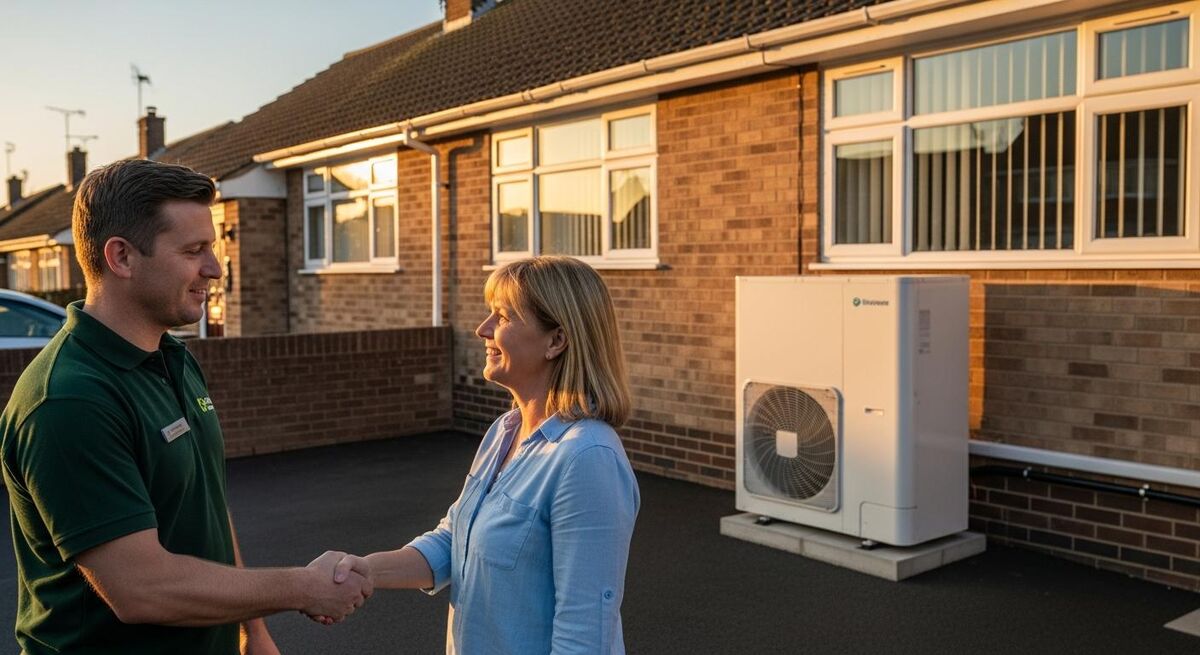
An AI receptionist on your website fixes this. It answers basic questions in plain English. It books a survey straight into your calendar. It captures the lead with name, postcode, fuel type and a rough idea of system size. It does not get tired. It does not have a mortgage. It does not call in sick. One of my Sheffield partners installed an AI on their site late January last year, and by October it had handled 307 conversations and booked 41 jobs that would otherwise have gone to voicemail. The cost of running it was roughly forty quid a month. The cost of one lost heat pump install is four grand of margin. You do the maths.
The trick is not just to slap a generic chatbot on the site and forget about it. The AI has to be trained on your specific offer, your service area, your pricing bands, your install process, the BUS grant rules, the typical objections homeowners raise. Mine takes about three weeks to set up properly per partner, and then needs a monthly review where I read the transcripts and add new answers to anything it fumbled. It is not "set and forget", it is a real product that needs maintenance. But once it is running, it is the cheapest sales person you will ever have.
The cheapest leads are the ones you already have
One last thing nobody talks about. Your easiest heat pump customer is a homeowner you already serviced a boiler for three years ago. You have their email address. You have their postcode. You know roughly when their current combi is going to need replacing. And in 87 percent of heating businesses I audit, that database is just sat in a spreadsheet or a CRM doing absolutely nothing.
Email marketing to your existing customer list is the highest ROI channel in the entire business. Cost per send: pence. Conversion rate: usually north of three percent if the offer is right. And you have already earned the trust the first time you fixed their boiler. The hard work is done. All you have to do is remind them you exist and let them know you now do heat pumps as well.
The structure I recommend is a quarterly email. Not weekly. Not monthly. Quarterly is enough to stay top of mind without becoming an annoyance. Each email has one tip (something the customer can act on), one offer (booking a service, a winter check-up, a heat pump survey), and one piece of social proof (a recent install with a real customer name and a real photo). Length: about 250 words. That is it.
| Marketing channel | Cost per lead | Speed to first lead | Long-term ROI | Best for |
|---|---|---|---|---|
| Local SEO + GeoTown blogs | £15-£40 | 6-12 months | Highest | Sustainable monthly leads |
| Google Business Profile | Free (time only) | 1-2 months | Very high | Reviews and Map Pack ranking |
| Email to existing customers | Pence per send | Days | Highest per pound | Re-engaging old work |
| AI receptionist on website | £40-£80 per month | Weeks | High | Capturing out-of-hours enquiries |
| Google Ads (PPC) | £60-£200 per lead | Days | Medium (stops when budget stops) | Quick wins, not sustainability |
| Print and door drop | £40-£120 per lead | 2-4 weeks | Low | Brand building in dense estates |
Build trust before the quote, not during it
The other thing the industry gets wrong, and I see this on training day after training day, is treating the quote as the moment to start selling. By the time you are stood in someone's kitchen holding a clipboard, you have already won or lost. The selling happened back when they first found your website. The selling happened in the testimonials they read at 11pm. The selling happened when your AI answered their first question and did not try to push them straight to a sales call.
What you want, mate, is for the homeowner to feel like they already know you before you turn up. That happens through video. It happens through blog content with your face on it. It happens through GBP posts that show real jobs in their town. It happens through a podcast appearance, or a column in a local paper, or a Facebook reel of you explaining what a heat loss survey actually involves. By the time you ring the doorbell, the homeowner should be saying "oh you're the bloke from the videos". That is when the close happens before you have even sat down.
I would rather an engineer spent four hundred quid on a proper video shoot of three customer testimonials than two grand on Google Ads, and I have done the maths on that exact trade-off in my piece on what to do instead of £500-a-month Google Ads. The video lives on the website forever. The video gets used on social. The video shows up in YouTube search. The video answers the trust question before the quote even gets sent. Two grand of Google Ads disappears the moment the budget runs out.
What heating engineers and homeowners are saying
Recommended videos

The Truth About Air-to-Air Heat Pumps and the New BUS Grant
UpsideDownFork

AI Heat Pump Installs For Just £1!? (Seriously)
Heat Geek

REVEALED: Heat Geek ZERO DISRUPT Heat Pump Install
Everything Home

Ultimate Heat Pump Installation. Rip It Out and Start Again!
Skill Builder
Heat Geek Gives His Verdict on John's Nightmare Heat Pump
Skill Builder
UK's Number One Plumber - Boiler Installation - Ideal Vogue
Allen Hart
Frequently asked questions
Yes, but as a second layer. Build for the boiler keyword first because that is where the searches are, then add heat pump landing pages on the same domain so when the homeowner gets curious and Googles it three weeks later, you turn up for that search too. You are playing both keywords with the same site.
Six months to start seeing movement, twelve to eighteen months to dominate. Anyone selling you "first page in 30 days" is lying or running ads they have called organic. Real organic ranking is slow, compounding, and the best ROI you will ever earn once it kicks in.
If you bolt on a generic one without training it, yes. If you train it properly on your service area and pricing bands and install process, customers do not even realise. The Sheffield partner I mentioned earlier had a 64 percent satisfaction score on conversations where the customer knew it was AI. That is higher than most call centres.
For a sole trader or two-van business chasing heat pump work, I would say six to eight hundred quid a month minimum split across website maintenance, content creation, AI receptionist subscription and a modest ad budget for paid retargeting. Less than that and you are not investing, you are dabbling.
Absolutely. From July 2026 to March 2027 off-grid properties can claim £9,000 instead of £7,500. Gov.uk has the rules. If your service area includes oil-heated rural villages, build a landing page specifically for the £9,000 angle. The search volume on "oil boiler replacement grant" is climbing fast.
Market them together. Most homeowners do not understand MCS, do not care about MCS, and just want to know you can fix the broken thing in their loft. Have a single website that sells all your services, with a dedicated landing page per technology. The MCS logo lives in the trust badge area at the bottom.
Not dead, but expensive per lead and hard to measure. Door drops can still work in dense, target-rich estates. I would only spend on print after the digital basics are solid. Otherwise you are pouring fuel into the bottom of a leaky bucket.
My verdict
Right, look. The heat pump market is buzzing. I am buzzing about it. There has not been a bigger growth opportunity for heating businesses in the last twenty years, and the engineers who get their marketing sorted in 2026 are the ones who will be turning over a million quid by 2028. But the marketing has to follow how the homeowner actually thinks, not how the policy makers wish they thought. They Google "boiler". You meet them there. You build their trust through GeoTown content, real customer photos, an AI that actually helps, and a Google Business Profile that turns up at the top of the Map Pack every time. By the time you walk into their kitchen for the quote conversation, they already know who you are, and the close is just paperwork. That is the playbook. Get cracking on it this week, mate, not next quarter. The window is open right now and it will not stay open forever.