
Quick Answer
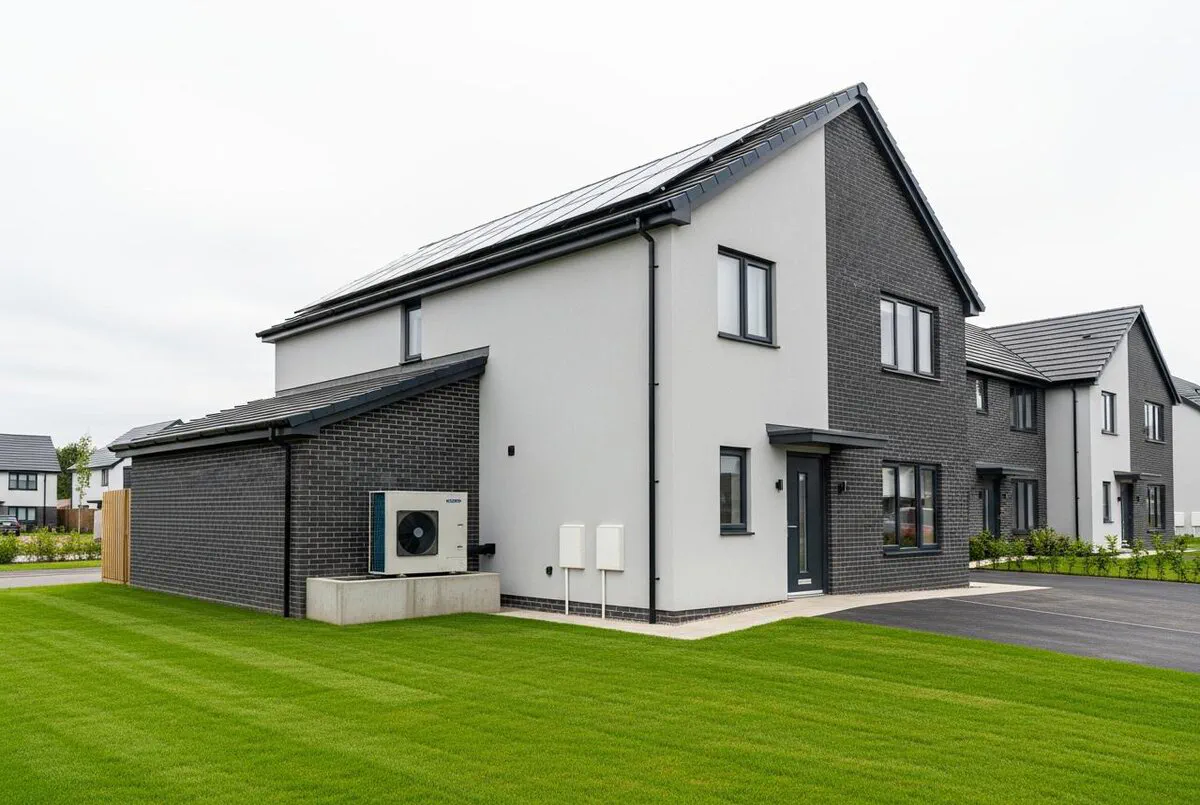
The Future Homes Standard was published on 24 March 2026 and comes into force on 24 March 2027, with a 12-month transition. In plain terms, new homes in England will need a heat pump (or other low-carbon heating), solar panels equivalent to 40% of the ground-floor area, much tighter fabric, and proper ventilation. If you want a slice of that work, you need an MCS-certified install route, properly trained engineers, and a quoting model that prices ventilation and commissioning as line items, not afterthoughts. This guide walks you through it, step by step.
Table of Contents
- What the FHS actually says
- Map your current capability against the new standard
- Step 1: Get MCS certified (or partner with someone who is)
- Step 2: Train your engineers properly on heat pumps
- Step 3: Get to grips with ventilation and airtightness
- Step 4: Rework your quoting for low-carbon jobs
- Step 5: Build a real relationship with one or two developers
- Step 6: Use AI to model performance and pre-empt compliance issues
- Common mistakes that will cost you work
- What tradespeople are saying
- Recommended videos
- Frequently asked questions
- My verdict
What the FHS actually says
Right, before we get into how to prepare, let's get the story straight. The Future Homes Standard was published by the Ministry of Housing, Communities and Local Government on 24 March 2026. The regulations come into force on 24 March 2027 for most projects, with a 12-month transition. Higher-risk buildings get an extra six months and kick in on 24 September 2027. Anything with a planning application before 24 March 2027 can still be built under the current standards, so the genuine cliff edge for full mandatory compliance is closer to March 2028.
The headline numbers are these. New homes in England must produce roughly 75 to 80% fewer carbon emissions than homes built to 2013 regulations. Gas boilers are effectively out for new build. Heat pumps are in. Solar panels are required, sized at 40% of the ground-floor area of each dwelling. The airtightness target drops from 8 m³/(h·m²) to 3 at 50 Pa, which is a serious jump and changes how you ventilate the house. The fabric U-values tighten too. The notional dwelling spec sits at roughly 0.15 W/m²K for walls and 0.11 for floors and roofs.
None of this is a surprise if you've been paying attention. The direction has been clear since 2019. What changed in 2026 is that the dates are now real and the statutory instrument is laid. You can plan against it.
The four pillars of the FHS, in plain English
Low-carbon heating (almost always a heat pump). Mandatory solar PV at 40% of ground-floor area. Tighter fabric (the famous fabric-first approach). Mechanical ventilation, because at 3 m³/(h·m²) the house can't breathe on its own.
Map your current capability against the new standard
Before you spend a penny on training or kit, sit down and do an honest audit. I'd do this on paper or in a simple spreadsheet, not in your head.
List every type of job you take on today. New builds, retrofits, boiler swaps, bathroom refits, commercial. Then list every accreditation, certification and trade body membership you currently hold. Gas Safe, NICEIC, Water Regs, OFTEC, MCS, anything. Now list every engineer on your team and what they're qualified to do.
That's your starting point. The gap between that list and what you'll need for FHS work is your work plan for the next 18 months. For most heating and plumbing firms, the gap looks something like this: MCS heat pump certification, Level 3 air source heat pump and low temperature design qualifications, F-Gas where you're handling refrigerant, and a real working knowledge of MVHR and dMEV systems.
Don't try to cover everything
You don't need to be the firm that does the heat pump, the solar, the MVHR, the airtightness testing and the commissioning all in one. Some firms will. Most will pick one or two lanes and partner for the rest. Decide which lane suits your kit, your engineers and your appetite for grant paperwork, and go after it properly.
Step 1: Get MCS certified (or partner with someone who is)
MCS certification is the single most important thing for any heating firm that wants new-build heat pump work or wants to install under the Boiler Upgrade Scheme. From 28 April 2026, only MCS installers can submit BUS applications. From 28 May 2026, MCS 020 is the only scheme accepted under England's permitted development rules for heat pumps.
To become an MCS-certified contractor you need a designated Technical Supervisor with the right qualifications, an Insurance-Backed Warranty (six years on labour after handover), evidence of competence on heat loss calculations and system design, and full compliance with MIS 3005. The application is not a tickbox exercise. You'll be audited.
If you don't want the overhead of running your own MCS scheme, there's a legitimate alternative. Find an MCS-certified contractor near you and work as a sub-contractor on their installations. You install. They take responsibility for the certification, the MCS paperwork and the BUS submission. The split varies. Expect to give up a meaningful margin in exchange for not running the MCS administration yourself.
Insurance-backed warranty isn't optional
Every MCS heat pump install needs a six-year IBG on the labour, paid into a scheme like IWA. Budget for this in your prices. Firms that forget to add it lose money on every job.
Step 2: Train your engineers properly on heat pumps
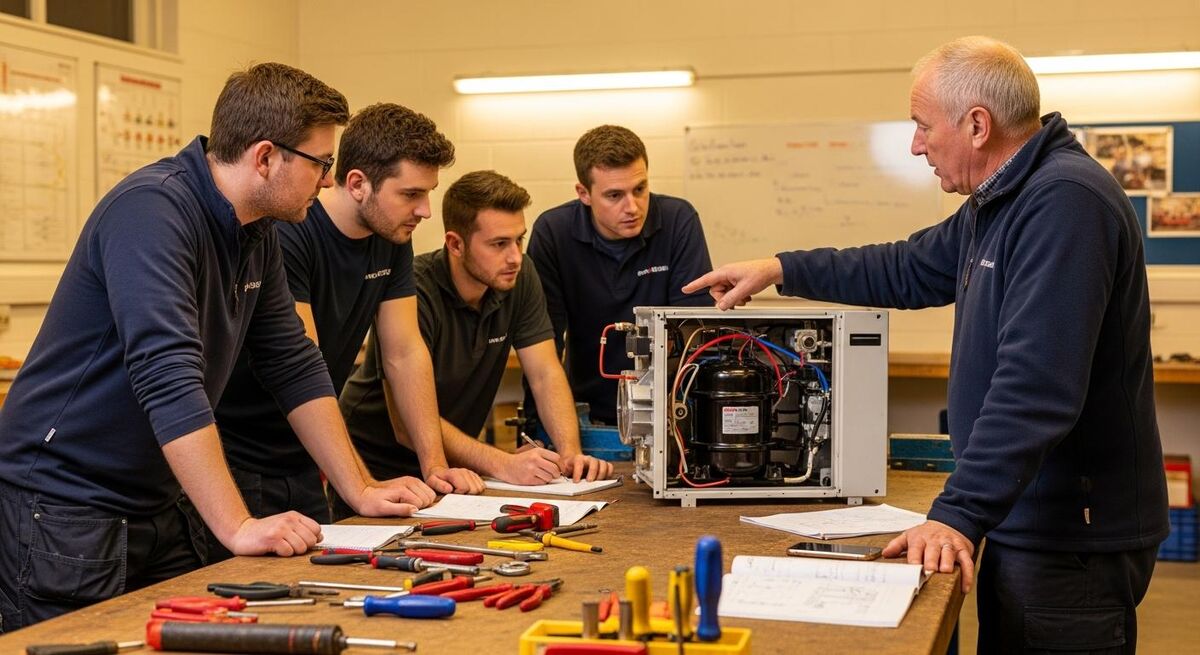
This is where I'd spend real money. The qualifications that matter for heat pump installation work are Level 3 in Air Source Heat Pumps and Level 3 in Low Temperature Heating and Hot Water System Design. The LCL Awards OFT21-504 is recognised by MCS. Most quality courses run three to five days for an experienced gas engineer and cost around £600 to £1,200 per head.
The Heat Training Grant from the Department for Energy Security and Net Zero gives you £500 off the cost. Over 60 training centres across England take it. Manufacturers like Baxi, Ideal, NIBE, Vaillant and Worcester Bosch run additional centres and often layer on their own discounts. The Energy Training Academy in Scotland runs Octopus Energy's 10-day intensive programme.
One thing I'd push hard on. The classroom qualification gets you certified. It does not make you good. Pair every newly trained engineer with a senior installer for their first ten heat pump jobs. Heat loss calculations, weather compensation curves, hydraulic separation, buffer tank sizing, refrigerant handling. These are not things you learn from a slide deck. They're learned by getting a job wrong and figuring out why.
Free training, real benefit
The Heat Training Grant is genuinely worth claiming. £500 off a £600 course is a no-brainer if your engineer has time. Apply early. The grant is finite and demand is high.
Step 3: Get to grips with ventilation and airtightness
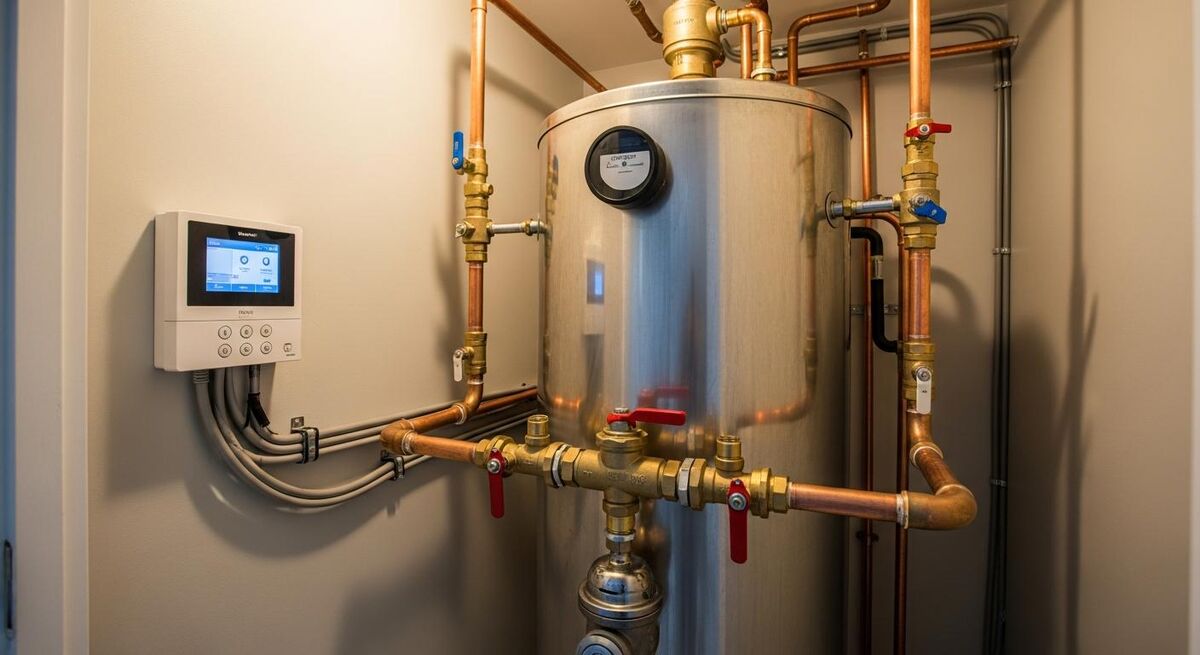
At 3 m³/(h·m²) at 50 Pa, the house cannot breathe naturally. You need mechanical ventilation. The FHS notional dwelling specifies decentralised mechanical extract ventilation (dMEV), but a lot of builders go straight for mechanical ventilation with heat recovery (MVHR) for the heat-recovery benefit at that airtightness level.
If you've never installed an MVHR system, you need to either learn the system from a manufacturer (Vent-Axia, Zehnder, Titon, Aereco all run installer training) or partner with a ventilation specialist. The work isn't difficult once you understand it. The risks are in commissioning. A badly balanced MVHR system causes condensation, mould complaints, and call-backs that wipe out your margin.
Read Approved Document F and the new Volume 1 that comes with the FHS package. Get familiar with the commissioning paperwork required for sign-off. If you're doing the work, you're signing the certificate, so you need to understand what you're signing.
Don't skip the commissioning paperwork
Missing commissioning documentation is one of the biggest sources of complaints against heat pump and ventilation installations. Renewable Heating Hub analysed 61,483 homeowner forum posts and found commissioning paperwork missing in 187 separate cases. Building Control will reject completion certificates without it.
Step 4: Rework your quoting for low-carbon jobs

A heat pump install is not a swapped boiler. The work, the materials and the design time are all different. If you quote it like a boiler swap, you'll lose money on every job. I've seen it happen.
Here's the breakdown your quote should cover, line by line:
- Heat loss calculation: A proper room-by-room calculation under MCS rules, not a rule of thumb. Charge for this whether or not you do the install.
- System design: Heat pump sizing, emitter sizing, hydraulic schematic, flow temperature strategy, weather compensation. Allow design time as a separate line.
- Materials: Heat pump, cylinder, buffer (if needed), pipework, valves, controls. List manufacturer and model. Customers can price-shop you on kit anyway, so be transparent.
- Labour: Day rate × days, including the apprentice or mate. Most heat pump installs run two to four days for a typical 3-bed.
- Refrigerant handling: If you're using a split system you need F-Gas. Sub-contract this out if you don't have the qualification, but show it on the quote.
- Electrical work: DNO notification, dedicated supply, isolation, RCD. Done by a qualified electrician, charged at their rate.
- Commissioning and handover: Two visits minimum. Commissioning visit, then a balance check after the first 30 days. Both have value. Both should be charged.
- Documentation pack: MCS certificate, commissioning report, user guide, warranty paperwork. This costs you admin time.
- Insurance-backed warranty: The six-year IBG premium, passed through as a line item.
That's nine lines. Customers see exactly what they're paying for. You stop losing margin in the gaps between line items. And when a customer wants to value-engineer the job, you have a sensible conversation about which line they want to cut, not a panicked race to the bottom.
Use the BUS grant in your quote, not as a discount
The Boiler Upgrade Scheme grant is £7,500 for most heat pumps, £9,000 for off-gas-grid homes on oil or LPG until 31 March 2027. Build the grant into your quote as a deduction line, not as a discount on your price. The customer sees the full project value and your work isn't suddenly free.
Step 5: Build a real relationship with one or two developers
If you want consistent new-build work from 2027 onwards, you need to be on the radar of the housebuilders in your area before the work starts. Big national developers (Redrow, Persimmon, Barratt, Taylor Wimpey) will procure FHS-compliant heat pumps through framework agreements with national partners. You're not getting on those frameworks as a small firm. But the medium and smaller regional developers (Cala, Crest Nicholson, Lovell, plus dozens of regional housebuilders) are still building the supplier list for FHS work.
Get in front of them now. Find the construction director or technical director for the local region. Email them. Offer a meeting. Bring a one-page capability statement and a sensible price list. Don't pitch a wholesale takeover of their M&E work. Pitch a clean line of work you can take off their hands consistently, on time, with proper paperwork.
Self-builders are another route. New-build self-build properties are excluded from the Boiler Upgrade Scheme grant, but the customer is usually motivated, paying out of pocket, and willing to spend properly on a heat pump system that works. They tell their architect, who tells the next self-builder. It's a slow burn but a profitable one.
Show up before the work is there
Developers shortlist their supply chain six to twelve months before a phase breaks ground. If you wait until you see scaffold up, you've missed the procurement window. Start the conversations in 2026.
Step 6: Use AI to model performance and pre-empt compliance issues
 ChatGPT
 Claude
 Gemini
The Home Energy Model (HEM) replaces SAP 10.3 as the assessment method for FHS compliance. HEM is more detailed and more sensitive to design choices. That's the official tool. It does the legal compliance calculation.
But ahead of HEM, you can use general-purpose AI to sanity-check your system designs, draft customer-facing explanations of the FHS, and turn complicated paperwork into something a non-technical buyer can read. ChatGPT, Claude or Gemini will all do this. They are not Building Control. They will not give you a compliance certificate. They will, if you prompt them properly, help you spot the obvious mistakes in your design notes before you send them to the customer.
Three practical uses worth your time:
Quote translation. Paste your engineer's design notes into Claude or ChatGPT and ask it to rewrite them as a customer-facing explanation in plain English. You save an hour per quote. We've written more about this in our guide on automating your quoting with AI.
Compliance checklists. Ask the AI to generate a job-specific checklist against the FHS requirements. Verify each line yourself. Use the checklist on site.
Customer service. Many of your FHS customers will be first-time heat pump owners. They will ring you about things that aren't faults. A simple AI-powered FAQ on your website cuts your phone time. Read our step-by-step on building a customer service bot.
For a broader run-down of which AI tools are worth your time and which aren't, see our complete guide to AI tools for tradespeople.
AI is a sense check, not a sign-off
Treat AI output the same way you'd treat a junior engineer's first attempt. Useful starting point. Always verified by someone who actually knows the regs. Never used as the final answer for a compliance question.
Common mistakes that will cost you work
Five things I'd watch for, based on what's already going wrong on heat pump installs around the country.
Oversized heat pumps short-cycling
Renewable Heating Hub's forum analysis logged oversized units short-cycling 453 times in three years. Run a proper heat loss calculation. Don't round up "for safety". An oversized pump cycles too often, wears the compressor and runs at a poor COP. Customers complain. Reviews suffer.
Flow temperatures set too high
342 forum mentions of flow temps at 55 to 60°C when they should be 35 to 45°C. High flow temps kill heat pump efficiency. If the emitters can't deliver the heat at low flow temps, the emitters need replacing. Tell the customer that at the design stage, not after handover.
Skipping the weather compensation curve
78 forum mentions of weather compensation set incorrectly. It's the single biggest determinant of running cost for the homeowner. Set it once, set it properly. Schedule a recommissioning visit at 30 days to fine-tune it.
Not telling the DNO
Heat pumps are a notifiable load. You must notify the District Network Operator before the install. Some require an explicit "Yes" before you start. Sounds boring. Easy to forget. Will cause you grief when the customer's electricity supply trips on cold mornings.
Treating R290 like R32
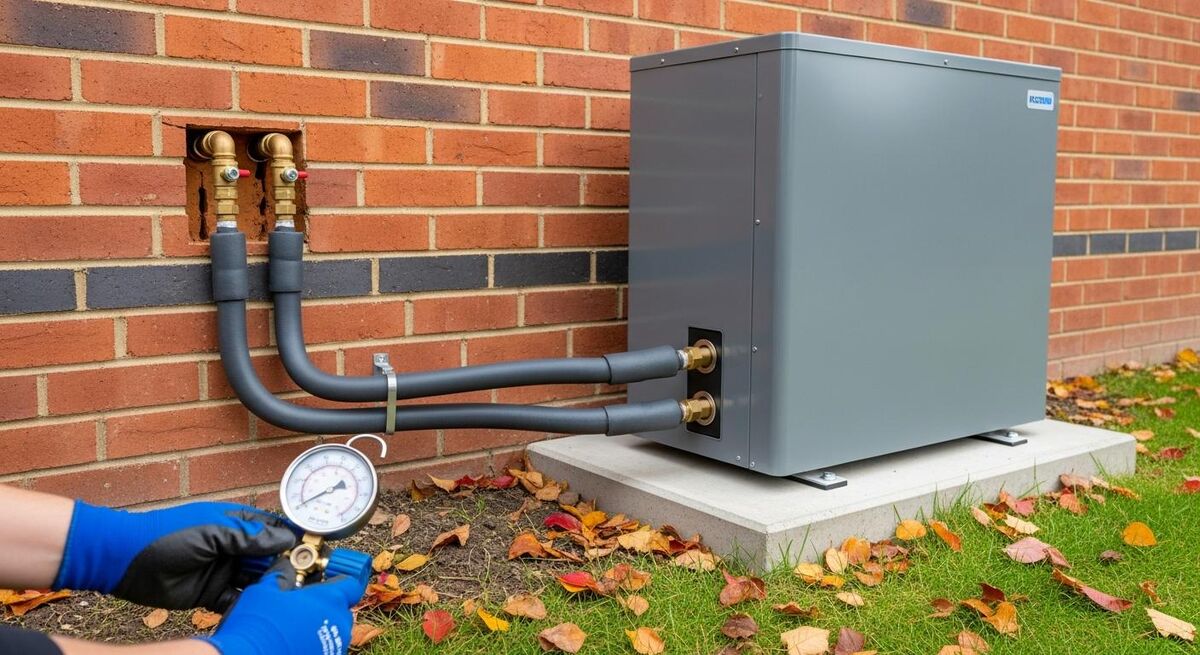
R290 (propane) is replacing R32 in most new heat pumps for environmental reasons. It's heavier than air. It cannot be installed in pits, basement light wells or near openings. Position the outdoor unit accordingly. The manufacturer's installer leaflet for R290 is a quick read and worth your time before the first install.
What tradespeople are saying
Recommended videos

What is Future Homes Standard and how will it affect property developers in 2026
Construction industry briefing

What's around the corner with the new Future Homes Standard
CPD overview for builders

The end of gas for new builds: what the FHS means for you
Practical implications for heating engineers

How heating engineers can train to install heat pumps
Nesta

The Ultimate Guide To MCS (Microgeneration Certification Scheme)
Renewable installer training

Building Regulations (England): Guide to Approved Document F
Ventilation compliance walkthrough
Frequently asked questions
It comes into force on 24 March 2027 for most building work and 24 September 2027 for higher-risk buildings. There's a 12-month transition. The first homes that must legally comply with the full FHS are projects with planning applications dated on or after 24 March 2027, which in practice means full mandatory rollout from around March 2028.
In existing homes, yes. The FHS only applies to new builds and certain non-domestic buildings. Retrofit gas boiler swaps are unaffected for now. New build properties will need a heat pump or other low-carbon system from the rollout dates above.
Application and audit fees vary by certification body, but budget £1,500 to £3,000 for the initial certification plus around £800 to £1,500 a year for surveillance audits. Add training costs for your Technical Supervisor and the IBG warranty premium. The bigger cost is the time spent getting your systems and paperwork to audit standard.
No. Solar PV installation is electrical and roofing work. If you're a roofer or electrician, MCS PV certification opens up the FHS solar requirement. If you're heating-focused, partner with a PV firm rather than trying to do everything.
The BUS is scheduled to run until 31 March 2028. It applies to retrofit installs in existing homes, not FHS new builds (which mandate the heat pump anyway, so don't qualify for a grant). The off-gas-grid uplift of £9,000 runs to 31 March 2027. After 2028 the government will decide whether to extend, restructure or wind down the scheme.
The classroom courses run three to ten days depending on the level and your starting point. The honest answer is that proper competence takes around ten supervised installs in the field after the classroom. Plan training time as months, not days.
dMEV (decentralised mechanical extract ventilation) is a continuous extract system with small fans in wet rooms and trickle vents on windows. Cheaper, simpler, fine for less airtight builds. MVHR (mechanical ventilation with heat recovery) is a whole-house ducted system that recovers heat from the outgoing air. More expensive, more efficient at high airtightness levels, and what most FHS new builds will use in practice.
R290 (propane) is a natural refrigerant and sits outside the F-Gas regime, but it's flammable, so handling rules are different. You still need refrigerant handling competence, and most heat pump manufacturers require manufacturer-specific R290 training before they'll honour the warranty on a unit you've installed.
My verdict
Start now, pick your lane, and don't try to do everything
The Future Homes Standard is real, the dates are real, and the work will land in 2027. Firms that have their MCS certification, their trained engineers and their developer relationships in place by the end of 2026 will pick up the early jobs. Firms that wait until they see scaffold up on the first FHS site will be three years behind, fighting for the scraps. Pick one lane (heat pumps, MVHR or solar) and do it properly. Partner for the rest. Get the paperwork right. Charge for the design work and the commissioning. The opportunity is genuinely there. Don't let it pass you by.