

Quick Answer
If you run a UK limited company in the trades and you have ever solved a technical problem that the off-the-shelf answer did not cover, you probably qualify for R&D tax relief. The merged scheme pays a 20 percent above-the-line credit on qualifying spend, worth roughly 15 to 16 pence in the pound after corporation tax. Loss-making R&D-intensive SMEs can claim up to 27 pence in the pound under Enhanced R&D Intensive Support. Construction firms recovered an average of £51,000 per claim under the merged scheme. Most trades businesses never claim because they think R&D means scientists in white coats. It does not.
Table of Contents
- Why nearly every trades business misses this
- What HMRC actually means by R&D
- Real qualifying work in plumbing, heating, electrical and construction
- The two schemes you might claim under in 2026
- What you can put in the claim
- The claim process, step by step
- The deadlines that void claims
- Using AI to document the work without losing weekends
- What HMRC scrutinises now
- How to pick an adviser without getting fleeced
- What tradespeople and accountants are saying
- Recommended videos
- Frequently asked questions
- My verdict
Why nearly every trades business misses this

Ask a heating engineer what R&D means and they will picture a laboratory. They will not picture the morning they spent on a sloping roof working out how to mount a flue terminal where the boiler manufacturer's instructions did not cover the geometry. That second thing is the one HMRC has been quietly paying companies for since the year 2000.
The numbers tell the story. Construction firms claimed nearly £800 million in R&D tax credits in the last published year, and the average claim under the merged scheme came to £51,000. Yet the sector is described, in the same breath, as one of the most under-claimed in the country. The reason is simple. Most trades business owners think the relief is for software companies and pharmaceutical labs, not for the firm that spent three weeks trying to make a heat pump work in a 1930s solid-wall house.
It is for both.
That gap is what this guide is about. The work qualifies, the rates are real, and the scheme has been simplified since April 2024. The catch is that HMRC has also tightened the rules at the same time, which has put a few cowboy advisers out of business and frightened some legitimate claimants away. SME claim volumes have dropped 29 percent year on year. The relief is harder to win and easier to mess up than it was three years ago. It is still very much worth winning.
The realistic prize
For a profitable limited company spending £100,000 on qualifying R&D, the merged scheme delivers a net benefit of roughly £15,000 to £16,000 after corporation tax. For a loss-making R&D-intensive SME spending the same, ERIS can pay out up to £27,000 as a cash credit. Not life-changing money on its own. Worth several engineers' worth of overhead if you bank it three years running.
What HMRC actually means by R&D
HMRC's definition is narrower than the marketing language some advisers use, and wider than most trades people assume. The relief applies when a project seeks an advance in science or technology by resolving a scientific or technological uncertainty that a competent professional in the field could not work out from existing knowledge.
Plain English version: you tried to solve a technical problem, the answer was not obvious to a qualified person in your trade, and you had to do work to figure it out. That is R&D. It does not need to succeed. Failed projects still qualify, which is one of the more useful corners of the rules.
Three tests sit underneath that definition. First, the work must seek an advance in a field of science or technology, not just an advance for your own business. Second, there must be genuine uncertainty about how to achieve it. Third, the uncertainty must not be readily resolvable by a competent professional working from published guidance, manufacturer's instructions, or standard practice.
The "competent professional" test in practice
If a sensible heating engineer with twenty years on the tools, or a chartered electrician, could have looked up the answer in BS 7671 or a manufacturer's installation manual and got it right first time, it is not R&D. If they would have had to prototype, test and iterate to make it work, it probably is. The test is not whether the work was difficult for you. It is whether the answer existed somewhere and you only had to look it up.
Real qualifying work in plumbing, heating, electrical and construction
The HMRC examples for construction and engineering work cluster around a few patterns. Knowing the patterns helps you spot the projects in your own job book that would qualify.
Bespoke fabrication and installation methods
Building a one-off support frame for a heat pump where the standard mounting kit will not work. Designing a steel sub-frame for a heavy bath in a timber-framed first floor where the manufacturer's instructions did not anticipate the load path. Making a custom flue chase through a listed building where the regulations and the conservation officer were both pushing in different directions. Every one of these involves design, analysis and trial that goes beyond catalogue solutions.
Material trials and substitutions
Testing whether a new low-carbon screed will perform with underfloor heating at a flow temperature your supplier has not tested. Substituting a hempcrete wall build-up into a system that was designed for blockwork and working out how it changes thermal performance. Trialling a lower-VOC adhesive on a wet-room install where the manufacturer's drying times do not fit your programme. The act of working out whether a new material behaves the same way as the one it replaces is technological investigation.
Modern methods of construction and prefabrication
Off-site assembly of bathroom pods, plant rooms or service modules where you have to invent the connection details on the fly. Building information modelling for clash detection on a project where the standard rules of thumb produce a service void that does not fit. Modular cabling looms for a fit-out where the consultant's specification was written for traditional containment. These are the activities the HMRC and construction trade press point to most often.
Ground conditions and existing-building problems
Working out how to underpin a Victorian extension built on Heath clay without the foundation design that should have been there. Designing a temporary works scheme for a facade retention on a tight site where the manuals do not cover the loading case. Investigating how to drain a basement conversion in a property where the original drainage details were never recorded. The combination of unknown conditions and the need to invent a method is usually enough.
Sustainability, retrofit and decarbonisation
Most of the work the heat-pump and retrofit trades are doing right now sits in this bucket. Trying to make a low-temperature heating system perform in a fabric that was specified for boilers running at 75 degrees. Adapting MVHR systems for properties with awkward duct routes. Solving the interface between a battery storage system, an existing consumer unit and a smart export tariff that the inverter manufacturer's app does not properly support yet. The technology is moving faster than the standard guidance, which makes the field a fertile one for legitimate claims.
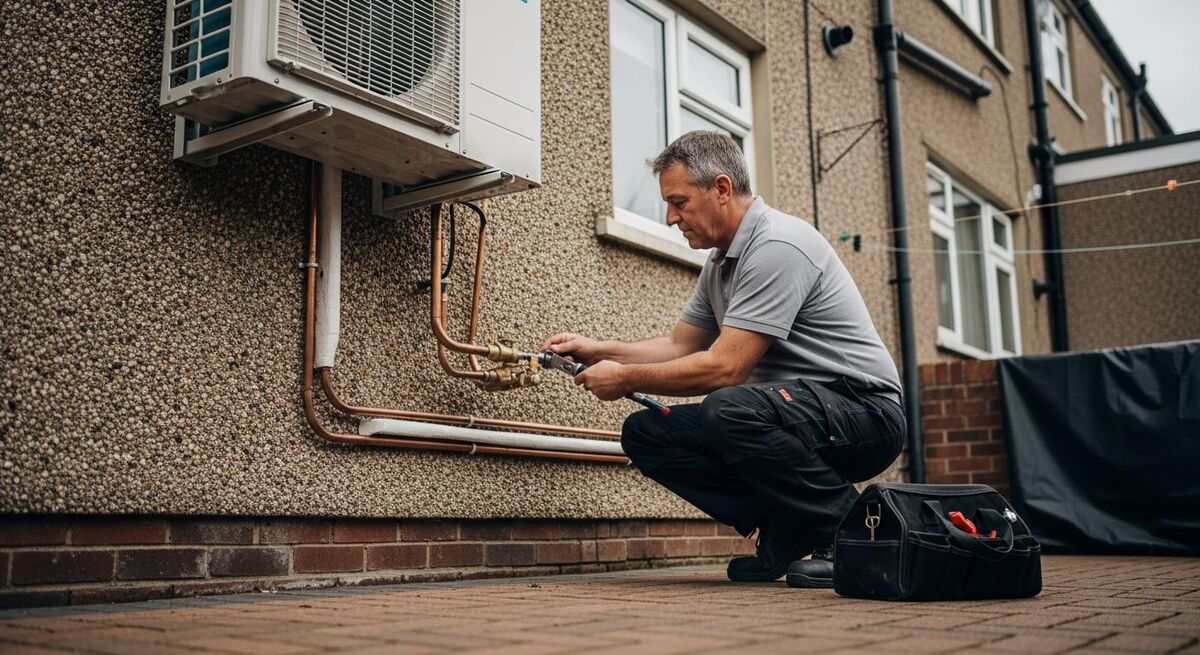
If your job log contains projects that involved any of the above, you have a starting point. The next step is understanding which scheme you will claim under and what the rates actually deliver in 2026.
The two schemes you might claim under in 2026
From April 2024, HMRC merged the old SME and RDEC schemes into one. The merged scheme now covers most companies. A smaller, more generous scheme called Enhanced R&D Intensive Support (ERIS) sits alongside it for loss-making SMEs that spend a high proportion of their costs on R&D.
| Feature | Merged Scheme (most companies) | ERIS (R&D-intensive loss-makers) |
|---|---|---|
| Who claims | Profitable or loss-making companies of any size, claiming for accounting periods starting on or after 1 April 2024 | Loss-making SMEs whose qualifying R&D is at least 30 percent of total expenditure |
| Headline rate | 20 percent above-the-line expenditure credit | Up to 27 percent payable credit |
| Net benefit per £1 of spend | Roughly 15 to 16 pence after corporation tax | Up to 27 pence as a cash payment |
| Treated as | Taxable income at the corporation tax rate | Non-taxable cash credit for loss-makers |
| R&D intensity threshold | None | 30 percent of total business expenditure on R&D (reduced from 40 percent in April 2024) |
| Best for | Most trades limited companies that are turning a profit | New ventures or growth-stage businesses pouring most of their cost base into innovation |
Two practical notes. First, sole traders and partnerships cannot claim. Both schemes are corporation tax reliefs, which means you need to be a UK limited company subject to corporation tax. If you are a sole trader doing genuine R&D, the question is worth asking whether incorporation makes sense for tax reasons that go beyond R&D relief. That is a conversation for your accountant, not this article.
Second, the merged scheme treats the credit as taxable income. The 20 percent headline rate looks generous until you net off the corporation tax. The real number for most trades businesses is closer to 15 pence in the pound. That is still a meaningful refund on a £100,000 R&D spend, but it is not the 33 pence figure that some older articles still quote for the pre-2023 SME scheme.
What you can put in the claim
The qualifying costs are tighter than the qualifying activities. Knowing the cost categories matters because misclassifying spend is one of the fastest ways to attract an HMRC enquiry.
Eligible costs in 2026 cover five main areas.
Staff costs are usually the biggest line. Gross salaries, employer NI, employer pension contributions and a share of bonuses for any employee who spent time on qualifying R&D, apportioned by the percentage of their time on the project. Directors' salaries count where the director was actually doing the technical work, not just signing the contracts.
Externally provided workers are agency staff and labour hire where the worker is paid through a third party but works under your direction. Sixty-five percent of the qualifying portion of their cost can be claimed. From April 2024, the work must be carried out in the UK to qualify, with limited exceptions.
Subcontractors are tighter than they used to be. Where you have contracted out part of the R&D to another business, 65 percent of the qualifying spend can usually be claimed under the merged scheme, again with the UK-territory restriction.
Consumables are materials, fuel, power and water consumed in the R&D process. This is the area that catches construction businesses out. Materials that end up in the finished building, sold to the client, do not qualify as consumed. Materials used in prototyping, mock-ups and tests that were not sold on, do.
Software licences used directly for the R&D work, and a reasonable share of cloud computing and data costs since the 2023 rule changes. BIM software, CAD packages, structural analysis tools and project-specific data subscriptions all sit here.
The consumed-materials trap
The most common construction-sector mistake is claiming for the entire bill of materials on a building that was sold. HMRC will reject this every time. Only materials that were used up in the testing and iteration phase, and not transferred to the customer as part of the finished work, count as consumed. Keep a separate record of trial materials and prototype components from the start of the project, not at year-end.
The claim process, step by step

The claim sits inside your corporation tax return (CT600), but two extra digital forms now have to land with HMRC at the right time, and the sequencing matters.
- Notify HMRC of your intent to claim. For first-time claimants, or for any company that has not claimed in the previous three years, submit the Claim Notification Form within six months of the end of the accounting period for which you plan to claim. Miss this and the claim is invalid, with no appeal. There is no exception.
- Identify the qualifying projects. Sit down with the technical lead on each project and write a one-page summary of the problem, the uncertainty, the work you did and the outcome. This is the document HMRC actually reads.
- Cost the qualifying expenditure. Pull salary, materials, subcontractor and software costs for the period, then apportion the percentage of each that relates to qualifying R&D. Conservative apportionments survive enquiries. Aggressive ones do not.
- Complete the Additional Information Form (AIF). Mandatory since 8 August 2023. The form goes in before the CT600 or on the same day. If the CT600 lands first without the AIF, the R&D claim is automatically rejected.
- File the CT600 with the R&D claim included. The merged scheme credit is treated as taxable income; ERIS is a payable credit. Your accountant or R&D specialist handles the mechanics of either.
- Wait for the credit. HMRC's published target is 28 to 40 days for SME claims. Real-world experience in 2025 has been longer, with some forum threads from limited company directors reporting waits of three to five months when claims are pulled for enquiry.
For trades businesses already wrestling with the CIS regime, the additional administrative load of R&D claims sits on top of an already busy compliance year. The most common CIS return errors guide covers the operational rhythm that frees up the time to think about R&D documentation in the first place.
The deadlines that void claims
Three dates sit on the wall. Miss the first one and the claim is dead before it starts. Miss the others and you have lost the money for that period.
The six-month notification deadline is the one that kills claims
If you are a first-time claimant, or you have not claimed R&D relief in the previous three years, you must submit the Claim Notification Form within six months of the end of the accounting period. A company with a 31 March 2026 year-end has until 30 September 2026 to notify. Miss the date and HMRC will refuse the claim, with no statutory right of appeal. This is the single biggest reason legitimate claims fail in 2026.
The full claim itself has a two-year window from the end of the accounting period. A 31 March 2025 year-end means the claim has to land by 31 March 2027. Two years sounds generous; in practice, getting the technical writeup, the cost apportionment and the AIF together takes longer than people expect, and the practical deadline most accountants work to is about nine months after year-end.
The third date is the AIF. It has to be filed before, or at the same time as, the CT600. File the CT600 first and the claim is automatically void. This catches firms that file their corporation tax return early, then add the R&D claim later as an amendment.
Using AI to document the work without losing weekends
The biggest reason small trades businesses do not claim, even when they qualify, is the documentation. The R&D itself happened months ago. The technical narrative HMRC wants is not in your head any more, and writing it from scratch on a Sunday afternoon is nobody's idea of a good time.
This is where the current generation of AI assistants earn their keep. Claude Cowork, ChatGPT and a handful of similar tools can take rough voice notes, project photos, time-sheet exports and email threads, and turn them into a structured technical narrative in the format HMRC wants. The principle is straightforward. The AI does not invent the work. You did. The AI captures, structures and writes up what you did.
A workable pattern looks like this:
First, build the input. After every project that touched on novel work, record a five-minute voice note describing the problem, the uncertainty, what you tried and what you learnt. Drop the audio file into a shared folder with the project's photos and any sketch drawings. The same approach we covered in the monthly management accounts guide applies to R&D documentation: capture in the moment, structure later.
Second, set up an AI prompt template. Feed in the voice transcript, the photos and a short prompt that asks for an R&D narrative in HMRC's preferred structure: project objectives, technological baseline, scientific or technological uncertainty, the work done to resolve it, the advance sought, and the outcome.
Third, review and edit. The AI's draft will be 70 percent right. You add the precise detail, strip the language back to plain English, and remove anything that sounds more confident than the underlying facts warrant. The output is a one-to-two page technical narrative per project that slots straight into the AIF.
The realistic time saving
A trades business with five qualifying projects in a year used to need a full day per project to write up the narrative. With contemporaneous voice notes and an AI structuring template, the time drops to about an hour per project, most of it editing the draft rather than starting from a blank page. The economics shift from "not worth the hassle" to "comfortably worth claiming."
One thing the AI must not do is fabricate detail or overstate the technological advance. HMRC reads these narratives in volume and has flagged "consultant-style" writing that uses identical phrases across multiple claims. Plain language, specific to your project, written in your voice, lands better than polished marketing prose.
What HMRC scrutinises now
Compliance activity has risen sharply. HMRC has been opening enquiries at rates not seen since the relief was introduced, partly because of well-documented fraud in the previous SME scheme, partly because the Treasury wanted to demonstrate that the new merged scheme would be policed properly.
The patterns that draw enquiries are predictable. Claims that look unusually large relative to the company's revenue. Claims where the same boilerplate technical narrative appears across multiple unrelated clients of the same adviser. Claims from sectors HMRC has flagged as historically over-claimed, which includes construction. Claims where the cost apportionment looks too neat, with every project's staff time recorded as exactly 80 percent or 100 percent.
The defensive position is straightforward. Keep contemporaneous records. Write technical narratives in plain English. Be conservative with cost apportionment. Use an adviser who will defend the claim if challenged, not one who will simply file it and disappear.
For the broader compliance burden landing on UK trades businesses in 2026, the Building Safety Act compliance costs guide covers the other costs and obligations that need to be sequenced alongside R&D claims so the cash flow planning works out.
How to pick an adviser without getting fleeced
The R&D advisory market in the UK has earned a poor reputation in places. The combination of contingent fee structures, aggressive cold calling, and HMRC's enforcement crackdown has left a trail of companies who paid a percentage to an adviser, had their claim approved, and then found themselves on the wrong end of an enquiry two years later with the original adviser nowhere to be found.
A few rules of thumb help.
Fee structure. The industry rate for a competent contingent-fee adviser is around 20 percent of the credit, falling for larger claims. Anything north of 25 percent is expensive. Anything below 15 percent usually means corners are being cut somewhere.
Contract length. Sign for a single year initially. The pattern of three-year contracts with early-termination penalties is the hallmark of an adviser who knows their work will not bear scrutiny over time.
Sector experience. Ask for examples of claims they have submitted in your specific trade. A specialist whose entire portfolio is software companies will struggle with the consumed-materials nuance in a construction context, and vice versa.
Enquiry defence. Get a clear written commitment that the adviser will handle any HMRC enquiry on the claim at no additional cost, and that the cost-free defence covers the full enquiry through to closure, not just the first response letter.
The technical narrative test. Ask to see anonymised examples of narratives the adviser has written. If they all sound identical, that is the red flag. Each project is different. The writeup should look different too.
For smaller claims under about £20,000 of expected benefit, the right answer is often to skip the specialist entirely and have your regular accountant prepare the claim. The fee model usually works out better, and your accountant has the long-term relationship that matters when HMRC asks questions.
What tradespeople and accountants are saying
Recommended videos

How do I claim Research and Development tax relief?
HMRCgovuk

HMRC R&D Tax Credits Explained: Claiming, Costs, and Compliance
Buzzacott

How Do You Claim R&D Tax Credits for the First Time in the UK?
Myriad

R&D Tax relief scheme replaced with merged RDEC and ERIS schemes
Dr Weronika M Swiech

What is R&D Tax Relief in 2025
Easy R&D

R&D Tax Credits UK: How to Claim for Capital and Revenue Costs
UK R&D Incentives
Frequently asked questions
No. Both the merged scheme and ERIS are corporation tax reliefs. They are only available to UK limited companies subject to corporation tax. If you are doing genuine R&D as a sole trader, that on its own may not be a reason to incorporate, but it is a factor worth weighing with your accountant alongside the other commercial reasons for going limited.
Two years from the end of the accounting period in which the R&D took place. A company with a 31 March 2024 year-end has until 31 March 2026 to file the claim for that period. The two-year window is firm. There is also a six-month notification deadline for first-time claimants that runs from the period end, which is the date most companies trip over.
Failure does not disqualify the claim. The relief is structured to reward the attempt to resolve technological uncertainty, not the commercial success of the project. If you tried to make a low-temperature heat-pump system work in a Victorian property and could not, the work to investigate and prototype still qualifies.
For straightforward claims under about £20,000 of expected benefit, a competent generalist accountant who is comfortable with the AIF and the technical narrative will usually be the right choice. For larger or more complex claims, especially those involving subcontracted work, externally provided workers or significant prototyping spend, a specialist with a track record of defending enquiries is worth the fee. The wrong specialist is worse than no specialist.
Subsidised R&D is treated differently. Historically, grant-funded SME R&D had to be claimed under the less generous RDEC scheme rather than the SME scheme. Under the merged scheme that mostly is no longer the distinction, but the interaction between grants and the relief is still complex. Always raise grant funding with your adviser at the start of the claim, not at the end.
Contemporaneous notes of the technical work, time records showing who worked on what, invoices and timesheets for the costs claimed, and a written technical narrative for each project that explains the uncertainty, the work done and the outcome. HMRC does not prescribe a format. They prescribe that the records exist and were made at the time, not reconstructed later.
HMRC's published target is 28 to 40 days for SME claims. In practice through 2024 and 2025 the average has been longer, with claims that get pulled for further checks taking three to five months. Build the cash into a forecast as a contingency, not a certainty. For the underlying cash flow approach that absorbs this kind of variability, see the 90-day rolling forecast guide.
An R&D enquiry is normally focused on the R&D claim itself, not the wider corporation tax position. The risk of a broader enquiry being opened off the back of an R&D one is small for a well-prepared claim. It is real if the R&D claim looks aggressive or out of proportion to the company's revenue, which is one of the reasons conservative apportionment matters.
My verdict
Claim it, but build the systems first
R&D tax relief is the most consistently undervalued tax relief in the UK trades. The merged scheme rates are lower than the old SME headline figure, but they still pay real money on real qualifying work. The 95 percent of eligible trades businesses who never claim are leaving an average of £30,000 to £50,000 a year on the table.
The right way in is not to phone the first R&D adviser who calls. It is to build the documentation habit first, work out which of your projects actually qualifies, and then either prepare the claim with your existing accountant or hire a specialist who will sign up for a single year and defend any enquiry at their own cost. Get the contemporaneous notes in place, set a reminder for the six-month notification window, and treat the relief as a recurring annual exercise rather than a one-off windfall. Do that and the scheme pays for itself many times over the working life of the business.