Insulation Compliance in 2026: How to Prove Part L (and Avoid a Building Control Fail)
Jump To...
Quick answer
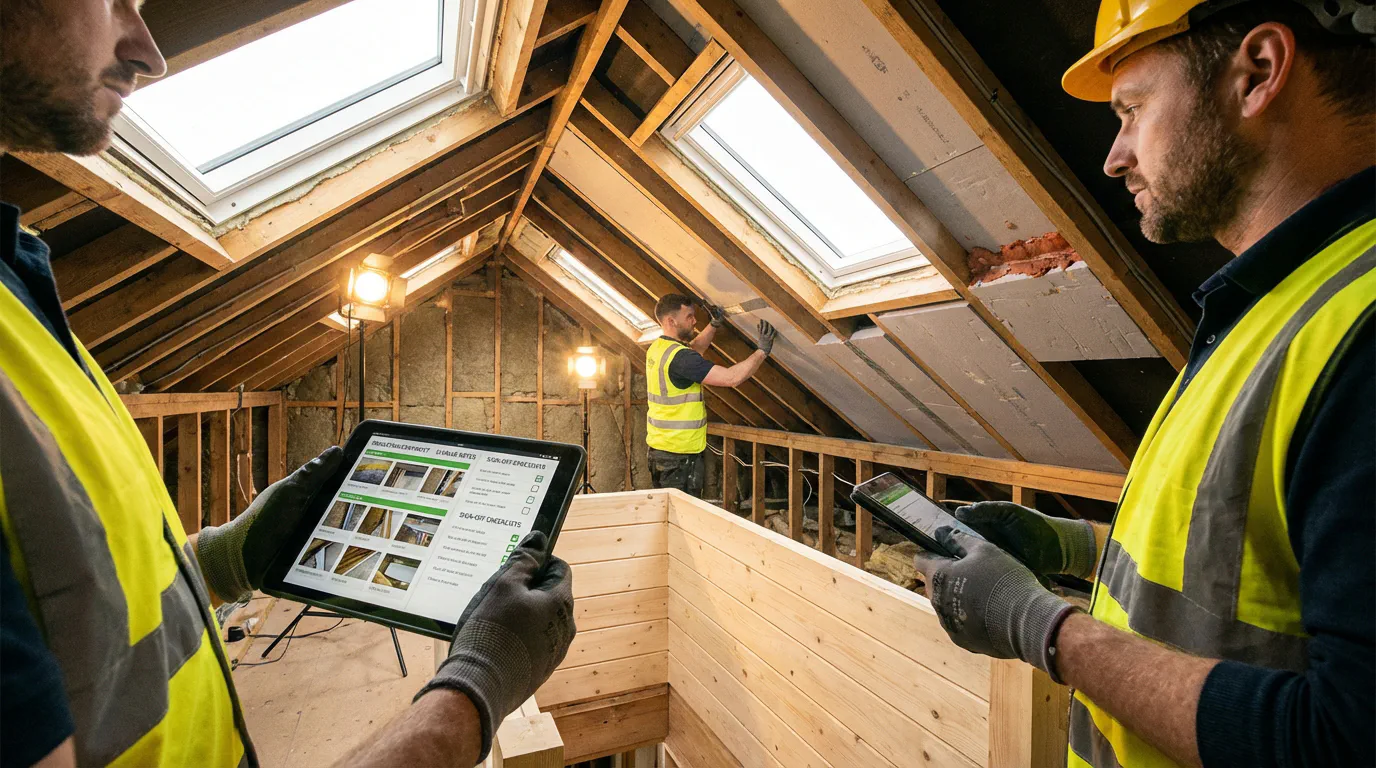
- In 2026, insulation compliance is a workmanship plus evidence problem: you need continuity at junctions, correct thicknesses, and a photo backed audit trail to get signed off.
- Part L requirements are set out in Approved Document L and are increasingly assessed through digital workflows aligned to the Home Energy Model (HEM) replacing SAP from 2025 into 2026.
- Building Control and assessors will look for proof at the riskiest points: eaves, dormer cheeks, party wall junctions, floor build-ups, service penetrations, and fire breaks (because Parts L and B collide in real builds).
- For loft conversions, sequence matters: document before it gets covered up (first fix is too late) and keep a tidy handover pack of photos, product data sheets, and sign-off notes.
- Older and heritage properties can be treated more flexibly, but only if you document why a specific detail or performance level was not achievable and what you did instead.
Who this is for
- Small builders and loft conversion teams who want fewer Building Control snags and faster sign-off
- Site managers and lead carpenters coordinating insulation, plasterboarding, fire stopping, and inspections
- Designers and retrofit leads needing a practical evidence workflow that survives audit and handover
- Trades working on older or heritage housing stock where perfect details are not always physically possible
- Anyone who has ever heard “we cannot see it now” from an inspector after the insulation is boarded
What this guide covers
- What Part L is really asking you to prove in 2026 (and how it links to Parts B, O, and M)
- How HEM changes the compliance conversation: metrics, notional building comparisons, and digital evidence
- A practical audit trail workflow: what to photograph, what to save, and when to call inspections
- Loft conversion specifics: head height constraints, thicker build-ups, sequencing, and what inspectors focus on
- Common misconceptions that cause expensive rework
In 2026, Part L is an evidence game as much as an insulation game
The big shift is not that insulation suddenly matters - it always did. The shift is that the bar for proving compliance has moved up. Part L expectations are defined in Approved Document L and, on site, that translates into a simple reality: Building Control cannot sign off what they cannot verify.
That is why the best teams now treat insulation like a traceable installation, not a hidden layer. The practical implications show up at the same pinch points on almost every job:
- Continuity at junctions (roof to wall, dormer to roof, floor to wall)
- Airtightness minded detailing (taped boards, sealed edges, clean penetrations)
- Avoiding thermal bridges where structure, steel, or timbers interrupt the layer
- Making sure fire stopping and insulation do not conflict (Part B is always in the room)
A useful way to frame it is the way Building Regulations Copilot explains it: high-level standards map down into Approved Documents, and the tightening of U-value thinking is paired with tightening documentation expectations for 2026 projects. If you are improving older stock, the same video also highlights the real-world nuance - there can be flexibility for heritage or vulnerable buildings, but you must show your reasoning and your compensating measures in writing and photos. No evidence, no flexibility.
HEM replaces SAP: what it changes for insulation specification and site records
From 2025 into 2026, the regulatory assessment world moves from SAP to the Home Energy Model (HEM). The key thing for trades and site leads is not the software name - it is what the model forces you to be disciplined about. HEM uses standardised assumptions (occupancy, hot water, weather) specifically so fabric performance and heat loss details can be compared consistently and audited properly across projects.
Practically, that means you will feel it in three ways.
First, compliance is framed around metrics and comparisons, not vibes. HEM looks at performance against a “notional” high-performance building, using metrics including target emission rate, primary energy rate, and fabric energy efficiency rate. When the model is that structured, vague site notes like “insulated as per spec” are not enough - the evidence needs to match the designed build-up.
Second, the model is forward-looking on climate and usage assumptions. That raises the importance of getting junction details right and keeping records that stand up to later scrutiny, especially if the job is questioned during a handover, warranty process, or a follow-up inspection.
Third, the workflow is more digital by default. The Cutting Through The Fog HEM deep dive makes the point bluntly: validated digital evidence is a crucial part of avoiding fails. In other words, if your photos, product data, and sign-offs are messy, you are creating risk even if the insulation work itself is decent.
If you are a builder, you do not need to become an assessor. But you do need to understand that HEM is pushing everyone toward traceable, timestamped site records that connect design intent to what was actually installed.
A practical audit trail: what to capture, when to capture it, and how to file it
A good audit trail is not hundreds of random images. It is a small set of repeatable proof points that show continuity, thickness, and the stuff that gets hidden. The simplest approach is to build a job folder with the same subfolders every time (Design - Products - Photos - Sign-offs), then capture evidence in the same sequence as the build.
Use this as your baseline:
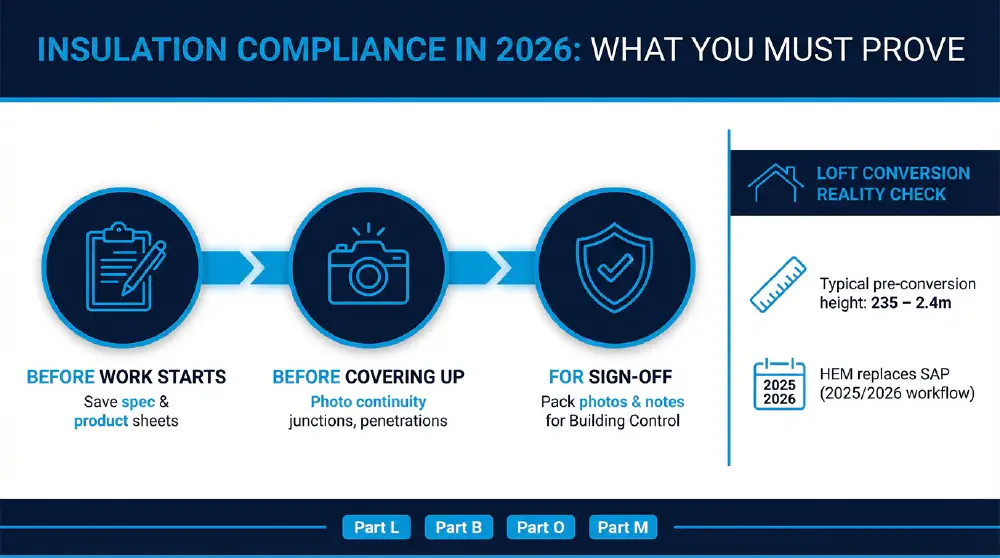
- Before you start: save the insulation spec (drawing detail or written build-up), and the product data sheets for the exact insulation and tapes used
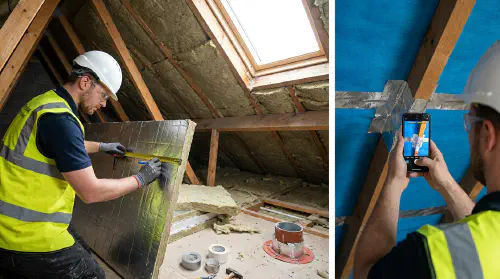
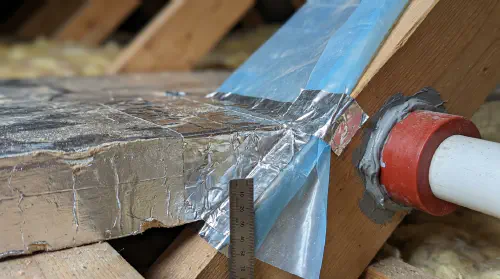
- During install: photograph each elevation or roof plane before boarding, including rulers or tape measures where thickness matters
- Junction close-ups: eaves, dormer cheeks, party wall abutments, floor edges, steel beams, and around rooflights
- Penetrations: pipes, cables, downlights, extract ducts - show sealing and any fire stopping
- After install, before cover: one wide shot per area showing continuity and that nothing has been missed
- Inspection moments: photo of the area on the day the inspector attends, plus a short note of any actions agreed
The reason this works is simple: it lines up with what assessors and inspectors are actually trying to verify. HEM based compliance and tighter Part L expectations make it harder to bluff. Your photos are the bridge between the modelled build-up and the real build-up.
One more point that experienced teams learn the hard way: if a detail is compromised (older property, awkward geometry, unexpected structure), document the constraint and the mitigation. The Building Regulations Copilot guide explicitly notes flexible application for heritage or vulnerable properties - but the flexibility only exists if you can show you acted reasonably and thoughtfully.
Loft conversions: where insulation, fire safety, and head height collide
Loft conversions are where the theory meets the tape measure. Silver Fern Developments’ February 2026 breakdown is useful because it shows the sequencing and the trade-offs in the open - including the uncomfortable truth that thicker floors and rafter build-ups can squeeze usable space.
One headline constraint they flag is pre-conversion height: typically 2.35 - 2.4m is needed to achieve compliant structure and insulation while still ending up with sensible headroom. That number matters because it is not just comfort - it drives whether you can physically fit the required build-ups without creating awkward steps, compromised ventilation paths, or rushed detailing at the eaves.
Their walkthrough also mirrors what Building Control tends to focus on in the loft context:
- Inspection timing and documentation: engineer involvement, certificates, and keeping photo logs and sign-off sheets aligned to the job sequence
- Fire breaks and separation between new and old spaces: insulation cannot be treated as separate from fire stopping, and plasterboard detailing becomes part of what gets audited
- The “hidden work” problem: once the rafters are boarded and the floors are down, it is too late to prove what is inside them
The practical takeaway is to plan your evidence capture around your programme. If you can only take photos at the end of the week, you will miss the key layers. Build the photo moments into the method statement: eaves detail complete, dormer cheeks complete, floor perimeter complete, service penetrations sealed. That is how you avoid the dreaded re-open request.
How to make your evidence stand up: consistency, clarity, and a handover pack mindset
A strong 2026 workflow looks less like “take some photos” and more like “build a handover pack as you go”. HEM and tightened Part L expectations reward teams who can tell a clean story: what was specified, what was installed, and what was inspected.
Aim for evidence that is consistent enough that someone who was not on site can follow it:
- Name photos by location and stage (for example: “Loft - South roof slope - insulation fitted - before board”)
- Include at least one wide shot plus two detail shots per critical area
- Make sure the photo shows orientation (label on a rafter, room name on a temporary tag) so it is not just anonymous insulation
- Keep product labels and batch information where available, especially if substitution ever happens
This is also where Parts L, B, O, and M stop being separate documents and start being one job. The Building Regulations Copilot video calls out that Parts B (fire safety), L (energy/insulation), O (overheating), and M (accessibility) all matter in modern work. On a loft conversion, insulation and airtightness can change overheating risk, and access constraints can affect where you route services or how you detail stairs. You do not need to write an essay about it, but you do need enough evidence that a checker can see you did not create a new problem while solving the insulation one.
If you want a simple quality filter, use this question: if Building Control asked you to justify a junction detail six months later, could you do it without reopening the build? If the answer is no, improve the record, not the argument.
A 2026-ready insulation compliance workflow (that works on small sites)
Most small sites do not fail because the team does not care. They fail because evidence is captured too late, stored too messily, or not tied to the detail that matters. A 2026-ready workflow is deliberately boring.
Build it around four repeatable steps:
- Specify: lock the intended build-ups early and keep the latest revision on site (printed or on a shared folder)
- Install: treat continuity and junctions as first-class work, not snagging
- Prove: photograph by stage, include measurement proof where thickness is critical, and capture penetrations and fire stopping before cover-up
- Hand over: compile a single folder that includes product sheets, photos, and short sign-off notes tied to inspection dates
This aligns with the direction of travel described in the HEM explainer: standardised modelling assumptions and notional comparisons mean the paper trail must connect to the physical build. It also matches the Building Regulations Copilot point that approved documents are the granular rulebook, and the industry is moving toward more documented proof.
Finally, keep the older-stock reality in mind. When geometry, heritage fabric, or existing structure forces compromise, you can still deliver a compliant outcome by documenting the constraint and agreeing a reasonable approach with Building Control early. Flexibility is part of the system - but it is not a substitute for evidence.
Common misconceptions (and what actually happens on site)
- Misconception: “Part L is just about hitting a U-value.” Correction: In practice, compliance is about demonstrating fabric performance through continuous insulation and verified detailing, backed by photographic and documented proof (Building Regulations Copilot).
- Misconception: “Photos are optional - Building Control will trust the builder.” Correction: The direction of travel is toward digital evidence and validated records because inspectors cannot verify hidden layers after they are covered (Building Regulations Copilot; Cutting Through The Fog).
- Misconception: “SAP is still the thing, so we can keep doing what we did.” Correction: The Home Energy Model (HEM) replaces SAP from 2025 into 2026, using standardised assumptions and performance metrics that increase the need for traceable site records (Cutting Through The Fog).
- Misconception: “Loft insulation is straightforward once the boards are in.” Correction: Loft conversions are defined by sequencing, fire breaks, and space constraints; once work is boarded over, missing evidence can trigger re-open requests and delays (Silver Fern Developments).
- Misconception: “Heritage or awkward properties mean the rules do not apply.” Correction: There can be flexible application, but you must document constraints and justify the approach - flexibility increases the need for clear records, not less (Building Regulations Copilot).
FAQs
Do I need to know the Home Energy Model (HEM) to fit insulation correctly?
No - but you should understand that HEM-driven compliance expects the installed build-up to match what was assessed, and that digital evidence is increasingly how that link is verified.
What is the single best way to avoid a Building Control snag on insulation?
Photograph critical junctions and penetrations before they are covered, and store the images in a structured folder tied to the job stages.
Which Building Reg parts should I think about alongside Part L on insulation jobs?
Part B (fire safety), Part O (overheating), and Part M (accessibility) commonly interact with insulation detailing and loft conversion layouts (as outlined in the Building Regulations Copilot guide).
On a loft conversion, when should I take photos for compliance?
During install and before boarding - especially at eaves, dormers, floor edges, rooflights, and service penetrations. End-of-job photos are usually too late to prove hidden layers.
Does increasing insulation ever create overheating risk?
It can, depending on the overall design and ventilation strategy. That is why Part O is increasingly discussed alongside Part L in modern compliance conversations.
What if the existing structure makes the specified insulation build-up impossible?
Document the constraint immediately, capture photos, and agree a reasonable alternative approach with Building Control or the designer before proceeding. The flexibility exists, but you must evidence it.
What should be in a simple handover pack for insulation compliance?
The intended build-up/spec, product data sheets for the installed materials, a labelled photo log by area and stage, and brief notes of inspections and any agreed actions.
Useful communities
- r/ConstructionUK - UK-specific site reality checks and practical threads on Building Control expectations.
- r/UKHousing - Homeowner and landlord perspectives on insulation upgrades, snagging, and retrofits.
- r/DIYUK - Good for seeing the most common mistakes and misunderstandings around insulation and ventilation details.
- r/LoftConversion - Niche discussions on sequencing, head height constraints, and what inspectors tend to question.
Training and resources
GOV.UK
Industry and professional
- Building Regulations Copilot: “Building Regulations - England Guide”
- Cutting Through The Fog: “The Home Energy Model: Future Homes Standard assessment”
- Elmhurst Energy: “Demystifying the Home Energy Model (HEM)”
- Silver Fern Developments: “THE SHOCKING TRUTH ABOUT LOFT CONVERSIONS - ALL PRICES REVEALED”
Want a reusable evidence pack template for Part L jobs?
We are building practical, site-tested templates for photo logs, inspection notes, and handover folders that match the 2026 compliance reality. Join the TrainAR Academy waitlist to get the first download when it lands.
Ready to Transform Your Business?
Turn every engineer into your best engineer and solve recruitment bottlenecks
Join the TrainAR Waitlist