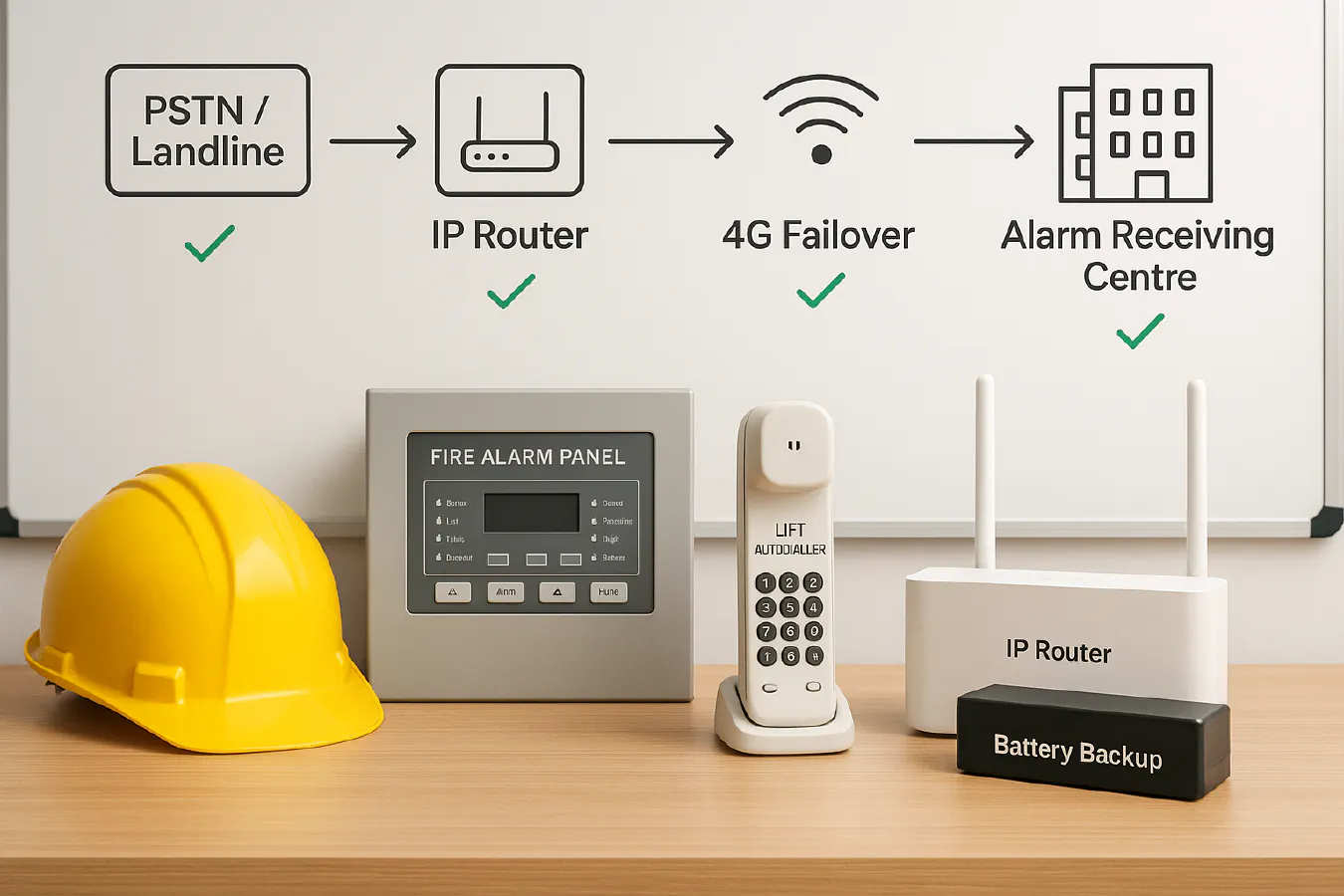
Lift alarms and site phones after the landline switch off: EN 81-28 checklist, GSM/4G options and power backup
Jump To...
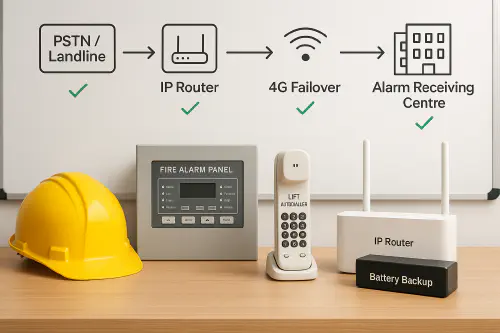
Site office desk with lift autodialler, router with battery backup and a whiteboard flow PSTN to IP to 4G to ARC
Who this is for
- Main contractors, facilities teams and lift owners with lifts that use a landline autodialler.
- Site managers with gate phones, intercoms, fire/intruder alarm monitoring or payment terminals still on a copper line.
Quick answer
- The old copper landline network (PSTN/WLR) is being retired. Migration is underway now. Most lines will be moved to digital by January 2027. See Government guidance and Ofcom.
- For lifts, you don’t have to keep a landline. You can use GSM/4G or VoIP as long as you still meet EN 81-28: two‑way voice, periodic test calls, and power backup.
- Easiest path for most sites: fit a 4G/VoLTE lift gateway with an external antenna, managed SIM and battery pack. Configure the 72‑hour test and monitor results. Keep your in-car alarm working during a power cut for at least one hour, including 15 minutes of speech.
What’s changing with landlines
- UK landlines are moving from analogue PSTN to digital services over broadband (VoIP). Openreach plans to withdraw the old network by 31 Jan 2027. See GOV.UK overview and Ofcom advice for consumers and businesses.
- Digital lines rely on power at your premises. During a power cut, you need a backup solution to call 999 if you’re landline-dependent. Providers must offer at least one hour of backup to vulnerable customers.
- Devices that used the old line (autodiallers, alarms, lift phones, payment terminals) may stop working unless you update them.
References: GOV.UK landline transition • Ofcom guidance on power cuts
Lift alarm compliance in plain English
EN 81-28 sets the rules for remote alarm systems in lifts. In practice you must:
- Provide two‑way voice to a rescue service when the alarm button is pressed. The passenger must not have to dial or re-press anything. The lift must be identifiable to the call handler.
- Send automatic test calls at least every 72 hours using the same path as a real alarm. Flag failures promptly and show a clear in-car warning.
- Keep the alarm alive during a power cut: at least 1 hour of standby and at least 15 minutes of speech. Low-battery should trigger an alert.
- Keep any top‑of‑car and pit alarms compliant after any comms change.
Useful industry guidance: LEIA: Telephone lines and lifts
Choose a replacement: VoIP vs GSM/4G
Option A: Keep the existing autodialler and present it with an analogue port from a VoIP adapter (ATA) on a broadband router.
Pros
- Reuse existing lift autodialler.
- Works if you already have solid broadband.
Cons
- Needs UPS on router and ATA or it dies in a power cut.
- Some autodiallers struggle with VoIP codecs and DTMF. Must be tested.
- If broadband drops, your alarm fails unless you also add 4G backup.
Option B: Fit a dedicated GSM/4G/VoLTE lift gateway.
Pros
- Independent of site broadband and copper.
- Designed for alarm voice calling and 72‑hour test calls.
- Easy to add high‑gain antenna for weak areas, roaming SIM for resilience.
Cons
- Needs indoor or cabinet space for the unit and a maintained battery.
- Make sure it’s 4G/VoLTE capable; 3G is being retired and 2G will be phased out by 2033.
Tip: Many contractors choose Option B for speed and reliability, then retire the PSTN. Whatever you pick, document the path and prove the tests.
Step-by-step migration plan
- Audit every device on the line
- Note each lift, intercom, gate phone, alarm panel, fax/PDQ still on PSTN.
- Record number, location, make/model, current comms path, signal strength if cellular.
- Decide the target path per device
- Lifts: GSM/4G gateway with battery, external antenna where needed.
- Intercoms/gate phones: move to SIP/VoIP or GSM modules.
- Alarm monitoring: ask your ARC for their IP/cellular options.
- Power resilience
- For VoIP: add a UPS that keeps the router, ONT and ATA alive for at least an hour.
- For GSM/4G gateways: use a maintained battery pack that meets the one‑hour plus 15‑minute speech requirement.
- SIMs and numbers
- Use managed or roaming SIMs for lift gateways. Label the SIM/account to the lift ID so call handlers see the right site.
- If porting the old number matters for the ARC, discuss options (call divert or number presentation) in advance.
- Configure and prove EN 81-28 tests
- Set the 72‑hour periodic test. Check the ARC receives it and that a missed test raises a ticket within an hour.
- Trigger a real car alarm call and check two‑way speech quality and location ID.
- Documentation and handover
- Update O&M manuals and the lift log card with new comms path, SIM ICCID, antenna location, UPS/battery service interval.
- Train the site team on the low-battery indicator and who to call.
Test and log: 72-hour checks that actually work
- The periodic test must use the same route as a real alarm. If you moved to GSM/4G, make sure the test goes out via that SIM, not over a Wi‑Fi fallback.
- Keep a simple spreadsheet or use your maintenance portal to record test receipts, failed attempts and fixes.
- After any router/firmware/SIM change, re-run a real alarm test and a forced periodic test.
Gotchas we see on UK sites
- Router on a 4‑way with no UPS: during a power cut your VoIP line dies and so does the lift phone. Fit a UPS sized for ONT + router + ATA.
- 3G‑only gateways: the 3G network is being withdrawn and 2G goes by 2033. Specify 4G/VoLTE now.
- Weak signal in a basement: add an external antenna and route coax to better signal.
- Test calls not enabled: many alarms were installed with the 72‑hour test disabled. Turn it on and monitor it.
- No in-car indication for failed comms: EN 81‑28 expects a visible indicator when comms isn’t healthy. Verify it works.
Diagrams
Flow: PSTN to IP router to 4G failover to ARC with green ticks
Useful links
- GOV.UK overview: UK transition from analogue to digital landlines
- Ofcom explainer: Moving landline phones to digital technology
- Ofcom power-cut guidance: Protecting access to emergency organisations during power cuts
- Industry guidance: LEIA: Telephone lines and lifts
- Background on 2G/3G sunsets: Ofcom expectations on 2G and 3G switch-off
Also see in the Academy:
- O&M manual for construction: what to include, UK checklists and a fast handover process
- Construction phase plan made simple: CDM checklist, free template and how to brief the team
FAQs
Do I have to keep a landline for my lift?
No. LEIA confirms you can use any communication method that meets EN 81‑28. GSM/4G gateways are widely used.
Will my lift phone work during a power cut?
It will if you provide backup. For VoIP you need a UPS on the ONT, router and ATA. For GSM/4G, use a maintained battery pack. EN 81‑28 expects at least one hour standby and 15 minutes of speech.
Can I just plug the lift phone into a router’s phone port?
Maybe, but test it. Some autodiallers won’t behave properly over VoIP without the right codec and DTMF settings. Always run a real alarm test to the ARC and enable the 72‑hour periodic tests.
What about 2G/3G being switched off?
Pick 4G/VoLTE‑capable gateways. 3G is being withdrawn and 2G will be retired by 2033 at the latest.
How do we prove compliance to a client or auditor?
Keep the audit sheet, SIM details, UPS spec, periodic test logs and screenshots/emails from the ARC confirming receipt of tests and live alarm trials.
Ready to Transform Your Business?
Turn every engineer into your best engineer and solve recruitment bottlenecks
Join the TrainAR Waitlist