
Quick answer
UK construction has the highest suicide rate of any sector, 3.7 times the national average according to the ONS. Mental Health First Aid (MHFA) training gives one person on site the skills to spot the warning signs and have the right conversation. Under the Health and Safety at Work Act 1974, employers already have a legal duty to assess and control mental health risks, the same way they do for physical ones. The standard MHFA England course runs two days at around £325 per person, with refresher training every three years. Lighthouse Construction Industry Charity runs the same course free for construction firms. CITB funding for MHFA was withdrawn in January 2026, so plan for unfunded delivery.
Table of contents
- Why MHFA matters more in construction than anywhere else
- The legal duty of care, in plain English
- What Mental Health First Aid actually is
- Choosing a training provider
- CITB funding withdrawal and what it means
- How many first aiders you need on site
- A 90-day rollout plan
- Policy and procedure you need in writing
- What tradespeople are saying
- Recommended videos
- Frequently asked questions
- My verdict
Why MHFA matters more in construction than anywhere else

I trained as a Gas and Heating engineer. I ran Elite Heating and Plumbing before I ever went anywhere near a screen for a living. So when the suicide stats for construction land on my desk, they don't read as abstract numbers. They read as people I know.
The Office for National Statistics put the suicide rate among male construction workers at roughly 34 per 100,000, against a UK average closer to 10. The provisional 2024 figures from the ONS counted 355 deaths by suicide among skilled construction and building trade workers in England and Wales alone. Mates in Mind has been pulling at this thread for years, and the picture has barely shifted.
The reasons are not a mystery to anyone who has worked on a site. Long hours. Travel away from family. Self-employment without sick pay. A culture that still treats "I'm not coping" as weakness. Add in the financial squeeze of late payments and tight quotes, and you have a workforce under chronic pressure with almost no formal route to ask for help.
Mental Health First Aid is not the answer on its own. It is the first piece. It puts at least one person on every site who knows what a panic attack looks like, what to say when someone tells them they have been thinking about ending it, and how to get the right help moving without making things worse. That is what a first aid course does for physical injuries. The principle is exactly the same.
The legal duty of care, in plain English
There is a persistent myth in trades that mental health is "not really a Health and Safety thing." It is. Section 2 of the Health and Safety at Work Act 1974 requires every employer to ensure, so far as reasonably practicable, the health, safety and welfare of employees at work. Health includes mental health. That has been the legal position for fifty years.
The Management of Health and Safety at Work Regulations 1999 then sit on top of that. They require a suitable and sufficient risk assessment, and the HSE has been explicit since the publication of its Management Standards for Work-Related Stress that this assessment must cover the six areas they set out: demands, control, support, relationships, role, and change. If your written risk assessment does not mention any of those, you have a paper gap that an HSE inspector or a tribunal could pick up tomorrow.
The Equality Act 2010 adds another layer. A diagnosed mental health condition that has a substantial and long-term effect on someone's day-to-day life is a disability under the Act. That means reasonable adjustments. It also means dismissal or treatment connected to that condition can become discrimination if it is not handled properly.
What Mental Health First Aid actually is
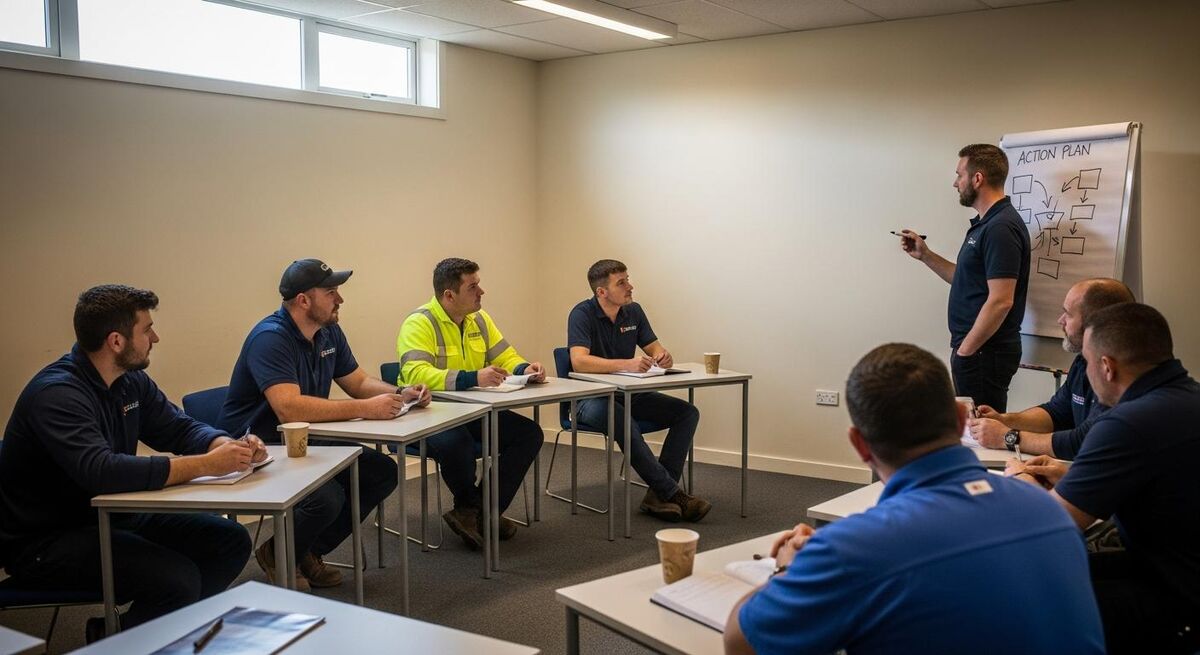
Mental Health First Aid is a structured course developed in Australia in 2000 and brought to the UK by MHFA England in 2007. The headline product is a two-day Mental Health First Aider qualification. Successful candidates get a manual, a workbook, a wallet card with an action plan on it, and a certificate that lasts three years before refresher training is recommended.
The course teaches three things. First, how to spot the early warning signs of common conditions: depression, anxiety, suicidal thoughts, psychosis, substance misuse. Second, a five-step action plan known as ALGEE: Approach, Listen, Give support, Encourage professional help, Encourage other support. Third, how to look after yourself when you are the person on site who other people start coming to.
The version of the course that matters for sites is the MHFA England Adult course, ideally with construction context built in by a specialist instructor. Lighthouse Construction Industry Charity delivers exactly that, and it is the right starting point for most trades businesses. Their version of the course is free to construction employers because Lighthouse is funded by industry levies and donations.
What MHFA is not is therapy training. A first aider is not a counsellor. They are not there to diagnose anybody or to solve anybody's problems. Their job is the same as a physical first aider with someone bleeding on a stairwell: keep calm, do what you have been trained to do, and get the right professional help on the way. That distinction matters, because the wrong expectations sink the whole programme.
Choosing a training provider
Three names you will hear over and over. MHFA England is the original qualifying body and trains the instructors. Lighthouse Construction Industry Charity sits on top of that, delivering the MHFA England course free to construction firms with construction-specific scenarios baked in. St John Ambulance, Mind, and a long tail of regional Mind charities also deliver the same MHFA England syllabus, with prices typically £150 to £325 per learner.
If you are a trades business with anything from one to fifty employees, my honest advice is to start with Lighthouse. Their Wellbeing Academy offers free e-learning modules, a free MHFA Champion half-day, and free two-day MHFA First Aider courses tied to construction. They will also support your first aiders after the course, which is the bit most providers stop short of.
If you cannot get a Lighthouse slot for the timeframe you need, MHFA England's instructor directory is the next best move. Look for instructors who have delivered to construction or trades clients before. Ask for two references, the same way you would for any other supplier. A good instructor changes the entire feel of the room and the retention of the material. A bad one can put people off the topic for years.
CITB funding withdrawal and what it means

This one is important and not widely understood. From 8 January 2026, the CITB removed all First Aid courses from its grant funding and Employer Network support. That includes Mental Health First Aid and the MHFA Refresher. CITB has been clear about the reason: a 36 per cent increase in employers drawing on grants against a flat levy income. Something had to give, and First Aid was on the chopping block.
What it means for trades employers is straightforward. If you levy CITB and you were planning to claim back the cost of MHFA training, that route is closed. You can still book the course, you just cannot claim a grant. CITB is still funding adjacent work, including a £90,000 pilot to train Mental Health First Aiders for apprentices specifically. But for the day-to-day employer paying for their site team to qualify, the funding has gone.
Three workarounds keep the cost manageable. First, use Lighthouse's free construction courses where you can. Second, train a single Mental Health First Aid Instructor in-house if you have more than 50 employees, then run the course internally. Third, treat the course fee as a deductible training expense, because it is.
How many first aiders you need on site
The widely cited number is one Mental Health First Aider per 100 employees, which comes from the Building Mental Health framework. That is a sensible ceiling, not a floor. For a trades business of five engineers, one trained MHFAider plus the business owner being aware is the right starting point. For a site with 30 to 50 operatives, you want at least two so cover survives holidays and sickness.
The point is not the ratio. The point is that the trained person has to be findable, approachable, and supported. A first aider hidden in head office is no use to the apprentice who is struggling on site. That means visible identifiers, a name on the site noticeboard, and the same priority on the morning briefing as the physical first aider.
| Team size | Minimum MHFA First Aiders | Recommended cover | Annual training cost (typical) |
|---|---|---|---|
| 1 to 9 | 1 plus owner aware | 1 MHFAider + Champion half-day for owner | £325 to £450 |
| 10 to 49 | 2 | 2 MHFAiders + 1 Champion | £700 to £1,000 |
| 50 to 99 | 3 to 5 | 3 to 5 MHFAiders + 1 Mental Health Awareness session for all staff | £1,500 to £2,500 |
| 100+ | 1 per 100, minimum 5 | In-house Instructor + ongoing refresher rotation | £3,000 to £6,000+ |
Pick the right people. The volunteer who comes forward is not always the right fit. You want people who are calm under pressure, trusted on the team, and not currently going through a major personal crisis of their own. Be honest about the demand. Being a first aider is rewarding work and it is also draining work—and losing good people over burnout is expensive. Build in supervision and a clear referral pathway from day one.
A 90-day rollout plan
Most trades businesses that try to "do mental health" all at once end up with a poster on the wall and not much else. Treat it like an installation. Plan the work, do the work, sign it off.
Days 1 to 14: assess and plan. Pull your current Health and Safety risk assessment up on the screen. Add the six HSE Stress Management Standards as a section. Be honest about where you stand on each one. Decide how many first aiders you need based on team size. Get sign-off from whoever owns the budget. Book a Lighthouse or MHFA England course for your candidates. Tell your insurer you are doing this, because some employer liability policies offer premium adjustments for mental health programmes.
Days 15 to 45: train and equip. Get your first aiders through the two-day course. While they are training, get your Champion or business owner through the half-day awareness course. Draft a one-page Mental Health Policy that names your first aiders, lists the support routes (Lighthouse helpline, Samaritans, GP, Employee Assistance Programme if you have one), and confirms that anyone disclosing a mental health concern will not be penalised for it.
Days 46 to 75: launch and embed. Run a 30-minute team meeting to introduce your first aiders. Add their names and photos to the site noticeboard. Brief your site supervisors on how to refer. Add a "How are you?" line to your morning toolbox talk and mean it. Send your first quarterly anonymous wellbeing pulse to the whole team, three questions max. Use a tool like templates and free downloads to keep the paperwork light.
Days 76 to 90: review and lock in. Sit your first aiders down with you for a confidential debrief. What have they seen? What is missing? Where did the system fail? Adjust. Book the refresher training for the three-year mark. Write a single-page case study of what you have done and share it with your apprentices, your insurer, and your client account managers. This is now part of how you run the business, not a campaign.
Policy and procedure you need in writing
The HSE has been clear in the last two years: mental health risk needs to be in writing, the same as any other risk. Five documents cover the ground.
1. A Mental Health and Wellbeing Policy. One page is plenty. State the company's commitment, name the trained first aiders, list the immediate support routes, and confirm the non-penalisation principle. Get the policy signed by the most senior person in the business.
2. A stress risk assessment. Map the six HSE Management Standards against your business. Workload, autonomy, support, relationships, role clarity, change. Note what you do well, what you need to fix, and the date you will review it again.
3. A clear referral pathway. Who does an MHFAider speak to after a difficult conversation? Where does the person go for ongoing help? An NHS GP, a Lighthouse helpline call, an EAP referral, a private counsellor, your retained Occupational Health provider if you have one. Write the routes down on a card.
4. A confidentiality and recording standard. An MHFAider should keep minimal notes, store them securely, and only share what is necessary to keep someone safe. Make this rule explicit and stick to it.
5. A return-to-work process. When someone has been off with a mental health issue, the conversation back into work matters as much as the time off. Plan it. Make adjustments. Review at 30, 60 and 90 days.
These five documents will get you through almost any HSE inspection, employer-liability claim, or tribunal that touches on mental health. They are also useful because they force you to think before you have to react.
What tradespeople are saying
Recommended videos

In My Mind: The Lighthouse Club on Construction Mental Ill-Health
iHASCO · Bill Hill, CEO Lighthouse Construction Industry Charity

Crossrail: Spotting the Signs of Mental Health Illness
Lighthouse Construction Industry Charity
Promoting Mental Health and Wellbeing in the Construction Industry
Lighthouse Construction Industry Charity

How MHFA England Training Supports Workplace Wellbeing
MHFA England webinar

Mental Health First Aid Training at Work
Scott, Hays UK

St John Ambulance Mental Health First Aid Training Experience
St John Ambulance
Frequently asked questions
Not specifically, no. The Health and Safety (First Aid) Regulations 1981 require a physical first aider, not a mental one. But the wider Health and Safety at Work Act 1974 duty of care extends to mental health, and the HSE Management Standards for Work-Related Stress make a written stress risk assessment a baseline expectation. The HSE has said it expects MHFA to feature in any reasonable response. So legally a "should," practically a "must."
The published RRP from MHFA England is £325 per learner. In practice, you will see prices from £150 with regional Mind charities up to £325 with the larger commercial providers. Lighthouse Construction Industry Charity delivers the same MHFA England course free to construction firms. CITB grant funding was withdrawn for First Aid courses, including MHFA, on 8 January 2026.
The Building Mental Health framework recommends one per 100 employees. In practice, for trades businesses under 50, plan on two so there is always cover. For a small business of one to nine, one MHFAider plus the owner doing the Champion half-day is a sensible minimum.
Yes. MHFA England, Lighthouse and St John Ambulance all open their courses to self-employed candidates. Lighthouse in particular pushes hard to reach sole traders, who are statistically the most exposed group in construction. The £325 cost is tax-deductible as a business expense for sole traders.
MHFA England recommend a half-day refresher every three years. The certificate does not technically expire, but the evidence base for MHFA assumes you keep current. Diarise the refresher when you book the original course.
A First Aider does the full two-day course and is the trained responder. A Champion does a one-day course and is there to lead awareness, normalise the conversation, and direct people to the First Aider. For trades businesses, the standard combination is one Champion (often the owner or a supervisor) and one to three First Aiders depending on team size.
This is the bit most businesses forget. Being a first aider is heavy work. Lighthouse offers free supervision and post-course support for construction MHFAiders, including a closed network group. MHFA England runs a Mental Health First Aider Support Service. Build a monthly internal check-in with your own first aiders into the calendar. Don't leave them to it.
Three things to track. First, an anonymous quarterly wellbeing pulse with three questions: how stressed have you felt in the last month, do you know who to ask for support, would you recommend this as a place to work. Second, sickness absence data, broken out by reason where you have it. Third, the number of first-aider conversations logged at a high level (no names, just frequency). Patterns matter more than absolute numbers.
My verdict
The single biggest reason trades businesses don't do MHFA is that it feels too big to start. It is not. Two days of training for one person on your team, a one-page policy, and a phone number on the noticeboard puts you ahead of most of the sector. The CITB funding has gone, but Lighthouse will train your people free if you are a construction firm. The legal duty is already there. The first aider on the wall is a fire blanket, not a sprinkler system. The point is you have one when it is needed. Start there.