
Quick Answer
Here is a hard truth: HMRC is not messing about with MTD penalties. From April 2026, if you earn over £50,000 from self-employment or property, miss four quarterly submissions and you are looking at a £200 fine, with another £200 stacking up for every late one after that. There is also a separate late payment penalty that kicks in from Day 16: 3% of what you owe, then another 3% at Day 31 plus 10% annual interest. I have been walking clients through these numbers at Together We Count, and trust me, the cost of ignoring this is far higher than the cost of getting set up.
Table of Contents
- Who qualifies for MTD ITSA
- Rollout timeline: 2026 to 2028
- How the points-based penalty system works
- Late payment penalties explained
- Penalty calculator: model your risk
- Old Self Assessment vs new MTD: key differences
- The soft landing: what it actually means
- How to avoid penalties in practice
- My Verdict
- What tradespeople are saying
- Watch: MTD explained by accountants
- MTD Penalty Points FAQ
The stakes just got higher for self-employed traders
I have had this conversation dozens of times with tradespeople who thought the old system would just keep rolling. Self Assessment has run the same way since 1997: collect your records, hand them to your accountant or fill in a return online, submit it by 31 January, done. From April 2026, that system ends for anyone earning more than £50,000 from self-employment or property.
Making Tax Digital for Income Tax Self Assessment (MTD ITSA) requires you to file four quarterly updates a year, plus an end-of-period statement, using HMRC-compatible software. Miss a deadline and you collect a penalty point. Collect four points and you get a £200 fine. Keep missing deadlines and those fines stack up fast.
On top of the points system, there's a completely separate late payment penalty. This one is percentage-based and has nothing to do with how many submissions you've missed. It kicks in the moment your tax bill is more than 15 days overdue, and the rates are rising from April 2027.
Who qualifies for MTD ITSA
The threshold applies to your qualifying income, which is not the same as your turnover or your taxable profit. It's the combined gross total of two income streams, before any expenses are deducted:
- Your gross self-employment income (all earnings from any self-employed trades or businesses)
- Your gross UK property income (all rent received before mortgage interest or maintenance costs)
If those two figures combined exceed the relevant threshold for a tax year, you must sign up for MTD ITSA. PAYE income, savings interest, dividends, and pension income do not count towards qualifying income for MTD purposes. If you work under the Construction Industry Scheme, the same gross income that pushes you into MTD also creates CIS reporting obligations, so read our guide to common CIS return errors alongside this one.
Threshold trap: don't confuse qualifying income with taxable profit
A sole trader earning £42,000 from plumbing jobs plus £12,000 gross rent from a buy-to-let property has qualifying income of £54,000 and must comply from April 2026, even if their taxable profit after expenses is well below £50,000. The threshold is gross income, not net profit.

Rollout timeline: 2026 to 2028
MTD ITSA rolls out in three phases over three years. Each phase lowers the qualifying income threshold, pulling more traders into the scheme. If you're just under the current threshold, you may only have a year or two before it applies to you too.
| Phase | From | Qualifying income threshold | Who is affected |
|---|---|---|---|
| Phase 1 | April 2026 | Over £50,000 | Higher-earning sole traders and landlords, around 780,000 people |
| Phase 2 | April 2027 | Over £30,000 | Majority of self-employed tradespeople; an additional 900,000 traders |
| Phase 3 | April 2028 | Over £20,000 | Lower-earning sole traders and part-time landlords; around a further 970,000 people |
Partnerships are currently excluded from MTD ITSA but HMRC has confirmed they will be brought in at a later date. Limited companies use Corporation Tax self-assessment and are not affected by these changes. If you are budgeting for compliance obligations more broadly, our guide to Building Safety Act compliance costs covers the other major regulatory expense hitting UK trades in 2026.
Late payment penalty rates also rise in April 2027
When Phase 2 rolls out in April 2027, the late payment penalty rates increase alongside the lower threshold. The Day 16 charge rises from 3% to 4%, and the Day 31 charge also rises from 3% to 4%. The 10% annual interest rate stays the same. Use the calculator further down this article to compare the financial impact across both years.
How the points-based penalty system works
The points system is designed so that occasional lateness does not immediately result in a fine. You have to miss four deadlines before any money changes hands. After that, there is no more grace: every late submission costs £200.
How points accumulate
Each missed deadline adds one penalty point to your record. Points accumulate across all your income sources, not per source. So if you have two self-employed businesses and a rental property, they all share the same penalty points pot.

How points reset
Once you have accumulated penalty points, clearing them is not straightforward. You must submit every required return on time for a continuous period of 12 months. This includes all quarterly updates, end-of-period statements, and final declarations. All outstanding returns from before this compliance period must also have been submitted. Only then are your points wiped back to zero.
Points do not expire automatically
Unlike driving licence points, HMRC penalty points do not expire after a fixed period. They stay on your record until you meet the 12-month compliance condition. If you miss another deadline while working towards a reset, the clock starts again from zero.
Late payment penalties explained
Late payment penalties are entirely separate from the points system. They apply to unpaid tax, not to missing submission deadlines. You can submit all your quarterly updates perfectly on time and still face late payment penalties if you do not pay your tax bill when it falls due.
Current rates (2026/27 tax year)
- Days 1 to 15: No penalty. Pay within two weeks and there is no late payment charge.
- Days 16 to 30: 3% of the outstanding tax is added as a penalty on Day 16.
- Day 31 onwards: An additional 3% of the outstanding tax is added on Day 31. From this point, 10% per annum accrues daily on the remaining outstanding amount until it is paid in full.
Rising rates from April 2027
When Phase 2 of the rollout begins in April 2027, the late payment rates increase. The 3% charges on Days 16 and 31 both rise to 4%. The 10% annual interest rate stays the same. This means the cost of paying late from 2027/28 onwards is noticeably higher than in the first year of MTD ITSA.
| Payment stage | 2026/27 rate | 2027/28+ rate |
|---|---|---|
| Days 1 to 15 | No penalty | No penalty |
| Day 16 charge (one-off) | 3% of amount outstanding | 4% of amount outstanding |
| Day 31 charge (one-off) | Further 3% of amount outstanding | Further 4% of amount outstanding |
| Daily interest from Day 31 | 10% per annum on outstanding amount | 10% per annum on outstanding amount |

Penalty calculator: model your risk
Use the calculator below to estimate what a late payment could cost you. Enter the outstanding tax amount, how many days overdue you expect to be, and which tax year applies to your situation. The result shows the penalty charges as they accumulate.
MTD late payment penalty calculator
Estimates your late payment penalty based on HMRC's tiered rate system. Figures are indicative only.
Interest accrues daily from Day 31 at 10% per annum on the outstanding tax amount. This calculator does not include points-based late submission penalties, which are charged separately.
Old Self Assessment vs new MTD: key differences
The penalty structure under MTD ITSA is fundamentally different from the old Self Assessment regime. The old system had flat-rate fines that were straightforward to understand. The new system has two separate penalty tracks running in parallel, which can catch traders off-guard if they only manage one and not the other.
| Feature | Old Self Assessment | New MTD ITSA |
|---|---|---|
| Submissions per year | 1 annual return by 31 January | 4 quarterly updates + 1 end-of-period statement |
| Late submission penalty | £100 flat on day 1, then escalating daily penalties after 3 months | Points-based: 4 points = £200, then £200 per late submission thereafter |
| Late payment penalty | Surcharge system, no tiered percentage charges | 3% at Day 16, further 3% at Day 31, plus 10% p.a. daily from Day 31 |
| Software requirement | None; paper returns accepted | HMRC-recognised bridging software mandatory |
| Penalty reset | Paid fine clears the slate | 12 months of continuous on-time submissions required |
| First-year protection | N/A | Soft landing: no submission points in 2026/27 |
The soft landing: what it actually means
In my eyes, the soft landing is the best opportunity you will get. HMRC has confirmed a soft landing period for the 2026/27 tax year. During the first four quarterly submissions, penalty points will not be issued for late filing. This applies to the period from April 2026 to April 2027. At Together We Count, we are using this window to get every client's quarterly routine locked in before the real penalties start.
What the soft landing does not cover:
- Late payment penalties still apply from Day 16. The soft landing only covers submission points, not payment penalties.
- The end-of-period statement for 2026/27, due by 31 January 2028, is not covered by the soft landing.
- From April 2027, the full points system applies immediately for Phase 2 joiners, with no equivalent soft landing.
Use the soft landing to get properly set up
The first year is your chance to test your software, build the quarterly record-keeping habit, and identify gaps in your bookkeeping without paying the price for mistakes. Connect bank feeds, reconcile monthly rather than at quarter-end, and do a dry run of the submission process before the full penalty regime starts. Using a structured job estimate spreadsheet for every quote also means your income records are consistent from the start, making quarterly submissions far simpler. The cost of getting set up properly now is far less than a string of £200 fines from 2027 onwards.

Quarterly submission deadlines
Quarterly updates follow the standard fiscal quarters. Submissions are due one month after each quarter ends:
- Quarter 1 (6 April to 5 July): submission due 7 August
- Quarter 2 (6 July to 5 October): submission due 7 November
- Quarter 3 (6 October to 5 January): submission due 7 February
- Quarter 4 (6 January to 5 April): submission due 7 May
Alternatively, you can elect to use calendar quarters (ending 31 March, 30 June, 30 September, 31 December) with corresponding submission deadlines. Check with your accountant which option suits your invoicing cycle before the first quarter begins.
How to avoid penalties in practice
Sound familiar? You know what you need to do, you just never quite get round to it. The mechanism for avoiding penalties is simple to state but requires discipline to execute: submit every update on time and pay your tax within 15 days of the due date. At Together We Count, our bookkeeping schedule is already built around these quarterly deadlines, so our clients barely have to think about it. The practical challenge is building habits and systems that make this routine rather than a quarterly scramble.
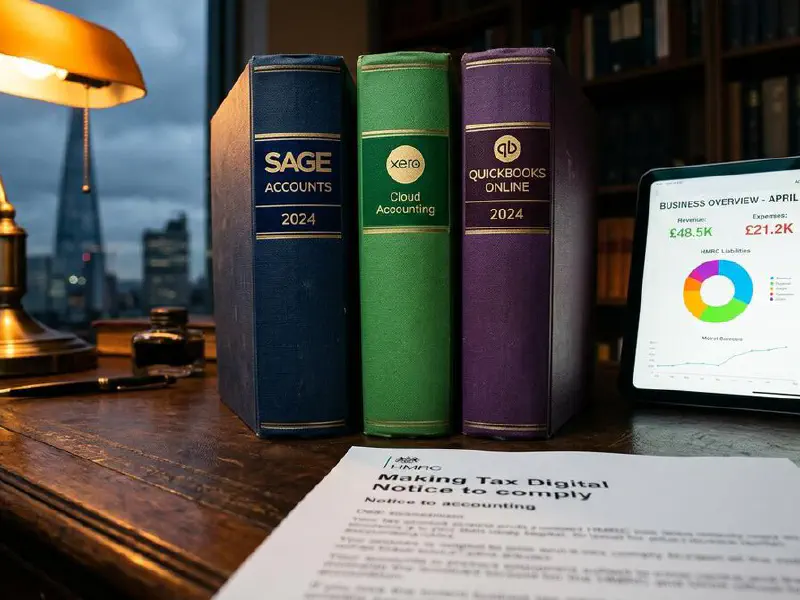
- Get the right software now. You cannot submit MTD updates through HMRC's own portal. You need HMRC-recognised software. Popular options used by UK tradespeople include QuickBooks, Xero, FreeAgent, and Sage. Our head-to-head comparison of Xero, QuickBooks, and Sage covers pricing, CIS features, and MTD readiness for trades businesses. Most have a bridging software option if you prefer to keep your existing spreadsheets and just use the software to file the submission.
- Connect your bank feeds. Bank feeds automatically pull transactions into your records. This turns quarterly catch-up sessions into a quick monthly review. An automation audit of your admin processes can reveal how much time you are losing to manual data entry each month. A plumber manually entering three months of supplier invoices in a panic the week before the deadline is exactly how mistakes and late submissions happen.
- Set four calendar reminders per year. Put the submission deadline in your calendar a month before the actual due date. This gives you time to collect any missing receipts, reconcile the account, and fix any software issues before the deadline arrives.
- Know your payment due dates. Under MTD, payment on account schedules may change. Confirm with your accountant when your tax payments fall due so you have the cash ready. Missing payment by just 16 days triggers the first percentage penalty.
- Talk to your accountant. Many accountants are already preparing clients for MTD. Some are offering quarterly bookkeeping review services designed around the MTD calendar. If yours hasn't mentioned it yet, raise it now. The earlier you start, the fewer surprises you face in April 2026.
My Verdict
MTD ITSA is the biggest change to how self-employed people report their income since Self Assessment launched in 1997. The penalty system is more complex than what it replaces, with two separate tracks running in parallel. Miss a submission deadline and you build up points. Miss a payment deadline and you face percentage charges. Both can apply to the same tax year independently.
The good news is that 2026/27 has a soft landing on submission points, giving you time to get software set up and habits in order. The bad news is that late payment penalties apply from Day 16 whether you are in the soft landing period or not, and those rates are rising from April 2027.
The practical advice is clear: sign up for HMRC-recognised software before April 2026, connect your bank feeds, set four quarterly deadline reminders, and confirm your payment due dates with your accountant. If you have not started your digital transformation yet, our digital transformation roadmap for UK trades businesses lays out a practical step-by-step plan. Traders who do that will barely notice the change. Traders who leave it will find the new penalty system far more expensive than the old one.
Points system: 4 missed submissions = £200, then £200 for every late submission after that
Late payment: 3% at Day 16, another 3% at Day 31, plus 10% per annum daily from Day 31
Soft landing: No submission points in 2026/27, but payment penalties still apply from Day 16
Reset rule: 12 months of clean compliance required to clear your points record
What tradespeople are saying
Conversations across Reddit, TikTok, and Instagram show that many self-employed traders are still figuring out whether they qualify and what software to use. Here is what the community is saying.
Watch: MTD explained by accountants
These videos from UK accountants and financial educators cut through the HMRC guidance and explain how MTD ITSA works in plain terms.

Making Tax Digital For Income Tax Self Assessment
Tax2u Ltd · 31,000 views

Will HMRC DESTROY Sole Traders in 2026?
Your Accountant · 43,000 views

Making Tax Digital EXPLAINED
Heelan Associates · 28,000 views

2026 Making Tax Digital roll out
The Independent Landlord · 23,000 views

How to Submit MTD Tax Returns
Optimise Accountants · 13,000 views

HMRC's New Tax Rules Will Catch You Out
Kiran Kaur · 16,000 views

Why HMRC's New MTD Rules WILL Fleece YOU
Your Accountant

Making Tax Digital - UK self employment is about to change FOREVER!
Small Business Toolbox
Get MTD-ready before the penalties start
TrainAR Academy has guides for every stage of your MTD preparation, from setting up Xero for MTD Phase 2 to understanding your pricing model and keeping your records straight.
Browse all guidesMTD Penalty Points FAQ
Yes. If your gross self-employment income alone exceeds the threshold (£50,000 from April 2026, £30,000 from April 2027, £20,000 from April 2028), you must use MTD ITSA. You only need to add property income to your self-employment income if you have both. There is no separate minimum property income threshold.
During the 2026/27 soft landing, HMRC will not issue penalty points for late quarterly submissions. You will not face the points-based fines even if you submit late. However, if you owe tax and your payment is overdue, late payment penalties still apply from Day 16. The soft landing only covers the submission points side of the system, not the payment side.
Yes. You can appeal to HMRC if you have a reasonable excuse for the late submission. Acceptable reasons include serious illness, bereavement of a close relative, a software or technical failure outside your control, or a natural disaster. A busy period at work, forgetting the deadline, or your accountant failing to submit on time are generally not accepted as reasonable excuses, though each case is considered individually by HMRC.
You need software that is recognised by HMRC for MTD ITSA. The most widely used options among UK tradespeople are QuickBooks Self-Employed, FreeAgent, Xero, and Sage Accounting. Our comparison of Xero, QuickBooks and Sage for UK trades covers MTD readiness in detail. If you already use spreadsheets, bridging software can connect your existing records to HMRC's systems. HMRC publishes an updated list of compatible software on their website. Check it before committing to any product, as not all accounting software is MTD ITSA compatible yet.
MTD for VAT is already in place and applies to all VAT-registered businesses, regardless of income. MTD ITSA is a separate scheme covering Income Tax. If you are already MTD-compliant for VAT, you will need to separately sign up for MTD ITSA before April 2026 if your qualifying income exceeds £50,000. The software requirements may overlap, as many MTD-compatible accounting packages handle both VAT and Income Tax submissions.