NICEIC assessment checklist: paperwork, test gear and on‑site examples
Jump To...
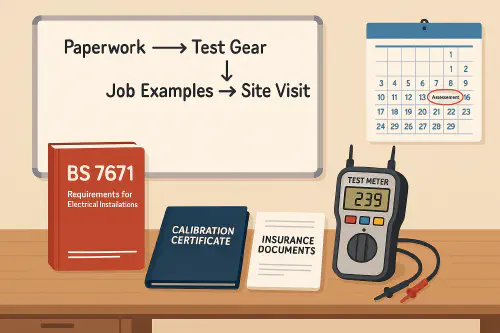
UK electrician's desk laid out for a NICEIC assessment: regs book, calibration folder, insurance docs and a simple flow diagram
Who this is for
- Electrical contractors preparing for their first or annual NICEIC assessment.
- Sole traders stepping up to Domestic Installer or Approved Contractor.
- Office managers who need a simple, repeatable checklist to stay audit‑ready.
Quick answer
Your assessment has two parts: an office audit and a site visit to inspect real work. You’ll pass if you can show:
- Your paperwork is in order: qualifications, insurance, BS 7671 documents and completed model forms for jobs you’ve done.
- Your test instruments are suitable, calibrated and you know how to use them.
- Your on‑site work is safe, labelled and matches BS 7671 and Building Regulations. You can explain what you installed, show test results and justify any design choices.
NICEIC’s own overview and checklists are worth reading before you start: see Your Assessment, the CPS Assessment Guidance checklist, the Electrical Surveillance Guide and Type of Work for Assessment on the NICEIC site. Links below.
What assessors check
- Office systems: complaints log, document control, quote to job to invoice flow, notifications to Building Control where applicable.
- Competence and supervision: Qualified Supervisor responsibilities, CPD, how you supervise anyone working under you.
- Insurance: Public Liability and, if you do periodic inspection, Professional Indemnity.
- Test gear: suitability for BS 7671, calibration in date, you can demo safe isolation and core tests.
- Two live jobs: workmanship, identification and labeling, protective device selection, RCD/RCBO performance, bonding, test results, and that paperwork matches what’s installed.
Paperwork pack: build it once, reuse forever
Print or keep digitally. Have it ready at your trading address.
Must‑haves
- Qualifications and cards for you and any operatives.
- BS 7671 current edition, Guidance Notes or access to them.
- Insurance schedule: Public Liability, and Professional Indemnity if you undertake periodic inspection and reporting.
- Complaints procedure and complaints log, even if it’s a simple one‑pager.
- Health and safety policy proportionate to your size, with a basic risk assessment and safe isolation procedure.
- Document control: how you keep forms, drawings, and revisions.
- Completed model forms from recent jobs: EICs, MEIWCs, schedules of inspections and test results.
- Building Regulations notifications evidence where required.
Nice‑to‑have proofs that impress
- Photos of concealed routes before cover‑up, CU internals and labels, bonding terminations, and nameplates. This is not a BS 7671 requirement but really helps auditors and reduces disputes. See Part L photo evidence rules for new dwellings in England.
- A site diary extract and RAMS snapshot for larger works. See our site diary and RAMS guides linked below.
Useful internal playbooks you can copy
- RAMS template for construction: what to include, free example and checklist
- Construction site diary template: what to include, examples and a fast digital setup
- Near miss reporting on construction sites: simple steps, examples and a QR code setup
Test gear: what must be in date and on hand
Bring the instruments you actually use and be ready to demonstrate them.
- MFT suitable for BS 7671 tests: continuity, insulation resistance, loop impedance, RCD tests. Accessories: leads, probes, croc clips, proving unit.
- Calibration: certificate in date for each instrument. Assessors often accept manufacturer interval guidance plus your own cross‑check regime between formal calibrations.
- Safe isolation kit: approved voltage indicator, proving unit, lock‑off kit and tags. Be prepared to demonstrate safe isolation step by step.
- EV, SPD, AFDD or other specialist testers if you install those systems.
Tip: keep a simple test‑gear register with calibration dates and a monthly self‑check log. It shows control and reduces questions.
Job examples: how to choose and prep two sites
Pick two jobs you completed recently that show different skills. Common combinations:
- Consumer unit change plus a small alteration or addition.
- New circuit for shower, EVCP or outbuilding plus a minor works job.
- A small three‑phase board change and a single‑phase domestic job if you do both.
What to prep before the visit
- Confirm access with the client. Block out enough time so you can demonstrate tests without rushing.
- Have the paperwork ready: EIC or MEIWC, schedules, circuit charts, and any notifications.
- Label boards clearly. Check basic items like grommets, gaskets, IP ratings, blanks, and identification notices.
- Re‑run key tests and note anything that has changed since installation, for example Zs where supply conditions vary.
On the day, expect to be asked to:
- Prove safe isolation on a circuit then reinstate safely.
- Show how you measured R1 R2, insulation resistance, Zs, RCD trip times.
- Explain protective device and cable selection, installation method, derating, and why the disconnection times are achieved.
Two‑week prep timeline
- Two weeks out
- Choose the two jobs and confirm client access windows.
- Build or refresh your office pack. Update insurance and calibration certificates if needed.
- Skim the NICEIC CPS Assessment Guidance checklist so you know what’s in scope.
- One week out
- Walk through safe isolation and key tests with a mate or apprentice. Time yourself.
- Reprint forms from the two jobs and check the model forms are complete and legible.
- Check your complaints log is present, even if empty. Add a short written policy for handling any future complaints.
- Two days out
- Re‑test the two jobs where practical and note values. Tighten labels and rectify any obvious snags.
- Put your BS 7671, Guidance Notes and key documents in one marked folder.
- Morning of the assessment
- Lay out your office pack at your trading address.
- Charge testers and proving unit. Pack safe isolation kit.
- Call the clients to reconfirm access times.
Common fails and easy fixes
- No complaints log or procedure. Fix: a one‑page policy and a simple spreadsheet is fine.
- Test instrument not in date or no proof of calibration. Fix: schedule calibration and keep interim cross‑check records.
- Safe isolation steps not demonstrated correctly. Fix: practice with proving unit and lock‑off kit until it’s muscle memory.
- Model forms incomplete, missing schedules or illegible. Fix: reissue clean forms and keep digital copies.
- Site labelling missing or poor. Fix: relabel CUs and circuits, add mandatory notices, update charts before the visit.
Useful links and resources
- NICEIC Your Assessment overview: https://niceic.com/for-the-trades-1/professional-standards/your-assessment/
- CPS Assessment Guidance checklist PDF: https://niceic.com/getmedia/7b7cbbe6-14f2-479a-a4ca-6f862b265ec9/CPS-Assessment-Guidance-Checklist-March-2024.pdf
- Electrical Surveillance Guide PDF: https://niceic.com/getmedia/e781921f-28d2-4e65-8dc2-d31ae28d513d/Electrical-Surveillance-Guide.pdf
- Type of Work for Assessment PDF: https://niceic.com/getmedia/1cf87852-dd21-4f13-8e8a-28425654f787/Type-of-Work-for-Assessment.pdf
- BS 7671 model forms: https://electrical.theiet.org/bs-7671/model-forms/
- Part L photo evidence rules for new dwellings in England: https://assets.publishing.service.gov.uk/media/662a2e3e55e1582b6ca7e592/Approved_Document_L__Conservation_of_fuel_and_power__Volume_1_Dwellings__2021_edition_incorporating_2023_amendments.pdf
Video: A useful walk‑through
FAQ
Do I need to bring two jobs every time?
Yes. NICEIC typically expects two examples that show different work types. Pick recent, representative jobs you’re proud of.
Do I have to include photos in my BS 7671 certificates?
No. BS 7671 doesn’t require photos in model forms. Photos are still excellent evidence and are required under Part L for new dwellings in England.
Will I fail if my tester is a few weeks out of calibration?
It’s risky. Keep formal calibration in date. If it has slipped, you must show solid interim checks that prove accuracy and get calibration booked.
What insurance levels do I need?
NICEIC guidance highlights Public Liability cover and, if you do periodic inspections and reports, Professional Indemnity. Check current scheme rules before your audit.
Can the assessment happen at my home office?
Yes, if it’s your registered trading address and you can lay out your o…
Ready to Transform Your Business?
Turn every engineer into your best engineer and solve recruitment bottlenecks
Join the TrainAR Waitlist