
Quick Answer
Most office-field communication breakdowns in trades businesses come from running on WhatsApp, paper, and memory. The fix is not more meetings or longer briefings. It is a job management platform that lets the office send the brief, the engineer accept it, and the customer see it, all in one place. For UK trades businesses with 5 to 20 staff, the realistic options are BigChange, Commusoft, ServiceM8, and Tradify. Pick one and commit. Rework caused by poor communication runs at 48% of all construction rework, so getting this right pays for itself inside a quarter.
Table of Contents
- Why the gap opens as you grow
- The real cost of communication breakdown
- The WhatsApp trap and why it gets worse, not better
- Five failure points where jobs go wrong
- Job management platforms that actually fix it
- The AI layer: job briefings, status updates, smart notifications
- A 30-day rollout plan
- What tradespeople are saying
- Recommended videos
- Frequently asked questions
- My verdict
 BigChange
 Commusoft
 ServiceM8
 Tradify
 WhatsApp
Why the gap opens as you grow
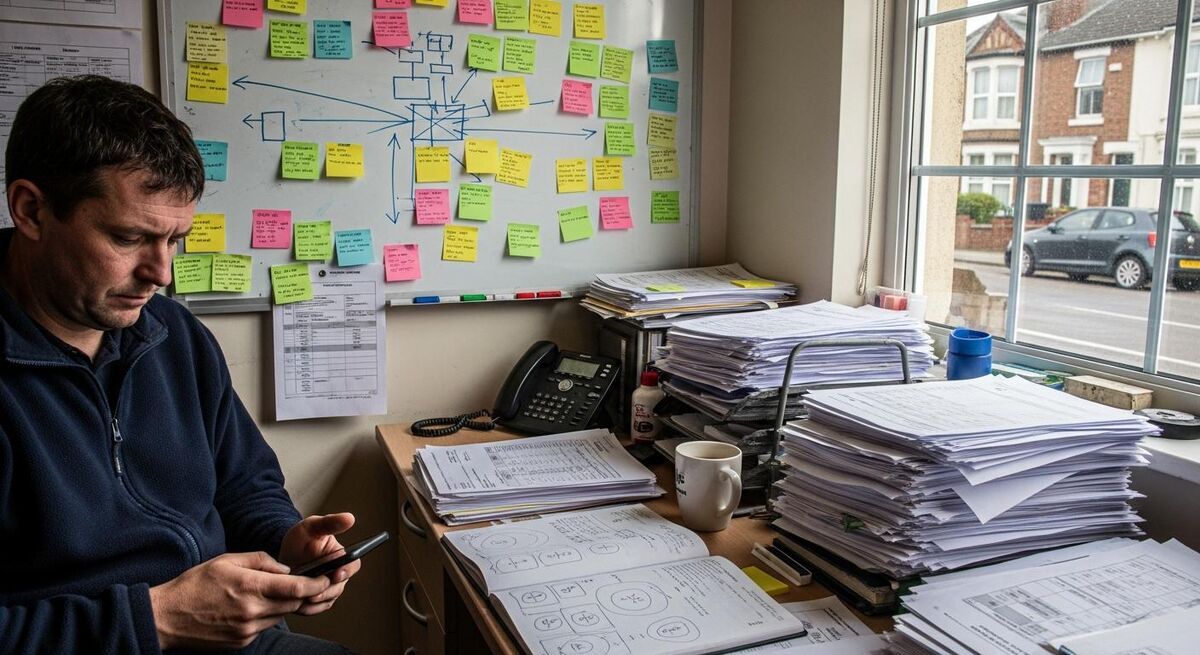
When it is just you and a mate in a van, communication is simple. The job comes in, you both know about it, you turn up. When you grow to four engineers, an office manager, and a director who still goes out on the tools twice a week, the same approach falls apart in a way nobody quite sees coming. The first sign is usually the engineer who phones the office at 8:15am asking where the parts are. The second is the customer who phones at 9am asking where the engineer is. The third is the director, sat in a van outside a job, replying to both of them while losing an hour of billable time.
This is the moment most growing trades businesses hit a ceiling. Not because the work has dried up. Because the operation cannot carry any more weight. Every extra engineer adds friction faster than they add revenue, and the owner ends up firefighting the rota instead of growing the business.
The honest truth is the problem is structural, not personal. WhatsApp, paper job sheets, and memory are great tools for a two-person crew. They are catastrophic for a ten-person crew. Information lives in the wrong place. It is on someone's phone, in a notebook in a van, or in a head that took yesterday off. When that information needs to move from the office to the engineer to the customer to the supplier and back, the gaps multiply.
The real cost of communication breakdown
Let me put numbers on this so it stops feeling abstract. Industry research published in 2024 surveyed over 2,500 contractors across 15 countries and found that poor communication was the number one cause of remedial work in the UK and 11 other markets. Other analysis puts rework at over 11% of project costs, rising to as much as 30% on UK jobs. Roughly 48% of that rework is directly caused by miscommunication between team members.
For a trades business turning over £750,000 a year, that means somewhere between £30,000 and £100,000 of revenue is being absorbed by jobs that have to be done twice, parts that get ordered to the wrong site, and engineers who turn up without the right kit. Most of that never appears on a P&L line called "rework". It hides inside labour, inside van costs, inside the hours the office manager spends on the phone.
Then there is the customer cost. Nearly two-thirds of UK contractors report they do not receive enough information from subcontractors to provide complete project oversight, and four in five have had disputes from a breakdown in communication. Disputes do not just cost time. They cost reviews, repeat work, and referrals.
The WhatsApp trap and why it gets worse, not better

I want to talk about WhatsApp specifically because it is the default for almost every trades business under twenty staff. It is free, everyone has it, and at small scale it does the job. So why is it the single biggest source of dropped jobs in growing businesses?
Three reasons. First, there is no audit trail you can search. When the engineer says the customer agreed to a £200 extra, and the customer says they did not, the message is somewhere in a thread that scrolled off a phone screen six weeks ago. Good luck finding it. Second, there is no system of record. The job address sent at 7:30am sits underneath the photo of someone's dog at 7:32am, the supplier asking about a delivery at 7:45am, and the chat about football at 8:00am. By 9am the engineer is searching a chat for a postcode while sitting on the wrong street. Third, and this is the one nobody talks about, WhatsApp is not GDPR compliant for business use. UK Employment Tribunal cases citing WhatsApp rose from 48 in 2019 to 562 in 2024. That is not a curve you want to be on.
What makes it worse is that WhatsApp scales badly in a way that hides itself. With two engineers, one group chat. With five engineers, three group chats. With ten engineers, an admin chat, two job-site chats, a supplier chat, a directors-only chat, and a customer-handover chat. By the time you notice, no one knows which chat the job lives in. Everything is duplicated. Nothing is searchable.
Five failure points where jobs go wrong
Before we look at the fix, it helps to know exactly where the breakdown happens. Across the businesses I have worked with, there are five recurring failure points. Tick the ones that have happened in your business this month. If it is more than two, you have outgrown your current setup.
1. The booking-to-engineer handoff
Customer phones the office. Office books the job. Engineer turns up not knowing what the customer has been told, what was quoted, or what the access situation is. The job runs over, the customer is irritated, and the engineer feels set up to fail. The root cause is that the office is taking notes the engineer cannot see.
2. The job-to-stock loop
Engineer arrives at the job. Realises they need a part. Phones the office. Office phones the supplier. Engineer waits, customer waits, billable hour disappears. The fix is letting engineers raise parts requests inside the same system the office uses, with a stock check that is live, not last week's. There is a full guide on van and warehouse stock management that covers this in depth.
3. The customer status gap
Customer has heard nothing since they booked. They phone at 9am asking when. Office puts them on hold to find out. Engineer is on another job and does not answer. Customer goes online and writes a review. The fix is automated status notifications: when the engineer is on the way, when they arrive, when they finish.
4. The engineer-to-office reporting lag
Job finished at 4pm. Engineer fills in the paperwork at 7pm at home, or worse, on Friday for the whole week. Invoice goes out the following Tuesday. Cash flow is destroyed by admin lag. The fix is engineers completing job records on site, signed by the customer, ready to invoice the same day.
5. The compliance paper trail
Customer disputes work three months later. You need photos, signed certificates, time stamps, and the original quote. They are scattered across three phones, two laptops, and a binder in the storage cupboard. The fix is one record per job, with everything attached, searchable in ten seconds.
Job management platforms that actually fix it

For a growing UK trades business with five to twenty staff, there are four platforms worth taking seriously. Each takes a different approach. None of them are perfect. The right pick depends on how complex your scheduling is and how much process you want baked in.
BigChange
Leeds-founded, now part of the Simpro Group after the 2024 acquisition. Used by over 2,000 UK field service businesses. It is the heaviest of the four, built for businesses that need real-time vehicle tracking, route optimisation, and full CRM in one place. The Lightning AI platform launched in 2026 with four agents: JobReady, JobScribe, JobBrief, and FieldReady, plus a conversational interface called JustAsk. The trade-off is complexity. Onboarding takes weeks, not days, and Trustpilot reviews flag a steep learning curve and inflexible commercial terms. Best for trades businesses already running ten plus vans where the office needs proper dispatch tooling.
Commusoft
British, built for service-and-maintenance trades, mostly heating and plumbing. Real-time job tracking with offline support means engineers can update status with a single tap, the office sees the change instantly, and the customer gets an automated text. The mobile app holds full job history, asset records, and digital forms, even with no signal. Strong customer portal, strong reporting. Pricing scales with users and modules. The reputation is for being fair, predictable, and trades-first.
ServiceM8
Australian-built, iOS-strong. Rated 4.4 on Trustpilot in the UK, with customisable job status, SMS templates, and a "Track My Arrival" customer-facing feature. Elite Heating and Plumbing in the UK (full disclosure, this was my old business before I moved into building TrainAR) is one of their customer stories. The Android app was limited until late 2024 when ServiceM8 Lite for Android shipped, so if half your team is on Android, check this before signing up.
Tradify
Lighter, simpler, and cheaper than the other three. 515 Trustpilot reviews, mostly very positive. Built for trades businesses up to about ten staff. The mobile app is the strong point. Tight Xero integration. Less office-side process, more engineer-side simplicity. If your operation is small and you want job in, quote out, invoice paid, with minimal overhead, Tradify is hard to beat at the price.
You will notice I have not put a comparison table here. That is deliberate. The choice between these four depends on what your operation actually looks like, not on a feature checklist. Read the company stories on each vendor's site. Demo two of them. Pick the one your office manager can run without you in the room.
The AI layer: job briefings, status updates, smart notifications
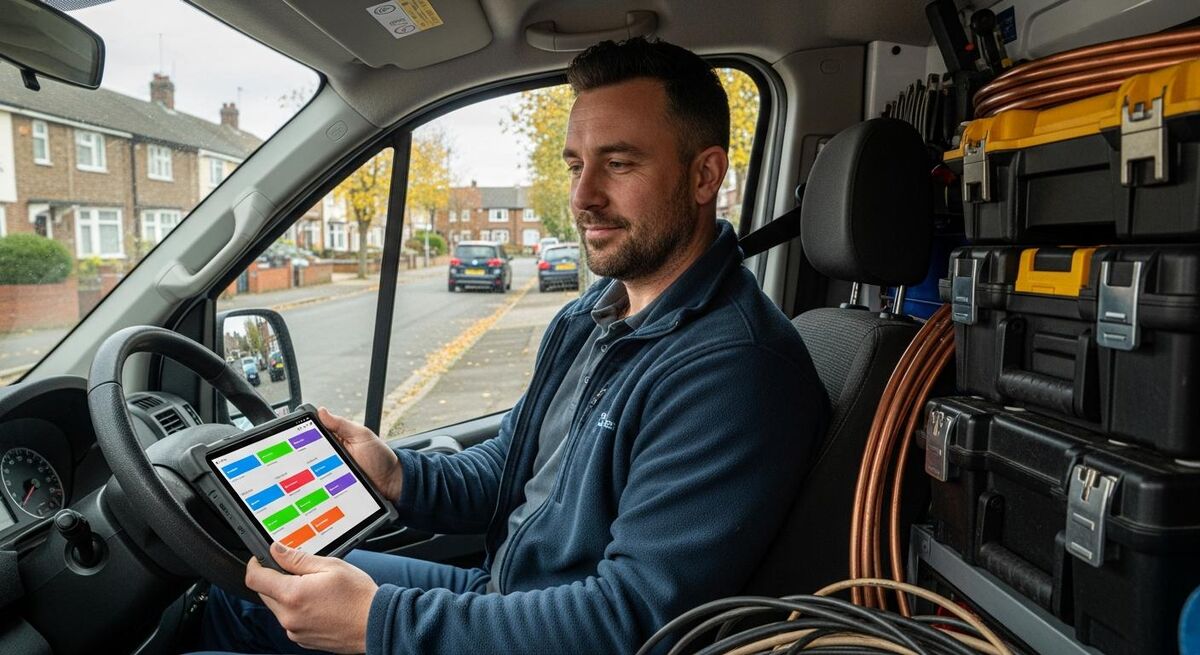
This is the part that has changed most in the last eighteen months. The platforms above are all bolting AI onto their core product. The most useful applications for office-field communication are not the ones that generate marketing copy. They are the dull, operational ones.
Automated job briefings. Before the engineer arrives, the system pulls together everything relevant: the customer history, the original quote, any open issues from previous visits, parking notes, and a short summary the engineer reads in 30 seconds. BigChange Lightning's JobBrief does this. So does Commusoft if you set it up properly. The result is engineers turning up actually prepared.
Status update automation. "On the way" texts, "Arrived" notifications, "Job complete" emails with a payment link. No one in the office has to send these. The customer gets a steady drip of contact and stops phoning to ask. ServiceM8's job status system handles this natively.
Smart routing and dispatch. The office sends a new job into the system. The system suggests which engineer to send based on location, current job, skills, and the rest of the day's schedule. The dispatcher confirms or adjusts. The engineer accepts. The whole sequence takes under a minute. Commusoft and BigChange both have this. Tradify and ServiceM8 are catching up.
Voice-to-job notes. Engineer talks into the phone at the end of a job. AI turns it into structured notes, certificate fields, and follow-up tasks. This one is new and it is the one most likely to save your engineers an hour a day.
A 30-day rollout plan
The hardest part of fixing this is not picking the software. It is getting the team to use it. Engineers who have worked off paper for fifteen years do not switch overnight. Here is the rollout sequence that works.
Week 1: pick and configure
Demo two platforms. Pick one. Have the vendor or an implementation partner set up your job statuses, customer fields, invoice templates, and notification rules. Do not skip this step thinking you will figure it out yourself. The cost of professional setup is small compared to the cost of a botched rollout.
Week 2: office only
Run the office on the new system for a week before the engineers touch it. Take incoming calls into the new system. Build customer records. Get the office manager comfortable. Do not push it out to the field yet.
Week 3: one engineer, real jobs
Pick your most adaptable engineer. Give them the app. Run real jobs for a week. Find every friction point. Fix the settings. This is where 90% of the configuration problems surface. Better to find them with one engineer than with all of them.
Week 4: full team, paper retired
Roll out to everyone. Day one: paper is dead. No exceptions. If you let paper run in parallel, paper will win and the rollout fails. Have a daily standup for two weeks. The office manager fields questions in real time. By week six it is routine.
The other half of fixing the operation is recurring revenue. Once the office-field communication is working, planned maintenance becomes a real opportunity. There is a full playbook for planned maintenance contracts that pairs naturally with this article: get the communication right first, then layer the recurring revenue model on top.
What tradespeople are saying
Recommended videos

Overview & Demo
ServiceM8 UK

Grow Your Trades Business
Commusoft

BigChange Lightning Demo
BigChange

How to Start a Plumbing & Heating Business UK
Todd Glister, Glister Services

How to Scale Your Trades Business Without Burning Out
Built for the Trades

6 of the Best Time Saving Apps For Tradesmen
One Base Media
Frequently asked questions
Yes. Five engineers is exactly the size where WhatsApp and paper stops scaling. Tradify or ServiceM8 at the smaller end costs roughly £35 to £45 per user per month. You will recover the cost in the first month from invoicing speed alone, before you even count the rework you stop doing.
Yes, that is the right approach. Use the job management platform for anything job-related. Keep WhatsApp for the morning football chat and the birthday banter. The mistake is letting job information leak back into WhatsApp because it is faster in the moment. Be strict about it for the first six weeks and the habit forms.
Two things. Pick an app the engineer can actually use one-handed, in poor signal, with cold fingers. That rules out a lot of options. Then show them what is in it for them: clearer briefings, fewer phone calls from the office, less paperwork at home in the evening. If you sell it as a control measure, they will resist. If you sell it as making their day easier, they will adopt it.
30 days is realistic for a five-to-ten engineer business if you commit to it. Larger operations, especially anything with multiple depots or subcontractors, can take 60 to 90 days. The difference is mostly in data migration and the political work of getting everyone aligned. The software install is the easy bit.
Yes, even worse than internal ones. Customer addresses, vulnerable adult details, and boiler servicing history sitting in a WhatsApp group is a GDPR problem. Move customer communication to the job platform's customer portal or to automated SMS through the platform. It is more professional and it covers you legally.
You still need a phone system. The app handles structured communication and updates. The phone handles the conversations that need to happen in real time. Most growing businesses pair their job management platform with a cloud phone system for the office, and the engineers carry standard mobiles.
Automated "on the way" notifications to customers. It is the lowest-effort change with the biggest immediate win. It cuts inbound phone calls by a third in most businesses inside a fortnight. Once the office has air to breathe, the rest of the rollout gets easier.
My verdict
The communication gap between office and field is the number one brake on growing trades businesses. The fix is not better meetings or more disciplined WhatsApp habits. It is one job management platform, configured properly, with everyone on it. For most UK trades businesses with five to twenty staff, that means BigChange, Commusoft, ServiceM8, or Tradify. Pick one. Roll it out in 30 days. Be strict about killing the paper and the WhatsApp work chats on day one. You will get a quarter of your office manager's week back, your engineers will arrive at jobs actually prepared, and your customers will stop phoning at 9am asking when. That is what scaling a trades business actually looks like.