PAT testing for trades: legal requirements, how often to test, and a simple setup that prints certificates
Jump To...
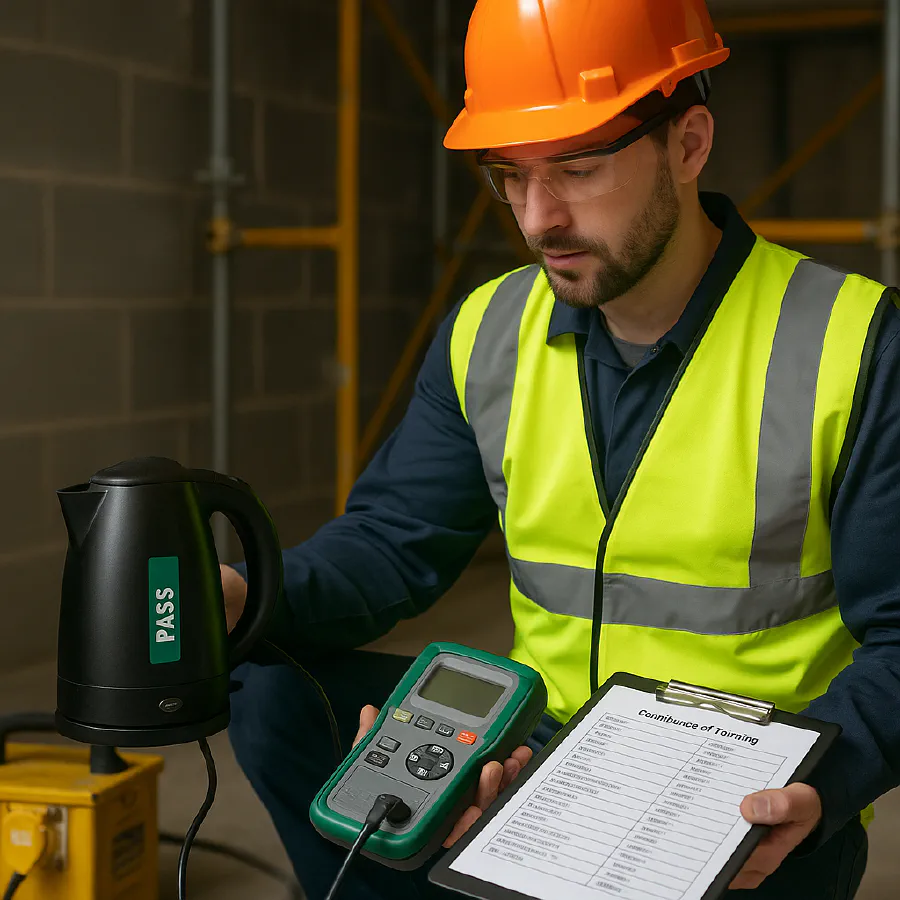
Engineer carrying out PAT testing with a handheld tester and a visible PASS label
Who this is for
- Trades business owners, site managers and supervisors
- Electrical contractors adding PAT alongside EICRs
- Landlord services teams and facility managers
Related reads:
- Route improvement for engineers: cut drive time and fit in one extra job per day (Route planning for trades)
- Training matrix with CSCS and IPAF expiry reminders (Training matrix template)
Quick answer
- PAT is not a law by name. The law is to maintain electrical equipment so it doesn’t give rise to danger. PAT is the common way to meet that duty. See HSE Portable appliance testing FAQs and HSG107.
- There’s no fixed “annual PAT” rule. Intervals come from risk assessment, environment and use. HSE gives suggested intervals in HSG107 and INDG236 for low‑risk settings.
- Labels and records are optional in law but useful to manage and prove your scheme.
- Landlords: rules differ by nation. England and Wales mandate 5‑year EICRs; PAT is recommended but not mandated. Scotland requires PAT on landlord‑supplied appliances as part of the repairing standard. Northern Ireland brings in 5‑year EICRs from 2025; PAT recommended.
Good sources: HSE PAT FAQs, HSG107, INDG236; GOV.UK landlord electrical safety guidance; gov.scot repairing standard.
What the law actually says
- Electricity at Work Regulations 1989 require electrical equipment to be maintained to prevent danger. PAT is one recognised way to do this, alongside user checks and formal inspection.
- HSE position:
- No blanket requirement for annual testing.
- Decide measures and frequency based on risk, manufacturer guidance and experience.
- Competent person can be in‑house if trained and equipped.
- Helpful HSE pages to bookmark:
- HSE Portable appliance testing FAQs: overview of responsibilities, competence, labels and records, and examples.
- HSG107 Maintaining portable electrical equipment: maintenance plan and suggested intervals.
- INDG236 Low‑risk environments: light‑touch approach and suggested intervals.
External guidance:
- England private rented sector: 5‑year EICR required; PAT recommended good practice.
- Wales: 5‑year electrical safety inspection under Renting Homes regulations; PAT not mandated but appliances must be safe.
- Scotland: EICR plus PAT of landlord‑supplied appliances required at least every 5 years; provide copies to tenants.
- Northern Ireland: new regulations introduce 5‑year EICRs for private tenancies; PAT recommended good practice.
Useful links:
- HSE PAT FAQs: https://www.hse.gov.uk/electricity/faq-portable-appliance-testing.htm
- HSG107: https://www.hse.gov.uk/pubns/books/hsg107.htm
- INDG236 (low‑risk): https://www.hse.gov.uk/pubns/indg236.htm
- England PRS guidance: https://www.gov.uk/government/publications/electrical-safety-standards-in-the-private-rented-sector-guidance-for-landlords-tenants-and-local-authorities/guide-for-landlords-electrical-safety-standards-in-the-private-rented-sector
- Scotland repairing standard (Annex D3): https://www.gov.scot/publications/repairing-standard-statutory-guidance-private-landlords/pages/16/
- NI regulations overview: https://www.communities-ni.gov.uk/articles/electrical-safety-standards-private-tenancies-regulations-northern-ireland-2024
How often should you PAT test
Use a risk‑based schedule. Start with HSE’s suggested intervals, then adjust up or down based on what you find.
- Think about:
- Environment: construction sites and workshops are harsher than offices.
- Equipment type: handheld and moved items fail more often than fixed IT kit.
- Usage and history: heavy use or previous damage means tighter intervals.
- Examples (starting points, then review):
- Offices/shops: user checks routine; formal visual every 12 to 24 months; combined inspection and testing for moved equipment every 12 to 24 months; large IT possibly 24 to 48 months.
- Construction sites: 110 V tools and extension leads visual each shift, weekly formal check, test before first use and monthly thereafter.
- Schools/hospitality: more frequent than offices due to public use and rough handling.
Source: HSE PAT FAQs, HSG107, and HSE construction guidance.
Set up a simple, compliant PAT workflow
Aim: spend less time writing stickers and more time testing safely. Here’s a small‑team setup you can copy.
- Decide your scope and risk groups
- Group by environment and equipment type: offices, workshops, construction sites, kitchens; then handheld, IT, stationary.
- Set starting intervals from HSG107; record your rationale.
- Prepare tools and labels
- PAT tester capable of earth continuity, insulation, polarity. Popular makes include Seaward and Kewtech.
- Pre‑printed pass/fail labels with space for date, next due, initials. Labels help run your scheme, though not legally required by HSE.
- Collect asset details fast
- Print a simple asset list per site: location, item, make, serial, asset ID.
- Barcode or QR stickers speed repeat visits, but a spreadsheet works.
- Do user checks and formal visual first
- Most failures are spotted visually: damaged flexes, cracked plugs, loose cord grips, signs of overheating.
- Only then run instrument tests as justified by risk.
- Record and issue certificates without fuss
- Options:
- Free spreadsheet certificate: community‑shared Excel templates exist and are fine for small runs.
- Pay‑as‑you‑go forms: Electraform lets you buy EIC, EICR and PAT forms individually.
- Tester vendor software: if you own a Seaward, use their app to pull results and print labels.
What Reddit says:
- One UK electrician reports using a free Excel PAT certificate sheet when only doing a few sites per year, avoiding another subscription. Another prefers Seaward tester plus software. Electraform was recommended as PAYG forms covering EIC, EICR and PAT. See thread: https://www.reddit.com/r/ukelectricians/comments/1lbfe86/pat_testing/
- Review intervals and improve
- If you see repeated passes and low wear, extend intervals within HSE guidance.
- If you find damage or misuse, shorten intervals and brief the client’s team.
Certificate options (free and paid)
- Free: spreadsheet certificates
- Suits small jobs and occasional PAT alongside EICR work.
- Manual entry, but no ongoing cost.
- Pay‑as‑you‑go portals
- Electraform sells individual PAT certificates and also covers EIC/EICR.
- Good when you want neat PDFs without a subscription.
- Vendor ecosystems
- Seaward and others offer label printers and apps that pull readings from the tester, saving time when you’re doing hundreds of items.
Tip: Labels and records are optional in law but very handy for scheduling and proving maintenance.
PAT testing workflow diagram
Simple PAT flow you can copy
- User check and visual
- Test where needed
- Label item
- Log result to sheet/app
- Email PDF to client with next due date
Construction site example intervals
- Before first use on site: combined inspection and testing
- During use: visual before each shift, formal visual weekly
- Ongoing: monthly combined inspection and testing for 110 V tools, extension leads and site transformers
These frequencies reflect HSE construction guidance for harsher environments. Always adapt to your risk assessment and manufacturer advice.
FAQs
Is PAT testing a legal requirement?
- Not by name. The legal duty is to maintain equipment so it doesn’t give rise to danger. PAT is the recognised way to show you’re doing that.
How often should landlords do PAT testing?
- England and Wales: 5‑year EICRs are mandatory; PAT is recommended. Some HMO licences require appliance testing, so check your council.
- Scotland: PAT on landlord‑supplied appliances is required alongside the 5‑year EICR; give copies to tenants.
- Northern Ireland: 5‑year EICR phased in from 2025; PAT recommended.
Do I have to put a sticker on every appliance?
- No. Labels and records are not legal requirements, but they help you manage schedules and show evidence. Many clients expect them.
Who can carry out PAT testing?
- A competent person. That can be in‑house if they’re trained, know what to look for and have suitable equipment. For large or higher‑risk sites, many businesses hire a specialist contractor.
What about fixed equipment that’s plugged in but never moved?
- Risk may be lower. Use user checks and periodic formal inspection; test less often than handheld tools unless your risk assessment says otherwise.
What changed with EET vs PAT?
- The industry is broadening language from PAT to in‑service inspection and testing of electrical equipment. The legal duties have not changed; follow HSE and IET guidance.
Ready to Transform Your Business?
Turn every engineer into your best engineer and solve recruitment bottlenecks
Join the TrainAR Waitlist