
Quick Answer
Payaca's interactive proposals let UK solar installers send branded, multi-option quotes that customers can review, customise, and sign on any device. Real installers using interactive proposals close 30 to 40 percent more than those still sending PDFs. On a typical solar pipeline of 100 quotes a year at an average ticket of £8,000, lifting your close rate by ten points adds roughly £80,000 to annual revenue. The setup takes two to four weeks if you do it properly. The conversion gain shows up in the first month.
Table of Contents
- Why proposals decide your close rate
- What Payaca's proposal builder actually does
- The five features that move the needle
- Setting up your first proposal: a working walkthrough
- Plugging in EasyPV, OpenSolar, and Heatpunk
- Conversion tips from installers running 200+ jobs a year
- Mistakes that quietly kill close rates
- The numbers: what a 10 point lift is worth
- What installers are saying
- Recommended videos
- Frequently asked questions
- My verdict
 Payaca
Why proposals decide your close rate

Most solar installers I speak with put 80 percent of their effort into the survey and 20 percent into the proposal. The customer experiences that ratio in reverse. They see the survey for an hour. They live with the proposal for a week while they decide whether to spend £8,000.
That gap is where most jobs are lost. Not on price. Not on equipment. On the document itself. A PDF with three line items, a logo stretched to fit the header, and a payment link buried at the bottom signals one thing to a homeowner: this person is winging it.
An interactive proposal flips the conversation. The customer clicks through options, ticks the battery upgrade, watches the price update, and signs on their phone. The same person who would have ghosted you for a week now responds in two days because you made it easy. That's the whole game.
If your average solar quote is £8,000 and you send 100 quotes a year, moving your close rate from 20 percent to 30 percent is the difference between £160,000 and £240,000 in revenue. The proposal tool costs less than one extra installation a year. It pays for itself before the second invoice clears.
What Payaca's proposal builder actually does
Payaca is a UK-built operating system for clean tech installers. The proposal builder sits at the front of it, but it's plugged into the same database as your jobs, your invoices, your customer records, and your engineer schedule. That matters because a quote that becomes a job inherits everything: pricing, line items, customer details, deposit terms. No re-entry.
For solar specifically, the proposal builder handles four jobs:
- Multi-option quoting. Customers see three packages side by side, click the one they want, and the totals update in real time.
- Design tool import. System designs from EasyPV, OpenSolar, Heatpunk, and Spruce flow straight into the proposal without manual re-entry.
- Digital signing and deposit collection. Customers sign on any device and pay a deposit via Stripe in the same flow.
- MCS-compliant document generation. Auto-generated handover packs, digital commissioning certificates, and the audit trail to back them up.
The product was built for renewables. That sounds obvious until you compare it to generic CRM tools that bolted on a solar template. The difference shows up in how DNO applications connect to ENA Connect, how MCS paperwork generates automatically, and how the proposal handles three technologies on a single quote.
The five features that move the needle
Not every feature in Payaca's proposal builder pulls its weight. After 18 months of watching installers use it, these five do the heavy lifting on conversion.
1. Side-by-side multi-option packages
This is the single biggest lever. Instead of one quote with one number, you present three: a base PV system, a PV plus battery, and a full package with EV charger included. Customers anchor on the middle option. Your average ticket goes up by 15 to 25 percent because you've given them somewhere to scale up to.
2. Real-time price recalculation
When a customer clicks the battery option, the price updates instantly. They're not waiting for you to send a revised PDF. They're not emailing you back to ask. They're seeing the new total and the new monthly finance figure in the same view. That removes a friction point that used to take three days.
3. Built-in finance options
Payaca's proposal can present financing alongside the cash price. For a £12,000 system that becomes £142 a month, you've changed the conversation from "can we afford it" to "does the monthly fit our budget". Same job, completely different decision frame.
4. E-signature with deposit capture
The customer signs and pays a deposit in one motion. No "I'll send the deposit on Friday" delay. The job is committed. Cash flow improves. Payaca reports that automated deposit collection at acceptance lifts the close-to-cash window from 14 days to under 48 hours.
5. View tracking and reminders
You can see when a customer opens the proposal, how long they spent on each section, and which option they hovered on. Automated reminders go out after three days of silence. The proposal works while you're on the roof of someone else's house.
Setting up your first proposal: a working walkthrough

Most installers undercook the setup phase and then complain the tool isn't working. Two to four weeks of proper setup is the difference between a system that pays for itself in a month and one that sits half-used for a year.
Week 1: branding and templates
Upload your logo at high resolution. Set your brand colours. Write three proposal templates: one for a standard residential PV system, one for PV plus battery, one for a commercial install. Each template should have a cover page with your accreditations, a system specification page, a financial breakdown, and a terms page.
Don't just import your old PDF and call it done. Rewrite the copy. The customer is reading this on a phone, not signing it in a meeting room.
Week 2: pricing and packages
Build your product catalogue. Every panel, every inverter, every battery, every accessory. Set margins on each. Group them into packages: Bronze, Silver, Gold or whatever names suit your brand. The work here pays back tenfold because every future quote is a five-minute job, not a 90-minute job.
Week 3: integrations
Connect your design tool (EasyPV, OpenSolar, or Heatpunk). Connect Xero or QuickBooks. Connect Stripe for deposits. Set up the ENA Connect integration for DNO applications. Connect your calendar so engineer availability flows through to your scheduling.
Week 4: pilot and refine
Run ten real proposals through the system in the final week. Watch how customers interact. Find the friction. Adjust copy, adjust pricing, adjust the order of options. Then you're live.
The £1,500 onboarding fee on the Growth plan is worth it. The Payaca team does the heavy lifting on templates, integrations, and workflow mapping. Trying to do all of it yourself in week one is a common reason setup overruns.
Plugging in EasyPV, OpenSolar, and Heatpunk
This is the integration that matters most for solar. Without it, you're manually transcribing system specs from your design software into your proposal. Three hours per quote, easy.
With it, your survey runs through EasyPV. You generate the design. The system specifications, equipment list, performance estimate, and pricing flow into Payaca as a draft proposal. You add your covering letter, set the package options, and send. Total time from survey to proposal in the customer's inbox: under an hour.
| Design tool | Best for | Cost | Payaca integration |
|---|---|---|---|
| EasyPV | Domestic PV with battery, MCS reporting | Free tier; Pro from £35/month | Native, bi-directional |
| OpenSolar | 3D modelling, shading analysis, US-style proposals | Free | Native import |
| Heatpunk | Heat pump heat loss calculations and design | From £49/month | Native, MCS-compliant output |
| Spruce | Heat pump design with EPC integration | Contact for pricing | Native |
If you're a domestic PV-only outfit, EasyPV plus Payaca covers everything. If you cross over into heat pumps, add Heatpunk. The integrations are the reason Payaca won this segment. Generic CRM tools simply don't speak to MCS design software.
Conversion tips from installers running 200+ jobs a year
Setup is half the battle. How you use the tool day to day is the other half. The installers I see hitting 35 percent close rates do these six things consistently.
Send within 24 hours, ideally within 4
Industry data is consistent on this. EPCs that deliver professional proposals within 24 hours close 25 to 35 percent of leads. The ones taking three to five days close 10 to 15 percent. The customer is shopping. Whoever lands first is in the lead.
Use the middle option as your anchor
People don't want the cheapest. They don't want the most expensive. They want the middle. So put your real recommendation in the middle of three options, not the bottom. Behavioural pricing 101.
Lead with the monthly figure, not the total
£142 a month feels different to £12,000. Payaca lets you show both. Put the monthly figure first in the headline. Customers compare it to their current energy bill, not to their savings account.
Include a payback timeline as a graphic
A line chart showing cumulative energy savings versus system cost over 25 years closes more jobs than any sales pitch. Customers screenshot it and show their partner. That's the moment the decision flips from "thinking about it" to "doing it".
Follow up at day three with a phone call, not an email
The automated reminder Payaca sends is useful. The phone call you make off the back of the view-tracking data is what closes the job. "I saw you spent a while on the battery option, anything I can answer?" works every time.
Always include the SEG export tariff in the savings model
Most installers forget the Smart Export Guarantee. It's currently 7 to 15p per kWh exported, depending on the supplier. On a 4kW system that's another £150 to £300 a year of payback. Show it in the model. The numbers look meaningfully better.
Build your proposal templates well enough that you can send a fully customised quote within four hours of the survey. That window is the single most important metric in solar sales.
Mistakes that quietly kill close rates
I see the same five mistakes across installers who set up Payaca and then wonder why their close rate didn't move. Each one is fixable in an afternoon.
Sending a proposal that looks like a PDF
If your Payaca proposal has no images, no interactive elements, and reads like a Word document, you've not used the tool. You've just changed where you store the same old quote. Customers don't see any difference. Use the visual elements: hero image, system diagram, savings chart, side-by-side options.
Showing one price, no options
A single number gives the customer one decision: yes or no. Multi-option lets them choose between three yeses. Always show three options.
Hiding the deposit step
Some installers turn off the deposit collection because they "want to keep things simple". Stop. The deposit is the commitment. Without it, the customer can drift for weeks. Make the deposit a fixed step in the acceptance flow.
Using stock photography
Generic solar stock images make you look like every other installer. Use real photos of your installs, your team, your van. The customer is buying from you, not from a database of free images.
Not following up
The automated reminders are useful. They are not a replacement for a phone call at day three and a second call at day seven. The proposal tool does 80 percent of the work. The other 20 percent is human.
Get a basic template live in week one. Tweak it based on real customer feedback over the next month. The installers who try to build the perfect proposal before launching never launch. The ones who ship and iterate hit 30 percent close rates inside 90 days.
The numbers: what a 10 point lift is worth
This is the section worth bookmarking. The economics of proposal software for solar installers are unusually clear.
| Scenario | Quotes/year | Close rate | Avg ticket | Annual revenue |
|---|---|---|---|---|
| PDF baseline | 100 | 20% | £8,000 | £160,000 |
| Interactive proposal | 100 | 30% | £8,000 | £240,000 |
| Plus upsell (multi-option) | 100 | 30% | £9,500 | £285,000 |
| Plus speed (24h delivery) | 100 | 35% | £9,500 | £332,500 |
The gap between the bottom row and the top row is £172,500 a year. The cost of the tool is around £12,000 to £14,400 a year on the Growth plan, plus the £1,500 onboarding fee. Even if you only capture half the upside, the return on investment is somewhere north of 6x in year one.
That maths assumes you actually use the tool. The installers who get the templates wrong, send single-option PDFs through Payaca, and ignore the view tracking get none of this. The tool isn't magic. The work is in how you use it.
UK residential solar in 2026 averages £7,500 for a 4kW system, £10,000 with a battery, and £13,500 for a battery plus EV charger package. If you're selling all three from a single proposal, your blended average ticket sits around £9,500 to £10,500 depending on take-up.
What installers are saying
Recommended videos
Payaca Workflow Demo: A Core Process for Renewable Installers
Payaca
From Site Survey to Client Handover: Payaca Workflow Demo
Payaca
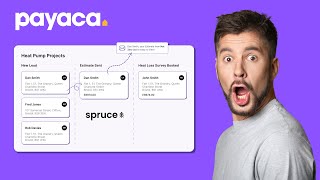
Payaca Integration with Spruce: Streamline Heat Pump Quoting
Payaca

How We Design and Quote Solar PV Installations: Live Example with Pricing
Solar industry walkthrough

7 Things to Know Before You Get ANY Solar Quotes
Consumer-side context for installers

How to Compare Solar and Battery Quotes
How customers evaluate your proposals
Frequently asked questions
The Growth plan is £999 a month billed annually (£1,199 monthly), with 25 user seats and a £1,500 onboarding fee. The Accelerator plan at £299 a month is for new businesses incorporated within 24 months and with eight or fewer staff. Scale pricing is custom for teams above 50 users. All prices exclude VAT and SMS charges (4p per message).
Yes. The platform auto-generates MCS-compliant handover packs, digital commissioning certificates, and the electrical paperwork on-site. The proposal builder itself flows the system specifications and performance estimates straight from EasyPV or OpenSolar, both of which produce MCS-aligned outputs.
Yes, and you should. Multi-technology proposals are where Payaca differs from generic quoting tools. The customer sees solar PV, battery storage, and EV charging on the same document with combined savings projections. Multi-tech sells better than three separate quotes.
Two to four weeks if you take the onboarding seriously. Week one is branding and templates, week two is pricing and product catalogue, week three is integrations, week four is a pilot. Trying to do it all in a weekend is the most common reason setup overruns.
No. Payaca is the business operating system. EasyPV and OpenSolar are the design tools. You need both. The design tool runs the technical modelling and produces the system spec. Payaca turns that spec into a customer-facing proposal, manages the sales pipeline, and runs the job through to completion.
Most installers see a measurable improvement in the first month, with rates settling 10 to 15 points above their PDF baseline by month three. The lift comes from three things: speed to first proposal, multi-option pricing, and digital signing with deposit capture. Stack all three and the maths is consistent.
The tool isn't the problem. The proposal copy is, the photos are, or your follow-up is. Use the view-tracking data to find where customers drop off. Most installers find their proposals are too long or the wrong sections are first. A 90-minute revision usually fixes it.
My verdict
The proposal builder is the strongest thing in the product. Multi-option quotes, real-time price recalc, MCS-compliant document generation, and a Stripe deposit flow that gets cash in 48 hours instead of 14 days. Pair it with EasyPV or OpenSolar and you have the operating system the UK solar trade was missing five years ago. Set it up properly, send within four hours of survey, always show three options, and follow up at day three. The maths is unforgiving but in your favour. Skip the setup work and you'll wonder why nothing changed. Do the setup work and your close rate climbs by ten points inside 90 days. Both outcomes are entirely on you.
For more on improving your sales pipeline, read our pieces on lead generation platforms, Google Local Services Ads, and local SEO for trades.