
Quick Answer
For most UK trades jobsites in 2026, a petrol inverter generator in the 2.2kW class (Honda EU22i around £1,065 to £1,430, or Hyundai HY2000Si around £450 to £550) is the realistic starting point. Step up to a 5kW open-frame petrol or small diesel from £600 to £1,200 if you are running heavy continuous loads. Portable power stations like the EcoFlow Delta Pro 3 (4kWh, around £3,000) are now usable for indoor and silent-zone work, especially with solar topping up during the day. Pick fuel if you need sustained output and runtime, battery if you need quiet, clean, indoor power, and hybrid if your sites swing between both.
Table of Contents
- What you actually need to power on a jobsite
- Petrol generators: cheap to buy, simple, loud
- Diesel generators: when continuous load makes them pay
- Inverter generators: clean power for sensitive tools
- Portable power stations: the quiet revolution
- Hybrid setups: solar, battery, and a small petrol backup
- How to size a generator for your tool inventory
- Cost of ownership: fuel, maintenance, replacement
- Head-to-head comparison table
- What tradespeople are saying
- Recommended videos
- Frequently asked questions
- My verdict
What you actually need to power on a jobsite
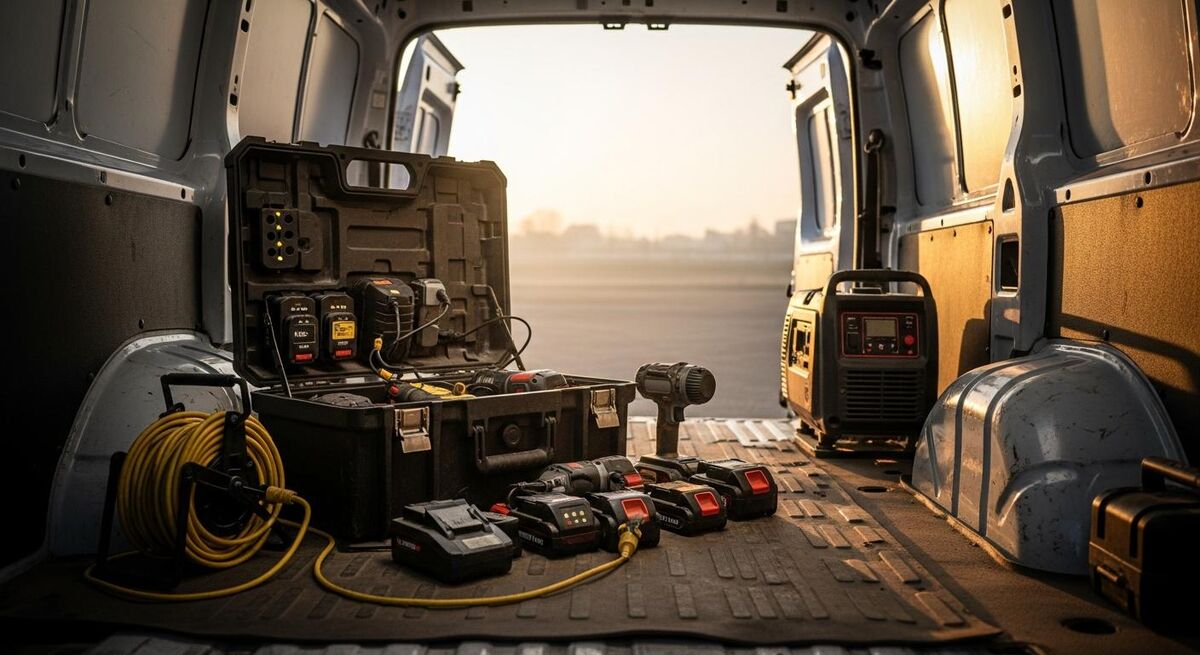
The right answer here depends on the work, not the generator. So before we talk about brands and fuels, work out what you actually need to keep running on a typical day. For a sparky doing a refurb, that might be one chop saw, a SDS drill, a small site radio, and three cordless battery chargers. For a roofer running a tile cutter on a flat roof, that could be a 1.5kW continuous draw for hours at a time. For a heating engineer commissioning a new boiler with no grid connection, it is a couple of meters, a laptop, and maybe an electric kettle.
The biggest single mistake I see on this is buying for peak draw and ignoring runtime. A 2.2kW generator will handle a chop saw firing up, but it will not run a halogen heater all afternoon and charge two batteries at the same time. The right kit is the one that matches your sustained load with a bit of headroom, not the one with the biggest sticker number.
The other mistake is the opposite: buying for one extreme event. People hear "table saw needs 4kW" and go and buy a 6kW open-frame petrol that they then drag to every site, when 90% of the time they are running a drill and a vacuum. Right-size for what you actually do. For the heavy days, hire.
Honda recommends 2,000W for a single power tool, 3,000 to 4,000W for two tools running together, and 4,000W and above for several tools in parallel. That holds up well in practice, but check the start-up surge on anything with a motor (chop saws, compressors, vacuums) which can pull 2 to 3 times the running wattage for a second or two.
Petrol generators: cheap to buy, simple, loud
The cheapest way onto site power is a petrol open-frame generator. £200 to £400 buys you a 2.5kW to 3.5kW machine that will run a couple of tools, charge batteries, and survive being thrown in the back of a van. The maXpeedingrods MXR3300 (3,300W max, 3,000W rated, 58dB) sits around the £400 mark and is a sensible budget choice. Hyundai's open-frame range goes from about £250 for a basic 2.8kW up to £1,000 for the HY10000LEK at 8kW with an electric start.
The trade-off is the noise and the fuel quality. Open-frame petrol generators run at 96 to 100dB at 7 metres. That is conversation-impossible territory. You will not get away with it on residential sites past 8am, and most builders' merchants car parks will quietly hate you for it. The output is also a "modified sine wave" on the cheaper machines, which is fine for resistive loads (heaters, lights, drills) but can confuse the electronics in modern battery chargers and laptops.
Petrol also goes off. If you leave fuel in the tank for more than a few weeks, it gums up the carburettor and you spend an hour stripping it down next time you need it. Most trades who own a petrol generator end up draining the tank between jobs, or fitting a fuel stabiliser. Neither is a deal-breaker, but it is the kind of detail that nobody mentions when they sell you the thing. Battery storage and energy management on your van or workshop changes some of this calculation, and we cover it in detail in our battery storage guide for installers.
Diesel generators: when continuous load makes them pay
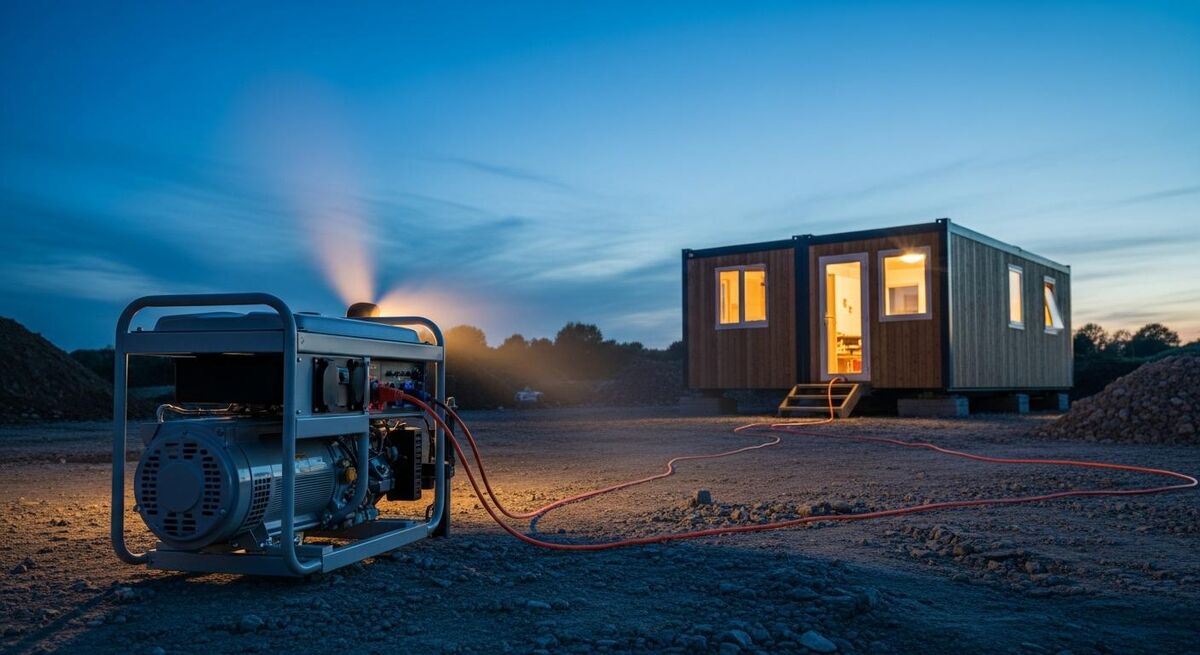
Diesel costs more up front, runs about 30 to 35% more fuel-efficient than petrol under sustained load, and lasts longer. The Hyundai DHY6000SE silent diesel sits around £1,800. A serious construction-grade unit from Atlas Copco or Pramac will start at £2,500 and climb past £5,000 for a 10kW machine on wheels. So why bother?
Because over the lifetime of the machine, if you run it hard, diesel wins. The break-even calculation that gets quoted most often: 1,000 hours per year at a 15kW average load, the diesel generator costs £3,500 more up front but pays for itself in around 10 months. For a small mobile trade running a generator for a couple of hours a week, that calculation never lands. For a site cabin running heaters, kettle, and lighting for 10 hours a day for months on end, diesel is the only sensible answer.
UK diesel was averaging £1.50 to £1.60 per litre at the time of writing, against £1.45 to £1.55 for petrol. The fuel price gap is only 3% or so. The real saving is in litres burned per kWh produced, not pence per litre at the pump.
Larger UK construction sites are moving to Hydrotreated Vegetable Oil (HVO) as a drop-in replacement for red diesel. It runs in standard diesel engines with no modification, cuts net carbon emissions by around 90%, and is now mandatory on some public sector contracts. For mobile trades it is not yet a buying factor, but if you are spec'ing a generator that might end up on a Crown Estate or local authority site, check the fuel policy first.
Inverter generators: clean power for sensitive tools
This is where most UK trades buyers should be looking in 2026. Inverter generators convert the engine output to DC, then back to a pure sine wave AC at a stable 230V. The result is power clean enough to charge a laptop, run a sensitive boiler controller, or power a Festool tool with soft-start electronics without tripping the protection circuit.
The Honda EU22i is the benchmark. £1,065 to £1,430 depending on retailer, 2.2kW peak, 21kg, eco-throttle drops engine speed to match load. 3.6L fuel tank, 3.5 hours at rated load, up to 8 hours on eco at quarter load. Noise levels run from 48dB(A) on eco to 71dB(A) at 7m at full chat. Five-year domestic warranty in the UK (one year commercial). It is twice the price of equivalent open-frame petrol, but it is also twice as quiet and runs everything cleanly.
The serious alternatives are the Hyundai HY2000Si at around £450 to £550 (same 2kW class, 58dB(A), 3-year warranty), and the DeWalt DXGNi2200 at around £900 to £1,100 (1,700W running, 11-hour runtime, 60dB minimum). The DeWalt has the longest runtime by some margin, but Honda's noise advantage is real. At 48dB on eco mode you can have a conversation next to it.
For higher loads, the Honda EU70is at 7kW is the gold standard for mobile UK trades who need to run a small site setup off one machine. £6,500 retail, but they hold value well and last 15 years if you service them. Champion's tri-fuel inverter 7.25kW sits closer to £1,500 if you are happy with a noisier, less polished machine.
On the Festool Owners Group forum, user Bertotti flagged something worth knowing: "This model has the power saving mode and the ts55 didn't draw enough to trigger the Gen to ramp up speed." Eco mode is brilliant for fuel economy, but soft-start tools that draw very low idle current can fail to trip the generator into full power, leading to undervoltage stalls when you start cutting. Turn eco off when running soft-start tools.
Portable power stations: the quiet revolution
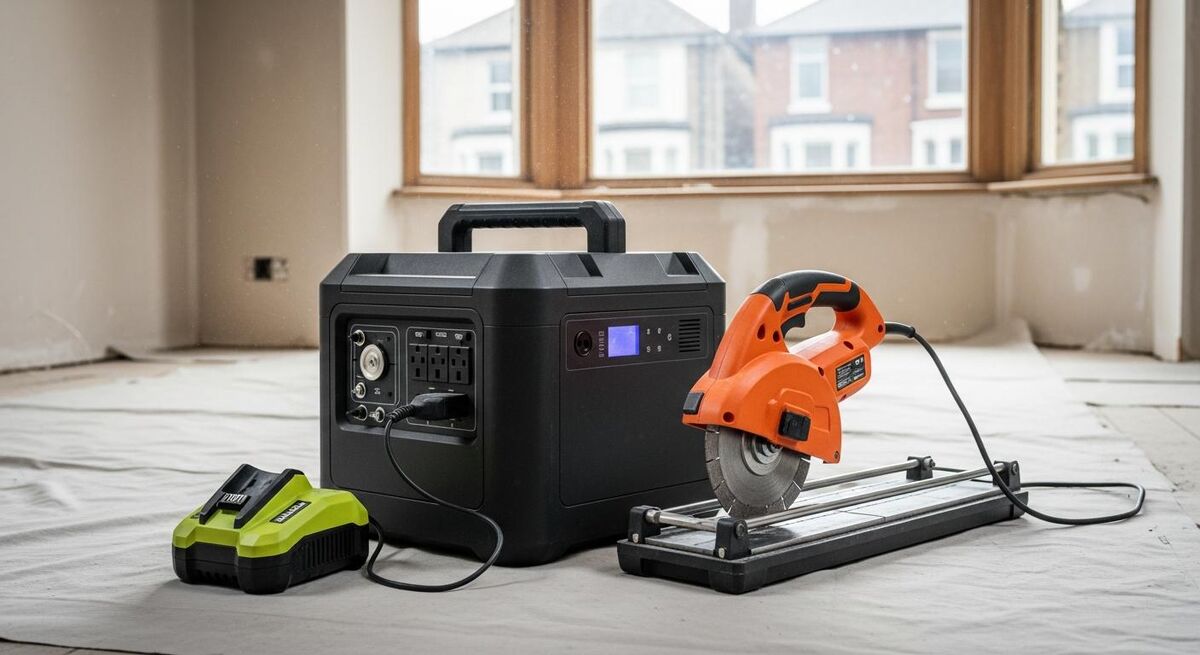
This is the category that has changed the most in the last 24 months. EcoFlow, Jackery, Bluetti, and Anker now sell portable lithium battery units with proper 230V AC inverters, 3kW to 7kW peak output, and capacities from 1kWh to over 10kWh expandable. They run silently. They produce zero emissions. They work indoors. They are the only sensible answer for any first-fix or finishing work where you cannot, or do not want to, run a petrol engine.
The EcoFlow Delta Pro 3 sits at the serious end. 4kWh capacity, 3,600W AC continuous, expandable to 48kWh with stacked extra batteries. Around £3,000 to £3,500 for the base unit in the UK. The Jackery Explorer 1500 Ultra is a smaller, lighter option at 1.5kWh and 3,600W peak (2,000W continuous for 15 minutes), IP65-rated for dust and water on site, and around £1,200 to £1,400. Bluetti's AC500 is the closest direct competitor to the EcoFlow at similar capacity and price.
The maths on battery only works if you can recharge between jobs. A 4kWh power station will run a 1.5kW tile cutter for around 2 hours 30 minutes flat out, or charge a stack of 18V battery packs for a full day's roofing work. It will not run a halogen heater for a week. But if you are doing first-fix in an occupied house, finishing work in a flat, or charging tools overnight from your van's solar setup, this is the tool. The lifetime maths is also better than petrol: LiFePO4 cells in current EcoFlow units are rated for around 3,000 full cycles to 80% capacity, and Jackery's LiFePO4 stations come in around 2,000 cycles. At 3,000 cycles, one Delta Pro 3 amounts to around 12,000kWh of power over its life.
Hybrid setups: solar, battery, and a small petrol backup
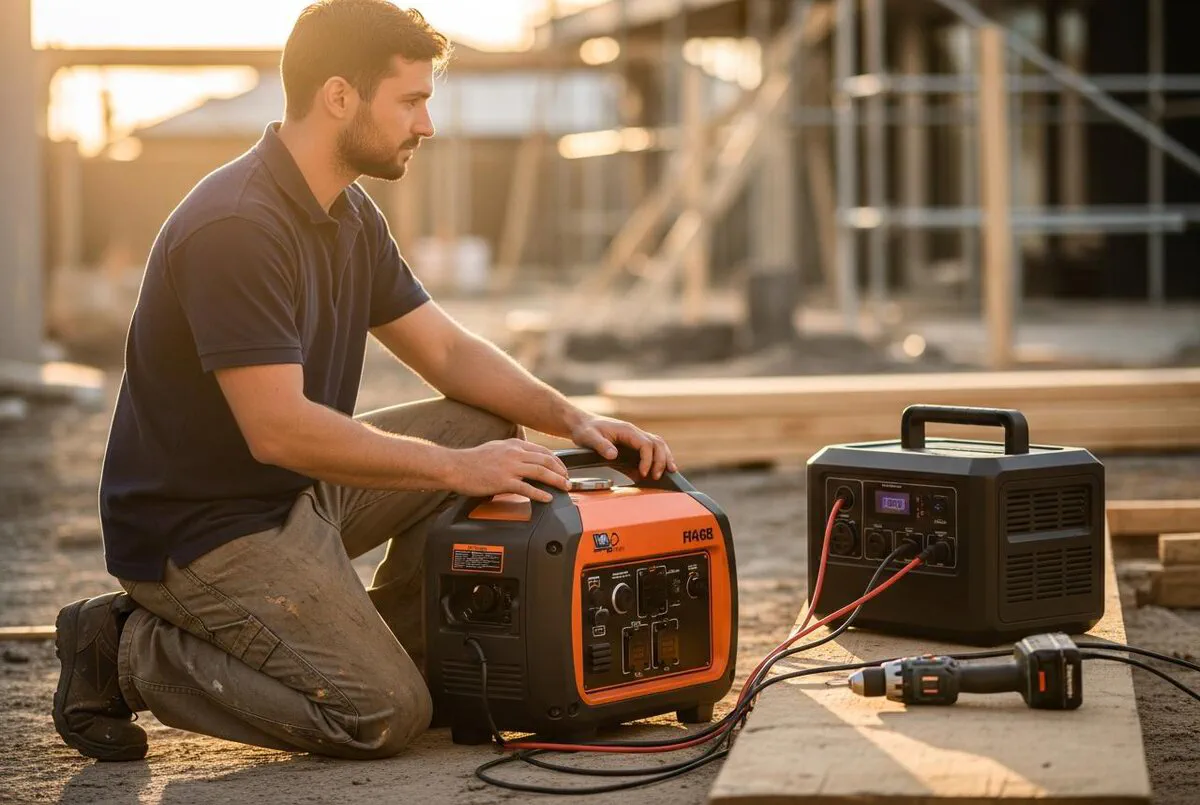
The interesting setup for mobile UK trades in 2026 is not pure battery or pure fuel. It is a hybrid. A portable power station on the van, charged overnight at home or by a 200W to 400W flexible solar panel on the van roof, sized to cover 80% of a normal day's tool charging and small AC loads. Then a 2kW petrol inverter generator, kept clean and dry, that comes out only when the job needs sustained AC power.
The reason this works is that most trades runs are short bursts, not continuous load. A drill is on for 20 seconds, a vacuum runs for two minutes, a battery charger pulls 90W for an hour. Battery handles all of that silently and indoors. The petrol generator is for the chop saw afternoons, the site cabin in winter, or the surprise call-out where the customer's power is out and there is real work to do.
EcoFlow sell a Smart Generator (Dual Fuel) at around £1,400 that ties directly into the Delta Pro ecosystem and switches on automatically when battery falls below a preset threshold. That is over-engineered for most trades, but it shows the direction the category is heading. The next step beyond hybrid is the same logic we covered in our battery storage and home energy systems guide, scaled down for your van.
A 2kW Hyundai inverter generator (£500) plus a 2kWh Jackery or EcoFlow power station (£1,500) plus a 200W flexible solar panel (£250) comes to around £2,250. That covers the vast majority of trades use cases, gives you silent indoor power, and saves you bringing a petrol engine to every job. Compare that to a single Honda EU70is at £6,500 and you can see why mobile trades buyers are mixing categories.
How to size a generator for your tool inventory
The sizing exercise is straightforward if you do it properly. Write down every tool, appliance, and charger you might run at the same time. Look at the nameplate wattage on each one. Add the running wattages. Then for any motor-driven tool (chop saw, vacuum, compressor, anything with a soft-start), add 50% to its running wattage to cover the start-up surge.
For a worked example: a tradesperson running a 1,500W chop saw, a 1,200W vacuum, and three 90W battery chargers in parallel needs roughly 1,500 + 1,200 + (3 x 90) = 2,970W of continuous running power. Add 50% surge on the chop saw and vacuum: 1,500 x 1.5 = 2,250W surge, 1,200 x 1.5 = 1,800W surge. The worst-case combined surge is when both motors fire together: 2,250 + 1,800 + 270 = 4,320W. So you want a generator with a peak rating of at least 4.5kW.
In practice, you never run everything at once. So most trades work to a sustained load of 60% of nameplate continuous, plus a 30% headroom buffer. For the example above, that maps cleanly onto a 3.5kW peak / 3kW continuous open-frame, or a 2.2kW inverter if you can stagger the loads (which you usually can).
| Tool | Running watts | Surge watts |
|---|---|---|
| 110V chop saw (Makita LS1019L) | 1,300W | 2,000W |
| SDS rotary hammer drill | 900W | 1,500W |
| Wet and dry vacuum (M-class) | 1,200W | 1,800W |
| 18V battery charger | 90W | 120W |
| Site halogen heater | 1,500W to 3,000W | same as running |
| Site radio / charger combo | 50W to 200W | same as running |
| Tile cutter (wet) | 1,500W | 2,200W |
| Air compressor (small, single-phase) | 1,800W | 3,500W |
The AI sizing calculators that some manufacturers now publish (PowerPlanner from Honda's UK distributors, CostCalc from a couple of the inverter brands) use this exact methodology. They are useful for a first-pass estimate, but they only know about the tools in their database. If you run a mix of brands, you still need to do the addition yourself.
Cost of ownership: fuel, maintenance, replacement
Buying the generator is the easy bit. The total cost of ownership over five years tells a different story. Petrol generators look cheap up front, but if you use them often, the fuel bill catches up fast. Battery power stations look expensive up front, but the per-kWh delivered cost is competitive over their lifetime.
A rough five-year cost-of-ownership comparison for a typical mobile trades user (100 hours per year, 2kW average load):
| Setup | Up-front | 5-year fuel | 5-year service | Total 5-year |
|---|---|---|---|---|
| Open-frame petrol 3.5kW | £400 | £900 | £300 | £1,600 |
| Honda EU22i inverter | £1,200 | £600 | £200 | £2,000 |
| Small diesel 5kW silent | £1,800 | £700 | £400 | £2,900 |
| EcoFlow Delta Pro 3 (4kWh) | £3,200 | £100 charging | £0 | £3,300 |
| Hybrid: Hyundai inv + EcoFlow 2kWh + 200W solar | £2,200 | £200 | £100 | £2,500 |
The numbers are illustrative, not gospel. Real costs depend on how much you use the unit, how cleanly you maintain it, and the resale value at the end. Honda inverters hold resale value extremely well; cheap open-frame petrol generators are nearly worthless after five years. Diesel and high-end power stations both depreciate steadily but predictably.
One thing that gets missed: the cost of replacement parts on a cheap generator is often higher than the second-hand value of the machine. If a £250 open-frame Hyundai blows its carburettor at three years old, the carb assembly is £80 plus your time. By the time you have done that twice, you would have been better off spending £500 on a Hyundai inverter that lasts twice as long. Buy once, cry once is a cliché, but on jobsite power kit it generally holds.
Head-to-head comparison table
Here is the side-by-side at a glance. The four categories with the kind of machine I would actually recommend in each, and the trade-offs you need to be honest with yourself about before you spend.
| Category | Typical model | Output | Up-front (£) | Noise (dB) | Indoor use | Best for |
|---|---|---|---|---|---|---|
| Open-frame petrol | maXpeedingrods MXR3300 | 3kW running, 3.3kW peak | £350 to £500 | 96 to 100 | No | Outdoor site work, occasional use, lowest cost |
| Petrol inverter | Honda EU22i | 1.8kW running, 2.2kW peak | £1,065 to £1,430 | 48 to 71 | Outdoor only | Sensitive electronics, residential sites, quiet running |
| Diesel silent | Hyundai DHY6000SE | 5kW continuous | £1,800 to £2,500 | 67 to 72 | No | Site cabins, all-day continuous load, long-term use |
| Dual fuel inverter | Pulsar G2319N | 1.8kW running | £500 to £700 | 59 to 65 | Outdoor only | Fuel flexibility, LPG cleaner-burn for cleaner sites |
| Portable power station (small) | Jackery Explorer 1500 Ultra | 2kW continuous, 3.6kW peak (15min) | £1,200 to £1,400 | 0 to 30 | Yes | Finishing work, tool charging, silent indoor |
| Portable power station (large) | EcoFlow Delta Pro 3 | 3.6kW continuous, 4kWh capacity | £3,000 to £3,500 | 0 to 40 | Yes | Whole-day battery, indoor heavy tools, hybrid with solar |
| Hybrid (gen + battery + solar) | Hyundai HY2000Si + Jackery 1500 + 200W panel | 2kW gen + 1.5kWh battery | £2,200 to £2,500 | 0 to 58 | Mostly yes | Mobile trades wanting one rig for all jobs |
If you are an electrician or heating engineer doing mostly first-fix and finishing work in occupied homes: hybrid or pure battery. If you are a builder running site cabins or a roofer running tile cutters all day: petrol inverter or small diesel. If you are a one-off rescue rig for power cuts at customers' houses: a quiet petrol inverter wins. There is no one right answer, but there is a right answer for your specific work pattern.
Never run a petrol, diesel, or dual-fuel generator indoors, in a garage with the door open, near an air intake, or in a partially enclosed space. The carbon monoxide risk is real and fatal. Battery power stations are the only category safe for indoor use. If you need quiet, indoor power, that is the only category to consider. The HSE publishes guidance on portable generator use on construction sites that is worth reading: hse.gov.uk.
What tradespeople are saying
Recommended videos

Testing the Honda EU22i: Performance and Load Capacity
Generator Place

Honda EU22i Generator - The Full Review
FullRangeCamping
Hyundai HY2000Si: Quick Overview & Demo
Kelvin Power Tools
EcoFlow Delta Pro 3 Review: Full Test Results
Brains Report
Portable Propane Dual Fuel Generator 2000 Watt: Pulsar Review
Silver Cymbal
Most Expensive Power Station Review (Project Farm)
Project Farm

We Tested 100 Power Stations: What We Learned
The Solar Lab
I Tested EVERY Major Power Station: The Winner
Tory Delury
Frequently asked questions
Yes, but only if the chop saw is a smaller 1.5kW class and the vacuum is sub-1kW. If you fire them both up cold at the same moment, you will trip the generator on surge. Start one, let it settle, then start the other. Or stagger your work. Two heavy tools running simultaneously is the textbook 4kW+ scenario.
Yes. They produce no emissions and no exhaust. The only safety considerations are the same as for any large battery: do not stack them on flammable surfaces, do not leave them charging unattended for days, and do not run them at maximum continuous load while covered or in a small unventilated cupboard. Otherwise, indoor use is the entire point of the category.
For most UK trades, no. LPG is cleaner-burning and roughly 30 to 50% cheaper per kWh produced than petrol, but you need to be running the generator for a lot of hours per year to make the price difference back. If you are on sites that ban petrol storage, or you already run gas appliances and have LPG bottles around, then yes. Otherwise it is a feature you do not need.
About 30 to 40dB at 7 metres. Open-frame petrol generators measure 96 to 100dB at 7m at full load. The Honda EU22i is 48dB on eco mode and 71dB at full load. That is the difference between "you cannot hear yourself think" and "you can have a normal conversation next to it." For residential sites, the inverter wins by a mile.
Yes, all of them. The chargers pull 90 to 120W and any portable power station will deliver that cleanly. A 2kWh power station will easily charge 15 to 20 battery packs from flat on a single charge, depending on the chargers. This is one of the most common real use cases for the category.
Honda's UK domestic warranty is five years (one year commercial use). Hyundai's UK warranty on petrol inverter and open-frame generators is three years, capped at 1,000 hours of use. Their P1-branded engines (a sub-brand) get two years. Hyundai is usually cheaper up front; Honda holds its resale value better and lasts longer in real use.
Realistically, no. UK winter daylight delivers around 20 to 30% of summer panel output. A 200W panel on a van roof in December will give you maybe 40 to 60W average through the daylight hours. That covers a few battery charges, not a heavy continuous draw. Hybrid (battery + small petrol backup) is the honest answer for UK winter work.
My verdict
If I were kitting out a one-van mobile trades operation today, I would not buy a single big generator. I would buy a Honda EU22i (£1,200 ish) for the days I need real outdoor AC power, plus an EcoFlow Delta 2 Max or Jackery 1500 Ultra portable power station (£1,200 to £1,400) for indoor finishing work and tool charging. Total spend around £2,400. That setup runs 95% of trades use cases silently, indoors, with no fuel storage and no carbon monoxide risk, and the petrol backup is there for the chop saw afternoons. The big single-machine answer (a Honda EU70is at £6,500) only makes sense if you are running real continuous load, and most mobile trades are not. Buy for your actual work pattern, not for the worst-case event you might see twice a year. For the bigger picture on how on-board power, solar, and battery storage are reshaping mobile trades, see our battery storage and home energy systems guide, and for related kit decisions our 3D printing for trades guide and our construction adhesives comparison.