Quick Answer
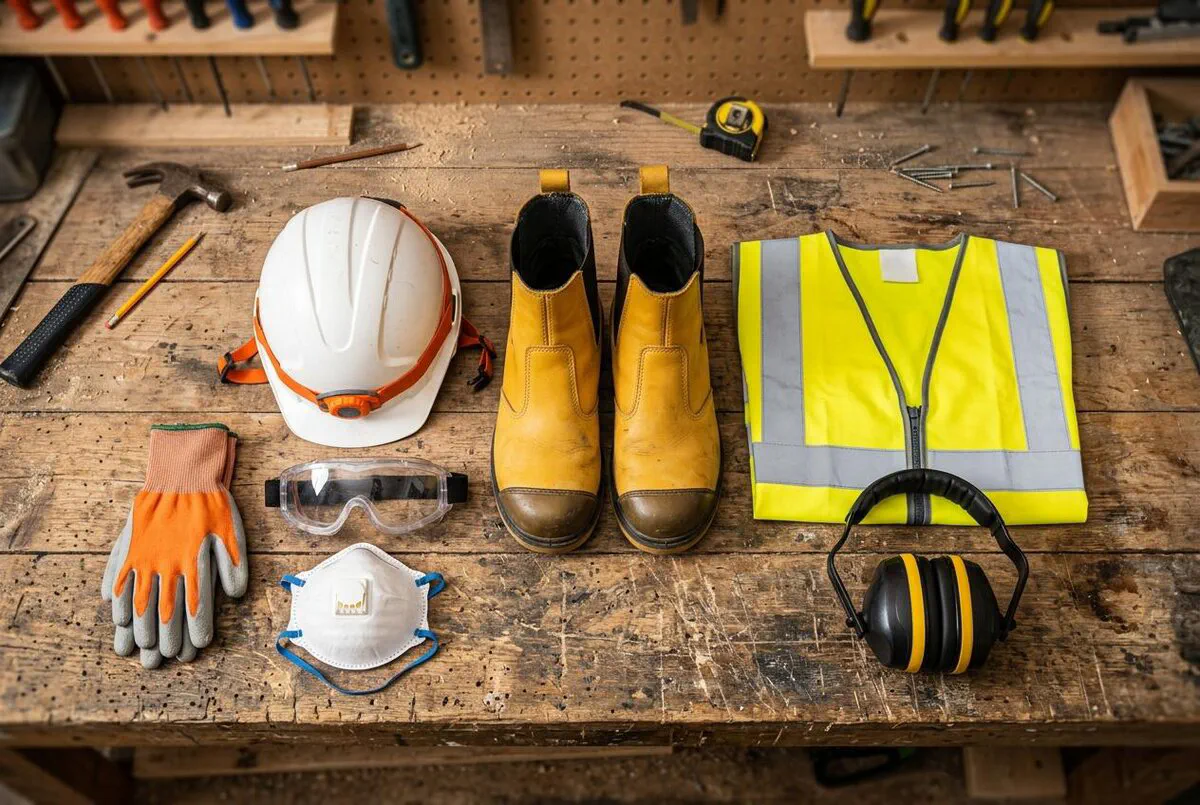
Every UK tradesperson needs at least five categories of PPE: safety footwear (S1P or S3 rated, from £40), cut-resistant work gloves (EN 388, from £5), high-visibility clothing (Class 2 minimum on site), head protection (EN 397 helmet, from £8), and eye protection (EN 166 rated, from £3). Since April 2022, the PPE at Work Regulations require employers to provide free PPE to all workers, including self-employed contractors on site. Replace boots every 6 to 12 months, gloves every 2 to 4 weeks with heavy use, and hard hats every 3 to 5 years unless damaged. This guide breaks down every standard, every rating, and what to actually buy.

Table of Contents
- UK PPE Regulations: What the Law Says
- Safety Footwear: S1P, S3 and What the Ratings Mean
- Work Gloves: EN 388 Ratings Decoded
- High-Visibility Clothing: Class 1, 2 and 3 Explained
- Head Protection: Hard Hats, Bump Caps and Smart Helmets
- Eye and Face Protection
- Hearing Protection: When You Need It and What Works
- Respiratory Protection: FFP Ratings and Face-Fit Testing
- PPE Requirements by Trade
- When to Replace Your PPE
- Top PPE Brands in the UK
- Smart PPE and Wearable Safety Tech in 2026
- PPE Videos Worth Watching
- What the Community Thinks
- Frequently Asked Questions
UK PPE Regulations: What the Law Says
The Personal Protective Equipment at Work Regulations 1992, amended in April 2022, set out clear duties for employers and workers across the UK. The 2022 amendment was significant because it extended PPE obligations to "limb (b)" workers, meaning agency staff, casual workers, and those on zero-hours contracts are now covered. Previously, only direct employees had a legal right to free PPE.
Under current UK law, employers must carry out a risk assessment identifying PPE needs, provide suitable PPE free of charge to all workers, ensure it fits properly, train workers on correct use, and maintain and replace PPE as needed. Workers have a duty to use the PPE provided and report any defects.
Self-Employed on Someone Else's Site
If you are self-employed but working on a site controlled by another party (a principal contractor, for example), that controller has a duty under CDM 2015 to ensure adequate welfare and safety arrangements. In practice, most principal contractors require all personnel on site to wear specified PPE regardless of employment status. If you run your own jobs, the PPE responsibility falls entirely on you. Our CDM Regulations guide covers these duties in detail.
HSE statistics for 2024/25 confirm construction remains the UK's deadliest industry. 35 workers died, accounting for 28% of all workplace fatalities. One in 40 construction workers suffered a non-fatal injury in the three-year period to March 2025. Falls from height caused a third of specified injuries, followed by slips, trips and falls on the level at 30%, and contact with moving or falling objects at 13%. Proper PPE does not eliminate risk, but it is the last line of defence when other controls fail.

Safety Footwear: S1P, S3 and What the Ratings Mean
Safety footwear is governed by EN ISO 20345:2022, the updated standard that replaced the previous 2011 version. All safety footwear must have a toecap rated to withstand 200 joules of impact and 15 kN of compression. Beyond that basic requirement, boots are classified into safety levels that tell you exactly what protection you are getting.
Understanding the Safety Ratings
| Rating | Protection | Best For | Price Range |
|---|---|---|---|
| SB | Basic toecap only | Light indoor work | £20 to £40 |
| S1 | SB + closed heel, antistatic, energy absorption, fuel-resistant sole | Indoor trades, clean environments | £30 to £60 |
| S1P | S1 + puncture-resistant midsole | Sites with nail risk, general construction | £40 to £80 |
| S3 | S1P + water-resistant upper + cleated outsole | Outdoor sites, wet conditions, heavy construction | £50 to £120 |
For most UK construction work, S1P is the minimum you should consider. If you work outdoors regularly, particularly in winter, S3 is worth the extra cost. The water-resistant upper and cleated sole make a genuine difference when you are trudging through muddy sites five days a week.
New 2022 Standard: S1PS, S1PL, S3S, S3L
The updated EN ISO 20345:2022 standard introduced new sub-classifications. Boots with "S" in the suffix (like S1PS, S3S) use a metallic puncture-resistant insole. Boots with "L" (like S1PL, S3L) use a larger non-metallic insert that covers more of the sole. The old certificates remain valid until the end of 2027, so you will see both markings in shops. Non-metallic midsoles are lighter and do not conduct cold, making them a better choice for electricians and anyone working in cold conditions.

What Tradespeople Actually Buy
DeWalt, Screwfix's own "Site" brand, Caterpillar, and Timberland PRO dominate the UK trades market. The DeWalt Newark Waterproof Hiker (around £80 from Screwfix) is consistently well reviewed for staying waterproof and being comfortable straight out of the box. The Screwfix Site Slate at around £15 to £20 is a popular budget choice that lasts roughly 9 months of daily use, though comfort varies by individual. At the premium end, brands like V12 and Grisport offer boots that tradespeople report lasting several years.
The key takeaway: spending £60 to £80 on a decent pair usually works out cheaper per month than buying £20 boots that fall apart in three months. If you need recommendations for other gear to protect on site, our van security guide covers protecting your tools when they are not on your feet.
Work Gloves: EN 388 Ratings Decoded
Work gloves for construction are tested under EN 388:2016, the European standard for protection against mechanical risks. The standard rates gloves across up to six performance categories, displayed as a code on the glove label.
Reading EN 388 Performance Codes
A glove marked "4X43F" means: 4 for abrasion resistance (scale 0 to 4), X meaning the older coupe cut test was skipped, 4 for tear resistance (scale 0 to 4), 3 for puncture resistance (scale 0 to 4), and F for cut resistance under the ISO 13997 straight blade test (scale A to F, with F being highest). A "P" at the end indicates impact protection was tested and passed.

Choosing Gloves by Task
| Task | Minimum Rating | Recommended Type | Cost Per Pair |
|---|---|---|---|
| General labouring | EN 388: 2131 | Nitrile-coated polyester | £2 to £5 |
| Handling sheet metal, glass | EN 388: 4X43C+ | Cut-level C or D HPPE | £5 to £12 |
| Demolition, heavy materials | EN 388: 4544E+P | Cut-level E with impact | £10 to £25 |
| Chemical handling | EN 374 rated | Chemical-resistant nitrile | £5 to £15 |
| Welding | EN 407 rated | Leather gauntlet, heat-resistant | £8 to £20 |
| Electrical work | EN 60903 rated | Insulating rubber (Class 0+) | £30 to £80 |
For most general construction work, a nitrile-coated polyester glove in the £2 to £5 range does the job. Buy in bulk packs of 10 or 12 from Screwfix or Toolstation. Replace them every 2 to 4 weeks under heavy daily use, as the coating wears and grip deteriorates. For cutting and handling sharp materials, invest in properly rated cut-resistant gloves. The difference between a £3 general glove and a £10 cut-level D glove could be the difference between a scratch and a trip to A&E.
High-Visibility Clothing: Class 1, 2 and 3 Explained
High-visibility clothing is governed by EN ISO 20471 and divided into three classes based on the minimum area of fluorescent and reflective material.
| Class | Fluorescent Area | Reflective Area | When Required |
|---|---|---|---|
| Class 1 | 0.14 m² | 0.10 m² | Low-speed environments (under 30 km/h), warehouses |
| Class 2 | 0.50 m² | 0.13 m² | Most UK construction sites, roads up to 60 km/h |
| Class 3 | 0.80 m² | 0.20 m² | Highways, railways, low-visibility conditions |
Class 2 is the standard minimum for most UK construction sites. A basic Class 2 hi-vis vest costs £3 to £8. If you work near roadways or railways, you need Class 3, which typically means a jacket rather than a vest (Class 3 requires more material area than a vest can provide). Hi-vis starts to degrade after about 25 washes, so replace vests every 6 months with regular use and jackets annually.

Combining Garments for Higher Class
You can combine two lower-class garments to achieve a higher class. For example, a Class 1 vest worn over a Class 1 trouser can achieve Class 2 overall. However, this only works if both garments are EN ISO 20471 certified and worn together. Most tradespeople find it simpler to just buy a Class 3 jacket.
Head Protection: Hard Hats, Bump Caps and Smart Helmets
Head protection falls under two main standards. EN 397 covers industrial safety helmets (hard hats) rated for falling objects and impacts. EN 812 covers bump caps, which protect against bumps from fixed objects but are not rated for falling debris.
On any construction site with overhead hazards or where objects could fall, EN 397 helmets are mandatory. Bump caps (EN 812) are only suitable for environments like maintenance work in low-ceilinged spaces where the risk is bumping your head, not falling objects. Using a bump cap where a hard hat is required is a serious safety violation.

EN 397 helmets cost £5 to £15 for basic models and £25 to £60 for helmets with integrated visors and ear defenders. Replace them every 3 to 5 years (check the manufacturer's recommendation stamped inside) or immediately after any significant impact. UV exposure degrades the shell over time, so if your helmet spends most of its life on a sunny dashboard, replace it sooner.
Eye and Face Protection
Safety eyewear is governed by EN 166 (currently being replaced by EN ISO 16321). The standard classifies eyewear by the level of impact protection: "S" for low-energy impacts, "F" for medium-energy, and "B" for high-energy. For most construction work, "F" rated safety glasses are sufficient.
Types of eye protection include safety spectacles (£3 to £15) for general use, safety goggles (£5 to £20) for dust, chemical splashes and grinding, and face shields (£10 to £30) for angle grinding, cutting and hot work. If you wear prescription glasses, you can get prescription safety lenses made to EN 166 standards through specialist suppliers, or use over-glasses safety specs that fit over your existing frames.
Angle Grinding Without Eye Protection
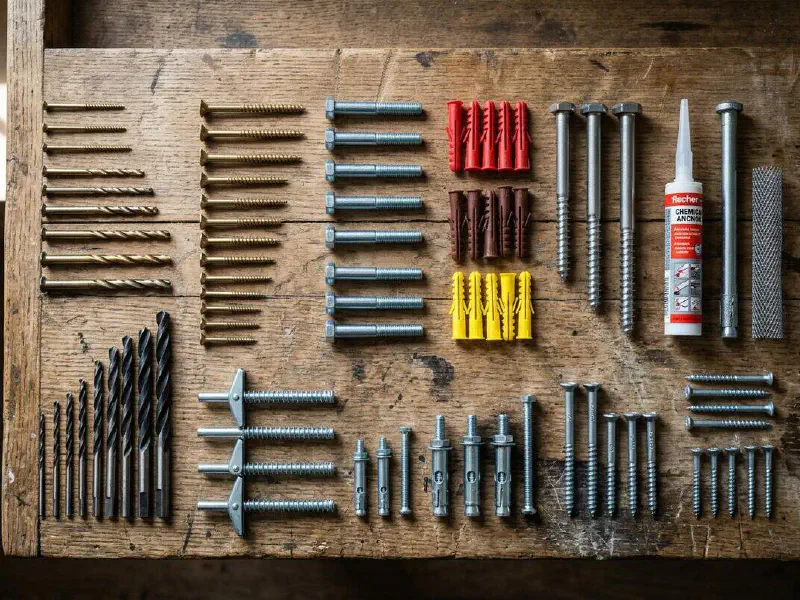
HSE data shows eye injuries are among the most common preventable construction injuries. A hot spark or metal fragment can cause permanent vision damage in a fraction of a second. Always wear at minimum safety goggles (not just spectacles) when using angle grinders, and a full face shield for extended cutting work. If you are working with fixings and fasteners that require drilling into masonry, safety goggles protect against concrete dust and fragments.
Hearing Protection: When You Need It and What Works
The Control of Noise at Work Regulations 2005 set two action levels. At 80 dB(A) daily exposure, employers must make hearing protection available. At 85 dB(A), wearing it becomes mandatory. For context, a circular saw produces around 100 dB(A), an angle grinder around 95 dB(A), and a hammer drill around 110 dB(A). If you use power tools regularly, you are almost certainly above the 85 dB threshold.
Hearing protection is rated by SNR (Single Number Rating), which tells you the noise reduction in decibels. Common options include foam earplugs (SNR 28 to 37 dB, £0.10 to £0.50 per pair), reusable silicone earplugs (SNR 20 to 30 dB, £5 to £15), and ear defenders/muffs (SNR 25 to 35 dB, £8 to £30). For the best protection on noisy sites, wear earplugs underneath ear defenders.
Hearing damage is permanent and cumulative. Unlike a cut or bruise, noise-induced hearing loss does not heal. Many tradespeople in their 40s and 50s suffer significant hearing loss from years without proper protection. It is the easiest PPE to skip and the hardest injury to reverse.
Respiratory Protection: FFP Ratings and Face-Fit Testing
Respiratory protective equipment (RPE) falls under EN 149 for disposable filtering facepieces. There are three protection levels:
| Rating | Filtration | Use Case | Cost Per Mask |
|---|---|---|---|
| FFP1 | 80% of particles | Low-risk dust (sweeping, general site work) | £0.30 to £1 |
| FFP2 | 94% of particles | Wood dust, plaster, concrete cutting | £0.50 to £2 |
| FFP3 | 99% of particles | Asbestos, MDF dust, silica, chemical fumes | £2 to £5 |
FFP2 is the minimum for most construction dust work. FFP3 is mandatory for asbestos work and recommended for any work generating fine silica dust (cutting concrete, stone or brick). For regular exposure, consider a reusable half-face respirator with P3 filters (£15 to £30 for the mask, £5 to £10 for replacement filters) rather than disposable masks.
Face-Fit Testing Is a Legal Requirement
Any tight-fitting RPE (FFP masks, half-face and full-face respirators) must be face-fit tested for each individual wearer. This is not optional. An ill-fitting mask can let in as much as 90% of the hazardous particles it is supposed to block. Facial hair, even stubble, prevents a proper seal. If you cannot shave for religious or medical reasons, you need a powered air-purifying respirator (PAPR) with a loose-fitting hood instead.
PPE Requirements by Trade
Different trades face different hazards. Here is a quick reference for the PPE priorities by trade sector.
| Trade | Essential PPE | Additional Requirements |
|---|---|---|
| Electrician | S1P boots (non-metallic), insulating gloves, safety glasses | Arc flash rated clothing for switchboard work, voltage detectors |
| Plumber | S3 boots, chemical-resistant gloves, safety goggles | FFP3 mask for soldering (lead fumes), knee pads |
| Carpenter/Joiner | S1P boots, cut-resistant gloves, ear defenders | FFP2 minimum for wood dust (FFP3 for MDF/hardwood) |
| Bricklayer | S3 boots, general gloves, hard hat | FFP2 for mortar mixing, knee pads, hi-vis |
| Roofer | S3 boots with ankle support, hard hat with chin strap | Fall arrest harness, hi-vis Class 3 near roads |
| Painter/Decorator | S1P boots, chemical gloves, safety glasses | FFP2/FFP3 for spray painting, solvent-resistant coveralls |
| Demolition | S3 boots, cut-level E gloves, hard hat, full face shield | FFP3 mandatory, hi-vis Class 3, full body coveralls |
If you work in fire safety related roles, our fire safety regulations guide covers the specific PPE requirements for fire stopping and fire door installation.
When to Replace Your PPE
PPE has a finite lifespan. Using worn-out equipment is almost as bad as using nothing at all, because it gives you a false sense of security. Here are the replacement intervals based on typical daily trade use:
| PPE Item | Replacement Interval | Replace Immediately If |
|---|---|---|
| Safety boots | 6 to 12 months | Sole separation, exposed toecap, loss of water resistance |
| Work gloves | 2 to 4 weeks (daily use) | Holes, worn coating, reduced grip |
| Hi-vis vest | 6 months | Fading, torn reflective strips, after 25+ washes |
| Hard hat | 3 to 5 years (check stamp) | Any impact, visible cracks, UV degradation |
| Safety glasses | 12 months | Scratched lenses, bent frames, impact damage |
| Ear plugs (disposable) | Single use | After each use |
| Ear defenders | 12 to 24 months | Cracked cups, worn cushions, broken headband |
| FFP masks (disposable) | Single shift | Damp, soiled, difficult to breathe through |
| Half-face respirator filters | Monthly (with daily use) | Smell or taste breakthrough, physical damage |
Top PPE Brands in the UK
The UK market has a solid range of PPE manufacturers and distributors. Here are the brands you will see most often at Screwfix, Toolstation, and trade suppliers.
 DeWalt
 Portwest
 Uvex
UvexDeWalt leads in safety footwear for UK trades. Their Newark Waterproof Hiker (around £80) and Apprentice boots are stocked widely at Screwfix. The brand is known for decent durability at a reasonable price. Portwest is one of the world's largest PPE manufacturers, offering everything from boots to gloves to hi-vis to respiratory protection, all at competitive prices. Uvex specialises in safety eyewear and hearing protection, with their Quatro safety boots also popular among trades.
Other brands worth knowing include Site (Screwfix's own brand, budget-friendly), Caterpillar (sturdy footwear), JSP (helmets and respiratory), 3M (hearing and respiratory protection), Snickers Workwear (premium workwear), and Scruffs (mid-range boots and workwear). If you use materials like timber regularly, cut-resistant gloves from brands like TraffiGlove or Polyco are worth investigating.
Smart PPE and Wearable Safety Tech in 2026
The UK smart PPE market is projected to grow from £100 million in 2025 to approximately £240 million by 2035, driven by IoT sensors, biometric monitoring and real-time hazard detection. Connected wearables account for 46% of the smart PPE market.
Practical examples of smart PPE available in 2026 include smart hard hats with built-in impact sensors that alert site managers when a worker takes a blow, wearable fatigue monitors that track heart rate and body temperature to flag heat stress risk, GPS-enabled hi-vis vests that track worker locations on large sites, and noise-dosimeters built into ear defenders that log cumulative noise exposure throughout a shift.
For most small and medium trades businesses, the cost of smart PPE (typically 3 to 5 times conventional equipment) is still hard to justify. But if you run a larger operation with multiple crews on different sites, the safety and insurance benefits can outweigh the extra spend. Keep an eye on this space; prices are dropping steadily as the technology matures. For more on how technology is changing the trades, our drone survey kit guide covers another area where new tech is creating opportunities.
PPE Videos Worth Watching
Health and Safety in Construction: A Visual History
The B1M

What Is PPE? Donning and Doffing Training
SafetyCulture

Construction Safety Training Video
Resonate Pictures
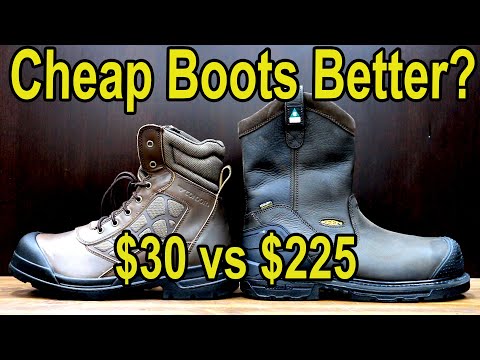
Are Cheap Boots Better? Brand Comparison Test
Project Farm

Best Gloves? Milwaukee vs Mechanix vs Carhartt
Project Farm

Safety Helmet and Safety Glasses Tests
SHP Online
Protect Your Hearing: Conservation Training
Ally Safety

Uncovering Construction's Biggest Killer
The B1M
What the Community Thinks
Frequently Asked Questions
If you are genuinely self-employed and working on your own projects, yes, you are responsible for your own PPE. However, if you are working on a site controlled by a principal contractor under CDM 2015, they must ensure adequate safety arrangements are in place. In practice, most main contractors either supply PPE or specify what you must bring. Since April 2022, employers must also provide free PPE to limb (b) workers (contractors, agency staff, zero-hours workers).
It depends on the site rules and risk assessment. Safety trainers that meet EN ISO 20345 standards (S1P or S3 rated) are technically compliant. However, many principal contractors and site managers insist on ankle-height boots for additional ankle support and protection. Always check the site requirements before turning up in trainers. On your own domestic jobs where you control the risk assessment, S1P trainers are generally fine for indoor work.
Check the date stamp moulded into the inside of the helmet. Most manufacturers recommend replacement every 3 to 5 years from the date of manufacture, regardless of visible condition. Replace immediately after any impact, even if there is no visible damage, as internal cracking can compromise protection. UV exposure accelerates degradation; if the surface appears chalky, faded, or has visible cracks, replace it. Never drill holes, paint, or modify a safety helmet.
HSE recommends FFP3 for MDF dust because the formaldehyde binders used in MDF are classified as a carcinogen. While FFP2 filters 94% of particles, FFP3 filters 99% and provides a much better safety margin for this particular hazard. If you regularly cut or sand MDF, invest in a reusable half-face respirator with P3 filters rather than relying on disposable masks. The better seal and higher filtration are worth the extra £15 to £20.
A CSCS card itself does not specify PPE requirements. However, the CITB Health, Safety and Environment Test (required for a CSCS card) will test your knowledge of PPE standards and when different types are needed. On any CSCS-controlled site, you will typically need at minimum: S3 safety boots, a hard hat, hi-vis vest (Class 2+), and safety glasses. Additional PPE depends on the specific work being carried out and the site risk assessment.