Compliance & Safety
PSTN switch‑off and alarms: how to migrate intruder and fire signalling to IP/4G without outages
TrainAR Team
4 months ago
5 min read
Jump To...
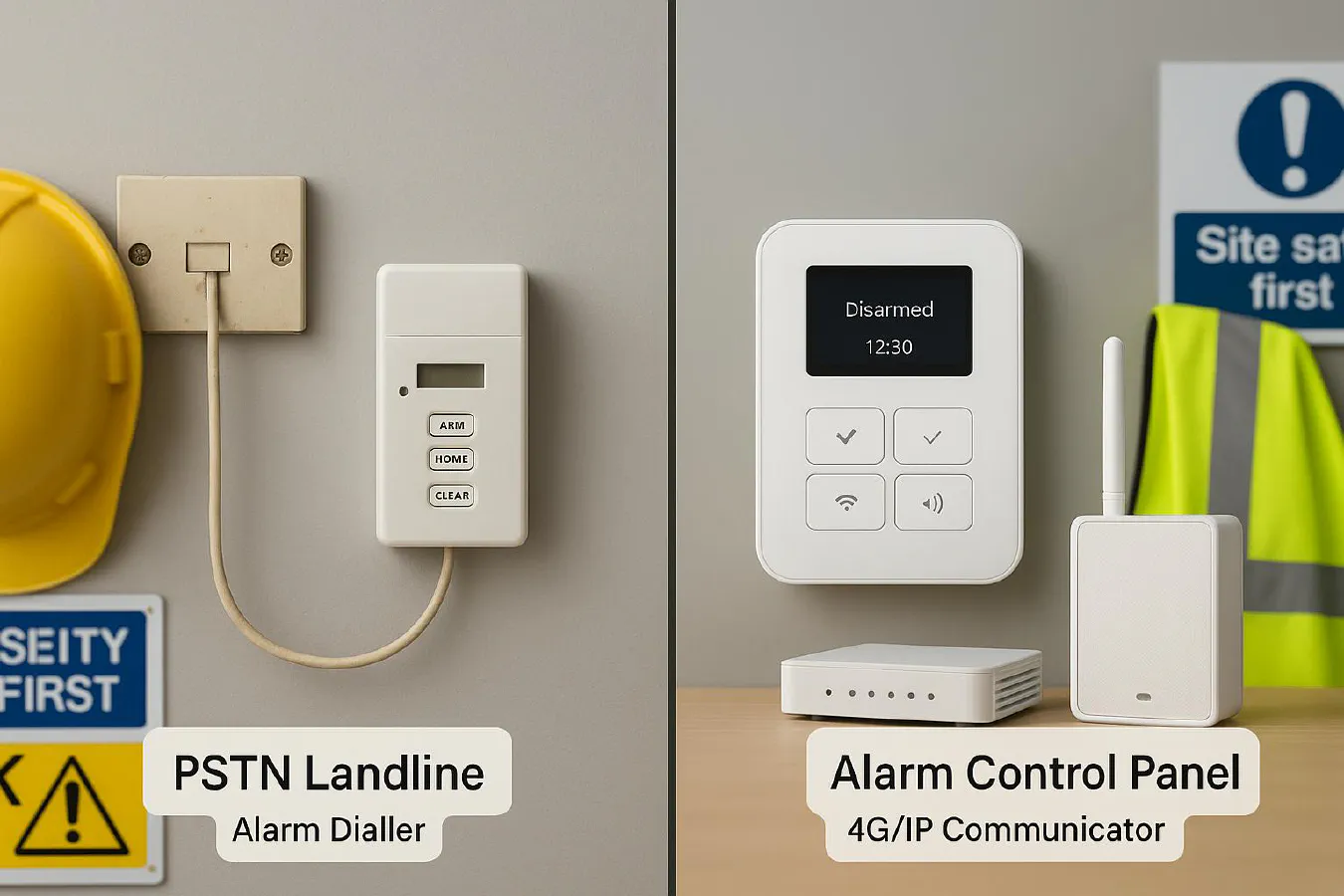
Old PSTN alarm dialler vs modern IP/4G communicator with battery backup
Quick answer
- The copper landline network is being retired nationwide and voice is moving to digital services. Openreach has aligned Wholesale Line Rental withdrawal to 31 January 2027. Don’t wait; migrations are accelerating and analogue alarm diallers are already unreliable on many lines. See Openreach’s WLR Withdrawal overview and stop-sell rules for context: Openreach WLR Withdrawal.
- Don’t use an analogue adapter on a router for life-safety or security signalling. Tones can be distorted, and service fails in a power cut without extra backup. Use a purpose-built Alarm Transmission System (ATS) that meets EN 50136 and is supported by your ARC.
- Typical solution: dual‑path IP plus 4G communicator with monitored paths, battery standby, and end‑to‑end testing witnessed by the ARC. Reference PD 6662 (intruder scheme) and your insurer/client requirements.
What’s changing and why your alarms will fail on PSTN
- BT Group has reset the PSTN switch‑off to 31 January 2027, with Openreach aligning WLR withdrawal to that date. Many providers still target earlier migrations to reduce risk. Official pages: Openreach WLR Withdrawal, BT Business summary.
- Analogue alarm diallers expect a copper line. Over digital voice, tones are packetised and can be delayed or dropped. During power cuts, VoIP service can go down unless there’s battery backup. Ofcom expects providers to protect access to emergency organisations and to support vulnerable users, but alarm signalling still needs a compliant solution. See Ofcom guidance on digital landlines and power cuts: Ofcom guidance.
Pick the right signalling (EN 50136) in plain English
EN 50136 defines performance categories for Alarm Transmission Systems (ATS). In practice:
- Single‑path radio (4G) or IP can suit lower‑risk sites with keyholder response.
- Dual‑path (IP plus 4G) is the common choice for higher‑risk or police response. The device supervises both paths and reports faults within set times. Use PD 6669 to choose categories and set actions if availability drops.
- For intruder/HUA systems, design and certification sit under PD 6662 with EN 50136 for signalling. For fire, ensure the transmission equipment is appropriate for life‑safety and follow BS 5839 processes with your ARC and client fire strategy.
Examples installers use in the UK:
- CSL DigiAir/GradeShift Pro range (single or dual‑path, 4G/IP) – product family overview: CSL Alarm Signalling.
- Texecom SmartCom 4G for Premier Elite – product page: Texecom SmartCom 4G.
- Honeywell Galaxy: E080 Ethernet module plus 4G/LTE communicator – product info: Honeywell E080.
Tip: Confirm with your ARC which devices and categories they support, and keep evidence of EN 50136 compliance for the SPT and the ARC equipment.
Step-by-step: migrate a monitored alarm the right way
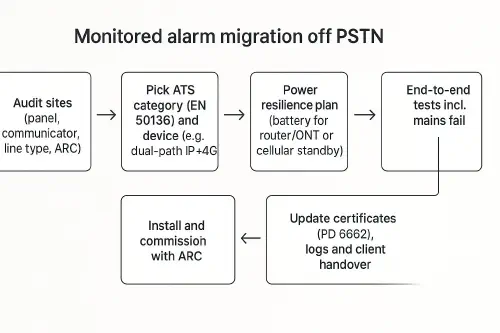
Monitored alarm migration off PSTN flow
- Audit every site
- Panel make/model and firmware; current communicator type (PSTN, ISDN, GSM, IP).
- Lines in use; check if already on digital voice. Note any BT Redcare dependencies.
- ARC details and signalling category on record; note insurer/client requirements.
- Choose ATS category and device
- Use PD 6669 guidance for availability targets and categories; align to PD 6662 for intruder.
- Typical pick for most SMEs: dual‑path IP plus 4G with roaming SIM; lock‑able enclosure and local supervision.
- Plan power resilience
- If using an IP path via router/ONT, provide battery backup so signalling survives a power cut to the required time.
- Ensure the cellular path has adequate signal on site. Consider multi‑network SIMs.
- Install and commission with the ARC
- Fit the communicator, program both paths, and register with the ARC.
- Run end‑to‑end tests: alarm, tamper, line faults, path failures.
- Prove failover and power‑fail behaviour
- Pull WAN, then mobile; simulate mains fail; confirm reporting times meet the category.
- Record results with timestamps and ARC acknowledgements.
- Update paperwork and handover
- Issue revised certificate referencing PD 6662 (intruder) and the ATS category.
- Update the site logbook/RAMS and the client’s fire strategy where applicable.
Power cuts and resilience: do not skip this
- Ofcom expects providers to protect access to emergency organisations for vulnerable/landline‑dependent users, typically with at least one hour of backup. For alarms, design your own resilience: battery‑back your router/ONT and switches, or rely on a cellular path with its own standby. Guidance: Ofcom power cut support.
- Mobile sunsets: 3G is gone and 2G is planned to retire by 2033 latest. Choose 4G/VoLTE‑capable devices and check your signalling provider’s roadmap. See industry note: FIA on 3G switch‑off.
BT Redcare closure: practical actions
- BT announced Redcare’s closure and later extended end‑of‑service to 15 December 2025. Many sites still need replacement or transition to alternative signalling. See the BSIA update: BSIA on Redcare postponement.
- Action list for Redcare estates:
- Export a full list of Redcare devices and site categories.
- Engage your ARC for approved alternatives and migration booking.
- Prioritise higher‑risk sites and any where power resilience is weak.
Common pitfalls to avoid
- Relying on an ATA port on a broadband router for a life‑safety or intruder system.
- Forgetting to provide standby for IP equipment so signalling dies in a power cut.
- Leaving 3G‑only communicators in service; not checking 4G signal on site.
- Skipping end‑to‑end tests with the ARC and failing to document failover times.
- Not updating certificates/logbooks or notifying the insurer/client.
Handy resources and further reading
- Openreach WLR Withdrawal (official timeline and stop‑sell context): Openreach
- Ofcom consumer and power‑cut guidance for digital landlines: Ofcom
- UK Government Telecare National Action Plan (relevant lessons on ATAs and resilience): GOV.UK
- PD 6662 scheme info and EN 50136 overview: PD 6662 (summary) • EN 50136-2 SPT
- Product examples used by UK installers: CSL Alarm Signalling • Texecom SmartCom 4G • Honeywell Galaxy E080
- Related Academy article for lifts and site phones: Lift alarms and site phones after the landline switch off
Related TrainAR Academy articles:
- PSTN switch off survival plan for trades: move to VoIP in 10 simple steps
- 2026 Fleet Compliance: Automate MOT, Insurance & Tax Alerts with Google & WhatsApp
Ready to Transform Your Business?
Turn every engineer into your best engineer and solve recruitment bottlenecks
Join the TrainAR Waitlist