Reactive maintenance priorities for contractors: simple P1, P2, P3 rules, UK SLAs and evidence you can trust
Jump To...
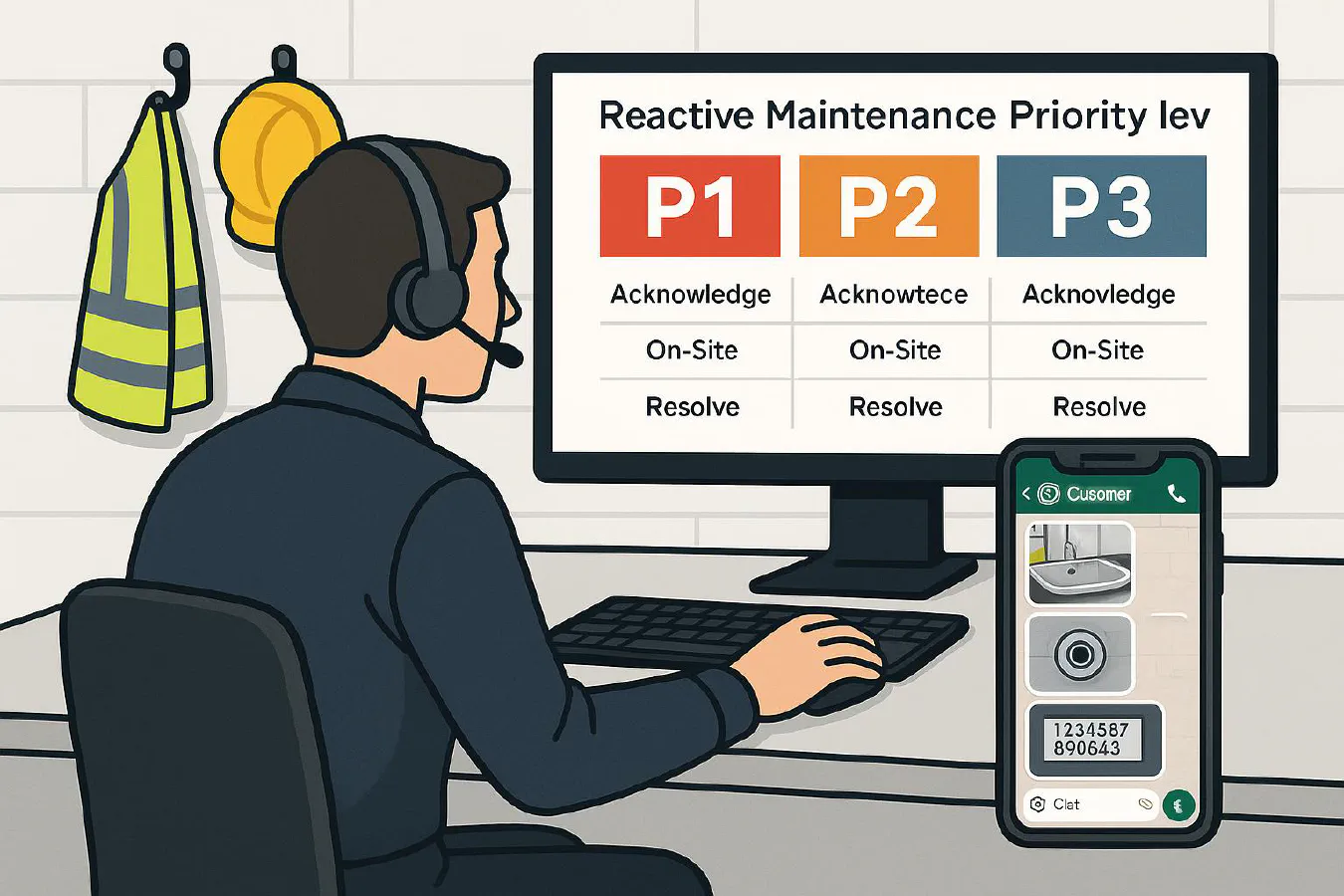
Dispatcher screen showing P1, P2, P3 priorities and SLA timers with WhatsApp photo triage on phone
Quick answer
- P1 Emergency: attend fast to make safe; aim within 2–4 hours, make safe within 24 hours.
- P2 Urgent: fix within 3–7 working days.
- P3 Routine: fix within 20–28 working days or schedule as programme works.
- Always record: who triaged, time acknowledged, time on site, time resolved, and a photo or signature to prove each.
These ranges line up with common council and housing SLAs such as Westminster, Ealing, Lambeth and others, and they sit above the legal Right to Repair minima for certain qualifying repairs.
Who this is for
- Small to mid-size UK contractors and FM teams handling housing, commercial and estates reactive jobs.
- Dispatchers, supervisors and site leads who need consistent rules and evidence without heavy software.
Plain-English P1, P2, P3 you can actually use
- P1 Emergency (risk to life/property or critical service down)
- Gas leak, live electrics, major leak, fire alarm down, lift trap-in.
- Action: acknowledge within 15 minutes, dispatch immediately. If safe, advise isolation steps while en route.
- P2 Urgent (material disruption but controlled risk)
- Faulty door closer in a busy corridor, partial power loss in non-critical area, blocked sink with alternative available.
- Action: book within 1 working day, attend and fix within 3–7 working days.
- P3 Routine (no immediate risk, minor impact)
- Dripping tap, loose skirting, decorative issues.
- Action: schedule within 5 working days, complete within 20–28 working days or bundle into programme works.
Tip: Allow engineers to reclassify on site using a 6-point check: risk to life, risk to property, ability to isolate, temporary make-safe available, occupancy/vulnerability, compliance-critical system.
Recommended UK-friendly SLAs (and realistic targets)
Use these as starting targets. Match to contract and geography.
- P1
- Acknowledge: under 15 minutes
- On site: under 60–120 minutes (urban vs rural)
- Make safe/temporary fix: under 24 hours
- P2
- Acknowledge: under 1 working hour
- Resolve: within 3–7 working days
- P3
- Acknowledge: same day
- Resolve: within 20–28 working days or next planned visit
Evidence these against public examples:
- Westminster: Immediate attend within 2 hours; urgent 1–7 days; routine up to 28 working days. Response times | Westminster City Council
- Ealing: Emergency within 4 hours; urgent 7 days; routine 28 calendar days. Service standards for council housing repairs | Ealing Council
- Lambeth: Make safe within 2 hours; fix within 24 hours; urgent 3 working days; routine 28 working days. Repair timescales | Lambeth Council
- Leicester (explicit P1–P3): P1 24 hours; P2 10 working days; P3 programmed. Priority of repairs | Leicester City Council
Set up fast WhatsApp/photo triage
What to ask for in one message:
- 1 wide shot showing context
- 1 close-up of the fault
- 1 label/serial plate (if plant)
- Short description of the risk (smell of gas, water pooling, vulnerable residents)
- Access window and contact on site
Copyable message template:
“Hi, to help us prioritise and send the right engineer, please send 3 photos: 1) wide shot, 2) close-up of the fault, 3) any serial/label. Tell us if there’s any immediate risk and when we can attend today. Thank you.”
Routing rules:
- If risk keywords appear (gas, burning smell, trapped, flood): flag P1, call back immediately.
- If isolation is possible and safe: text instructions, downgrade to P2 and book within 24 hours.
- If cosmetic or no risk: P3 and batch for next visit.
Data note: WhatsApp strips EXIF metadata. Keep the chat thread, take a timestamped screenshot, and move photos to your job system or a dated folder same day.
Prove attendance and resolution times without fancy software
You need four stamps for every job: acknowledged, en route, on site, resolved. Options:
- Photos: take a phone home-screen screenshot with visible time on arrival outside the property, then a completion photo with the job card.
- Client sign-off: a quick signature or photo of a signed docket.
- GPS/geofence: use built-in location sharing or a simple time-and-location logging app.
- System logs: emails/SMS/WhatsApp timestamps plus call logs.
Bundle evidence for each P1 into a single folder per job. Run a monthly spot check on 10 random jobs to ensure all four stamps are present.
Flow showing triage to dispatch to onsite to resolve with timestamped evidence
Lone worker go/no-go checks
Before sending a lone worker to a P1 at night, run this quick matrix:
- Is there a known risk of violence or unsafe access?
- Can the system be isolated remotely or by the client until morning?
- Is there mobile coverage for check-ins? If not, send two.
- Will the job likely require roof space, confined space or live electrics? Send two or reschedule.
- Set timed check-ins every 15–30 minutes with escalation if missed.
Make your policy audit-proof (Right to Repair baseline)
If you maintain council or social housing, ensure your policy references the Secure Tenants of Local Housing Authorities (Right to Repair) Regulations 1994. The schedules list maximum times for defined “qualifying repairs” (e.g., total loss of electricity = 1 working day; partial loss = 3 working days; door entryphone not working = 7 working days). Link your P1/P2/P3 targets to these or faster.
- Legislation: Right to Repair Regulations 1994 (Schedules)
Simple weekly KPI dashboard
Track these 5 metrics. Review every Monday:
- P1 acknowledgement median time (target <15 minutes)
- P1 on-site median time (target <60–120 minutes)
- First-time fix rate (target 70 percent plus)
- SLA compliance per P-level (target 90 percent plus)
- Overdue P2/P3 count (targets: P2 zero over 7 days; P3 zero over 28 working days)
Helpful links
Public SLA examples you can reference in bids and policies:
- Westminster repairs response times: westminster.gov.uk
- Ealing repairs standards: ealing.gov.uk
- Lambeth repair timescales: lambeth.gov.uk
- Leicester priority of repairs: leicester.gov.uk
Related Academy articles to speed your ops:
- WhatsApp-first lead triage: read it
- Cut no access visits with WhatsApp confirm: read it
- PSTN switch off survival plan: read it
Ready to Transform Your Business?
Turn every engineer into your best engineer and solve recruitment bottlenecks
Join the TrainAR Waitlist