
Quick Answer
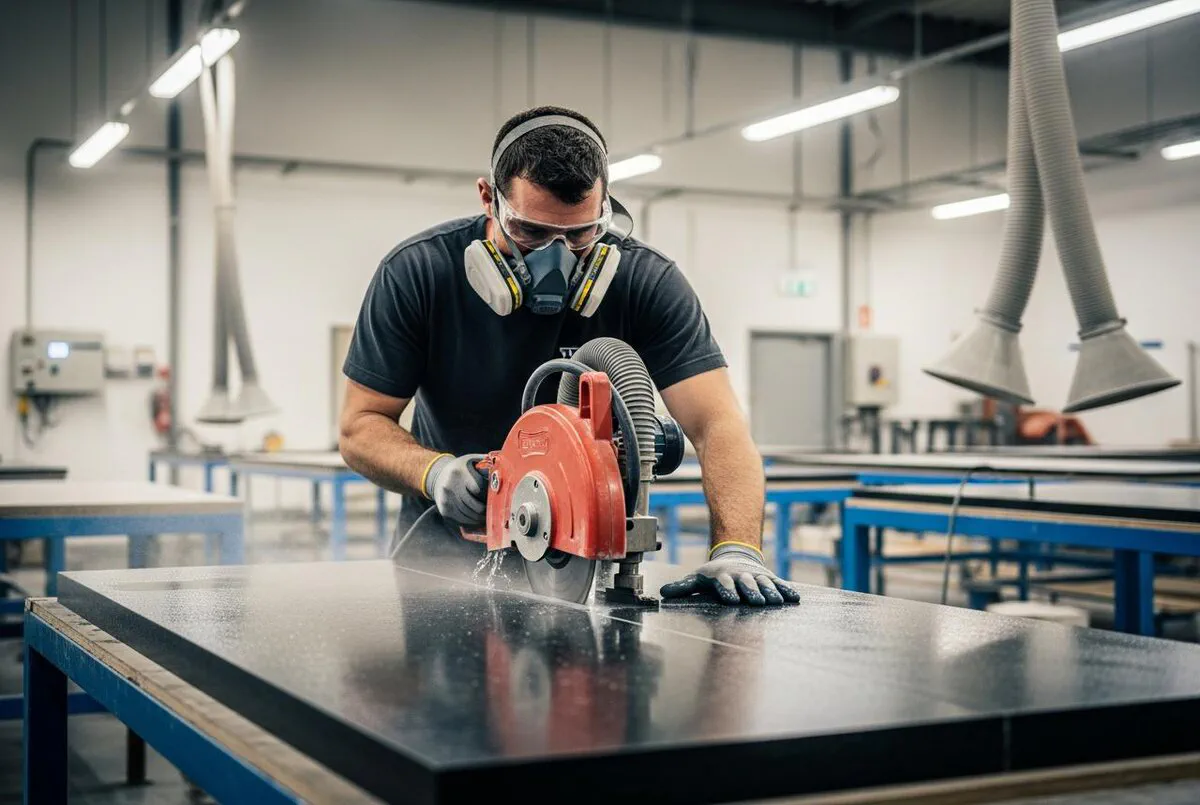
UK trades must keep respirable crystalline silica (RCS) exposure below the workplace exposure limit of 0.1 mg/m³ over an 8-hour shift, set under COSHH and EH40. From May 2026, HSE classes uncontrolled dry cutting of engineered stone as unacceptable, with a 1,000-visit inspection programme running through 2026/27. Control sits in a strict order: eliminate, substitute, engineering controls (on-tool water suppression or M-class extraction), safe systems of work, then RPE (FFP3 minimum, face-fit tested, clean-shaven). Health surveillance is required where there is a reasonable risk of silicosis. Get this wrong and you face improvement notices, prohibition notices, prosecution, and in the worst cases custodial sentences.
Table of Contents
- What the law actually says in 2026
- The 0.1 mg/m³ exposure limit and what it really means
- The engineered stone crackdown
- The hierarchy of controls in practice
- Respiratory protection, FFP3 and face-fit testing
- Health surveillance and what employers must do
- Enforcement, fines and the new inspection programme
- Using AI to keep the compliance paperwork honest
- What tradespeople are saying
- Recommended videos
- Frequently asked questions
- My verdict
What the law actually says in 2026

The core law has not changed. The Control of Substances Hazardous to Health Regulations 2002 (COSHH) place the duty on every employer, and on every self-employed tradesperson, to assess the risk of exposure to silica dust before work starts, to prevent or adequately control it, and to maintain that control. The Health and Safety at Work Act 1974 sits above it and applies to anyone whose work could affect another person's health.
What has changed is HSE's appetite for enforcement. In May 2026 HSE published targeted guidance on working with engineered stone and announced a programme of more than 1,000 inspection visits to fabricators running through 2026 and 2027. The framing is deliberate. Mike Calcutt, HSE's Deputy Director in Engagement and Policy, put it plainly when the guidance landed: “Silicosis is incurable, but it is entirely preventable. To every employer in this sector: the guidance is now published, the expectations are clear, and our inspectors are coming.”
The rest of CAR-style asbestos rules sit alongside this. If you are working in older buildings, the asbestos surveys before renovation obligations stack on top of your silica duty. Mixed-material work means stacked compliance, not either-or.
The 0.1 mg/m³ exposure limit and what it really means
The workplace exposure limit (WEL) for respirable crystalline silica is 0.1 mg/m³ averaged over an 8-hour shift. That number is published in HSE's EH40 Workplace Exposure Limits. It is also the figure your COSHH assessment must be calibrated against.
Two things to understand here. First, 0.1 mg/m³ is the legal ceiling, not the target. The duty under COSHH Regulation 7 is to reduce exposure as far below the WEL as is reasonably practicable. If you are running at 0.08 mg/m³ with no controls, that is not compliance, it is luck.
Second, the WEL is a time-weighted average. A 15-minute burst of dry-cutting at 5 mg/m³ followed by quiet paperwork for the rest of the day still produces a problem on the lung even if the 8-hour average looks reasonable. Peaks matter clinically. They also matter to HSE inspectors, who look at the task, not just the spreadsheet.
The BOHS and the Scientific Committee on Occupational Exposure Limits have argued for years that 0.1 mg/m³ should be halved to 0.05 mg/m³ to match the international evidence on disease risk. That change is not in force in 2026, but it is in the political pipeline. Designing your control measures to 0.05 mg/m³ today buys you regulatory headroom tomorrow.
The engineered stone crackdown

This is the single biggest change to your day-to-day working life in 2026 if you fit kitchens, fabricate worktops, or finish stone on site. Engineered stone (sometimes sold as quartz, composite, or sintered stone) can be up to 95 percent crystalline silica. Cutting it dry produces respirable dust at concentrations that destroy lungs in months, not decades. The acute silicosis cases in younger workers that triggered the policy response involved men in their twenties and thirties.
HSE's May 2026 guidance does not ban engineered stone. The UK has chosen a controls-based route rather than the Australian-style prohibition that took effect on 1 July 2024. What HSE has done is make clear that dry cutting is not an acceptable control measure under COSHH. Water suppression at the point of cutting is the expected baseline. Local exhaust ventilation (LEV) with M-class or H-class extraction sits alongside it. RPE is the last line, not the first.
Unite the union has called for a full ban. Sharon Graham, Unite's general secretary, has said the UK should follow Australia and ban the material outright. The Worktop Fabricators Federation disagrees and has welcomed the controls-based approach. Whatever your view, the practical reality is the same. If you cut engineered stone dry, you will be served a prohibition notice and probably prosecuted.
The hierarchy of controls in practice
COSHH builds compliance around a hierarchy. You work through it in order, every time, and document why you stopped where you stopped. Do not skip to the bottom because RPE feels easier.
- Eliminate the task. Can the cut be moved to a fabricator with workshop controls? Can pre-cut components be ordered to size? On rewiring jobs, can you surface-mount in trunking instead of chasing?
- Substitute the material. Lower-silica products exist. Sintered stone with under 10 percent silica is one option. Solid surface composites with no crystalline silica are another. The look is similar. The risk profile is not.
- Engineering controls. On-tool water suppression for stone cutting. M-class or H-class on-tool extraction for chasing, drilling, grinding, and scabbling. Fixed LEV in workshops. Wet sweeping instead of dry brushing.
- Administrative controls. Job rotation to limit exposure time. Restricted access during high-dust tasks. Clear written method statements. Training records for every operative. Building control notification paperwork that names the dust controls in use.
- RPE. FFP3 minimum, face-fit tested, clean-shaven, used correctly. RPE is the last layer, not the first.
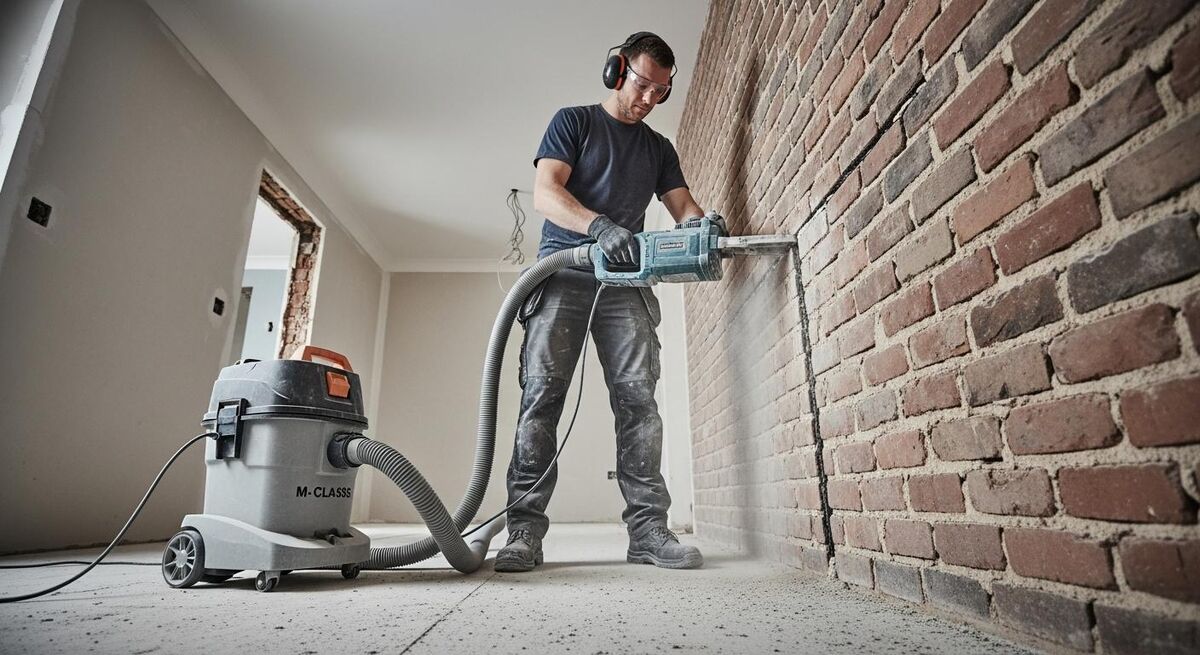
The reason this order matters is that the lower controls become unreliable the harder they are made to work. Water suppression that is properly plumbed and maintained delivers consistent reductions. An FFP3 mask worn by a stubbled operative under a rushed deadline delivers what feels comfortable, not what the label promises. Inspectors know this. So do coroners.
If you are using a wall chaser, an SDS hammer drill, or an angle grinder on masonry, the extraction unit attached to it is doing more for the operative's lungs than the mask. HSE's task-specific guidance sets out the expected control level for each common activity. Read the one that matches your day.
Respiratory protection, FFP3 and face-fit testing
If RPE is part of your control regime, get it right. The rules below apply to disposable FFP3 masks and to half-mask reusables with P3 filters. They apply differently to powered hoods and loose-fitting PAPRs, which are covered further down.
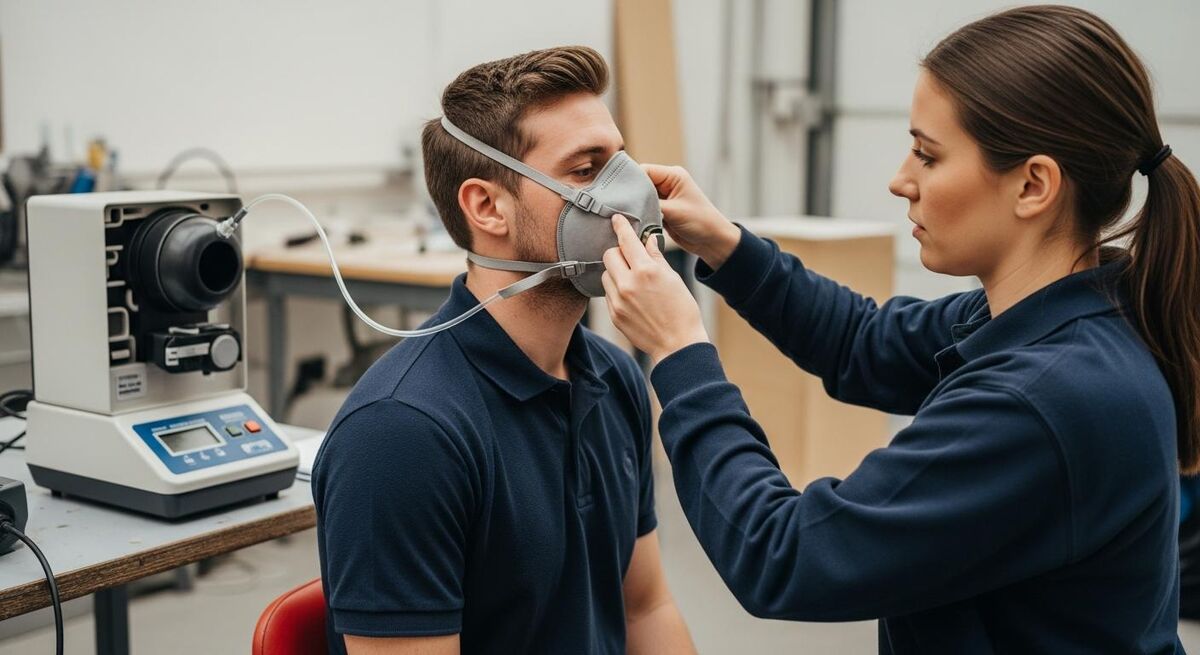
FFP3 is the minimum protection factor (APF 20) for RCS work. FFP2 is not adequate for silica even though it is sold for “dust”. Buy the wrong rating and you have an enforcement problem regardless of how often the mask is worn.
Face-fit testing is mandatory for tight-fitting RPE under COSHH Regulation 7. The HSE's Fit2Fit-accredited tester scheme is the gold standard. A fit test is specific to the wearer and the model. Switch from a 3M Aura 9332+ to a Moldex 2505, you need a new test. Grow a beard, the test is invalid. Lose or gain significant weight, the test is invalid.
Stubble is the issue almost nobody owns. Studies HSE cites show that even a day or two of beard growth breaks the seal of a tight-fitting respirator. If you cannot maintain a clean shave or have personal reasons not to, you must move to a loose-fitting powered air-purifying respirator (PAPR) hood. PAPRs do not require fit testing because they do not rely on a face seal. They are more expensive up front and need filter changes, but they are the right answer for any operative with facial hair.
Health surveillance and what employers must do
Where work could foreseeably expose operatives to RCS at levels that present a reasonable risk of silicosis, COSHH Regulation 11 requires health surveillance. For silica that means a baseline respiratory health questionnaire on hire, annual repeat questionnaires, and lung-function tests (spirometry) and chest x-rays as indicated by the occupational health provider. HSE's guidance note G404 sets out the expected regime.
The employer pays. The records are kept for 40 years from the date of the last entry. The employer must act on adverse findings, including reassigning the operative if continued exposure would worsen their condition.
Sole traders do not have an employer above them. The duty of self-care still applies under the Health and Safety at Work Act, and your professional indemnity and public liability insurers increasingly ask whether you are under occupational health review. The pragmatic answer is to arrange your own annual spirometry through a local provider. The cost is around £80 to £120 a year. The cost of finding out you have silicosis a decade too late is everything.
| Surveillance element | When | Who provides | Typical cost (per operative) |
|---|---|---|---|
| Baseline respiratory questionnaire | On hire, before exposure starts | Occupational health nurse or GP service | £40 to £70 |
| Spirometry (lung function) | Baseline, then annually | Accredited OH provider | £60 to £120 |
| Chest x-ray | As indicated by OH after questionnaire/spirometry findings | Imaging clinic referral | £100 to £180 |
| Face-fit test (RPE) | Initial, on model change, every 2 years | Fit2Fit-accredited tester | £25 to £55 per test |
Enforcement, fines and the new inspection programme
HSE's 2026/27 inspection programme is targeting engineered stone fabricators and installers first. Visits are unannounced. Inspectors look at the COSHH assessment, the method statement for the specific work being done that day, the maintenance records on extraction and water suppression equipment, the face-fit test certificates, and the health surveillance records. They also watch the work.
The enforcement toolkit, in order of severity:
- Improvement notice. Fix a specific failing within a set period, often 21 days. Failure to comply is a criminal offence.
- Prohibition notice. Stop the activity immediately. Used where there is risk of serious personal injury. Common for dry cutting of engineered stone.
- Fee for Intervention (FFI). HSE charges the employer for inspector time at £177 per hour from the moment a material breach is identified. Bills regularly run into thousands.
- Prosecution. Health and Safety Offences Act 2008 sentencing guidelines apply. Fines are linked to turnover. For a medium-sized business, six-figure fines for a serious breach are routine.
- Custodial sentence. Available for directors found to have consented to or connived in a breach, or where neglect is provable. Asbestos prosecutions have set the recent precedent. Silica is following the same arc.
Two practical things will help you on an inspection. First, the paperwork must match the practice. A COSHH assessment that names water suppression is worthless if the workshop has no water tank. Second, train every operative on what to do if HSE turns up. Stop the work safely, fetch the manager, do not lie about anything. Inspectors respect honest mistakes more than rehearsed evasions. For the broader compliance picture see our 2026 BSI standards changes guide, which covers the parallel updates landing in 2026.
Using AI to keep the compliance paperwork honest

Most prosecutions hinge on documents. A COSHH assessment was missing, out of date, generic, or did not match the task. Method statements named PPE that operatives had no record of being trained on. The face-fit certificates had lapsed. None of this is rocket science. It is just admin that gets squeezed when the day starts at 5am and the van is already loaded.
AI tools can help here in three specific ways. First, drafting and updating task-specific COSHH assessments. A model like Claude or ChatGPT, given a clear prompt that names the task, the material, the tools, the controls, and the WEL, will produce a competent first draft in a couple of minutes. You then check it against HSE guidance and sign it. The draft is not the final document. It is the first 80 percent of the work removed from your weekend.
Second, fit-test records and health surveillance reminders. Connect your calendar to an AI assistant that knows the renewal cycles. The assistant flags upcoming expiry and drafts the booking emails to your OH provider. Nothing falls through.
Third, daily method-statement checks. Photograph the controls in place at the start of the job, send the image to a multimodal AI with the method statement attached, and ask it to flag any obvious mismatches. This is not a replacement for a supervisor walking the job. It is a backstop for the days a supervisor cannot be there.
None of this changes the duty. You still need the engineering controls, the RPE, the training, and the health surveillance. What AI does is make the paperwork side of compliance survive a busy diary, which is the part that fails first.
What tradespeople are saying
Recommended videos
Hierarchy of Controls to reduce silica dust exposure
WorkSafeBC

Activities that generate construction dust
HSE

Silica: dust suppression on tools
Independent contractor channel

Managing construction silica dust: Code of Practice
SafeWork industry briefing
Managing exposure to silica in construction
Industry safety webinar

Identifying high-risk crystalline silica work
Regulator training video
Frequently asked questions
The Health and Safety at Work Act applies to you. The WEL exists to define a level above which serious harm is likely. Working below it is the standard whether you have an employer or not. Insurers, accreditation schemes, and main contractors will want to see your COSHH paperwork regardless.
Not in a blanket sense. The May 2026 ban on uncontrolled dry cutting is engineered-stone specific. For brick, block and concrete, HSE's expectation is that you use water suppression or on-tool extraction sized to the task. Uncontrolled dry cutting of any silica-bearing material is unlikely to survive an inspection.
Initial fit test, then a fresh test on any model change, any significant change in facial appearance, and at minimum every two years. Each wearing requires a user seal check, which the operative does themselves before starting work.
FFP3 is the rating for a disposable filtering facepiece respirator. P3 is the filter class used on reusable half-mask and full-face respirators. Both deliver an Assigned Protection Factor of 20 in the UK. P3 reusables are typically cheaper per shift if used heavily.
No. PAPRs and loose-fitting powered hoods are recognised under HSE guidance as the right answer for any wearer with facial hair. No exemption is needed. The employer must risk-assess and provide suitable equipment.
40 years from the date of the last entry, under COSHH Regulation 11. Records belong to the employer but the operative is entitled to a copy. On business sale or closure the records transfer to the new owner or, in the case of closure, to HSE.
Yours, for the work you do. The main contractor will have a site-wide assessment, and you must cooperate with it. Your task-specific assessment sits inside that umbrella and is yours to write, sign, and act on.
The 2026/27 charge-out rate is £177 per hour. A targeted inspection that uncovers a material breach, requires document review, follow-up correspondence and a return visit, regularly produces invoices between £1,500 and £4,500. Larger investigations run higher.
My verdict
Five hundred construction workers are dying every year from a disease that is entirely preventable, and the regulator has stopped pretending otherwise. The 2026 inspection programme will find people who have been getting away with it. If you fit kitchens, fabricate worktops, chase walls, or grind masonry, sort the engineering controls first, the RPE second, and the paperwork third. Then book the health surveillance you have been putting off. The cost is small. The cost of not bothering is everything.