

Quick Answer
If you employ a trade apprentice in England in 2026, the funding has finally caught up with the cost of training. CITB pays you £2,500 a year while the apprentice attends college, then £3,500 when they finish. From October 2026, hire a 16 to 24 year old and you get a further £2,000 SME incentive. Hire one who has been on Universal Credit for six months and you stack another £3,000 from the new UC Youth Jobs Grant. That is up to £14,000 per apprentice over a three year programme, on top of 100 percent training fees being covered for under 25s at SMEs. Skills Bootcamps cover existing engineers who want to add heat pumps, solar, or retrofit to their tickets, with 90 percent of the course cost paid by government. Below is the full picture, the cut-off dates that matter, and how to actually claim.
Table of Contents
- Why this matters now
- CITB grants for apprenticeships
- Growth and Skills Levy: what changes April 2026
- SME and UC Youth Jobs incentives
- Skills Bootcamps for existing engineers
- Funding in Scotland, Wales and Northern Ireland
- 2026 funding timeline
- How to actually claim
- What employers and engineers are saying
- Recommended videos
- Frequently asked questions
- My verdict
Why this matters now

I started my career as a Gas and Heating engineer. I did my apprenticeship at Oaklands College, eventually ran my own business at Elite Heating and Plumbing, and over the years I trained six apprentices through to qualified engineer status. I can still remember my own apprenticeship, putting my foot through a ceiling on a third-floor job and having to learn fast. A trade is a craft. To become a master of any craft takes repetition and the ability to make mistakes and learn from them, without those mistakes being severe.
For years I argued in the trade press that government support for apprentice employers was not enough. In 2022 the headline grant was £1,000. That did not cover uniform and fuel costs in the first year, let alone wages, supervision time, and the inevitable small incidents that come with training someone new. Many of my fellow trade owners agreed but went on hiring apprentices anyway because the alternative, an industry that stops training, was unthinkable.
In 2026 the position is different. Between the CITB grants, the new Growth and Skills Levy that lands on 1 April, the SME incentive that follows in October, and the UC Youth Jobs Grant that arrives in June, an SME hiring a young apprentice can now stack support that runs to five figures over a three year standard. That is not a token. That is a meaningful change in the economics of training someone from scratch, and through my work at RAFT with employers, colleges and providers across multiple regions I am seeing more small firms now consider taking their first apprentice. The aim of this guide is to lay out every route that exists, what got cut on 8 January 2026, and what is worth claiming. If you want the wider context on why the supply pipeline matters, the academy guide to the UK trades apprenticeship crisis sets the stage.
CITB grants for apprenticeships
If you pay the Construction Industry Training Board levy, or even if you do not, the CITB grants scheme is still the largest single source of trade-specific funding in the UK. After the changes that came in on 8 January 2026 the scheme is leaner, but the headline numbers for apprenticeships have not been cut and the travel and accommodation support has actually been widened.
The two grants that matter most for a trade SME are the attendance grant and the achievement grant. The attendance grant pays £2,500 per apprentice per year for the duration of the standard, processed every 13 weeks. The achievement grant pays a further £3,500 when the apprentice successfully completes a programme of at least 12 months. For a standard plumbing or electrical apprenticeship of three years that is £11,000 from CITB alone, before any government incentive is added on top.
What got cut on 8 January 2026
The reform was real and it hurt some employers. Most short course standard grants were abolished. The First Aid training grant disappeared entirely, with no Employer Network replacement. The old tiered NVQ achievement grants were consolidated into a single flat £600 payment regardless of qualification level. Level 7 funding was removed for new starters, except for Level 7 Apprenticeships and Scottish Advanced Craft Quals at SCQF 7. And from 31 March 2026, large employers with 250 plus staff lose access to the Employer Networks model entirely.
For trade SMEs that means the day-to-day "send the lads on a Site Manager Safety course and claim the grant" route is gone. SMSTS, SSSTS and TWC are now flat rated at £115 per learner through the Employer Network, down from up to £378 previously. If you used to lean on those grants, your annual return from CITB will fall. The apprentice route is now the only meaningful way to extract real value back from a levy contribution.
The 2026 levy rate and small business exemption
The 2026-29 Levy Order confirmed the rate at 0.35 percent on PAYE wages and 1.25 percent on net taxable CIS payments. The small business exemption ceiling was raised from £135,000 to £150,000 combined wage bill, and the 50 percent reduction band now extends from £150,000 up to £499,999. If your combined PAYE plus net CIS bill sits in that range you pay half levy. Below £150,000 you pay nothing at all.

The new Large Employer Fund that opens on 1 April 2026 gives businesses with 250 plus staff up to £18,000 to spend on in-scope training of their choice. The application is a Request for Funding form sent to LargeEmployerFund at CITB, deadline 30 June 2026. Half the money is paid in July and August 2026, the other half in February and March 2027. If you employ 250 people you should already have someone in your training team working on the submission. If you do not, this fund will close before you notice it opened.
One thing has not changed and it is the most important thing on the page. All Level 2 and above construction apprenticeships remain fully funded through the standard scheme. Plant operations and scaffolding short courses also remain on the standard grant. So if you train apprentices, the CITB position is broadly as strong as it has ever been. If you train mostly short course adult workers, you have lost something.
Growth and Skills Levy: what changes April 2026
From 1 April 2026 the Apprenticeship Levy becomes the Growth and Skills Levy. The headline rate of 0.5 percent on payroll above £3 million stays the same. What changes is how SMEs and levy-paying employers can spend the money, and how generous the government remains when those funds run out.
For SMEs the news is good. From the 2026-27 academic year, non-levy employers will be 100 percent funded for apprenticeships for anyone under 25. The old 95-5 co-investment is gone for under-25s at SMEs. There is also no employer National Insurance contribution for apprentices under 25 earning below £50,270, which has been the case since 2022 and is worth several hundred pounds a month on a typical first-year apprentice wage.
The other new mechanic from April 2026 is apprenticeship units. These are short focused training segments lasting 30 to 140 hours that can be drawn against your levy balance, up to 50 percent of your annual fund. At least 50 percent must still be retained for full apprenticeships. For trades that want to skill an existing engineer in a single area, say solar PV or heat pump commissioning, this is the route that did not exist before. The first units cover Foundation apprenticeships in construction, digital, engineering and health and social care, with catering and hospitality and retail joining in April 2026.
Sixteen apprenticeship standards lose funding from September 2026, with another thirteen under review. Most are leadership and management apprenticeships that had drifted into being CPD for staff aged 25 plus. None of the core trade standards (plumbing, electrical installation, gas, carpentry, bricklaying, plastering) are on the withdrawal list. From the same date, all new and existing adult apprentices aged 19 plus no longer need to hold or achieve separate English and maths qualifications. They demonstrate those skills in real work tasks instead. This removes a long-standing blocker that had been killing adult retraining numbers.
SME and UC Youth Jobs incentives

Two new direct-to-employer payments arrive in 2026, and the way they stack is the single most consequential funding change for small trade businesses.
From 1 October 2026, non-levy paying SMEs receive £2,000 for every apprentice they hire aged 16 to 24, provided the apprentice joined the employer within the previous three months. The payment is processed via your training provider in at least two instalments, with the first triggered at around day 90 of the apprenticeship. It is straightforward to claim if your provider has registered for the scheme, and most have.
From June 2026, the new UC Youth Jobs Grant pays employers £3,000 for hiring any 18 to 24 year old who has been claiming Universal Credit for six months or more. It is not restricted to apprentices, so it works for a labourer hire as well as an apprentice intake, but it stacks with the SME apprentice incentive. The Department for Work and Pensions expects this to support 60,000 young people over three years.
To put that in context against the position I argued was untenable in 2022: the headline grant has gone from £1,000 to potentially £14,000 stackable for an SME hiring a young UC claimant. The system has actually moved. Not far enough to remove all the friction, but far enough that an employer who once decided apprentices were too expensive should run the numbers again.
Skills Bootcamps for existing engineers
Apprenticeships are for new entrants. Skills Bootcamps are for adults who already have a trade, or want to switch into one, and need a fast accelerated route to a specific qualification. Each bootcamp runs up to 16 weeks, is free to unemployed learners, and is subsidised for employed learners with the employer contributing 10 percent of the cost if you are an SME and 30 percent if you have 250 plus staff.
For the trades, the most useful bootcamps in 2026 cover heat pump installation, solar PV, retrofit assessment, EV charging installation, and the Level 3 electrical pathways. Construction bootcamps also exist for bricklaying, carpentry and joinery, painting and decorating, plastering, groundworks, and heritage construction. Availability is regional and competitive: the West Midlands Combined Authority runs a retrofit and EV charging bundle, West Yorkshire Combined Authority has a £940,000 construction bootcamp programme, and London is running Wave Six bootcamps with an average cost per learner of just under £3,200.
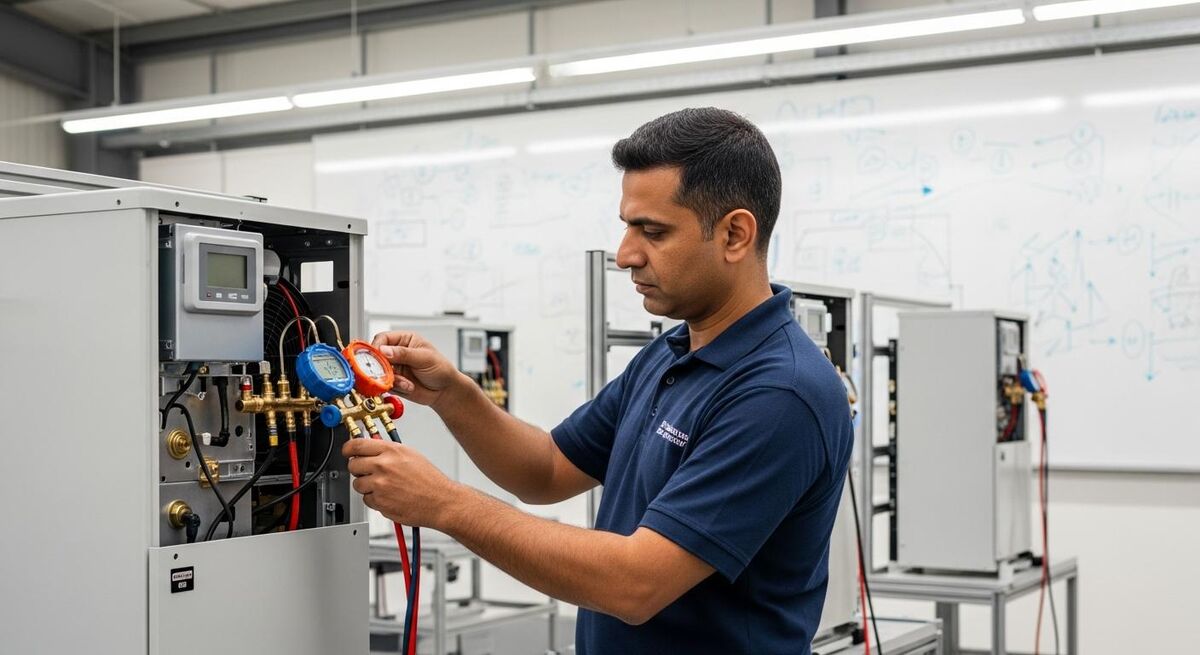
Heat pump bootcamps are how we extend an engineer's career into renewables. Most providers, including Tradeskills4u, Worcester Bosch at New College Durham, Wiltshire College, SGS College, Harlow College, Colchester Institute, Glasgow Clyde, Activate Trade Training and Yuzu Training, require the learner to already hold a relevant gas, oil or solid fuel registration. Gas Safe CENWAT, OFTEC OFT10-105E or OFT15-108W, MCS, or HETAS H004 will get someone in the door. From there a bootcamp typically runs four to six weeks, delivers Level 3 Air Source Heat Pump Systems, and pairs with a separate £500 Heat Training Grant that the Department for Energy Security and Net Zero pays towards the course cost.
Skills Bootcamps also come with an outcome guarantee: providers must offer eligible candidates a job interview on completion, and 80 percent of starters must complete the course to keep the provider funded. So if you are a small trade firm willing to offer interviews to bootcamp graduates, you can usually get yourself on a provider's outcome list and meet candidates who have been pre-screened and pre-trained at 10 percent of the cost to you. That is a route into hiring qualified solar or heat pump engineers that did not exist five years ago.
Funding in Scotland, Wales and Northern Ireland
If you operate outside England, the CITB grants for apprenticeships still apply but several other schemes work differently or do not exist.
Scotland
CITB operates separately as CITB Scotland and the Scottish Advanced Craft Certifications at SCQF Level 7 remain funded under the 2026 changes. The Flexible Workforce Development Fund, historically the main route for trade upskilling, had no funding in the 2023-24 and 2024-25 academic years following the Scottish Budget. The position for 2025-26 and 2026-27 is unclear at time of writing, so check with Skills Development Scotland or the Scottish Funding Council before assuming the fund is active. The National Construction College at Inchinnan is expanding its apprenticeship range and CITB Scotland is working with Skills Development Scotland on the review of construction apprenticeships.
Wales
CITB Wales operates the apprenticeship grant scheme on the same terms as England. Beyond that, the Welsh Government runs ReAct+ via Working Wales and Business Wales. Eligible adults can claim up to £1,500 towards vocational training, with £200 of travel support, and employers receive a wage subsidy of up to £4,000 paid in four instalments over the first 12 months of employment. The candidate must be aged 20 plus, Welsh resident, with right to work in the UK. Apply via Working Wales on 0800 028 4844. New Construction Degree Apprenticeships are launching and the STEM ambassador network is expanding to 80 in Wales.
Northern Ireland
CITB NI is an entirely separate organisation operating at citbni.org.uk with its own apprenticeship grant scheme. Apprenticeship support is administered by the Department for the Economy, not CITB NI, and the levy rules differ. If you are a Belfast or Lisburn trade firm, do not assume the England rules apply to you. Start at the citbni.org.uk grants page and the Department for the Economy ApprenticeshipsNI portal.
2026 funding timeline
Here is the calendar of cut-off dates and launches that matter for any UK trade employer in 2026.
| Date | What happens | Who it affects |
|---|---|---|
| 8 January 2026 | CITB grant reform: most short course grants abolished. SMSTS/SSSTS/TWC flat rated at £115. First Aid grant removed. NVQ achievement grant standardised at £600. | All CITB-registered employers |
| 1 April 2026 | Growth and Skills Levy launches. 100% government funding for SME apprentices under 25. Apprenticeship units (30-140 hours) eligible for up to 50% of levy spend. CITB Large Employer Fund opens (deadline 30 June 2026). | SMEs and 250+ staff employers |
| 1 April 2026 | English and maths qualification requirement waived for adult apprentices aged 19+. | Adult apprentices and their employers |
| June 2026 | UC Youth Jobs Grant launches: £3,000 per employer for hiring 18-24 year olds on UC for 6+ months. | All employers |
| 30 June 2026 | Deadline for CITB Large Employer Fund applications. | 250+ staff employers |
| 1 August 2026 | 10% government top-up on levy funds ends. Levy expiry drops to 12 months. Co-investment for levy-payers rises from 5% to 25% after balance is exhausted. | Levy-paying employers (£3m+ payroll) |
| September 2026 | Funding withdrawn from 16 apprenticeship standards (none in core trades). | Mainly leadership and management standards |
| 1 October 2026 | £2,000 SME apprentice incentive launches for non-levy employers hiring 16-24 year olds. | Non-levy SMEs |
How to actually claim
The reform makes the headline numbers stronger but the paperwork is unchanged. Three practical things to do this week if you have, or are considering, an apprentice.
First, register with CITB if you have not already. Even if you are below the £150,000 levy threshold and pay nothing, registration is what unlocks the grants. The portal is at citb.co.uk, and the registration takes about 30 minutes if you have your company UTR and PAYE references to hand.
Second, get your training provider relationship right. The £2,500 attendance grant is paid every 13 weeks once CITB receives evidence from the college that the apprentice attended. If your provider does not send timely attendance data, your grant gets held. The same goes for the £2,000 SME incentive that lands in October 2026: the payment routes through the provider, so a poor administrative relationship costs you money. Ask your provider's apprenticeship team for the named contact who handles your account.

Third, plan the supervision. An apprentice does not generate revenue for the first three years. Every engineer I have trained at Elite Heating and Plumbing has made my business stronger over time, but the cost in the early days is real, and grants do not pay for the senior engineer's lost billable hours when they are sitting with the apprentice on a Friday afternoon. If your business cannot absorb that, you are not yet ready to take an apprentice, and no amount of stacked incentive will change that. The grant is a contribution. The investment is yours.
For Skills Bootcamps the route in is different. You either nominate an existing employee to a bootcamp at a local provider, paying the 10 percent SME co-funding contribution, or you sign up as an employer willing to offer post-bootcamp job interviews on the provider's outcome list. Both routes start with finding the bootcamps live in your region via the National Careers Service course finder or by contacting your Local Enterprise Partnership or Combined Authority skills team. London, the West Midlands, West Yorkshire and Greater Manchester have the deepest 2026 programmes.
If you want to think more broadly about how funded routes fit your hiring pipeline, see the guide on writing trade job adverts that attract quality candidates, and once you have hired, the first week matters: see how to onboard a new engineer in 5 days. The funded incentives only work if the apprentice or bootcamp graduate stays, and that is a generational question. The guide on what Gen Z trades workers expect from employers is worth reading before you decide what your apprentice offer looks like.
What employers and engineers are saying
Recommended videos

Why take on an apprentice and claim CITB grants
CITB

CITB grant changes explained
Federation of Master Builders

The 10k CITB grant most builders miss
Develop Coaching

Apprenticeship Funding Rules 2025 to 2026
DfE Sector Comms

Growth and Skills Levy: 2026 rules
Solveway Apprenticeships

Heat pumps upskilling course
Energy Saving Trust
Frequently asked questions
No. Registration with CITB is what unlocks the grant, not levy payment. If your combined PAYE plus net CIS bill is below £150,000 you pay no levy at all but you can still register and claim the £2,500 per year attendance grant and £3,500 achievement grant for any construction apprentice you employ.
Yes, provided the candidate is 18 to 24, has been claiming Universal Credit for six months or more at the point of hire, and the hire date for the SME incentive falls after 1 October 2026. The UC Youth Jobs Grant is not restricted to apprenticeships, so the same £3,000 applies if you hire a labourer who meets the UC criteria. The two payments come from different departments and do not affect each other.
Honestly, on their own, no. A Level 2 multi-skills bootcamp gives a beginner a useful taster and some practical hours but does not produce a qualified electrician or plumber. Treat bootcamps as a feeder into a full apprenticeship for beginners, or as a focused reskilling route for an existing engineer who already holds a relevant ticket and wants to add heat pumps, solar or retrofit to their offer.
The attendance grant is paid 13 weekly while they are still attending college, so partial completion still earns you partial grant. The £3,500 achievement grant only pays on full completion of a programme of 12 months or more. The SME incentive of £2,000 is paid in two instalments, the first at around day 90, so if a candidate drops out in month one you receive nothing. This is one reason getting the right candidate matters more than chasing the largest funding stack.
You lose Employer Network access from 31 March 2026. From 1 August 2026 you lose the 10 percent levy top-up, your unspent funds expire at 12 months instead of 24, and your co-investment rate after the levy balance is exhausted rises from 5 percent to 25 percent. On the other side, the new Large Employer Fund opens 1 April 2026 with up to £18,000 per business, deadline 30 June 2026. If you have a 250 plus headcount and have not yet engaged with the application, do it this quarter.
CITB grants for construction apprentices apply across England, Scotland and Wales, with Scottish Advanced Craft Quals at SCQF 7 specifically protected under the 2026 changes. The Growth and Skills Levy and the £2,000 SME incentive are England-only schemes. The UC Youth Jobs Grant is UK wide. Scotland has the Flexible Workforce Development Fund (status uncertain for 2025-27), Wales has ReAct+ with up to £4,000 employer wage subsidy, Northern Ireland operates an entirely separate apprenticeship system via the Department for the Economy and CITB NI.
My verdict
In 2022 I argued the government incentive was nowhere near enough to make taking on an apprentice commercially rational for most small trade firms. In 2026 that argument no longer holds. The CITB attendance grant, the achievement grant, the new SME incentive and the UC Youth Jobs Grant stack to something close to £14,000 per apprentice over three years, with 100 percent training fees funded separately for under 25s at SMEs. That is a meaningful change. It does not mean every trade SME should immediately take an apprentice. The hidden costs, supervision time, supervision quality, putting the right senior engineer alongside the right junior, accepting that revenue does not appear for three years, are unchanged. What has changed is that the cash side of the equation is now defensible. If you have been waiting for the system to actually pay you something close to the real cost of training, this is the year the maths starts working. Through RAFT I am seeing first time apprentice employers come forward in numbers we have not seen in years. The cycle of learning that shaped my career, that put my foot through a college ceiling and taught me what site discipline really means, is worth preserving. The industry needs it. In 2026 the funding finally agrees.