
Quick Answer
Here's the thing: if you're buying a boiler for a customer before they've paid you a penny, you're running a finance company, not a heating business. Structure your installations into three payment stages, collect a deposit before you order materials, take a mid-point payment when the old system is out, and collect the balance on commissioning. It protects your cash flow and it's completely normal. Stop being the bank.
Table of Contents
- Why you're funding your customers' boilers
- The real cost of a boiler installation
- A three-stage payment structure that works
- How to present stage payments in your quote
- What the law says about deposits and stage payments
- Digital payment tools that speed up collection
- Timeline: from quote to final payment
- Handling customer objections
- What tradespeople are saying
- Recommended videos
- Frequently asked questions
- My verdict
Why you're funding your customers' boilers

Let's cut to the chase. If you're a heating engineer installing boilers and collecting payment on completion, you've got a cash flow problem. You just might not have realised it yet.
You drive to the merchants. You pay for the boiler, the flue, the fittings. You spend a day, maybe two, ripping out the old system and fitting the new one. And then you hand the customer an invoice and hope they pay within a week. Sound familiar?
The boiler alone costs you anywhere from £800 to £2,500 depending on the make and model. Add in the flue kit, the magnetic filter, the gas pipe, the condensate fittings, the inhibitor. You're easily £1,200 to £3,000 out of pocket before you've even picked up a spanner. That's your money sitting in someone else's house.
And here's the bit that really stings. While that cash is tied up in Mrs Johnson's new combi, you've still got your van lease to pay, your insurance, your Gas Safe renewal, your fuel bill. You're running a short-term lending operation for your customers, and you're not even charging interest.
If you're installing four boilers a month at £2,400 each and waiting 14 days for payment, you've got £9,600 of your own money tied up in other people's heating systems at any given time. That's not a cash flow issue. That's a crisis waiting to happen.
I see this constantly with the plumbing and heating businesses I work with. Good engineers, excellent at their job, but working month to month because they've never structured their payment terms properly. They're so focused on winning the work that they forget to protect themselves financially. It doesn't have to be this way. Learning how to write a professional quote that includes clear payment terms is half the battle.
The real cost of a boiler installation
Before you can structure your stage payments, you need to understand exactly what a boiler installation costs you. Not what you charge the customer. What it costs you out of pocket.
I call a spade a spade with this stuff. Most heating engineers I talk to know roughly what their materials cost. Very few know the true cost of doing a job when you factor in everything.
Your variable costs (the obvious ones)
A like-for-like combi boiler replacement in 2026 typically breaks down like this on the materials side:
- Boiler unit: £800 to £2,500 (depending on brand and output)
- Flue kit: £60 to £150
- Magnetic filter: £80 to £130
- Gas pipe, fittings, and sundries: £40 to £100
- Condensate pipe and fittings: £15 to £30
- Inhibitor and system cleaner: £25 to £40
Total materials outlay: £1,020 to £2,950. That's real money leaving your bank account before the customer pays you a penny.
Your fixed and hidden costs (the ones you forget)
On top of materials, you're covering:
- Fuel to get to the job and the merchants: £20 to £40
- Your daily rate (what you need to earn per day to cover overheads and wages): £200 to £350
- Waste disposal for the old boiler: £20 to £50
- Benchmark registration and notification: £3 to £5
- Insurance contribution per job: £8 to £15
- Vehicle wear and depreciation: £15 to £25
A typical combi-to-combi swap costs you between £1,300 and £3,400 out of pocket, including your time. If you're quoting £2,400 for a job that costs you £1,800, your gross margin is only 25%. Get your payment terms wrong and one late payer can wipe that margin out entirely. Understanding your true pricing means understanding what every job actually costs you first.
A three-stage payment structure that works
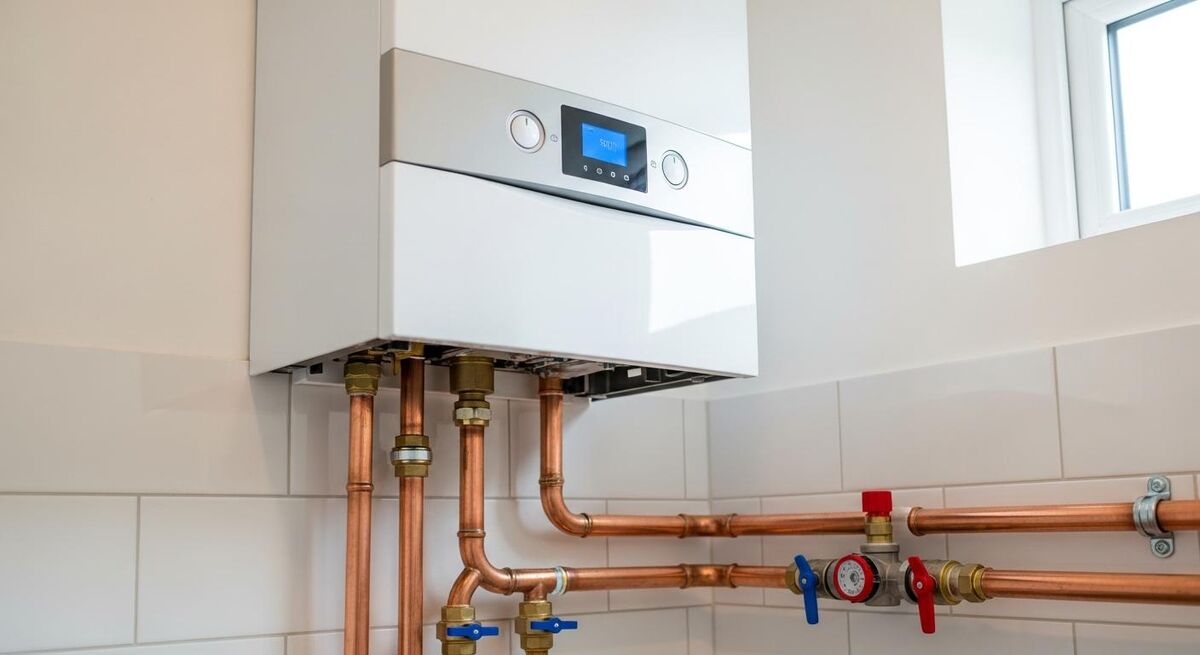
In my eyes, the simplest and most effective way to handle payment on a boiler installation is to break it into three stages. Nothing complicated. Nothing that puts customers off. Just a clear, professional structure that protects both sides.
Stage 1: Deposit on acceptance (30%)
The customer signs your quote and pays 30% of the total. This is your commitment fee. It covers the cost of ordering the boiler and key materials, and it confirms the customer is serious about going ahead.
On a £2,800 installation, that's £840. It won't cover all your materials, but it means you're not shouldering the entire burden alone. It also locks the customer in and stops the last-minute cancellations that waste your time and leave you with a boiler you didn't need.
Stage 2: Mid-point payment (40%)
The second payment falls when the old system is stripped out and the new boiler is on the wall. This is the natural halfway point of the job. The customer can see real progress and you've done the heavy lifting.
On a £2,800 job, that's £1,120. Combined with the deposit, you've now collected £1,960, which is 70% of the total. Your materials are covered. Your time is partly covered. You're not exposed.
Stage 3: Final payment on commissioning (30%)
The balance is due when the system is commissioned, tested, and handed over. The customer has a working boiler, you've completed your Benchmark checklist, and the Gas Safe notification is done.
That final £840 is your profit and remaining labour cost. You collect it before you leave. Not 7 days later. Not 30 days later. On the day.
A 50% deposit can put customers off. It feels like a lot upfront, especially for a £3,000+ job. The 30/40/30 split feels more balanced. The customer pays less upfront, you collect the bulk once they can see real work happening, and neither party carries too much risk at any point.
How to present stage payments in your quote

Here's where most heating engineers trip up. They know they should take stage payments but they don't know how to present them without looking unprofessional or like they don't trust the customer.
Your payment terms need to be baked into your quote document. Not mentioned verbally on the doorstep. Not scribbled on a Post-it note. Clearly stated, in writing, as part of your professional quote.
What to include in your payment terms section
At a minimum, your quote should spell out:
- The total price (broken down into materials and labour if you choose)
- Stage 1: 30% deposit due on acceptance to secure your installation date
- Stage 2: 40% due on day one of installation when the new boiler is delivered to site
- Stage 3: 30% balance due on commissioning and handover
- Accepted payment methods: bank transfer, card payment, or cheque
- What happens if payment is late: work pauses until payment is received
This isn't about being aggressive. It's about being professional. Every decent-sized plumbing and heating business in the country has payment terms in their quotes. If you don't, you're the outlier.
When presenting your terms to a customer, frame the deposit as protecting their booking slot and guaranteeing material availability. Frame the mid-point payment as reflecting the work completed so far. Frame the final payment as conditional on their complete satisfaction. Everyone wins.
If you're still handwriting quotes on headed paper or sending a text message with a price, it's time to level up. A structured, professional quote with clear payment milestones tells the customer you know what you're doing. And it makes it almost impossible for them to "forget" when payment is due.
What the law says about deposits and stage payments
I get asked about this a lot. Is it legal to take a deposit? Can I refuse to carry on if they don't pay the mid-point? What happens if they dispute the amount?
Let's face it, most of us aren't lawyers. But you need to know the basics, because getting this wrong can cost you more than a late payment ever will.
Consumer Rights Act 2015
Under the Consumer Rights Act 2015, any work you carry out must be done with reasonable care and skill, within a reasonable time, and at a reasonable price (if no price was agreed in advance). The Act also requires clear, written terms that are fair and transparent.
Stage payments are completely legal. There's nothing in UK law that prevents a tradesperson from requesting payment in instalments tied to work milestones. What matters is that the terms are agreed in writing before work begins and that they're fair to both sides.
What makes payment terms "fair"
The Competition and Markets Authority (CMA) has guidance on unfair contract terms. Your stage payment structure is likely to be considered fair if:
- It's clearly explained before the customer commits
- Each payment is linked to a specific milestone or deliverable
- The deposit is proportionate (30% is widely accepted)
- The customer isn't paying the full amount before any work is done
- There's a clear process for handling disputes or defects
Verbal agreements are legally binding in England and Wales, but they're a nightmare to enforce. If a customer refuses to pay and your terms were only discussed over the phone, you've got very little to stand on. Put your payment terms in your quote, get the customer to sign or confirm acceptance, and keep a copy.
Deposits vs advance payments
Technically, a "deposit" and an "advance payment" are different things in law. A deposit can be forfeited if the customer cancels. An advance payment is typically refundable. For most boiler installations, what you're collecting is an advance payment against the total price. But whatever you call it, make sure your terms explain what happens if either party cancels.
Digital payment tools that speed up collection

Gone are the days when you'd hand someone an invoice and wait for a cheque to arrive in the post. If you're not offering digital payment options in 2026, you're making it harder for customers to pay you, and that means you're waiting longer for your money.
Card payments on site
Card terminals have dropped in price to the point where there's no excuse not to have one. You can get a mobile card reader for under £30 and the transaction fees are typically 1.5% to 1.75%. On a £840 stage payment, that's about £14 in fees. I'd argue that's a small price to pay for getting your money on the spot instead of chasing it for a fortnight.
Bank transfer with payment links
Most accounting and invoicing software now lets you send a payment link with your invoice. The customer clicks the link, confirms the amount, and the money is in your account within hours. No chasing. No awkward phone calls. No "the cheque's in the post."
Finance options for larger installations
For higher-value jobs like full system installations or renewables work, offering customer finance can remove the biggest barrier to getting paid promptly. The customer spreads the cost over 12 to 60 months, you get paid in full by the finance provider within days of completing the work, and nobody's cash flow suffers.
There are several finance providers that work specifically with heating and plumbing businesses. The setup is straightforward and most handle the credit checks and paperwork for you. Customer finance options have transformed cash flow for many heating engineers, especially on larger installations.
The more ways a customer can pay you, the faster you'll get paid. Offer bank transfer, card payment, and finance as standard. Remove every possible excuse for late payment.
Timeline: from quote to final payment
Here's what a well-structured boiler installation looks like from a payment perspective, start to finish.
| Stage | When | What happens | Payment |
|---|---|---|---|
| Survey and quote | Day 0 | Visit the property, assess the job, send a written quote with payment terms | None |
| Quote acceptance | Day 1-7 | Customer accepts the quote and pays the deposit | 30% deposit |
| Materials ordered | Day 2-8 | Order the boiler and materials using the deposit funds | None |
| Installation day 1 | Day 7-14 | Strip out old system, mount new boiler, connect pipework | 40% mid-point |
| Installation day 2 | Day 8-15 | Complete pipework, commission, test, Benchmark registration | 30% balance |
| Post-completion | Day 9-16 | Send Gas Safe notification, file paperwork, follow up | Fully paid |
The entire payment cycle, from quote to final payment, should take no more than two to three weeks. If it's taking longer than that, something in your process needs tightening.
Handling customer objections

You'll get pushback from some customers when you introduce stage payments. That's normal. Here's how to handle the most common objections without losing the job.
"I've never been asked to pay a deposit before"
Just because they haven't been asked doesn't mean it's unusual. Stage payments are standard practice across the trades. Builders, electricians, kitchen fitters, bathroom installers, they all take deposits. Heating engineers are actually late to the party on this one.
Your response: "It's standard practice across the industry. The deposit secures your installation date and allows me to order your specific boiler. It protects both of us."
"Can I just pay everything at the end?"
This one's simple. No. Politely, but firmly, no. You wouldn't walk into a kitchen showroom and expect them to install £15,000 worth of units before you've paid a penny. A boiler installation is no different.
Your response: "I understand the preference, but the materials for your installation cost me over £1,000 upfront. The staged structure means neither of us carries too much risk."
"What if I'm not happy with the work?"
This is a fair concern. The way to address it is by making the final payment conditional on commissioning and handover. The customer doesn't pay the balance until the system is tested, working correctly, and they're satisfied. That's their protection built right into the payment structure.
If you present your payment terms apologetically, the customer will question them. If you present them as standard practice, professionally and matter-of-factly, most customers won't bat an eye. The ones who refuse are often the same ones who'd have given you trouble at invoice stage anyway.
What tradespeople are saying
Recommended videos

The Financial Side of Running a Heating & Plumbing Business
Profit, costs and cash flow webinar

The Plumbing Pricing Strategy That Doubled My Profit Margin
Practical pricing walkthrough

Are You Actually Making Money? 3 Numbers Every Tradesperson Must Know
Essential financial metrics for trades

How to Write Quotes and Invoices for Plumbing Jobs
Quote template walkthrough
How Much Does a New Boiler Cost? Gas Safe Engineer's Guide
Boiler pricing breakdown

Growing a Plumbing Business from £300K to Over £1M in 3 Years
Business growth and financial systems
Frequently asked questions
Between 25% and 30% is the sweet spot. It's enough to cover your material order costs without feeling excessive to the customer. Anything over 50% tends to raise eyebrows and can put people off.
Walk away. Seriously. A customer who won't pay a reasonable deposit before you commit £1,500 of your own money is telling you something. In my experience, the ones who resist a deposit are the same ones who'll give you grief when the final invoice lands.
Your quote is your contract. Include your payment terms, your scope of work, your timescales, and your terms and conditions. Get the customer to sign it or confirm acceptance via email. That's your protection if things go sideways.
Yes. If your terms state that work continues on receipt of stage payments, and the customer hasn't paid, you're within your rights to pause. Politely remind them, give them 24 hours, and if it still hasn't landed, down tools until it does.
Absolutely. In fact, many customers prefer it because credit card payments over £100 give them Section 75 protection. Get yourself a card terminal. The transaction fees are worth the peace of mind of getting paid on the spot.
Finance is great for higher-value jobs. The finance provider pays you in full shortly after completion, and the customer spreads the cost. It removes the cash flow risk entirely. Just make sure you're working with an FCA-regulated provider.
Not at all. Some engineers use 25/50/25 or 33/33/33. The exact split matters less than having a structure in the first place. Pick one that covers your material costs with the first two payments, and stick with it consistently.
My verdict
If you take one thing from this article, let it be this: you are a heating engineer, not a finance company. Every installation you do without stage payments is a loan you're giving to a customer at 0% interest with no security. Structure your payments, put them in writing, collect at every milestone, and protect the cash flow that keeps your business alive. Your accountant will thank you. Your bank balance will thank you. And your stress levels will drop off a cliff.