
Quick Answer
The trades businesses that survive the next three years will not be the ones with the best tools in the van. They will be the ones that got their operating costs under control while competitors were still filling in paperwork by hand. AI adoption is splitting the sector in two: businesses that automate their admin, quoting, and scheduling, and businesses that keep burning 16+ hours a week on tasks a machine handles in minutes. The gap is already widening, and the numbers are stark.
Table of Contents
- The big picture in numbers
- What is actually happening with AI in UK trades
- The operating cost breakdown your accountant will not flag
- Who is adapting and who is standing still
- How AI changes the cost equation
- The AI adoption timeline for UK trades
- Five things to do this quarter
- The financial case in plain numbers
- What tradespeople are saying
- Recommended videos
- Frequently asked questions
- My verdict
 ChatGPT
 Claude
 Gemini
 Copilot
 n8n
n8n Zapier
The big picture in numbers
What is actually happening with AI in UK trades
When it comes to AI in the trades, the conversation has shifted. Two years ago it was curiosity. Last year it was experimentation. This year, 39% of UK businesses are using AI tools in their daily operations, according to a Moneypenny survey of 750 firms published in 2025. In the architecture, engineering, and building sector specifically, combined adoption sits at 61%.
That is not a niche trend. That is a structural shift in how businesses operate.
A separate survey by Housecall Pro found that over 70% of tradespeople across North America have tried AI tools, with nearly half using them actively. Plumbers were the most likely to say AI had helped their business grow. Electricians reported the highest satisfaction rates with the technology. These are not people replacing their skills with machines. They are using AI to handle the paperwork, the quoting, and the scheduling that eats their evenings.
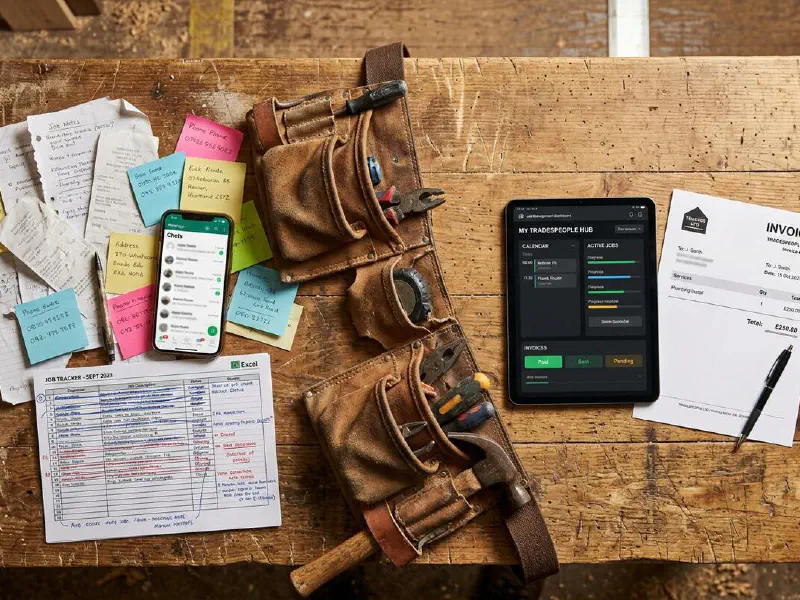
The pattern is clear. Trades businesses that have already adopted digital tools and workflows are layering AI on top. Those still running on WhatsApp and spreadsheets are facing a growing efficiency gap, and that gap translates directly to operating costs.
The operating cost breakdown your accountant will not flag

Every tradesperson knows what their van costs. They know what insurance runs each year. The figures that follow are familiar to most sole traders and small firms operating in the UK.
Van lease or finance: £200 to £400 per month. Fuel: £150 to £300 per month, depending on patch size. Insurance: £800 to £1,800 per year. Tools and equipment replacement: £1,000 to £2,000 per year. Software subscriptions: £50 to £150 per month. Accountant fees: £800 to £2,000 per year. Marketing: £100 to £500 per month.
Add it up and the typical sole trader carries £7,000 to £12,000 in annual overhead. That is the number most people focus on. It is also the wrong number to worry about.
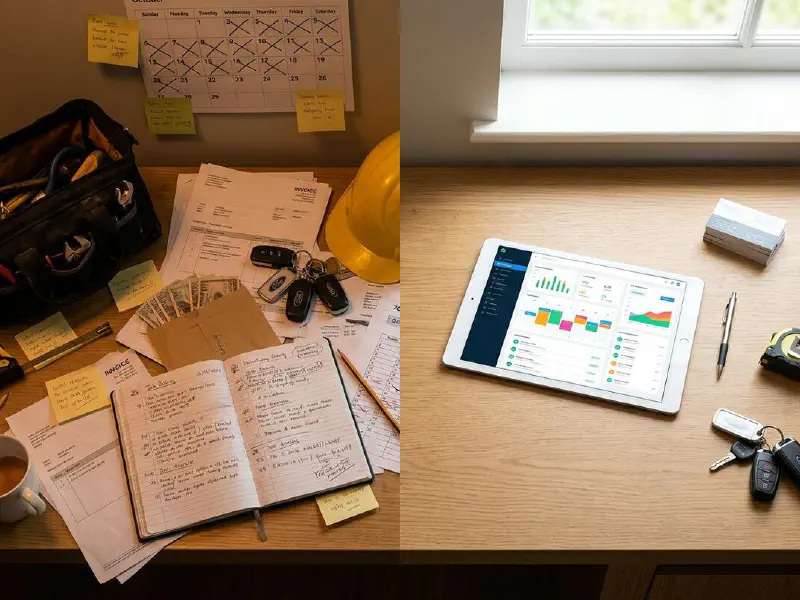
The cost that actually decides who survives is admin time. Research consistently shows that the average tradesperson spends 16+ hours per week on non-billable work. That includes quoting (roughly 5 hours per week alone), invoicing, scheduling, chasing payments, responding to enquiries, and updating records. At an effective rate of £30 per hour, that is over £25,000 per year in lost earning capacity.
Your accountant will not flag this because it does not appear on any ledger. But it is the single largest operating cost most trades businesses carry, and it is the one AI can cut by quite some margin.
Who is adapting and who is standing still
The split is not random. It follows a pattern, and that pattern is worth understanding if you want to know where your business sits.
Multi-engineer firms with existing job management software are moving fastest. They already have structured data, digital job records, and workflow logic that AI tools can plug into. When ServiceM8 or Commusoft releases an AI scheduling feature, these firms adopt it within weeks because the infrastructure is already in place.
Sole traders and micro-firms running on WhatsApp and spreadsheets face a different reality. For them, AI adoption means rebuilding from the ground up. Not just subscribing to ChatGPT, but fundamentally changing how they capture job information, generate quotes, and track costs. That is a bigger ask, and the Moneypenny data shows it: 42% of sole traders say they have no plans to adopt AI at all.
The risk here is not that these businesses will collapse overnight. It is that they will gradually become uncompetitive on price. A business that quotes in 10 minutes will win more work than one that takes two hours, even if their trade skills are identical. Over three years, that compounds.
Electrician wages have risen 5% to 7% annually in recent years. Material costs fluctuate but trend upward. The only cost that can realistically go down is admin overhead, and AI is the tool that makes that reduction possible at scale.
How AI changes the cost equation
The numbers here are specific and verifiable.
Quoting. Manual quoting takes the average tradesperson roughly 5 hours per week. That includes site surveys, writing up specifications, pricing materials, and formatting the document. AI-assisted quoting, using tools like ServiceM8's AI quote builder or ChatGPT with a custom prompt template, brings that down to under an hour for most standard jobs. ServiceM8 reports that their AI Auto-Invoicing feature alone saves businesses sending 4 invoices per day roughly 3.5 hours each week.
Scheduling and dispatch. AI scheduling analyses job priority, technician skills, location, and traffic patterns to suggest optimal routes. For firms running crews across a metro area, this reduces windshield time by hundreds of hours per year. That is not a theoretical figure; it is what dispatch platforms report when comparing AI-optimised routes against manual scheduling.
Customer communications. Automated follow-ups, appointment confirmations, and review requests run without anyone touching them. Set them up once and they handle the drip. Zapier automations or n8n workflows connect your job management platform to email, SMS, and review sites.
Marketing. AI content tools generate social media posts, job descriptions, and even blog content from a few bullet points. What used to take an evening now takes fifteen minutes.
Combined, these savings represent 10 to 15 hours per week for a typical small trades business. At £30 per hour, that is £15,600 to £23,400 per year in recovered earning capacity. The cost of the AI tools that deliver this? Typically £50 to £200 per month, or £600 to £2,400 per year. The maths is straightforward.
The AI adoption timeline for UK trades

| Year | What happened | Impact on trades |
|---|---|---|
| 2023 | ChatGPT launches publicly; first trades professionals experiment | Curiosity phase; mostly used for email drafting and troubleshooting |
| 2024 | Dedicated AI features appear in FSM platforms; trades-specific AI tools emerge | Early adopters integrate AI into quoting and invoicing workflows |
| 2025 | 39% UK business AI adoption; Housecall Pro reports 70%+ trades have tried AI | Mainstream awareness; adoption splits between digital-ready and legacy firms |
| 2026 | AI-native FSM platforms launch; ServiceTitan IPO at £5bn+ valuation | AI scheduling, dispatch, and job costing become standard platform features |
| 2027 | Future Homes Standard drives further digital requirements | Compliance reporting adds another layer where digital tools outperform paper |
| 2028-29 | AI becomes table stakes for competitive trades businesses | Non-adopters face structurally higher costs and slower quote turnaround |
The pattern here mirrors what happened with cloud accounting between 2015 and 2020. Xero and QuickBooks were optional luxuries in 2015. By 2020 they were baseline expectations. The same compression is happening with AI, only faster.
Five things to do this quarter
This is not a five-year transformation plan. It is a list of things you can do in the next 90 days that will shift your operating cost structure meaningfully.
1. Audit your admin hours for one week. Track every minute you spend on non-billable work. Use a simple timer app or a notebook. You will almost certainly find the number is higher than you thought. Most tradespeople estimate 8 to 10 hours per week; the actual figure is closer to 16 to 20.
2. Pick one AI tool and commit for 30 days. ChatGPT is the simplest starting point. Use it to draft quotes, write customer emails, and generate job descriptions. Do not try to automate everything at once. Master one workflow first.
3. Automate your quoting process. Build a template in your job management software or create a custom ChatGPT prompt that generates professional quotes from a few bullet points. This single change will save you more time than any other.
4. Set up automated follow-ups. Whether through Tradify and Zapier or a built-in platform feature, automate your post-job follow-up emails and review requests. This runs silently and builds your online reputation without lifting a finger.
5. Review your software stack. Check whether your current job management, accounting, and scheduling tools have AI features you are not using. Most platforms have added AI capabilities in the last 12 months. You may already be paying for tools you are not switching on.
The financial case in plain numbers

| Cost category | Without AI | With AI tools |
|---|---|---|
| Admin time (hours/week) | 16+ | 4-6 |
| Quoting time (hours/week) | 5 | 1 |
| Annual admin cost (at £30/hr) | £23,040+ | £5,760-£8,640 |
| AI tool costs (annual) | £0 | £600-£2,400 |
| Net annual benefit | Baseline | £12,000-£20,000+ recovered |
| Break-even point | - | First month |
These are not aspirational figures. They are based on documented time savings from platforms like ServiceM8 (3.5 hours/week on invoicing alone), Housecall Pro (4 hours/week average for AI adopters), and real-world usage data from trades businesses already using these tools.
The cost of AI tools ranges from free (ChatGPT basic tier) to roughly £200 per month for a comprehensive stack including job management AI features, automation workflows, and AI marketing tools. Even at the high end, the payback period is measured in weeks, not years.
For a sole trader earning £50,000 per year, recovering 10 hours of admin time per week is equivalent to a 25% increase in available billable hours. That does not mean revenue automatically increases by 25%, but it means the capacity is there. Fill even half of those recovered hours with billable work and the business case is overwhelming.
What tradespeople are saying
Recommended videos

AI Will Make Plumbers Earn More Than Lawyers
The Diary Of A CEO

AI is the Future of Construction: How to Prepare
Construction Brothers Podcast

How AI Will Transform Construction (2026)
Tim Fairley

The First AI Designed for the Trades
Master The NEC

AI Automation for Plumbing Companies You Can Copy
Hamza Automates

AI Customer Service for HVAC and Plumbing Companies
Service Business Mastery Podcast

AI in Construction: Estimating, Scheduling and More
Tom Stephenson

How Small Business Owners Should Adopt AI Automation
Mitch Asser
Frequently asked questions
No. AI cannot install a boiler, rewire a house, or fix a leaking pipe. What it does is handle the admin, quoting, scheduling, and customer communication that currently eats 16+ hours of your working week. Your trade skills are safe. Your paperwork is not.
ChatGPT's free tier handles basic tasks. Paid tiers run £16 to £20 per month. Job management platforms with AI features typically charge £30 to £80 per month. A full AI stack including automation tools might cost £100 to £200 per month. Against the £15,000+ in admin time you recover, the investment pays for itself within weeks.
More so than for larger firms, if anything. A sole trader has no admin staff to absorb the paperwork. Every hour spent quoting or invoicing is an hour not spent earning. AI tools give you the admin capacity of a business with a dedicated office manager, at a fraction of the cost.
Start with ChatGPT for writing customer emails and drafting quotes. Spend 30 minutes setting up a prompt template for your most common job type. Use it for a week and measure the time savings. Once that clicks, look at automating your invoicing and follow-ups.
Check for AI features in your current platform. ServiceM8, Commusoft, Tradify, and most major FSM tools have added AI capabilities in the last 12 months. You may already be paying for features you have not switched on. Start there before adding separate tools.
Use business-grade AI tools rather than pasting customer details into free chatbots. Enterprise tiers of ChatGPT and Claude do not use your data for training. Job management platforms handle data under UK GDPR requirements. Read the privacy policy before connecting any tool to your customer data.
The tipping point is closer than most think. Cloud accounting went from optional to essential in roughly five years (2015 to 2020). AI tools are following the same curve but faster. By 2028, businesses without AI-assisted workflows will face structurally higher costs and slower response times than competitors who adopted earlier.
Yes, and it is one of the quickest wins. ChatGPT can generate social media posts, Google Business profile updates, email newsletters, and blog content from a few bullet points about your recent jobs. What used to take an evening now takes 15 minutes. Consistency matters more than perfection in trades marketing, and AI makes consistency easy.
My verdict
When it comes to AI adoption in the trades, I see two clear groups forming. The first group is already saving 10+ hours a week on admin, quoting faster, and reinvesting that time into billable work. The second group is still debating whether ChatGPT is a fad. Three years from now, the cost structures of these two groups will look fundamentally different. The businesses with lower operating costs will be able to price more competitively, respond to enquiries faster, and absorb material cost increases without passing them all to customers. That is not opinion; that is arithmetic. Start small. Pick one process. Automate it this quarter. The compound effect of recovered time is the best investment most trades businesses will make this decade.