

Quick Answer
A skills matrix is a grid that maps every engineer's competencies against the skills your business needs. It shows you who can do what, where the gaps are, and who is ready for the next level. Businesses that implement structured skills tracking reduce engineer turnover by up to 35% and spend less time scrambling when someone hands in their notice. You do not need expensive software to start. A spreadsheet works. What matters is that you actually use it.
Table of Contents
- What is a skills matrix and why does it matter?
- The real cost of losing a field service engineer
- How to build a skills matrix for your team
- Core skills every field service engineer needs
- Choosing a rating system that works
- Integrating your skills matrix with FSM software
- Using your matrix to create career paths
- AI-powered skills gap analysis
- Implementation timeline
- What tradespeople are saying
- Recommended videos
- Frequently asked questions
- My verdict
 Commusoft
 BigChange
 Joblogic
What is a skills matrix and why does it matter?

A skills matrix is a grid. Down one side, you list your engineers. Across the top, you list the skills your business needs. Each cell gets a rating. That is it.
The simplicity is the point. Most trades businesses above ten people have a vague sense of who can do what. The experienced gas engineer who is also decent with electrics. The newer lad who is surprisingly good with customers. The senior engineer who everyone assumes can do everything but has never actually touched a heat pump.
A skills matrix takes that vague knowledge and makes it visible. Once it is visible, you can act on it. You can see which skills are concentrated in one person (a risk). You can see which engineers are close to being ready for a senior role. You can spot gaps before they become emergencies.
According to the 2025/2026 Skills Snapshot Survey by Mercer, 55% of organisations now map skills directly to jobs, up from 47% in 2023. The trend is clear. Businesses that track skills systematically outperform those that do not.
A skills matrix tracks what someone can do (fault-finding, boiler servicing, heat pump installation). A competency matrix tracks how they do it (communication, leadership, problem-solving). Most trades businesses should start with skills, then layer in competencies later. Do not overcomplicate it at the beginning.
The real cost of losing a field service engineer

Replacing a field service engineer costs between £5,000 and £10,000 when you add up recruitment fees, training time, lost productivity, and the gap between the old engineer leaving and the new one becoming fully effective. For specialist roles, the cost can reach 150% to 200% of annual salary.
But the number only tells half the story. When an experienced engineer walks out, they take client relationships with them. They take knowledge of quirky installations and difficult sites. They take the mentoring they were giving to junior staff, whether they realised it or not.
The IET reported in 2025 that 46% of engineering employers say employee turnover hinders their progress. That is nearly half the industry admitting they cannot keep people long enough to get things done properly.
A skills matrix will not solve all of this. But it creates the foundation for two things that do reduce turnover: clear career progression and targeted development. Companies with strong internal mobility retain staff 41% longer than those without clear advancement paths. When people can see where they are headed, they tend to stick around.
If you have 15 engineers and lose three per year at £7,500 each, that is £22,500 annually. Reducing turnover by just one person per year through better development and career clarity saves you £7,500, more than enough to justify the time spent building and maintaining a skills matrix.
How to build a skills matrix for your team
You do not need software to start. A spreadsheet works perfectly well for teams up to about 30 people. Here is how to build one that actually gets used.
Step 1: Define your skill categories
Start by listing every skill your business needs. Group them into categories. For a typical field service operation, these might include technical skills (gas, electric, plumbing, renewables), safety certifications (Gas Safe, Part P, F-Gas), soft skills (customer communication, report writing), and digital skills (FSM app usage, diagnostics tools).
Keep the list to 20-30 skills maximum. If you list everything, nobody will fill it in. If you are too broad, the matrix tells you nothing useful.
Step 2: List your team
Put every field engineer in the left column. Include apprentices. Include anyone who does any field work at all, even if only occasionally. The matrix needs to reflect reality, not just the ideal team structure.
Step 3: Rate each person
This is where most businesses stall. They argue over the rating scale, then never finish the matrix. Pick something simple and commit to it. A 1-4 scale works well for trades:
| Rating | Meaning | What it looks like |
|---|---|---|
| 1 | No competence | Cannot perform this skill unsupervised |
| 2 | Basic | Can perform with guidance or supervision |
| 3 | Competent | Can perform independently and consistently |
| 4 | Expert | Can teach others and handle complex scenarios |
Involve the engineers themselves in the rating process. Self-assessment paired with manager assessment gives you a more honest picture. It also shows your team that you value their input, which matters more than most managers realise.
Some engineers will rate themselves as a 4 on everything. Some will undersell themselves. Cross-reference self-assessments with job performance data and peer feedback. The goal is accuracy, not politics.
Step 4: Analyse and act
Once the matrix is populated, patterns emerge fast. Skills concentrated in one person are a risk. Large clusters of 1s and 2s in a critical area mean you need training. Engineers with mostly 3s and 4s but no clear next step are flight risks.
The matrix is a decision-making tool, not a filing exercise. Review it quarterly. Update ratings after training courses, after engineers complete new types of work, and after any significant change in your service offering.
Core skills every field service engineer needs

Your specific matrix will depend on your trade and services. But there are categories that apply across nearly all field service operations.
Technical skills
These are the bread and butter. Gas Safe compliance, Part P electrical work, unvented hot water, F-Gas handling, heat pump installation, fault diagnostics, commissioning. List what your business actually delivers, not what you think it should deliver in three years.
Safety and compliance
Working at heights, asbestos awareness, confined spaces, manual handling, first aid. These are non-negotiable. Your matrix should flag any engineer whose certifications are about to expire.
Customer-facing skills
Communication, conflict resolution, explaining technical problems in plain English, upselling additional services without being pushy. These skills are harder to measure but often determine whether a customer rebooks or goes elsewhere.
Digital skills
Using your FSM app, completing digital forms, uploading photos, using diagnostic software, reading digital schematics. The engineer who refuses to use the app properly costs your business hours of admin time every week.
Leadership and mentoring
Not every engineer will become a manager. But identifying those who can mentor apprentices, lead small teams, or supervise complex jobs is valuable. These are the people who multiply the capability of your entire operation.
For more on what makes people stay in your business, see our guide to staff retention in UK trades.
Choosing a rating system that works
The most common mistake is overengineering the rating scale. A 1-10 scale sounds precise. In practice, nobody can consistently tell the difference between a 6 and a 7. Here are three approaches that actually work in trades businesses.
Traffic light system
Red (cannot do), amber (learning), green (competent). This is the simplest option. It works well for compliance-focused matrices where you mainly need to know if someone is certified or not.
Four-point scale
The 1-4 system described above. This is the sweet spot for most businesses. Enough granularity to be useful, simple enough that people actually complete it.
Dreyfus model adaptation
Novice, advanced beginner, competent, proficient, expert. Five levels, each with clear behavioural indicators. This works for larger operations (25+ engineers) where you need more nuance for career planning and pay progression.
A skills matrix that gets filled in once and forgotten is worse than having none at all. It creates a false sense of security. Set a quarterly review in your calendar. Make it part of your regular one-to-one meetings with engineers. A live document beats a perfect document that nobody looks at.
Integrating your skills matrix with FSM software

Once your matrix exists, the next step is connecting it to how you actually dispatch and manage work. This is where field service management software earns its keep.
Commusoft
Commusoft's scheduling engine lets you match engineers to jobs based on service type, skills, and shift patterns. If your matrix shows that only two engineers are qualified for unvented hot water work, Commusoft can automatically prioritise those engineers for those jobs. The platform integrates with Sage and Xero, which keeps the finance side clean. Pricing is not published, but most businesses budget around £97 per user per month. Standard plans run on 12-month contracts, with daily licences available for subcontractors.
BigChange
BigChange combines CRM, scheduling, live tracking, and invoicing in one platform. The skill-matching element means managers can see which engineers are qualified for specific job types when assigning work. Rob Hol, Head of Building Services at FSE UK, reported that since implementing BigChange, his team grew from four or five engineers to nearly 30, crediting the platform with helping manage that growth. Pricing starts at £79.95 per user per month, with a premium tier at £99.95 that includes rugged tablets.
Joblogic
Joblogic excels at reactive maintenance and planned preventative maintenance (PPM) contracts. Its asset management module tracks service history for every piece of equipment, which pairs well with a skills matrix because you can match engineer capabilities to equipment types. The customer portal lets clients see who is assigned to their jobs and why. Pricing is available on request, with a free 30-day trial.
None of these platforms include a built-in skills matrix feature. That is the gap. You will need to maintain your matrix in a spreadsheet or dedicated tool and use it to inform how you configure your FSM software's scheduling rules.
Even if your FSM platform does not have a native skills matrix, most allow you to tag engineers with skill categories. Create custom fields or tags in your FSM software that mirror your matrix categories. When you update the matrix, update the tags. This gives your dispatcher visibility of skills without leaving the scheduling screen.
Using your matrix to create career paths

The skills matrix on its own tracks where people are. Career paths show them where they can go. Combine the two and you have something properly powerful for retention.
90% of workers now rank clear career paths as their top job priority, according to recent workforce data. Career stagnation is not tolerated any more. People want growth tied to skills, not just time served.
Here is how to turn your matrix into a career framework.
Define levels
Create three to five progression tiers. For a heating and plumbing business, this might look like: Apprentice, Junior Engineer, Engineer, Senior Engineer, Lead Engineer. Each level has a minimum set of skill ratings from your matrix.
Set clear thresholds
An apprentice needs to reach level 2 in at least 12 core skills and hold their Gas Safe registration before progressing to Junior Engineer. A Senior Engineer needs level 4 in at least five technical skills plus level 3 in customer communication and mentoring. Write it down. Make it specific.
Link progression to pay
Skills-based pay progression is more motivating than annual inflation increases. When an engineer hits the threshold for the next level, their pay increases. This is transparent, fair, and directly connected to what they can actually do for your business.
When you are ready to attract more talent, our guide on writing trade job adverts covers how to communicate these career paths in your recruitment materials.
Create a technical specialist track alongside the management track. Some of your best engineers have zero interest in spreadsheets and meetings. Let them progress by deepening technical expertise, mentoring, or specialising in complex installations. Forcing everyone onto a management ladder is how you lose your most skilled technicians.
AI-powered skills gap analysis
AI is starting to change how businesses identify and close skills gaps. The technology is not science fiction any more. It is practical and more affordable every year.
Automated gap detection
AI tools can analyse your skills matrix alongside your job data to identify patterns you would miss manually. If 40% of your callback jobs involve heat pumps but only one engineer has a level 3 rating in heat pump servicing, that is a training priority the AI can flag automatically.
Personalised learning paths
Rather than sending everyone on the same generic training course, AI can recommend specific development steps for each engineer based on their current ratings, their career goals, and your business needs. One engineer might need a manufacturer-specific heat pump course. Another might benefit more from a customer communication workshop.
Predictive workforce planning
Machine learning can model what your skills landscape will look like in 6 or 12 months, factoring in planned retirements, certification expiry dates, and industry trends like the shift to renewable energy. This lets you train proactively rather than reactively.
The apprenticeship system is already under pressure. Our guide to the apprenticeship crisis explains why getting skills development right matters more than ever.
No AI system knows your team like you do. Use AI for pattern recognition and recommendations. Keep the final decisions about development plans, progression, and team composition with the people who actually work alongside your engineers every day.
Implementation timeline
You do not need to build the perfect system on day one. Here is a realistic timeline for getting a skills matrix up and running.
Define skills and categories
List 20-30 skills your business needs. Group them into technical, safety, customer, digital, and leadership categories. Get input from your most experienced engineers.
Build the spreadsheet and conduct first assessments
Create the matrix in Excel or Google Sheets. Run self-assessments with every engineer. Cross-reference with manager assessments. Expect this to take 20-30 minutes per engineer.
Analyse gaps and prioritise training
Identify your biggest skills risks (single points of failure, certification gaps, weak areas in growing service lines). Book training for the top three priorities.
Link to FSM software and scheduling
Tag engineers in your scheduling system with skill categories from the matrix. Update dispatch rules so the right engineer goes to the right job.
Define career paths and communicate them
Create progression tiers with clear skill thresholds. Share the framework with your entire team. Start using the matrix in one-to-one conversations and appraisals.
Quarterly reviews and updates
Review and update the matrix every quarter. Track certification expiry dates. Celebrate progression. Adjust training plans based on changing business needs.
What tradespeople are saying
Recommended videos
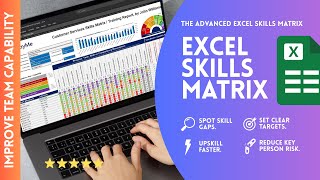
Skills and Training Matrix Demonstration in Microsoft Excel
Lean Smarts

What Is an Employee Skills Matrix?
AG5 Skills Management
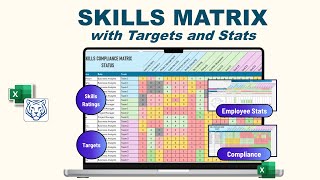
Skills Matrix Excel Tutorial: Build a Professional Competency Tracker
Excel for Freelancers

Streamlining Employee Training: Onboarding with CS Heating
Commusoft

How Commusoft Helps Us to Grow: CS Heating and Plumbing
Commusoft

Build a Skills Matrix: The Digital Way
Lean Smarts
Frequently asked questions
For a team of 10-15 engineers, expect to spend about a day defining skills and another day completing the initial assessments. The spreadsheet itself takes an hour. The conversations take longer, and they are the valuable part.
No. Excel or Google Sheets works fine for most trades businesses. Dedicated tools like AG5 or MuchSkills exist if you outgrow spreadsheets, but do not let software selection delay getting started.
Quarterly is the minimum. Update it after any training course completion, new certification, or significant change in an engineer's responsibilities. Treat it as a living document, not an annual exercise.
Frame it as development, not judgement. Show them the career paths it enables. Include self-assessment so they have a voice. The engineers who resist loudest are often the ones who benefit most from clarity about their progression.
Yes. Even with five people, a matrix highlights concentration risk. If your only F-Gas certified engineer is off sick, you need to know that before a job comes in. It also makes succession planning visible for when you are ready to grow.
Always. The matrix gives apprentices a clear picture of what they are working towards. It also shows you exactly how their development is progressing, which feeds into their training plan and any apprenticeship reporting requirements.
My verdict
A skills matrix is not complicated. It is a grid with names and ratings. The value comes from what you do with it: closing gaps before they become emergencies, giving people a visible path forward, and making smarter decisions about training and scheduling. Every engineer I have trained has made my business stronger, and a skills matrix makes sure that investment is tracked, visible, and built upon. Do not wait for the perfect system. Build a spreadsheet this week. Talk to your team about it. The businesses that track skills properly are the ones that keep their best people, and in this market, keeping good engineers is worth more than finding new ones.
For more on supporting your team's wellbeing alongside their development, read our guide on mental health and burnout in UK trades.
Ready to Transform Your Business?
Turn every engineer into your best engineer and solve recruitment bottlenecks
Join the TrainAR Waitlist