Toolbox talks UK: what HSE expects, free 5‑minute scripts and a printable sign‑in sheet
Jump To...
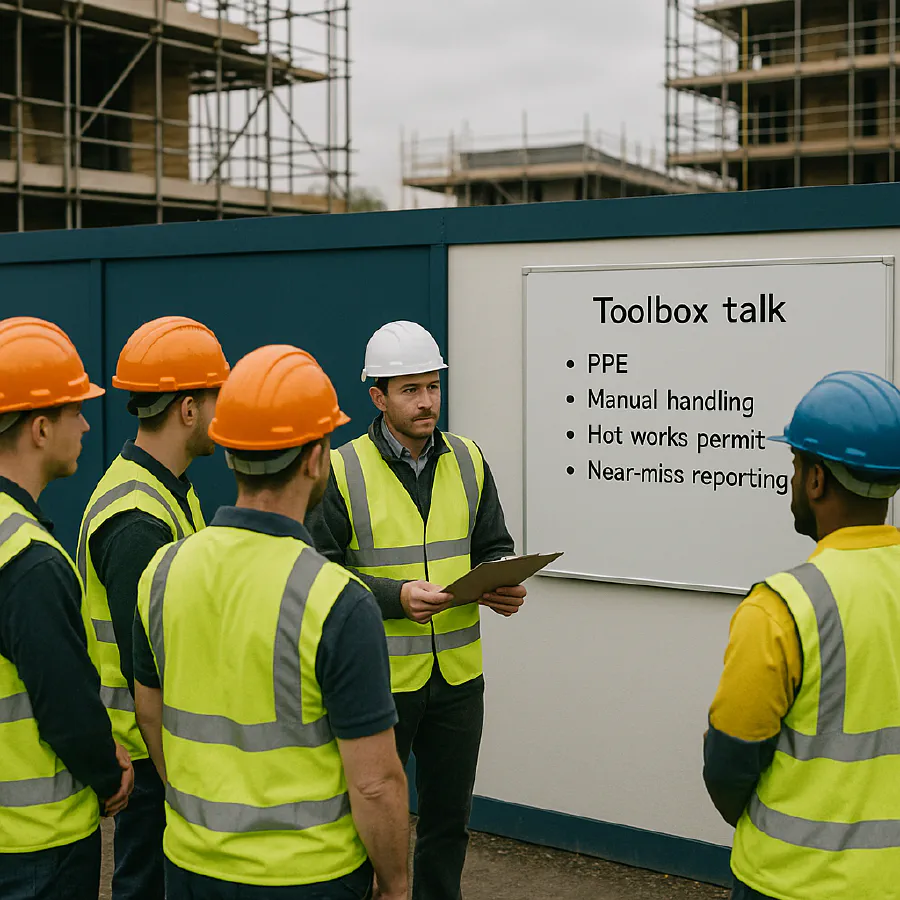
Site supervisor running a toolbox talk huddle on a UK site
Who this is for
- UK builders, electricians, plumbers, HVAC and maintenance teams who want toolbox talks that are short, relevant and accepted by principal contractors.
- Site supervisors and small contractors who need simple scripts and a tidy way to record attendance.
What HSE actually expects
A toolbox talk is a short chat on one safety topic. HSE provides ready talks and explains the purpose clearly. There’s no law that says you must run “toolbox talks” by name, but the law does require you to give your workers information, instruction and training so far as is reasonably practicable. Toolbox talks are a simple way to do that. In 2026, HSE is prioritising short, focused briefings on temporary works basics, correct use of access equipment, fragile surfaces and rescue planning.
Useful sources
- HSE toolbox talks page: https://www.hse.gov.uk/construction/resources/toolboxtalks.htm
- Health and Safety at Work etc. Act 1974, section 2 duties: https://www.legislation.gov.uk/ukpga/1974/37/section/2
- Management of Health and Safety at Work Regulations 1999, reg 10 information for employees: https://www.legislation.gov.uk/uksi/1999/3242/regulation/10
- CDM 2015 and site inductions: https://www.legislation.gov.uk/uksi/2015/51/regulation/15/made and HSE guidance: https://www.hse.gov.uk/construction/safetytopics/site-rules-induction.htm
- 2026 HSE priorities for toolbox talks: focus on temporary works, access equipment, fragile surfaces and rescue planning.

When and how often
HSE doesn’t set a fixed frequency. Brief workers on an ongoing basis, matched to the risks and changes on your job.
Use this rule of thumb
- New phase or high‑risk task starts: do a focused talk before you begin.
- New equipment, method or substance: brief before first use.
- After an incident or near miss: run a short refresher the same day.
- New starters or returners: include in induction on day one.
- Routine cadence: weekly for busy sites or monthly for steady, low‑risk works. Increase frequency if risks are higher.
Pick topics that matter
Choose topics based on your current hazards and season. Examples:
- Working at height and MEWP rescue basics
- Manual handling for awkward plant and boilers
- Hot works and permits
- Temporary electrics, 110V and RCD checks
- Asbestos awareness limits and don’t disturb rules
- Dust control and face fit for RPE
- COSHH for adhesives, sealants and fuels
- Traffic and deliveries on live sites
- Noise, vibration and HAVS limits
- Near‑miss reporting culture
Good free sources for topics and sheets
- HSE toolbox talks: https://www.hse.gov.uk/construction/resources/toolboxtalks.htm
- ECA guides and templates: https://www.eca.co.uk/member-support/health-safety/guides-and-templates
- Protecting.co.uk toolbox talks: https://protecting.co.uk/toolbox-talks/
Run a 5‑minute talk
Keep it at the workface. Make it a conversation.
- Set the scene
- Topic, why it matters on this job, and today’s specific risk.
- Cover 3 key points
- Hazards to watch.
- Controls you expect to see.
- How to report a problem or stop the job if needed.
- Ask two questions
- What could go wrong on this task today
- What do we do if that happens
- Agree actions
- Who is checking equipment or permits
- Any barriers or signage to put in now
- Record and get back to work
Copyable 5‑minute scripts
Manual handling on flats third‑floor install
- Hazards: back strain on stairs, slips, trapped fingers.
- Controls: team lift, use stair climber, take breaks, gloves with grip, clear landings.
- Questions: where are our tight turns who is spotting on the landings
- Action: [Name] on spot, [Name] checks stair climber wheels, call a pause if pace gets rushed.
Working at height on a short duration ladder job
- Hazards: over‑reach, unstable ground, dropped tools.
- Controls: right ladder class, three points of contact, use tool lanyards, firm level base or footing, 10 minutes max on ladder before a change.
- Questions: what’s our alternative if this takes longer where are we tying off
- Action: [Name] checks ladder tag; if more than 10 minutes, switch to a podium or tower.
Hot works in a plant room
- Hazards: fire spread, fumes, hidden combustibles.
- Controls: hot‑works permit, fire watch 60 minutes, extinguishers to hand, covers and spark containment, gas checks, CO monitor.
- Questions: what could catch if a spark travels where do we assemble if alarms go
- Action: [Name] holds permit; [Name] is fire watch with timer and extinguishers.
Near‑miss reporting culture
- Message: we want the near miss, not the injury. Quick photo and note to the supervisor.
- Examples: missing guardrails, trip hazards, plant defects.
- Action: send to [company WhatsApp group or app name]. We will feed back fixes weekly.
Record it properly
Principal contractors often ask for proof. Keep it simple and consistent.
What to capture every time
- Topic, site, date, supervisor
- Key hazards and controls discussed
- Names and signatures of attendees
- Any actions and who is responsible
Storage and retention
- Paper: keep in the site file and scan weekly.
- Digital: store in Google Drive or Microsoft SharePoint with clear folder names by project and month. See our Drive automation guide: https://academy.trainar.ai/servicem8-to-google-drive-with-zapier-uk-how-to-auto-save-job-photos-into-client-folders
Downloads
Printable sign‑in sheet
Copy and paste to your document.
TOOLBOX TALK SIGN‑IN SHEET
Site/Project:
Location/Area:
Date & Time:
Supervisor:
Topic:
Key points covered:

Name | Company | Signature | Time
-----|---------|-----------|-----
 | | |
 | | |
 | | |
 | | |
 | | |

Actions agreed and who is responsible:

Next review date:
One‑page whiteboard checklist
- PPE checks
- Permits in place
- Today’s top three hazards
- Controls we expect to see
- Who to call if something changes
- Near‑miss reporting route
Video
A short UK‑relevant video on effective toolbox talks.
Related TrainAR Academy guides
- RAMS made simple for UK sites: https://academy.trainar.ai/rams-for-uk-construction-simple-steps-free-template-and-how-to-brief-your-team
- Outlook and field app calendar sync issues around BST and GMT: https://academy.trainar.ai/outlook-servicem8jobbertradify-uk-stop-duplicate-calendar-entries-and-fix-bstgmt-shifts
FAQ
Are toolbox talks a legal requirement in the UK
No law names toolbox talks, but UK law requires you to give information, instruction, training and supervision. Toolbox talks are one effective way to meet that duty.
How often should we do toolbox talks
There’s no fixed rule. Do them whenever risks change, for new tasks or equipment, after incidents, for new starters, and on a sensible routine like weekly on fast‑moving sites.
Do we have to keep records
It’s good practice and often required by principal contractors. Keep a simple sign‑in sheet with topic, date, attendees and actions.
What topics are best for a small building firm
Start with working at height, manual handling, hot works, dust and RPE, temporary electrics, traffic and deliveries, and near‑miss reporting.
Ready to Transform Your Business?
Turn every engineer into your best engineer and solve recruitment bottlenecks
Join the TrainAR Waitlist