Traffic marshal ticket: costs, hand signals and the fast way to get on site
Jump To...

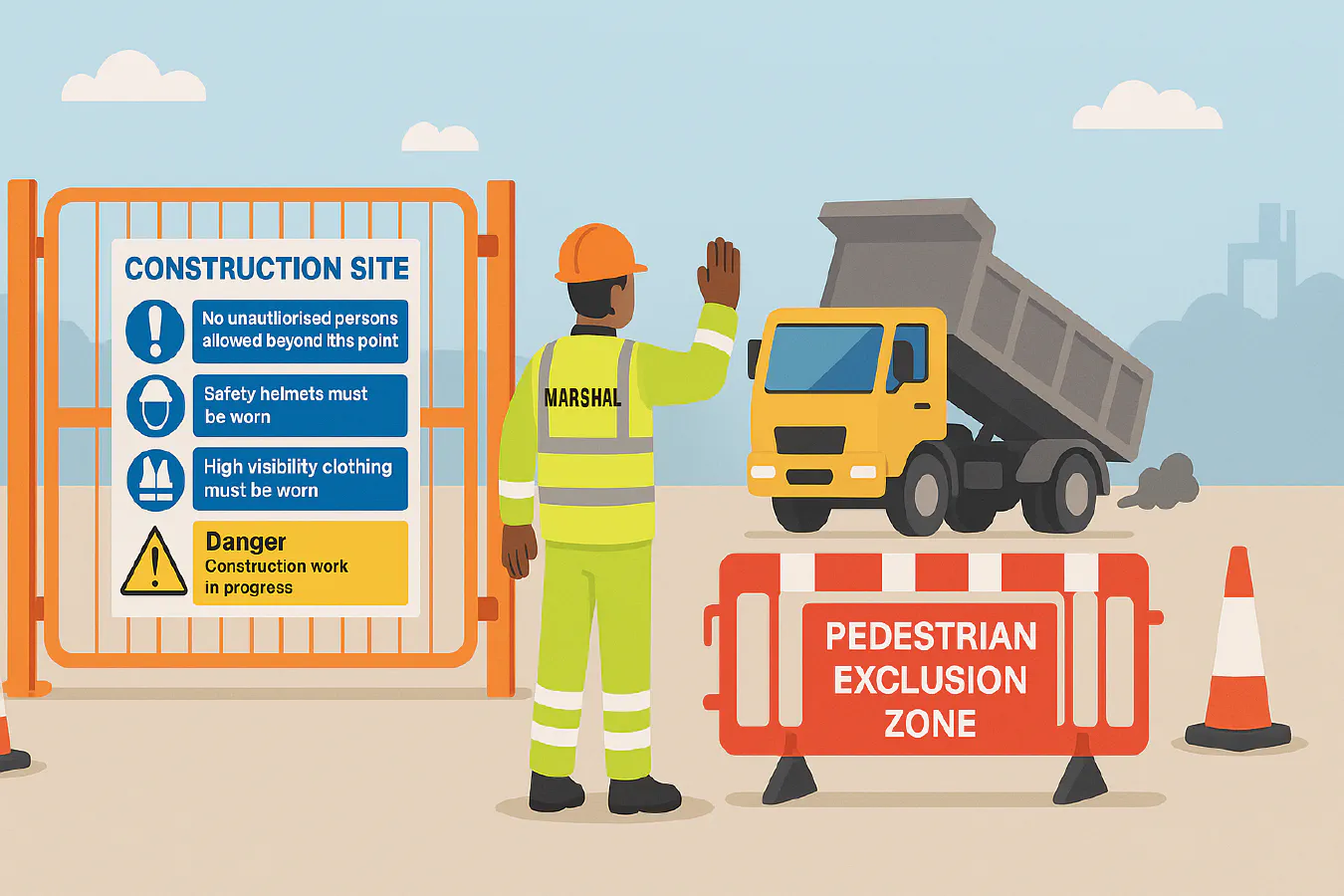
Traffic marshal guiding lorry at a site gate with HSE-standard hand signals
Quick answer
- A traffic marshal ticket is a short course certificate and ID card showing you’re trained to guide site vehicles safely. You’ll also see it called “banksman”.
- Typical course length: half‑day to one day. Validity often 3 years.
- Typical prices: £30 to £160 depending on provider and whether you get a physical photo card on the day.
- Many UK sites will also ask for a CSCS card (usually the Green Labourer card) and a site induction.
- HSE guidance says only use banksmen as a last resort; design your site so reversing is avoided where possible and keep people and vehicles apart.
Useful links: HSE banksmen and signallers, HSE traffic management on site, CITB HS&E test booking, Apply for a CSCS card.
What is a traffic marshal ticket?
A “traffic marshal ticket” is the certificate and often a photo ID you receive after completing a Traffic Marshal or Banksman course. It proves you’ve been trained to direct vehicle and plant movements using agreed hand signals and safe working methods. HSE uses “banksman” for vehicle manoeuvring and “signaller” for lifting operations.
- Role on site: control vehicle entry/exit, guide reversing, enforce exclusion zones, and stop work if you lose sight of the driver.
- Legal angle: Employers must organise safe traffic routes and systems of work. Using a banksman doesn’t remove the duty to design out reversing, segregate people and vehicles, and provide visibility aids. See HSE guidance on banksmen and traffic management.
Do you need CSCS?
Most principle contractors require a CSCS card to access site. For entry‑level traffic marshalling roles, the Green Labourer card is common.
- Book the CITB HS&E Operatives test (£22.50) via the official CITB site or Pearson VUE. Book a test.
- Complete the Level 1 Health and Safety in a Construction Environment qualification if you’re applying for the Green card.
- Apply for the CSCS card (£36) on the CSCS portal. Apply for CSCS.
Avoid third‑party “apply for you” sites that add fees. Use official links above.
How much does it cost?
Recent UK pricing examples:
- Online awareness with card: from around £30 to £55 from various providers.
- Classroom half‑day with photo card: commonly £60 to £160 depending on location and extras.
- CPCS A73 Traffic Marshal course (plant/telehandler interface): specialist route around £895 where CPCS competence is required.
Note: Prices vary. Always check the provider is reputable and that the card you get is recognised by your contractor.
The fast route: get your ticket in a week
Here’s a simple order that gets most people job‑ready quickly:
- Book your Traffic Marshal/Banksman course for the earliest date you can do. Aim for a provider that issues the certificate and photo card the same day.
- In parallel, book your CITB HS&E Operatives test and start revising with a question bank app. Keep your receipt.
- If you don’t already have it, enroll on the Level 1 Health and Safety in a Construction Environment. Many centres turn this around within a few days.
- After you pass the HS&E test and Level 1, submit the CSCS Labourer card application online and pay the £36 fee.
- Keep digital copies of your ticket, CSCS card application proof and test booking. Upload them to your phone wallet and share with agencies.
Tip: Agencies often place you on sites that accept a training certificate and HS&E booking confirmation while your physical CSCS card arrives. Confirm with the site before travelling.
Core hand signals (HSE standard)
Below is a quick refresher of hand signals commonly used for reversing and stopping. Always agree signals with the driver before you start. For visuals, this short video demonstrates the HSE set clearly:
- Stop: One arm raised with palm visible. Driver must stop immediately if they lose sight of you.
- Move straight back: Both arms making a beckoning motion toward your body.
- Move left or right: One arm gestures the direction of the vehicle’s rear, the other indicates the path.
- Slow down: Arms moved up and down slowly with palms facing down.
See HSE’s reference on standard signals and workplace transport signage. HSE signals guide.
Set up a safe system of work
HSE’s hierarchy is clear: avoid reversing first, then control the risk if you must reverse.
- Design: one‑way systems, turning circles, marked reversing pockets, good lighting.
- Separation: barriers, cones, banksman‑only zones, and keep pedestrians out with clear signage.
- Communication: radios if needed, pre‑agreed signals, and the stop rule.
- Vehicles: check mirrors, cameras, reversing alarms and clean windscreens.
- Authorisation: only trained, briefed marshals act as banksmen. Record briefings.
Useful HSE references: Traffic management on site, Reversing, HSG136 Safe site – safe vehicle – safe driver.
Smart checks and record keeping
- Inductions and daily briefings: log who was briefed on routes and signals.
- Permit to reverse: simple checkbox form for high‑risk manoeuvres.
- Photographic evidence: mark up exclusion zones and keep photos in the site diary.
- CSCS and ticket checks: use CSCS Smart Check and keep a record in your induction app or spreadsheet. See our guide to CSCS Smart Check and QR inductions.

Related articles
- Right to work checks on construction sites: what site managers must do in 2025
- CSCS digital skills passport: setup, site checks and a 30 day rollout plan
- How to translate RAMS and site inductions safely with AI
FAQ
Is a “traffic marshal” the same as a banksman? Yes for vehicle movements. For lifting operations the HSE uses “signaller”.
Can I work with just the traffic marshal ticket and no CSCS? Some smaller or private sites may allow it, but most principal contractors will expect a valid CSCS card as well as a site induction.
How long is the ticket valid? Often 3 years, but it’s provider‑dependent. Keep an eye on expiry and set reminders.
Is an online course enough? Awareness‑only courses exist, but many sites prefer a classroom session with practical signalling. Ask recruiters which they accept.
What about street works traffic management? That’s different. For local authority roads you generally need NRSWA O1/S1 or Lantra 12D. See this explainer from NRSWA providers.
What PPE is mandatory for marshalling? Hi‑vis, safety boots, helmet, and gloves as a minimum on most sites. Radios and eye protection based on your risk assessment.
Typical pay? Job boards show around £22k to £34k per year depending on region, nights and experience.
Ready to Transform Your Business?
Turn every engineer into your best engineer and solve recruitment bottlenecks
Join the TrainAR Waitlist