
Quick answer
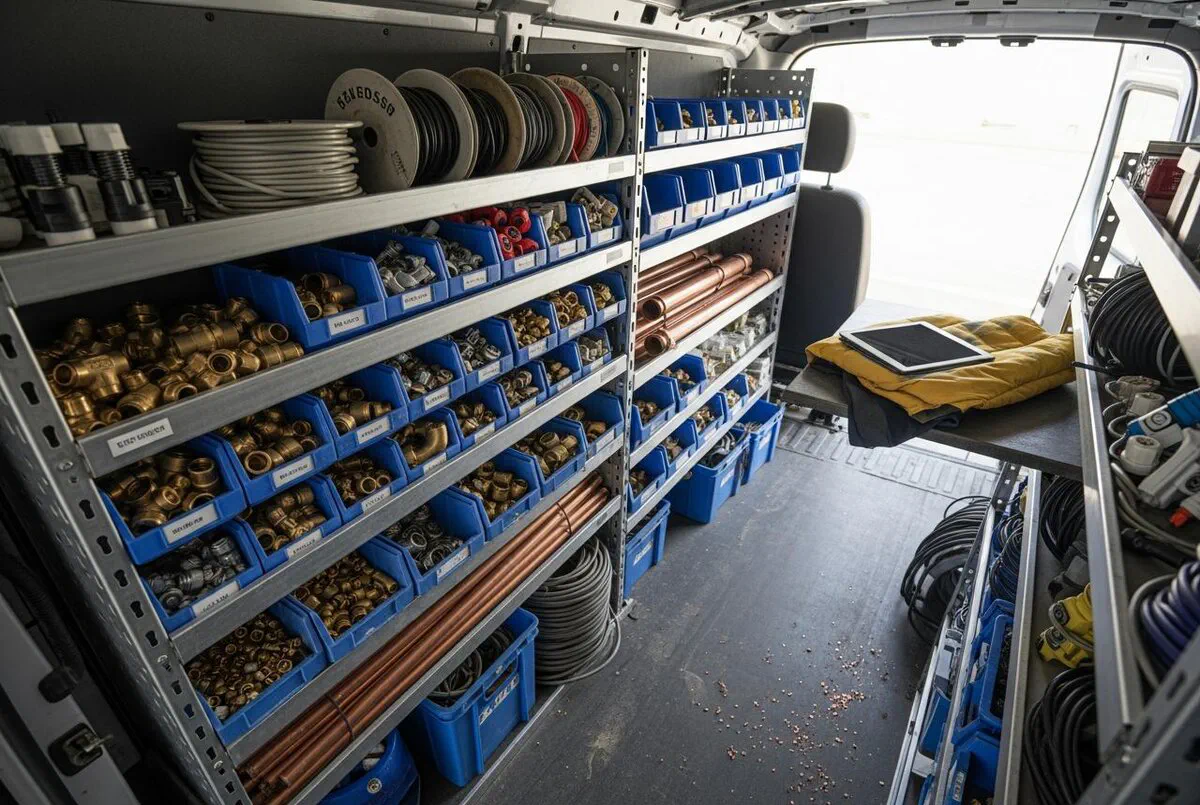
Most UK trades businesses with five-plus engineers lose £2,000 to £5,000 a year in untracked parts, and weekly manual van audits eat 2 to 4 hours per van. The fix is not a fancy warehouse. It is a single source of truth that lives where the parts live: in the van, in the office, on the engineer's phone. Pair that with a sensible reorder point on the 30 SKUs you actually use, and the waste largely disappears. The software side comes later, and only when your physical system already works.
Table of contents
- Why van stock is the most expensive mess in your business
- What untracked stock actually costs (with real numbers)
- Step one: get the physical system right
- The 30-SKU rule and how to set sensible min/max levels
- Choosing software: FSM stock vs dedicated apps
- Where AI and auto-reorder actually earn their keep
- Rolling it out across a five-engineer team without losing a week
- What tradespeople are saying
- Recommended videos
- Frequently asked questions
- My verdict
 Commusoft
 BigChange
 Simpro
 Joblogic
Why van stock is the most expensive mess in your business
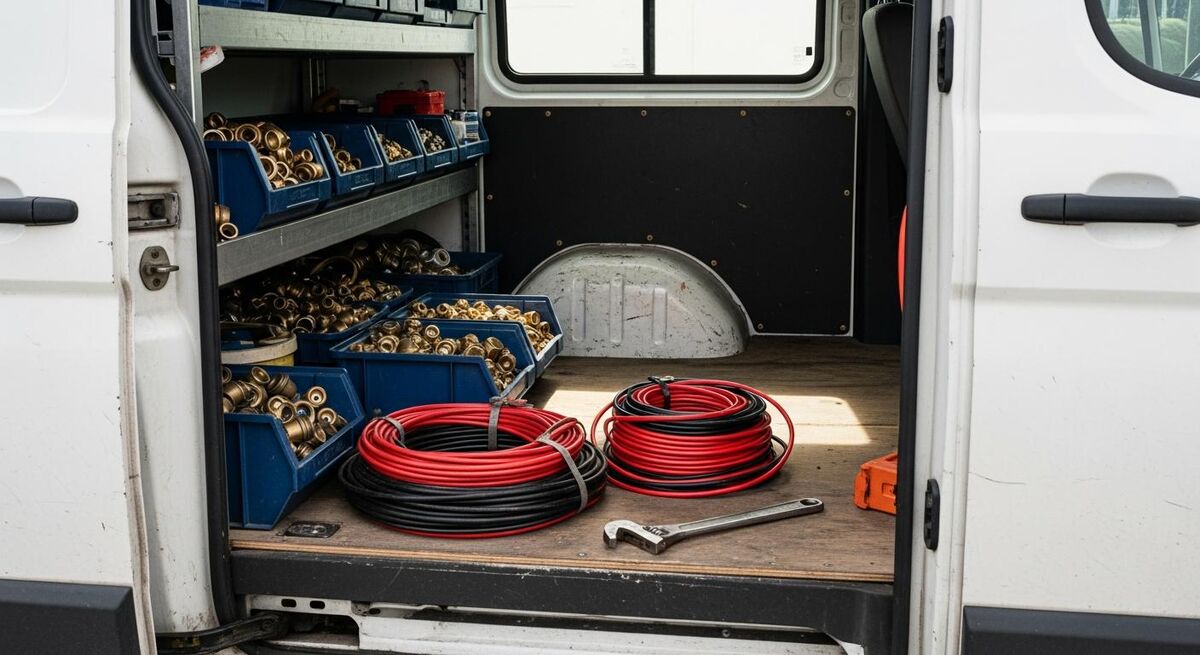
Ask any owner of a five-engineer plumbing, electrical or HVAC business where their margin actually goes, and they will list labour, fuel, insurance, finance, and "I don't know, the merchant". That last one is the problem. Materials should sit at roughly 20 to 30 percent of revenue on most service jobs. When it climbs to 35 percent without anyone noticing, you have a van stock problem. You just cannot see it because nothing tracks it.
The pattern is the same in nearly every business I look at. Engineer one buys two boilers worth of fittings on Monday. Engineer two pulls from his van for a swap on Wednesday and orders his own. Engineer three is now running on whatever has fallen out of the original ten boxes. Nobody knows where the four pumps you bought last quarter actually are. Three of them get scrapped because the box is split and nobody trusts them anymore.
None of this is a software problem. It starts as a physical problem and a discipline problem, and software only helps once the physical and the discipline are in place. This guide walks you through both, in order.
What untracked stock actually costs (with real numbers)
The figures most owners quote are guesswork. Here is what the public data and our own client work consistently shows for UK trades businesses with five to fifteen engineers.
Untracked van stock costs roughly £400 to £1,000 per van per year in pure shrinkage. That is parts written off, lost, damaged in transit, or bought twice because the first one could not be found. For a five-van team that is the £2,000 to £5,000 in the brief. It is not catastrophic on its own, but it is pure margin, and it grows year on year if you ignore it.
The bigger number is wasted time. Filplastic surveyed 168 UK tradespeople and found 55 percent waste between 30 minutes and an hour every working day searching for tools and parts in their vans. Their MD, Paul Taylor, put it plainly: "There's a lot of different tools, fixtures and fittings that tradespeople must store in their vans for every eventuality, but keeping everything tidy is difficult when you're driving around or rummaging for the item you specifically require." Applied to a five-engineer team on £498 a week each, that is roughly £8,000 to £16,000 a year in productive hours lost to disorganisation alone.
Then there is the first-time fix rate, which is where the proper money lives. IBM and Aberdeen Group benchmarks put the industry average around 75 to 80 percent. The top quartile sits at 88 percent. The bottom sits at 63 percent. The gap is almost never about engineer skill. It is about whether the right parts were in the right van when the engineer left the depot. A 10 point swing in first-time fix on a five-engineer team is worth somewhere between £18,000 and £30,000 a year in recovered revenue, depending on average job value. That dwarfs the shrinkage number.
If you want a single sentence to take to your accountant: every percentage point of first-time fix is worth more than your entire annual van stock budget.
Step one: get the physical system right
Before any app, before any reorder algorithm, before you even open a spreadsheet, your physical system has to work. The single most common mistake I see is teams trying to fix the problem in software while the vans themselves are still chaos. It never works. The data in the system is only as good as the discipline in the van.
Every van needs the same layout. Not similar. Identical. Same racking, same labelled bins, same shelf for the same SKUs, same first-aid kit in the same place. When engineer two covers engineer three's job, they should be able to open the side door and know exactly where the 22mm compression elbows live. The cost of standardising racking across five vans is somewhere between £400 and £900 a van for a proper system from Bri-Stor, Bott, or System Edstrom. You will recover it inside six months on time saved alone.
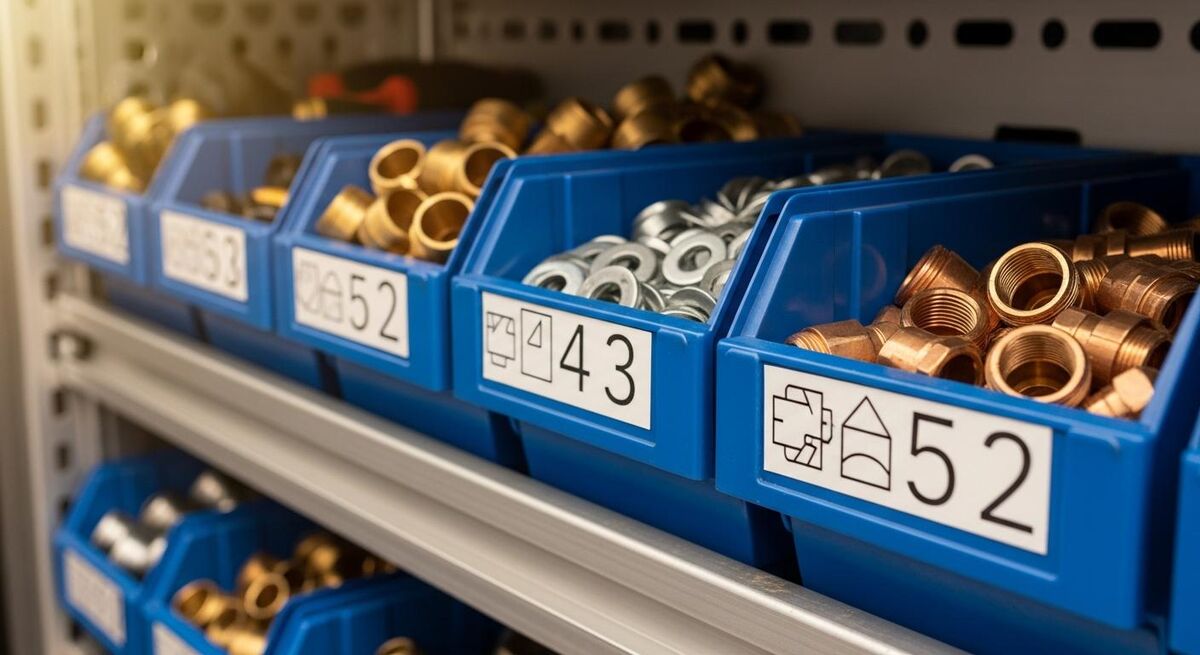
Labels matter more than people realise. Print them. Laminate them. Stick them to the bin, not the shelf, so when the bin moves the label moves with it. Use the same product code that your wholesaler uses. If Plumbase calls it "BES 1041", your label says "BES 1041" and nothing else. Engineers should not have to translate between three different names for the same fitting.
One owner I worked with had a brilliant rule. Every van does a five-minute tidy at the end of every Friday. Not a full audit, just a tidy. Bins back where they belong, empties binned, anything obviously out of place sorted. It took ten minutes a week per engineer and it dropped his weekly merchant run frequency by roughly a third inside two months. No software. Just discipline.
The 30-SKU rule and how to set sensible min/max levels
Most trades businesses try to track everything. That is a mistake. The Pareto principle applies brutally here. Roughly 30 SKUs make up about 80 percent of your usage. Track those properly and you have solved most of the problem. The rest can sit in a shared spreadsheet or just be re-ordered as the engineer notices.
To find your 30, pull twelve months of merchant invoices and sort by line count, not value. The fitting you bought 600 of in single units is more important to track than the boiler you bought twice. You want frequency, not spend. Most plumbing and heating businesses end up with a list that looks like this: 15mm and 22mm compression fittings, push-fit equivalents, flux, solder, gas tape, PTFE, common WRAS valves, immersion elements, motorised valve heads, condensate trap kits, a handful of branded pump spares, and a small set of consumables like silicone and PVA.

For each SKU, set two numbers. A reorder point, which is the level at which you reorder, and a max, which is the level you reorder up to. The reorder point should be roughly two weeks of average usage. The max should be roughly six weeks. So if you fit on average 20 of a particular fitting per fortnight, your reorder point is 20 and your max is 60. When the van drops to 20, you reorder up to 60.
That sounds obvious until you realise most teams have no number at all, so engineers either hoard ("I'll grab a hundred just in case") or run dry ("I'll get some next time I'm near the merchant"). Both are expensive in different ways. The hoarder ties up cash and creates clutter. The dry runner kills your first-time fix rate.
| SKU category | Typical reorder point | Typical max | Why this matters |
|---|---|---|---|
| 15mm/22mm fittings (compression, push-fit) | 2 weeks | 6 weeks | Highest turnover. Reorder little and often. |
| Consumables (PTFE, flux, solder, silicone) | 2 weeks | 8 weeks | Cheap, long shelf life, very expensive to run out of. |
| Common branded spares (pumps, motors) | 1 per van | 2 per van | High-margin first-time fix items. Worth carrying. |
| Specialist boiler parts | 0 per van | 1 in main store | Order on demand. Carrying spares ties up cash. |
The tracking method itself can be a Google Sheet to start with, one row per SKU, columns for each van, weekly count by the engineer on the Friday tidy. It is not glamorous. It absolutely works. You can graduate to software later, once you know what the actual numbers look like.
Choosing software: FSM stock vs dedicated apps
Once the physical system holds together for three months and the spreadsheet is being filled in honestly, you are ready for software. There are two routes. Use the stock module inside your field service management (FSM) platform, or run a dedicated inventory app alongside it. Each has a real reason to exist.
If you already run Commusoft, BigChange or Simpro, your default should be to use the built-in stock module. The benefit is that parts can be allocated to jobs directly from the engineer's mobile app, which automatically depletes the van inventory and updates job cost in real time. No double entry. No separate logins. The cost is that none of the three has a stock module that earns universal love. Commusoft's parts management is the cleanest of the three for trades-shaped businesses and tracks parts from purchase order through to van and final job allocation. BigChange tracks van and warehouse stock with check-in/check-out scanning but Trustpilot reviewers regularly call out the stock and equipment side as harder to set up than the rest of the platform. Simpro Premium has a proper warehouse hierarchy with aisle, rack, shelf and bin levels, and ABC analysis built in, but it is the most complex to roll out and has the steepest learning curve.

The dedicated route uses something like Sortly, QR Inventory, or one of the newer trades-specific apps. These are simpler, faster on a phone, and engineers tend to actually use them. The trade-off is that stock is no longer joined up with jobs and accounting unless you build an integration. For a business that does not already have an FSM, a dedicated app plus a Xero or QuickBooks link is often the cheapest path to a working system.
The question I would ask is brutally practical: which system will your engineers open every day without being chased? If the answer is "the FSM, because they use it for everything else", build stock into the FSM. If the answer is "they barely open the FSM", go with a phone-first dedicated app and accept the integration cost.
| Approach | Best for | Typical cost | Watch-out |
|---|---|---|---|
| FSM stock module (Commusoft, BigChange, Simpro) | Teams already on a full FSM and using it daily | Included in plan, £60–£120 per user per month | Setup time is real. Allow 2–4 weeks to load SKUs properly. |
| Dedicated inventory app (Sortly, QR Inventory) | Smaller teams or those without a full FSM | £25–£60 per month total | Will not flow to jobs or accounts unless integrated. |
| Spreadsheet plus weekly count | Two to four engineers, simple service work | Free | Caps out around 5 vans before it breaks under its own weight. |
| FSM plus dedicated app side by side | Larger teams running a transition | £40–£100 per month plus FSM | Double entry risk. Avoid as a permanent state. |
Where AI and auto-reorder actually earn their keep
The AI angle in stock management is interesting and most of it is still hype. Here is what actually works in 2026 and what is still a year or two off.
Auto-reorder based on simple min/max thresholds is mature and works well. Every serious FSM and inventory tool supports it. Set the reorder point, set the supplier, and the system fires a purchase order automatically when the count drops. This is not AI, it is rules, and it is the single highest ROI feature in any stock platform. Turn it on for your top 30 SKUs and you will see your "stock out at the worst moment" incidents drop by something like 70 percent inside a quarter.

The new thing is AI prediction based on your forward job schedule. The pitch is: the system sees you have eight boiler services and three landlord safety checks booked next Tuesday, knows the average parts profile for each, and pre-allocates van stock accordingly. The early implementations of this inside Commusoft and Simpro are decent for high-volume repeat work like boiler servicing, where the parts profile is predictable. They are less useful for reactive work, where you do not know what is needed until the engineer is on site. If 70 percent of your work is planned servicing, AI scheduling-based stock prediction is worth turning on. If 70 percent is reactive call-outs, it will not move the needle.
Where I would not yet trust AI is full demand forecasting based on weather, seasonality and historical patterns. The models work in retail because the data sets are huge and the SKUs are stable. For a five-engineer plumbing firm with 30 SKUs and three years of slightly patchy data, the forecasts are about as accurate as your gut. Save the licence fee.
Rolling it out across a five-engineer team without losing a week
This is the part most owners get wrong. They buy the software, expect engineers to figure it out, and three months later nobody is using it. The rollout matters as much as the choice.
Here is a 30-day plan that works. Week one is physical. Standardise racking and bins in every van. Print and laminate labels. Do a proper count of every SKU in every van and write it down. Pay your engineers for the time. Week two is your top-30 list. Build it from the merchant invoices, set reorder points and max levels, and put it in a shared sheet. Week three you do the same with software in parallel, in shadow mode. Engineers count by hand on Friday and someone in the office enters it into the software, so engineers do not have to learn the tool while the data is still being cleaned. Week four you flip. Engineers count directly into the app. The office spot-checks.
After 30 days you keep the Friday count for another 8 weeks, because that is how long it takes to trust the numbers. Around week 12 you cut the Friday count to monthly and rely on the running totals. That is the moment you are actually running on the system.
One last point. Pay people for the time. The 5 to 10 minutes a day a stock system needs from an engineer is paid time, on the clock. The moment it feels like unpaid admin, it stops happening, and the system dies. Treat it the same as filling in a job sheet. It is part of the job.
If you want a wider operating systems view of how stock sits alongside scheduling, pricing and reporting, the trades business systems playbook covers the seven layers that need to wire together. For the dedicated inventory app side, the small-business inventory comparison looks at Tradify, Vospers and spreadsheets for teams under five engineers. If van security is also on your mind, the tool insurance guide is worth a read alongside.
What tradespeople are saying
Recommended videos
How to stock truck/van for plumbing
Roger Wakefield · Practical stocking walkthrough
Stocking the right parts in electrical service vans
Electrician U · Save space, fuel and stock the right parts

Plumbers van tour UK
UK plumber walks through a real working van setup
Inventory management with Simpro
Simpro official · Real-time stock tracking demo
Getting started with Simpro stock & Job P&L
Platinum Consultants · A practical setup walkthrough

Commusoft: Connect & Preview 2025
Commusoft official · Stock and parts feature roadmap
Frequently asked questions
Enough to fix the top 80 percent of jobs you do without a merchant run. Pull twelve months of invoices, find the 30 SKUs that drive most of the work, and stock six weeks of average usage of each. Anything beyond that is just clutter and tied-up cash.
A spreadsheet plus a weekly count works fine up to about four vans. Beyond that the admin gets painful and the data goes stale. Five-plus engineers is roughly the point where software starts paying for itself.
Commusoft is cleaner for trades-shaped businesses and tracks parts from PO through to van and final job allocation reliably. BigChange has the broader fleet and scheduling layer but reviewers consistently flag the stock module as harder to configure. Run a proper POC on your real SKUs before you commit either way.
Four weeks of focused work and roughly 12 weeks before you can trust the numbers without a manual Friday count. Anyone promising it inside a week is selling you a demo, not a working system.
Stand at the back of each van and physically count the top 10 fittings. Compare it to what the engineer thinks is there. The gap will tell you exactly how much you have been losing and will make the case for everything else.
Auto-reorder on min/max thresholds is mature and worth turning on day one. Schedule-based parts pre-allocation pays off if you do meaningful volumes of repeat servicing. Full demand forecasting is still mostly noise for businesses with fewer than 50 engineers.
My verdict
The teams that fix this never start with software. They start with identical racking, labelled bins, and a Friday five-minute tidy. They build a top-30 SKU list from real merchant invoices, set sensible reorder points, and run it on a spreadsheet for a quarter. Only then do they choose between FSM stock or a dedicated app, based on which one their engineers will actually open every day. Done in that order, the £2,000 to £5,000 a year in shrinkage largely disappears, first-time fix climbs five to ten points, and the weekly merchant chaos turns into a planned order. Done in the wrong order, you end up paying for software that nobody uses while the vans stay as messy as they were.