
WhatsApp & Google Forms: Automated Reviews for Trades (2026)
Jump To...

Who this is for
- UK sole traders and small teams in electrical, plumbing, HVAC, building, maintenance, and specialist installs
- Businesses already running jobs and customer comms through WhatsApp Business
- Anyone who wants a lightweight, no-code feedback and review capture flow
- Firms working with contractors, councils, or commercial clients who now expect auditable review processes
What this guide covers
- A field-friendly QR - WhatsApp - Google Forms feedback loop that works on site
- Automation options (no-code to API) with realistic UK costs
- Message templates that nudge reviews without triggering complaints or bans
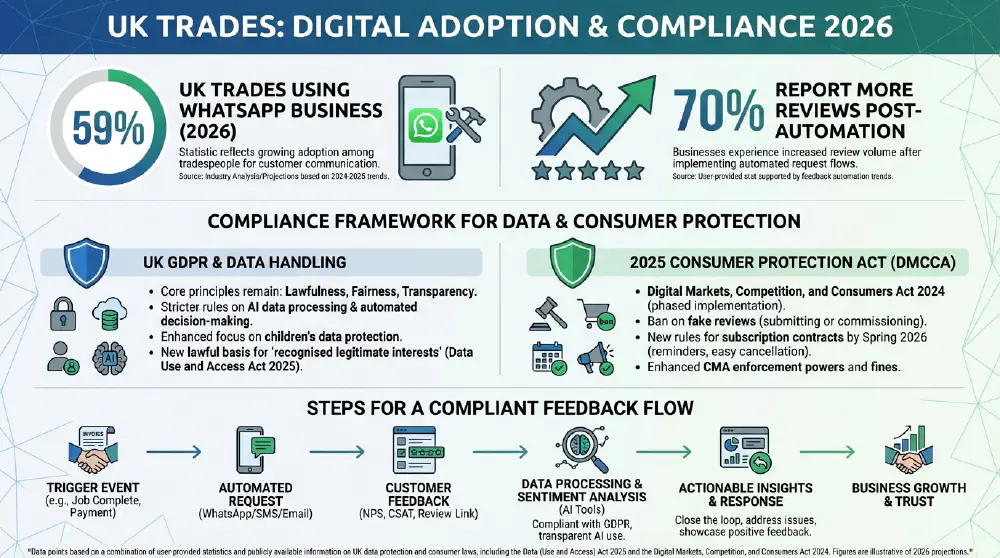
- 2025 to 2026 compliance: authentic reviews, consent, opt-out, and audit trails
The real shift in 2026: reviews are operational, not cosmetic
For UK trades, reviews are no longer a nice-to-have marketing asset. They are now part of how customers validate risk: “Will you turn up, do the job to spec, and sort snags?” Increasingly, they are also part of procurement. On larger commercial work, “recent, credible feedback” has started to show up informally in tender scoring and supplier selection.
WhatsApp and Google Forms win here for one reason: they match how trade businesses already work. WhatsApp is where the customer replies fastest, and Google Forms is the quickest way to standardise what you collect after the job. Put together, they give you a repeatable workflow that works on a phone, in a van, at a boiler cupboard, or after an EICR.

The workflow: QR to Form to WhatsApp follow-up
The best systems feel invisible to the customer. They should not feel “marketed to”. They should feel looked after.
A clean 2026 flow looks like this:
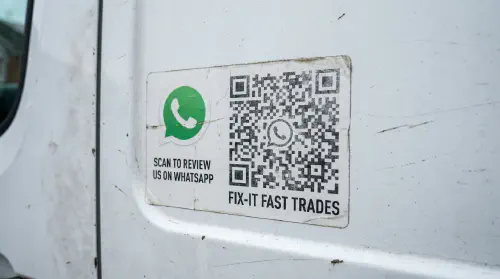
- Customer scans a QR code on your invoice, van, job sheet, or handover card
- They land on a Google Form with two jobs:
- capture private feedback (snags, comms, cleanliness, punctuality)
- capture permission and preferences (contact/opt-out)
- Your Google Sheet logs the submission (this is your audit backbone)
- Automation sends a WhatsApp message:
- a thank you
- an opt-out line
- a Google review link when appropriate
The point is not to “spam for stars”. The point is to build a defensible, repeatable customer closeout, like a digital version of leaving the site tidy and walking the client through the isolator location.
Tooling choices that are realistic for UK trades
You have three practical lanes. Pick based on volume and how much control you need.
Lane A: Simple and cheap (manual WhatsApp, structured Form).
Use a QR to Google Form, then send the WhatsApp message yourself using a saved template. This is perfect for micro teams doing a few jobs a week, and it avoids API complexity.
Lane B: No-code automation (Google Forms/Sheets + Make or Zapier + WhatsApp API via a provider).
This is the “set it once, run it every job” option. It is also the easiest to audit, because you can show what triggered what, and when. Pricing varies by provider and message volume, but plan for:
- automation platform subscription (Make/Zapier)
- WhatsApp Business API costs via your BSP
- template message charges from Meta (your provider will itemise this)
Lane C: Specialist WhatsApp form tools (lightweight conversational capture).
Some tools turn a form into a WhatsApp conversation. This can lift completion rates, but you need to be careful on compliance, logging, and how the data is stored.
If you want the fastest internal setup path, pair this guide with TrainAR’s Set Up a Google Reviews QR Code for Your Vans and Invoices and WhatsAppFirst Lead Triage for Trades Autoreplies That Book Surveys in 10 Minutes.

Compliance in plain English: what changed, and what you must do
Two things matter in 2026: authenticity and auditability.
Reviews: authenticity is now enforceable
The UK has moved from “platform policy” to “consumer law teeth” on reviews. Under the Digital Markets, Competition and Consumers Act 2024, fake reviews and misleading review practices can trigger enforcement. Start here: https://www.gov.uk/government/news/fake-reviews-and-sneaky-hidden-fees-banned-once-and-for-all and the CMA’s guidance pack: https://www.gov.uk/government/publications/fake-reviews-cma208
Operationally, for a trade business, that means:
- Do not fabricate reviews, buy review bundles, or “gate” reviews in a misleading way.
- Keep evidence that a review request was sent to a real customer after a real job.
- If you incentivise reviews, disclose it clearly and do not require positivity.
Messaging: direct marketing rules still apply
If you are sending review requests, you need a lawful basis and a simple opt-out. For many small trade firms, this is typically handled as legitimate interests, but you still need to do it properly and document it. ICO guidance: https://ico.org.uk/for-organisations/direct-marketing-and-privacy-and-electronic-communications/sending-direct-marketing-choosing-your-lawful-basis/
A practical “site-ready” compliance pattern:
- Tell customers at booking or before job start that you will request post-job feedback
- Include opt-out in every WhatsApp template: “Reply STOP to opt out”
- Log the send event (sheet entry, automation run history, or BSP message log)
- Keep your privacy notice updated to mention WhatsApp and feedback processing
If you work in environments where children might reasonably access the form (for example, domestic jobs where a child uses the household phone), read the ICO Children’s Code overview and ensure your collection is appropriate: https://ico.org.uk/for-organisations/childrens-code/
Message templates that actually work (without looking desperate)
What you send matters. The best messages read like a professional closeout, not a marketing blast. Keep them short, specific, and personal.
Completion message (send within 1 to 2 hours of finishing):
“Hi {first_name}, it’s {engineer_name} from {company_name}. All done with your {job_type} today. Happy with everything? If you’re pleased, a quick review makes a huge difference: {review_link}. If not, reply here and I’ll sort it. Reply STOP to opt out.”
Nudge (48 to 72 hours):
“Hi {first_name}, just checking in - did the {job_type} meet expectations? If you’re happy, a quick review helps us keep prices fair: {review_link}. If anything’s not right, reply here and we’ll fix it. Reply STOP to opt out.”
The tone is deliberate: it invites issues privately without implying you are filtering public reviews. If your process starts to look like systematic “positive-only routing”, you drift into risk territory under CMA expectations.
The audit trail: the bit that wins commercial trust
If a contractor or a council asks, “How do you know these reviews are genuine?”, you want to be able to answer without scrambling.
Minimum viable audit pack:
- Google Sheet row per job: date, job ref, customer contact, form submitted timestamp
- WhatsApp send logs from your BSP or automation run history
- A short public reviews policy: incentives, moderation stance, complaint handling
- Retention plan: how long you keep logs, and how you handle subject access requests
For teams scaling engineers, treat this like documentation for Part P or commissioning paperwork: it is not glamorous, but it stops pain later.
FAQs
Can I automate WhatsApp review requests without getting banned?
Yes, if you use approved WhatsApp Business API providers and stick to template rules, sensible frequency, and opt-outs. Avoid unapproved automation tools and bulk messaging people who have not reasonably expected follow-up.Can I offer a discount or voucher for reviews?
You can, but you must clearly disclose the incentive and you cannot require a positive review. If the incentive is conditional or hidden, you are creating compliance risk.Should I only send the Google review link to happy customers?
You can ask for private feedback first as part of good service recovery. But if you systematically prevent certain customers from accessing the same review route, it can become misleading at scale. Keep the process fair and defensible.Where do I sanity-check what other businesses are doing?
Two useful communities for real-world discussion are r/nocode for automation patterns and r/WhatsappBusinessAPI for WhatsApp API tooling and pitfalls.What if a customer leaves negative feedback in the Form?
Treat it like a snag list. Reply quickly, record the resolution, and close the loop. A well-handled complaint often converts into a later review and protects your reputation better than chasing stars.
Training and resources
TrainAR internal reading
- Set Up a Google Reviews QR Code for Your Vans and Invoices
- WhatsAppFirst Lead Triage for Trades Autoreplies That Book Surveys in 10 Minutes
- How to Get More Google Reviews for Your Trade Business Legal Ways That Work Now
Video
Official guidance and sources used
- UK government announcement on banning fake reviews and enforcement context: https://www.gov.uk/government/news/fake-reviews-and-sneaky-hidden-fees-banned-once-and-for-all
- CMA guidance: Fake reviews (CMA208): https://www.gov.uk/government/publications/fake-reviews-cma208
- ICO guidance on lawful basis for direct marketing: https://ico.org.uk/for-organisations/direct-marketing-and-privacy-and-electronic-communications/sending-direct-marketing-choosing-your-lawful-basis/
- ICO Children’s Code overview: https://ico.org.uk/for-organisations/childrens-code/
- Ofcom online habits and UK app usage context: https://www.ofcom.org.uk/media-use-and-attitudes/online-habits/from-apps-to-ai-search-how-the-uk-goes-online-in-2025
- Twilio WhatsApp pricing: https://www.twilio.com/en-us/whatsapp/pricing
- Make pricing: https://www.make.com/en/pricing
- WhatsForm pricing: https://whatsform.com/pricing
- ASA advice on fake consumer reviews: https://www.asa.org.uk/advice-online/fake-consumer-reviews.html
Want to slash training times and increase revenue per Engineer? Join our Waitlist: https://trainar.ai/waitlist
Ready to Transform Your Business?
Turn every engineer into your best engineer and solve recruitment bottlenecks
Join the TrainAR Waitlist