
Quick Answer
If you haven't touched your Google Business Profile in the last 30 days, Google is already starting to forget you exist. For me, the monthly routine is dead simple: upload 4-8 fresh job photos, publish one Google Post, reply to every single review, and check your business info hasn't been edited by Google or a random member of the public. That takes about 20 minutes once a month. Skip it and your competitors who ARE doing it will quietly push you out of the local 3-pack, right? Do it consistently and you'll stay visible to the 44% of local searchers who click on those top three map results.
Table of Contents
- Why your Google Business Profile goes stale after 30 days
- What Google actually looks at in 2026
- The monthly GBP maintenance routine
- Photos and posts: the freshness signals that move the needle
- Reviews: the engine behind your local ranking
- How AI search is changing local discovery
- Your 12-month GBP timeline
- What the local SEO community is saying
- Recommended videos
- Frequently asked questions
- My verdict
Why your Google Business Profile goes stale after 30 days

Right, let me be straight with you. I've been building out websites, running SEO, and managing Google Business Profiles for heating engineers and trades businesses for over three and a half years now. And the single biggest pattern I see with businesses that aren't getting leads? Their GBP has been gathering dust.
Google treats your Business Profile like a shop window. If the window display hasn't changed in a month, people walk past. Google does the same thing with its algorithm. Profiles that go 30 or more days without new photos, posts, or review activity start sending weaker signals to Google's ranking system. It's not a dramatic cliff edge where you vanish overnight, but it is a slow fade. And in a local market where three businesses get 44% of all clicks, a slow fade is all it takes to drop from position three to position six, do you know what I mean?
The WhiteSpark 2026 Local Search Ranking Factors report, which I covered on my YouTube channel earlier this year, confirms what I've been seeing across my partners' accounts. Google now rewards businesses that look alive. Not businesses that just exist. Active review responses, recent photo uploads, fresh Google Posts, updated service lists. These are the signals that separate the businesses sitting in the local 3-pack from the ones buried on page two.
What Google actually looks at in 2026
I use something I call the CAT framework when I'm explaining local SEO to my partners. Content, Authority, and Technical. In some recent research, we found that 61% of "Local Map" ranking factors are down to the strength of the website across Content, Authority, and Technical ranking factors. Content accounts for just 15% of ranking factors in the map area, but 35% of ranking factors on Google organic search. That tells you something important: your Google Business Profile and your website work together. You can't just optimise one and ignore the other.
According to the WhiteSpark 2026 report, the ranking factors that actually move the needle for the local 3-pack break down like this:
| Ranking factor | Influence | What it means for you |
|---|---|---|
| Google Business Profile signals | ~25-32% | Categories, completeness, photos, posts, Q&A |
| Reviews | ~16-20% | Volume, velocity, recency, response rate, sentiment |
| On-page SEO (website) | ~19% | Local content, service pages, NAP consistency |
| Links and citations | ~11% | Directory listings, local backlinks |
| Behavioural signals | ~7% | Clicks, calls, direction requests from your profile |
Note: Proximity — how close your business is to the searcher — accounts for roughly 55% of local ranking decisions according to the WhiteSpark 2026 data, but it is completely uncontrollable. The percentages above show factors you can influence, which is where your effort should go.
Look at that table. GBP signals and reviews together account for roughly half of what determines your controllable local ranking factors. And both of those categories are things you can directly influence with 20 minutes of effort each month. You can't move your business closer to the searcher, but you absolutely can upload fresh photos, respond to reviews, and keep your profile active.
The monthly GBP maintenance routine

For me, this is where the rubber meets the road. I've tested this across 14 partners and the businesses that follow a monthly routine consistently outperform the ones that don't. It's not complicated, it just needs to be consistent. Here's exactly what I do on the first Monday of every month:
Step 1: Check your business information (2 minutes)
Log into your Google Business Profile and verify that your business name, phone number, address, service areas, and opening hours are all correct. Google and members of the public can suggest edits to your profile, and sometimes those edits go live without your approval. I've seen phone numbers swapped, opening hours altered, and even business titles edited by random users. Two minutes to check. Don't skip it.
Step 2: Upload fresh photos (5 minutes)
Add 4-8 new photos from recent jobs. Real photos from real jobs. Not stock images, not the same van photo you uploaded six months ago. Businesses with photos on their profiles receive 42% more requests for driving directions and 35% more clicks through to their websites. Your phone is full of job photos already. Pick the best ones and upload them.
Step 3: Publish a Google Post (5 minutes)
Write one post about a completed job, a seasonal service reminder, or a helpful tip. Mention the town or area you worked in. Google Posts expire after seven days in the main feed, but they remain visible in the "Updates" tab and the freshness signal they send to Google persists longer. One post a month is the minimum. Weekly is better if you're in a competitive area. And if you're already posting job photos on social media, repurpose that content here too.
Step 4: Respond to every review (5 minutes)
Every single one. Positive reviews get a personal thank you that mentions the service you did and the area. "Thanks Paul, glad the boiler service in Hillsborough went smoothly" is a thousand times better than "Thanks for the review." Negative reviews get a professional, calm response. Never argue. The review response isn't for the person who left it; it's for the 50 people who'll read it before calling you.
Step 5: Check your insights (3 minutes)
Open the Insights tab and check three things: what search terms people are finding you with, how many people called or visited your website, and how your numbers compare to last month. This isn't vanity metrics. If your calls dropped, something changed. If a new search term appeared, there might be demand you're not serving yet.
Photos and posts: the freshness signals that move the needle
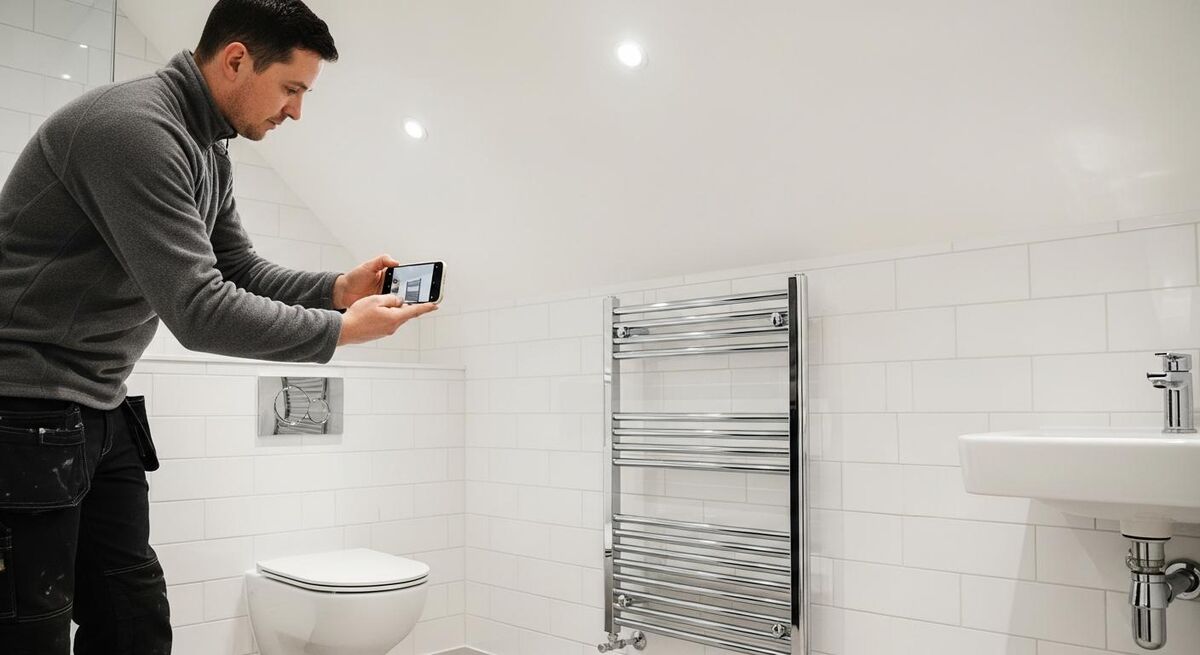
I want to dig deeper into photos and posts because this is where most trades businesses completely drop the ball. You fit a beautiful bathroom, you install a boiler that's going to last 15 years, you rewire a house from top to bottom, and then you don't take a single photo. Or you take photos but they sit on your phone forever. For me, every completed job is content. Every before-and-after is a freshness signal.
A profile with 80 photos all uploaded three years ago does not send the same signal as one with steady uploads across recent months. Google can see when photos were uploaded. A burst of 20 photos in January followed by nothing until December tells Google you're not consistently active.
What to photograph each month:
- Completed installations (before and after)
- Your team at work (real workwear, real settings, not posed stock photo rubbish)
- Your van with branding visible
- Equipment and materials for specialist work
- The area you're working in (street level, neighbourhood shots)
Google Posts are slightly different. They appear on your profile and in Google Maps search results. There are four types: Updates, Offers, Events, and Products. For trades businesses, Updates work best. Keep them short, mention a real location, and include a call to action like "Call for a free quote." One post a month is the bare minimum. Businesses posting weekly see 28% more website clicks than those posting monthly or less, according to SOCi research.
Reviews: the engine behind your local ranking
Right, let's talk about reviews. Because if there's one thing I bang on about with my partners, it's this: reviews are not optional. They're not a nice-to-have. Reviews are worth over 15% of your local pack score. The competitive baseline for most UK local businesses is 15 to 50 quality reviews. Businesses in the top three local pack positions average over 200 Google reviews. That's the gap you're competing against.
But here's what most people miss. It's not just about the total number. Review velocity matters, which means how many new reviews you're getting per month. Review recency matters, because a business with 200 reviews but nothing in the last three months looks dormant. And review sentiment matters, because Google's algorithm in 2026 actually reads the content of your reviews, not just the star rating.
How to build a review engine:
- Ask every customer after every completed job. In person, while you're still there. "Would you mind leaving us a quick Google review? It really helps."
- Send a follow-up text or WhatsApp message with a direct link to your Google review page. Make it one tap.
- Aim for 2-4 new reviews per month as a minimum.
- Respond to every review within 48 hours. Every single one.
- Never incentivise reviews with discounts or freebies. Google's terms prohibit it and you'll get flagged.
How AI search is changing local discovery

This is the bit that gets me super super excited, right? Google's AI Mode is now pulling from the same engagement signals I've been talking about, review recency, photo freshness, post activity, service completeness, when deciding which local businesses to surface in AI-generated answers. For the first time ever, AI search signals have entered the WhiteSpark ranking factors study.
What does this mean in practice? When someone asks Google's AI "Who's the best plumber in Sheffield?" or "Find me a reliable electrician near me," Google's AI isn't just looking at your star rating. It's looking at whether your profile is actively maintained. Fresh reviews, recent photos, updated services, consistent posting. These are the signals that tell the AI your business is current, active, and trustworthy.
Businesses with stale profiles aren't just slipping down the map pack. They're becoming invisible to AI-powered discovery entirely. And AI search is only going to grow. The businesses that build good GBP habits now are the ones that'll benefit most as AI becomes the default way people find local services.
As one local SEO expert put it: "People are increasingly using AI tools to research and find local services. This bypasses all the normal search behaviours and can make a static profile redundant." That's the reality in 2026. Your profile either looks alive or it doesn't exist.
Your 12-month GBP timeline
I always tell my partners: this is a long game. You saw that hockey stick graph I shared on my YouTube channel. Year one, not much happens. Year two, things start to build. Year three, the compound effect kicks in and suddenly you're getting leads you never had before. Here's what a realistic 12-month GBP timeline looks like:
| Month | Focus | What you should see |
|---|---|---|
| Month 1 | Complete profile audit, fix categories, upload 10-15 photos, start review collection | Profile completeness score improves, no ranking change yet |
| Month 2-3 | Weekly posts, 4-8 new photos per month, 2-4 reviews per month, respond to all reviews | Slight increase in profile views and direction requests |
| Month 4-6 | Consistent monthly routine, local content on website, citation building | Movement in map pack rankings for secondary keywords |
| Month 7-9 | Review velocity building, photos accumulating, posts driving engagement | Appearing in local 3-pack for primary keywords, increased calls |
| Month 10-12 | Maintaining routine, expanding service area pages, seasonal campaigns | Consistent 3-pack visibility, measurable increase in inbound enquiries |
Most trades businesses start seeing noticeable improvements in rankings and calls within 3 to 6 months, depending on competition and consistency. The key word is consistency. I had one partner who built a website, did nothing for a year, and saw zero results. Same business, same area, but once they committed to a proper monthly routine with their GBP and website content, the results came. It takes time to build, but what you're building compounds.
What the local SEO community is saying
Recommended videos

5 Secrets to Optimise Your Google Business Profile in 2026
Sterling Sky Inc

7 Local SEO Hacks Working Like Crazy in 2026
Ranking Academy

Google Business Profile Masterclass 2026
Zanet

Local SEO Ranking Factors in 2026
Surfside PPC

Boost Your Google Business Profile (2026 Masterclass)
Thencan Designs

Google Business Profile SEO: 3 Tips for Better Local Results
BKA Content
Frequently asked questions
Monthly is the absolute minimum. Weekly is better if you're in a competitive area. Upload fresh photos, publish a Google Post, and respond to reviews at least once a month. The whole routine takes about 20 minutes.
Posts are a freshness signal, not a direct ranking factor. They tell Google your profile is actively managed. They also improve click-through rates because searchers see current, relevant content. Think of them as keeping the lights on in your shop window.
There's no magic number. The competitive baseline for most UK local markets is 15 to 50 quality reviews. But consistency matters more than total count. A business with 30 reviews and 3 new ones this month will often outrank a business with 150 reviews and nothing recent.
It's harder but not impossible. Service area businesses can rank in surrounding towns, but if three competitors are physically based in that area, you'll struggle to crack the 3-pack there. Focus on organic rankings and localised website pages for those areas instead.
It happens more than you'd think. Google allows the public to suggest edits, and sometimes those edits go live automatically. That's why the first step in your monthly routine is checking your business info. Catch unauthorized changes before they cost you calls.
Always. A calm, professional response to a negative review tells every future customer that you care about service quality. Never argue, never get defensive. Acknowledge the issue, offer to resolve it offline, and move on. The 50 people reading your response are more important than the one who left it.
My verdict
For me, Google Business Profile maintenance is the single highest-ROI marketing activity a trades business can do. It costs nothing, unlike throwing money at Google Ads. It takes less time than a tea break. And the compound effect over 6 to 12 months is massive. I've seen it across my own partners' accounts: the businesses that commit to a consistent monthly routine outperform the ones that set and forget, every single time. Your GBP is not a one-time setup task. It's your digital shop window. Keep it fresh, keep it active, and keep showing Google that you're open for business, right? The businesses sitting in those top three map results aren't doing anything magical. They're just doing the basics, consistently.